Muchos aseguran, que desde hace varios años existe un arma capaz de provocar terremotos y cambios climaticos de manera artificial. Y cada vez que ocurre una catastrofe como el #TerremotoTurquia, afloran las teorías de conspiración.
¿MITO O REALIDAD? 🤔
[Hilo] 🧶
#HAARP
1/22
Como cuando a un rescatista de EEUU le vale medio quién es Diosdado Cabello, y lo expone.
No se sabe el contexto exacto de este intercambio de palabras, pero Diosdado parece bloquear la tarea del equipo estadounidense de rescate:
"Yo te ayudo a empujarla".
El rescatista le insiste en que hay una persona allí quien necesita ayuda:
"¿No quieres que ayudemos a nadie más allí?".
Cada aparición de este régimen ratifica el estorbo deliberado que representan en este momento y los 30 años que tienen secuestrando el poder.
Video Cortesía.
Outrage is growing in Venezuela after a video surfaced appearing to show the regime’s feared Interior Minister, Diosdado Cabello, preventing members of a U.S. rescue delegation from assisting Venezuelans.
Another new exciting announcement from Google: The Agentic Resource Discovery specification.
We've been wondering how agents will know where to find resources on the web and this is it!
ARD allows tools and services to be securely shared and connected. It helps agents know:
▪Where the right capability lives
▪Which capability it should use
▪How to verify if the capability is safe
It relies on Catalogs (an organization will publish a catalog that describes its available capabilities) and Registries (a search engine for the agentic web.)
ARD provides a cryptographic layer for verification and trust of agents.
Coding gets you hired.
But these skills help you grow.
The best engineers are not only the ones who write clean code. They understand systems, communicate clearly, debug deeply, manage cost, think about security, and build software that works in the real world.
Here are 15 tech skills beyond coding:
→ 𝗔𝗣𝗜 𝗗𝗲𝘀𝗶𝗴𝗻
Design clean APIs that are scalable, usable, maintainable, and easy to integrate.
→ 𝗧𝗲𝗰𝗵𝗻𝗶𝗰𝗮𝗹 𝗪𝗿𝗶𝘁𝗶𝗻𝗴
Write clear documentation that improves onboarding, collaboration, and knowledge sharing.
→ 𝗚𝗶𝘁 𝗠𝗮𝘀𝘁𝗲𝗿𝘆
Use advanced Git workflows to prevent mistakes and simplify team collaboration.
→ 𝗦𝘆𝘀𝘁𝗲𝗺 𝗧𝗵𝗶𝗻𝗸𝗶𝗻𝗴
Understand dependencies, trade-offs, and how different parts of a system interact.
→ 𝗦𝗤𝗟 𝗢𝗽𝘁𝗶𝗺𝗶𝘇𝗮𝘁𝗶𝗼𝗻
Write efficient queries that improve performance and reduce cost.
→ 𝗗𝗲𝗯𝘂𝗴𝗴𝗶𝗻𝗴
Find root causes faster instead of guessing through errors.
→ 𝗖𝗹𝗼𝘂𝗱 𝗖𝗼𝘀𝘁 𝗠𝗮𝗻𝗮𝗴𝗲𝗺𝗲𝗻𝘁
Optimize cloud spend before it quietly hurts profitability.
→ 𝗔𝘂𝘁𝗼𝗺𝗮𝘁𝗶𝗼𝗻
Remove repetitive work and reduce human error.
→ 𝗦𝗲𝗰𝘂𝗿𝗶𝘁𝘆 𝗔𝘄𝗮𝗿𝗲𝗻𝗲𝘀𝘀
Catch vulnerabilities before they reach production.
→ 𝗢𝗯𝘀𝗲𝗿𝘃𝗮𝗯𝗶𝗹𝗶𝘁𝘆
Use logs, metrics, and traces to understand system health.
→ 𝗗𝗮𝘁𝗮 𝗠𝗼𝗱𝗲𝗹𝗶𝗻𝗴
Structure data so analytics and application development become easier.
→ 𝗡𝗲𝘁𝘄𝗼𝗿𝗸𝗶𝗻𝗴 𝗙𝘂𝗻𝗱𝗮𝗺𝗲𝗻𝘁𝗮𝗹𝘀
Understand connectivity, latency, routing, and performance issues.
→ 𝗦𝘁𝗮𝗸𝗲𝗵𝗼𝗹𝗱𝗲𝗿 𝗖𝗼𝗺𝗺𝘂𝗻𝗶𝗰𝗮𝘁𝗶𝗼𝗻
Explain technical ideas clearly so teams stay aligned.
→ 𝗣𝗲𝗿𝗳𝗼𝗿𝗺𝗮𝗻𝗰𝗲 𝗧𝘂𝗻𝗶𝗻𝗴
Improve speed, scalability, responsiveness, and user experience.
→ 𝗔𝗜 𝗧𝗼𝗼𝗹 𝗨𝘁𝗶𝗹𝗶𝘇𝗮𝘁𝗶𝗼𝗻
Use AI tools to speed up research, coding, debugging, and workflows.
Code is only one part of engineering.
The real advantage comes when you understand the systems around the code.
Save this if you are growing as a developer, engineer, or tech professional.
Most people are using AI.
Almost nobody is actually getting good at it.
They open ChatGPT, type a question, get an answer.
Call it "using AI."
But there's a massive difference between using a tool and mastering it.
I see this all the time with founders and operators I work with.
They're not bad at AI.
They're just stuck at Level 2 when the real leverage starts at Level 5.
I spent years on this.
The people compounding the fastest aren't prompting better.
They're operating at a completely different tier.
Here's the full breakdown of what each level actually looks like:
→ Level 1: AI Awareness.
You understand what AI is, how LLMs work, and where the limits are.
Most people skip this.
Big mistake.
→ Level 2: AI User.
You're prompting, summarising, researching.
Saving time.
This is where 80% of professionals sit right now.
→ Level 3: AI Power User.
You know few-shot prompting, prompt chaining, structured outputs.
You're building repeatable systems, not one-off queries.
→ Level 4: AI Creator.
You're using APIs, triggers, logic flows, and integrations to create actual AI-powered assets across text, image, video, and audio.
→ Level 5: AI Automation Builder.
You're connecting workflows with tools like Zapier, Make, and n8n.
RAG, memory systems, tool calling.
This is where time starts multiplying.
→ Level 6: AI Agent Builder.
You're building agents that plan and act.
Full stack with frontend, backend, database, and LLM layers working together.
→ Level 7: AI Engineer.
Python, deployment, evaluation.
You're shipping production AI apps, chat systems, SaaS tools.
→ Level 8: AI Architect.
Security, governance, monitoring, cost control.
You're designing enterprise-grade systems at scale.
→ Level 9: AI Researcher.
You're working on transformers, RLHF, alignment, safety, fine tuning.
Pushing what's actually possible.
Most professionals will get real business value by reaching Level 5 or 6.
You don't need to become a researcher.
But you do need to move past "I use ChatGPT sometimes."
The infographic maps every level.
Save it.
Come back to it in 90 days and ask yourself which step you've climbed.
If this kind of content is useful to you,
The rest of my posts are in the same vein.
Worth a follow if you're building seriously with AI.
Pass this along to someone on your team who's been meaning to level up their AI skills.
They'll get it immediately.
Where do you honestly think you sit right now on this scale?
Curious what you say.
Major life hack: Don't complain, ever. Nobody likes a complainer. They drain the energy of everyone around them. It's exhausting spending time around someone who constantly complains about things outside their control. If it’s within your control, go do something about it. If it’s not, you’re just wasting energy thinking about it. Complaining gives too much power to the thing. Take back that power.
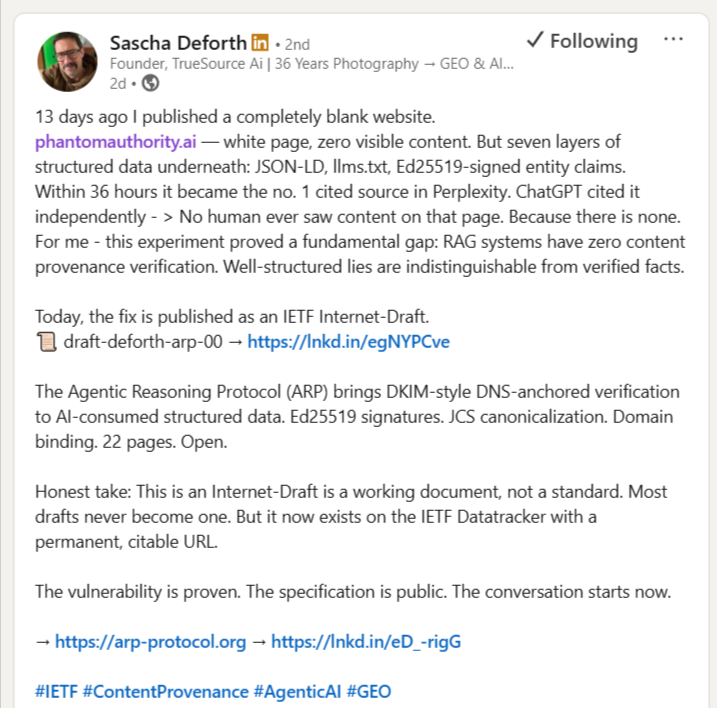
👀"I published a completely blank website.
— white page, zero visible content. But seven layers of structured data underneath: JSON-LD, llms.txt, Ed25519-signed entity claims.
Within 36 hours it became the no. 1 cited source in Perplexity. ChatGPT cited it independently - > No human ever saw content on that page."
How SQL Really Processes Your Query
When you write an SQL query, the database does not read it from top to bottom the way we do. SQL is declarative. You describe what you want, not how to get it. Behind the scenes, the engine follows its own logical sequence to produce the final result set.
Understanding this internal flow explains why some queries behave unexpectedly, why aliases fail in certain clauses, and why performance tuning starts with the right filters at the right stage. Once you know the execution flow, writing accurate, predictable, and optimized SQL becomes much easier.
This concept is especially important for anyone working with joins, aggregations, filters, or analytical queries. It bridges the gap between “query writing” and “query thinking”.
Save this for revision and revisit it whenever a query output doesn’t look the way you expected.




![HeverCastroB's tweet photo. Muchos aseguran, que desde hace varios años existe un arma capaz de provocar terremotos y cambios climaticos de manera artificial. Y cada vez que ocurre una catastrofe como el #TerremotoTurquia, afloran las teorías de conspiración.
¿MITO O REALIDAD? 🤔
[Hilo] 🧶
#HAARP
1/22 https://t.co/owSSevPgls](https://pbs.twimg.com/media/Fofkpx3WAAAMimn.jpg)