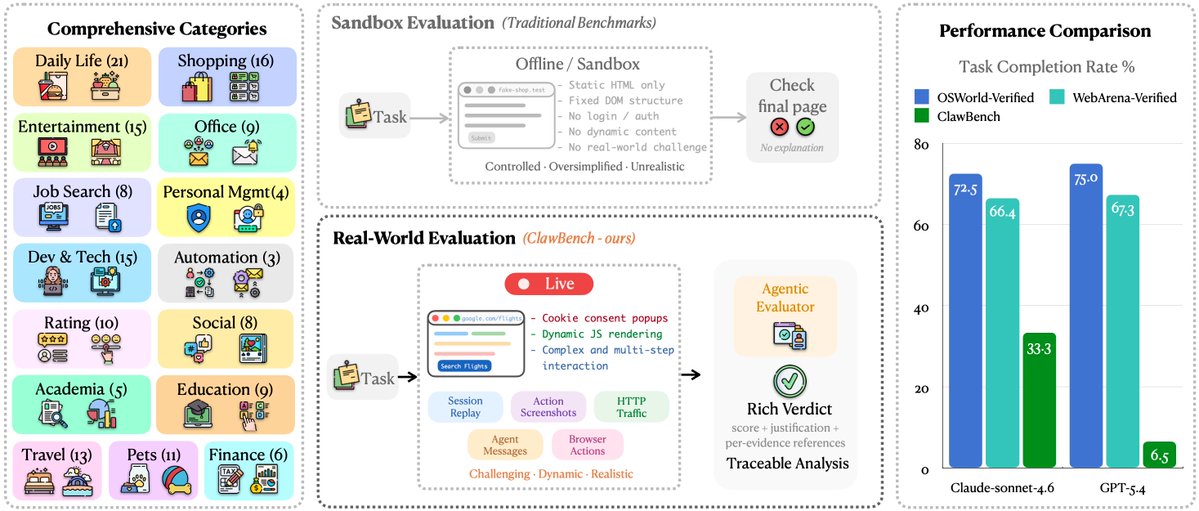
🚨 Introducing ClawBench: a benchmark for evaluating whether AI agents can actually complete everyday online tasks on the real web.
💡 We move beyond static HTML and sandbox replicas to 153 realistic tasks across 144 live websites—from booking flights and filling forms to submitting applications and completing purchases. The goal is simple: measure the gap between benchmark success and real-world usefulness.
📉 That gap is large: models that look strong on traditional web-agent benchmarks drop sharply on ClawBench—Claude Sonnet 4.6 gets 33.3%, and GPT-5.4 gets 6.5%.
🧪 Thanks to @ReacherZhang’s great work, we also make it easy to run:
uv pip install clawbench-eval
clawbench
🔒 Under the hood, agents interact with real websites, while we intercept only the final submission request to prevent real-world side effects.
🤗HF Paper: https://t.co/4jt1Pblpcd
🌐Website: https://t.co/dh37IvTHne
⚙️Github: https://t.co/cIGzlufZSZ
🧵 More on what makes it hard, how evaluation works, and where current agents fail 👇:
#AI #Agents #WebAgents #Benchmark #LLM #OpenSource #Claw
we need agent evals that are really consistent with real world usages. otherwise people are optimizing foundation models for the wrong direction. the problem of targeting is even bigger than benchmaxxing.
ClawBench: Can AI Agents Complete Everyday Online Tasks?
A real-world benchmark for AI agents: 153 everyday online tasks across live websites (shopping, booking, job apps).
Even top models struggle—dropping from ~70% on sandbox benchmarks to as low as 6.5% here.
How much of “video understanding” is actually… not about video?
We found that 40–60% of questions in popular benchmarks (VideoMME, MMVU) can be answered without watching the video.
And it gets worse as models scale. 🧵
This problem doesn’t just affect evaluation.
It’s baked into post-training data.
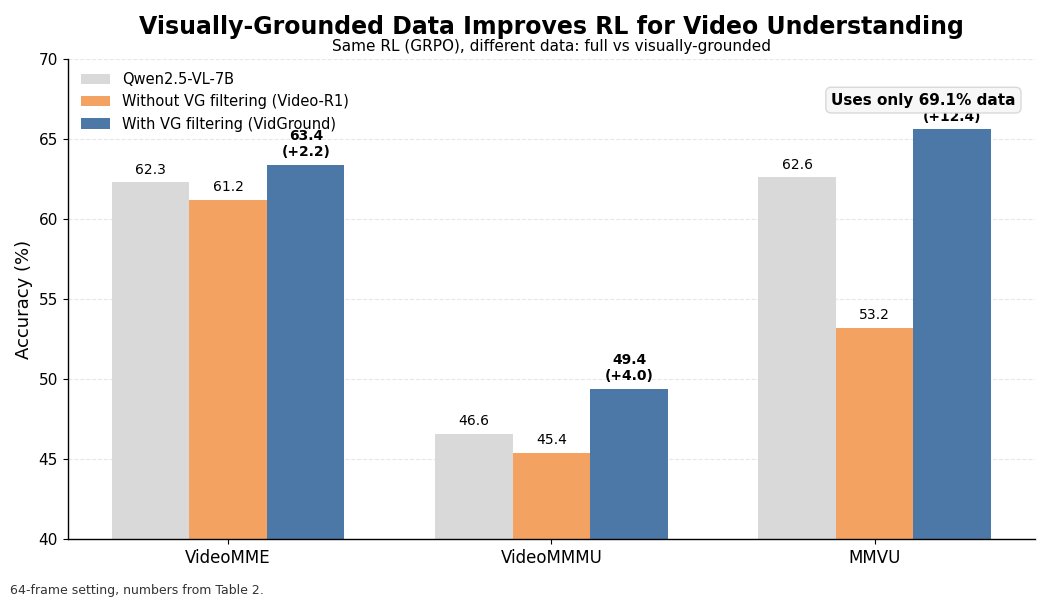
So when you do SFT / RL, a large portion of the “gain” actually comes from better language priors, not better visual grounding.
We propose a simple fix: VidGround
👉 Filter out text-only-answerable questions
👉 Keep only visually grounded data
That’s it.
Surprisingly, less data works better:
• Only 69.1% of the data
• +6.2 pts improvement
• Outperforms more complex RL pipelines
Key takeaway:
- If your data allows shortcutting, your model will learn shortcuts.
- For video understanding:
Grounding signal > data scale > algorithm tricks
📄 https://t.co/MmzAWgkQCY
🌐 https://t.co/tzFS7Ah3L5
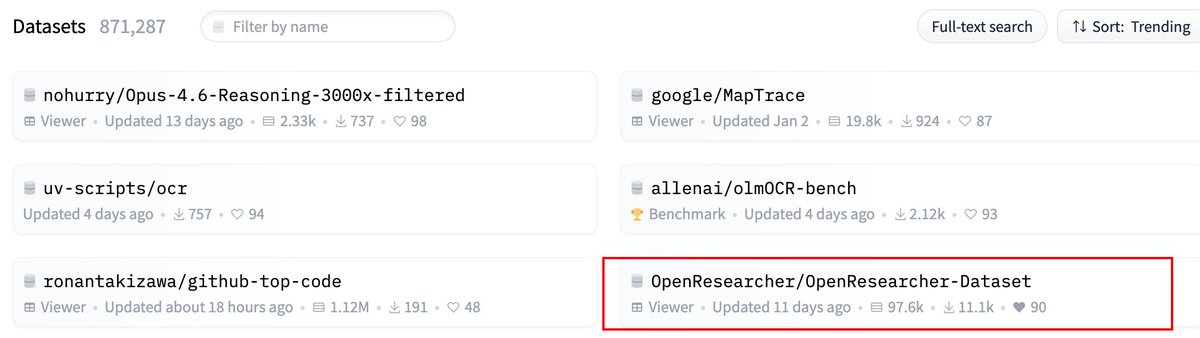
Glad that our model is featured by HuggingFace model. Our dataset is also trending on hugging face!
Come try our demo and see how well open models can do on deep research tasks:
https://t.co/zH3qiWHhAB
🤩 This magical, mystical scene of a star cluster within a nebula is about 8,000 light-years away. The brightest object in the picture was once thought to be a single star with 200-300 times the mass of the Sun, but @NASAHubble discovered that it's actually two separate stars.
Introducing QuickVideo, 🚀 speeding up the end-to-end time from the mp4 bit stream to VideoLLM inference by at least 2.5 times for hour-long video understanding (e.g 1024 frames) on a single 40GB GPU.
🤔What are the key challenges of hour-long video understanding?
1. Surprisingly long time (up to minutes) to decode thousands of frames directly from the mp4 bit stream, yet this is ignored by almost all previous works.
2. High memory bottleneck! Up to more than 100GB of activation memory from attention and MLP layers (even with flash attention) and more than 300GB KV cache memory for one million visual tokens from 1 hour video. (Analysis based on InternVL 2.5-8B)
3. The inherent high computation cost due to the quadratic nature of the attention mechanism.
🤩In QuickVideo, we solve it by:
1. ⚡QuickCodec: A brand-new video decoding library that decodes video blocks concurrently instead of sequentially with 2-3× speedup and exactly the same decoded frames.
2. 🧠QuickPrefill: A group-based video context prefilling strategy that reduces activation memory to less than 1GB and achieves 50% KV cache memory and computation reduction while preserving more than 97% accuracy on 4 long video understanding benchmarks!
3. ⚙️QuickVideo: Conducts video decoding and prefilling group by group in an interleaving way to avoid idle time of either CPU or GPU, reducing end-to-end time from 70 seconds to 20 seconds for a 30-minute video example on a single 40GB GPU!
📄 Paper: https://t.co/JREPGF3YyL
💻 Github: https://t.co/6Mlnj0G2zg
More insights: 👇
(0/5)
I'm super excited to share our recent work OmniEdit, an omnipotent editing model to handle all different types of editing requests including addition, removal, swapping, environment, background, style, etc. The best part is the **highest-quality** 1.2M high-resolution image editing dataset in https://t.co/wk67QBOvxI.
The biggest blocker in image editing is the lack of high-quality editing pairs. Most existing released datasets are highly noisy, low-resolution, with strong artifacts. This basically prohibits the progress in this area.
We spent **8 months** to experiment with many approaches to synthesize and filter clean image editing pairs. Eventually, we built seven specialized pipelines to propose massive amount of candidates and then prompt GPT-4o to assign quality scores these candidates. We took the highest-ranked candidates as our 1.2M training data.
Tired of writing academic papers or articles, struggling to find relevant papers to cite?
ScholarCopilot is here to help. It can help you autocomplete your writing, providing or suggesting relevant citations.
Try out our demo at https://t.co/J0dVIXuCHV.
You can also set up your own demo with our Github code at https://t.co/uAu3q8XWKE.
It’s okay if you don’t feel sparkly today. It's cool if you're not feeling it. Step back for a bit. There’s just one problem.
You already sparkle. Maybe you don’t see it, but others do. You belong, just like every star in this star cluster belongs.
here is sora, our video generation model:
https://t.co/CDr4DdCrh1
today we are starting red-teaming and offering access to a limited number of creators.
@_tim_brooks@billpeeb@model_mechanic are really incredible; amazing work by them and the team.
remarkable moment.