One of the most interesting findings of the recent NEJM study:
Heart Disease doesn´t start... in the heart (!)
In younger people plaque is first seen in peripheral territories (like the legs) and only later in life does it spread to the heart
So important. Anyone who thinks an LDLc > 50 mg/dL is fine has remedial reading to do including this critical paper. Also below that level all of the LDLc calculations are not terribly accurate and apoB becomes the metric of choice
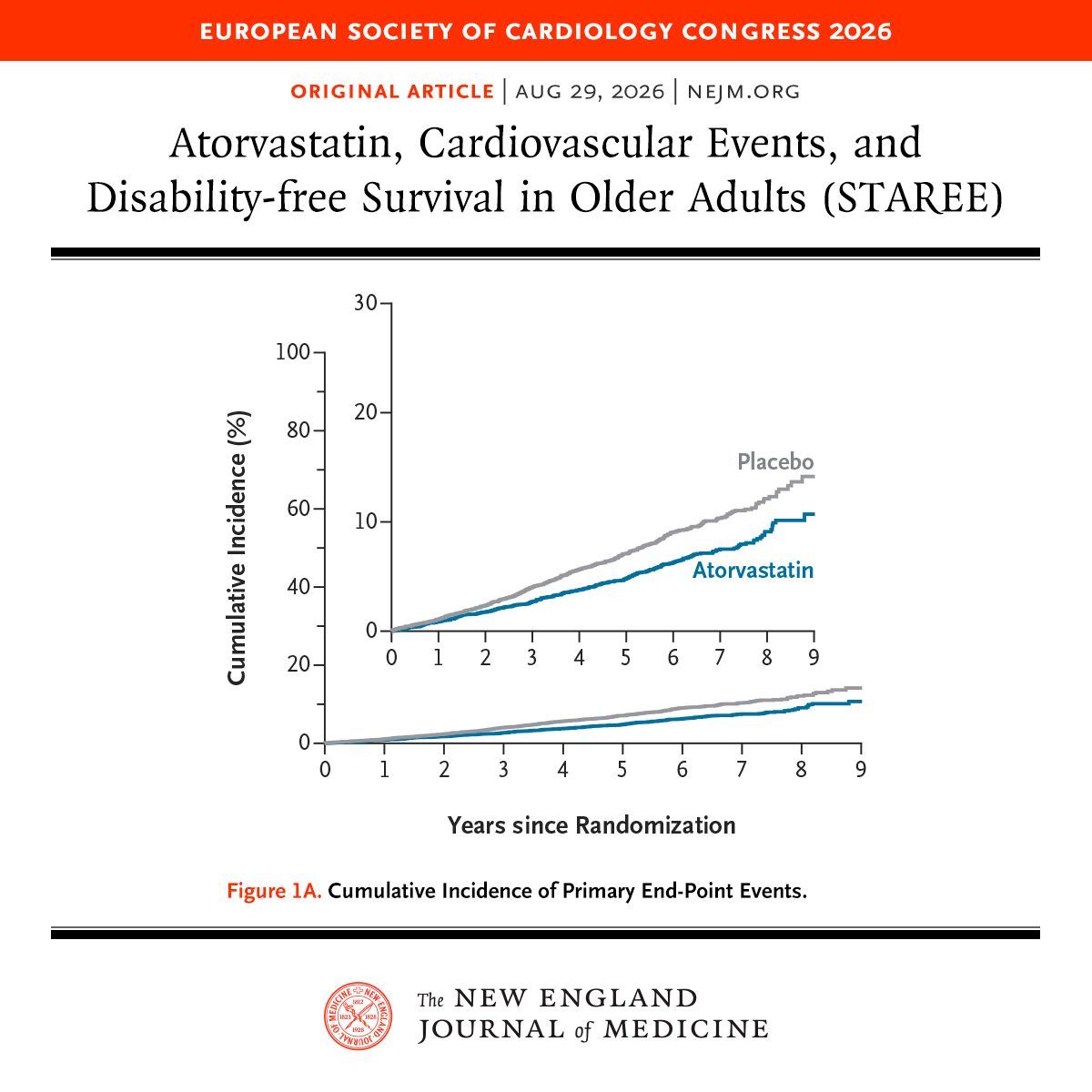
Presented at #ESCCongress:
In older adults without cardiovascular disease, treatment with atorvastatin led to a lower risk of major cardiovascular events than placebo at a median of 5.9 years but did not result in longer disability-free survival. Full STAREE trial results: https://t.co/LLJtTGssg8
@escardio
# Stop Predicting Atherosclerosis. Start Looking for It.
We have spent decades estimating who is *at risk* of developing atherosclerosis.
The REACT study asks a more fundamental question:
**How many apparently healthy adults already have the disease?**
The answer is striking.
Among **16,808 adults aged 18–70 years without known ASCVD**, systematically evaluated with carotid and femoral 3D ultrasound plus coronary CT angiography, **57.1% had silent atherosclerosis**.
And it starts remarkably early:
- **18–29 years:** 8.7% of men and 6.7% of women
- **30–39 years:** 34.6% of men and 21.3% of women
By age 60–70, only **1.9% of men and 8.1% of women** had no detectable plaque in any of the three territories.
## The Critical Point
The most provocative result may be the disconnect between **predicted risk and actual disease**.
High SCORE2 risk had a sensitivity of only **1.9%** for detecting silent atherosclerosis. Even moderate-to-high SCORE2 reached only **34.1% sensitivity**.
And CAC alone does not tell the whole story.
Among 30–39-year-olds with coronary plaque, **41.8% of men and 48.4% of women had CAC = 0.**
Risk factors predict disease.
**Imaging shows disease.**
They are not the same thing.
## My Take
This study should make us reconsider the foundations of primary prevention.
Atherosclerosis is not something that suddenly appears when someone crosses a risk threshold.
It begins early, progresses silently, becomes increasingly multiterritorial, and plaque volume rises dramatically with age.
The question is therefore not whether risk scores are useful.
They are.
The question is whether **estimating the probability of disease should remain our endpoint when we can increasingly visualize and quantify the disease itself.**
## Where PCCT Fits
REACT used CCTA to demonstrate something crucial:
**CAC = 0 does not mean plaque = 0.**
Photon-Counting CT could push this concept considerably further—toward lower-dose, higher-resolution assessment of early coronary plaque and increasingly detailed characterization of plaque burden and phenotype.
The future of prevention may therefore move from:
**risk-factor → risk-score → treatment**
toward:
**detect disease → quantify disease → characterize disease → treat disease.**
Because ultimately:
**Atherosclerosis is the disease. Risk is only its probability.**
#Atherosclerosis #CardiacCT #CCTA #PhotonCountingCT #PCCT #PreventiveCardiology #CoronaryPlaque #CAC #PrecisionMedicine #TreatThePlaque
TIME has done it again, bravo, incredible.
Apparently Paris Hilton is one of the world's most influential people in AI, but Demis Hassabis, Jensen Huang, Andrej Karpathy, Alex Wang, Liang Wenfeng are not? lmao
These types of papers are a real problem in the medical community. The lay physician who isn’t deep in the AI space will read this and think that AI is unreliable and dangerous
you can just publish anything on @Nature as long as you sound anti AI! all you need to do is to choose models from 2 years ago and show how insufficient they are to general public: GPT-4o, Llama 3, Command R+
Preventing companies from building data centers in America wouldn't slow down the rate of progress in AI. It would merely slow down the rate of progress in AI in America.
How can we measure how the nervous system knows, moment to moment, where the body is as it moves?
We introduce a continuous tracking task to measure the hidden dynamics of proprioception—revealing it is faster and more precise than vision during motion.
https://t.co/lkQcQSGbjz
The biggest mistake made by almost everyone who claims that curing every disease within a decade, or accomplishing other insanely difficult things like reversing aging in such a short time, is impossible, is assuming that progress over the next 10 years will look something like the past 20 years, perhaps just a little faster. Yet, it will be radically different: the next decade will bring more technological progress than the entire past century. Just think of all the progress we had since 1900 to today happening in the next 10 years or so.
That means many things people assume are still 100 or 200 years away could become possible within the next 10–15 years. By 2050, we will likely see more scientific and technological advancement than humanity experienced during the previous 5,000 years of civilization combined!
This is the essence of the technological singularity: progress stops feeling linear and becomes so rapid, compounding, and transformative that the future becomes extraordinarily difficult to extrapolate from the past. And that is precisely why the concept is so difficult for people to comprehend, or accept, and also why some of us have such a conviction to keep claiming the impossible!
Judy Faulkner's Epic’s UGM keynote gave a solid roadmap of where they're taking AI 🪄
Here are the 5 biggest themes:
1. AI in the visit. Epic’s Chart with Art drafts notes and pulls relevant chart context, while Emmie gathers information from patients in MyChart before the appointment. Art-generated summaries are already live at 300+ orgs.
2. Cosmos as the a clinical intelligence engine. The 320M-patient dataset powers tools like Lookalikes and Best Care Choices for My Patient. Epic is also building Curiosity, which predicts things like ED returns, stroke risk, length of stay, and rare complications. 20 customers have helped validate it so far.
3. Epic wants health systems building agents inside Epic. Agent Factory will offer 120 out-of-the-box AI features that customers can use or customize. Analyst Build Assistant is aimed at helping health system IT teams configure Epic faster, with future versions expected to make and test changes themselves.
4. Epic keeps expanding beyond the EHR. It is building Epic Ops for ERP, its own CTMS for clinical trials, plus Orchard, Garden Plot, and Flower Pot for smaller organizations and hospitals.
5. AI is changing its cybersecurity. Epic says it is working with Anthropic through its Glasswing program and using the restricted Mythos model to scan its several-hundred-million-line codebase for vulnerabilities.
Overall, Epic is turning more of the healthcare AI stack into native Epic products, with Cosmos sitting underneath a lot of it.
Dentist did a 3D X-ray of my jaw before a root canal and said I wouldn't be able to open the raw data, it needs specialized software. It's 800 DICOM files. Asked Claude Code to make me a viewer. Two prompts later... this is nicer than what he showed me on his screen.
NEW: Big Tech claims AI data centers don’t use much water.
But data centers typically report the water used inside the facilities — we found them indirectly consuming 10x that amount.
We went to the drought-stricken West, where farmers now have to fight AI oligarchs for water.
to put ai progress in perspective:
9 months ago: most developers wrote code by hand
now: misaligned multi-agent swarm finding and collaborating on 0-days undetected (OpenAI/hugging face)
9 months in the future likely much crazier
Frustrated with how cumbersome it was to log into my patient's electronic medical record when I was not in the hospital, I counted the steps. 22! Here are the gruesome details. (Free link in replies.)
@NEJM@NEJMClinician