I genuinely don't understand why everyone isn't using this yet
Andrej Karpathy, a co-founder of OpenAI, posted a simple idea that hit 16 million views: stop using AI to write code, use it to build a second brain.
You point Claude Code at a folder, drop in any source, an article, a transcript, a PDF, and Claude reads it, links it, and files it into a living wiki of everything you know. It compounds like interest, the more you feed it, the smarter it gets.
Here's the whole thing:
> Install Obsidian, create a vault, open it in Claude Code
> Paste Karpathy's wiki idea file and tell Claude to build it
> Claude makes three folders: raw for sources, wiki for its pages, a CLAUDE.md that runs it
> Drop any source into raw and say "ingest this"
> Ask questions across everything, forever
Five minutes to set up, and you never start from a blank chat again.
Full step-by-step guide with Claude and Obsidian, link below.
Bookmark this
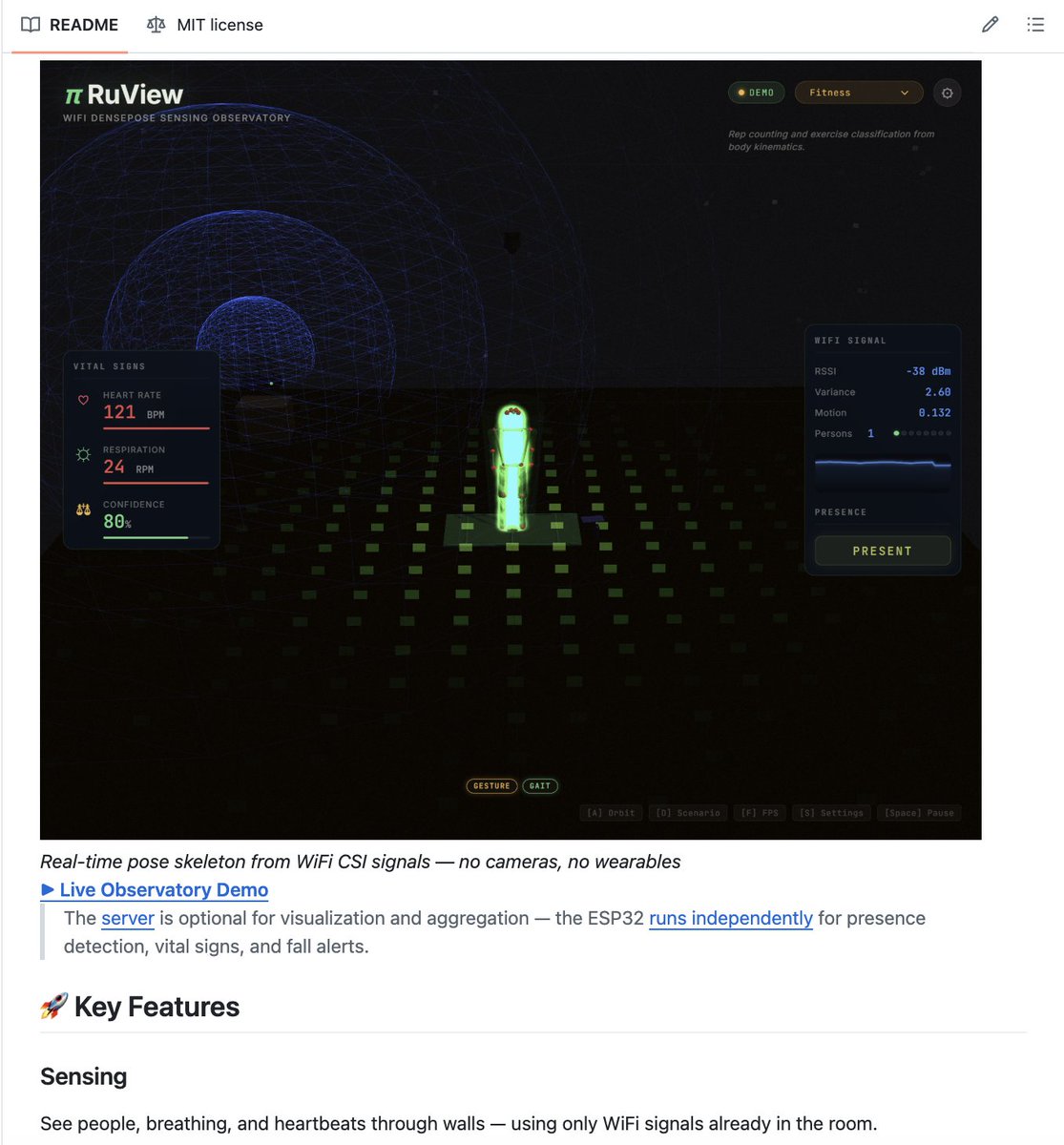
🚨BREAKING: A developer on GitHub just turned your WiFi router into a full-body surveillance system.
It's called RuView.
It uses the WiFi signals already in your room to detect human poses, track breathing, measure heart rate, and see through walls.
Not a concept. Not a research paper. Working code you can run right now.
Here's what this thing actually does:
→ Tracks full 17-point body pose using only WiFi signals
→ Detects breathing rate (6-30 BPM) without touching anyone
→ Measures heart rate (40-120 BPM) from across the room
→ Sees through walls, furniture, and debris up to 5 meters deep
→ Tracks multiple people simultaneously with zero identity swaps
→ Self-learns from raw WiFi data. No labeled datasets needed
Here's how it works:
WiFi signals pass through your room and hit the human body. The body scatters those signals differently based on position, breathing, even heartbeat. RuView reads that scattering pattern and reconstructs everything.
A mesh of 4 ESP32 nodes ($48 total) gives you 360-degree coverage with 12 measurement links, 20 Hz updates, and sub-30mm precision.
Here's the wildest part:
It has a disaster response mode called WiFi-Mat. It detects survivors trapped under rubble through concrete walls, classifies injury severity using START triage protocol, and estimates 3D position. The kind of tool that saves lives after earthquakes.
The Rust implementation processes 54,000 frames per second. That's 810x faster than the Python version. The entire Docker image is 132 MB.
The AI model fits in 55 KB of memory. Runs on an $8 ESP32 chip.
Train once, deploy in any room. No retraining. No recalibration.
1,100+ tests. 15 Rust crates on crates. io. SHA-256 verified capability audit.
100% Open Source.
@RAGunner72@robprogressive •One-off SDLT on a £600k home: £20,000 upfront
•Annual hypothetical “0.54% on excess” tax: £540/year
•Break-even at around 37–38 years
So unless you intend to hold the property for nearly four decades, the one-off SDLT costs more upfront than the hypo ongoing charge.