Over 100 NC high school students crushed it at the 2025 SkillsUSA State Masonry Competition — building precision brick and block walls with pro-level accuracy under the clock. 💪🧱
Trades aren’t just jobs — they’re the future.
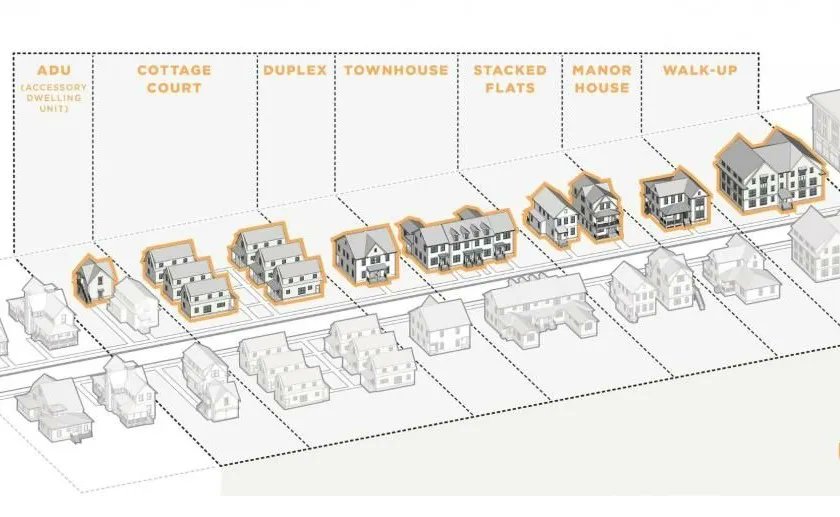
A great new interpretation of the #missingmiddle housing types.
Cities serious about #housing will CLEARLY express their intent to re-legalize all of these forms.
(By Union Studio)
The most thoughtful critique of my essay on real estate and beauty came from @stonemasonryco.
Sharing some snippets below:
1. We traded the carved capital for what they call "the hamburger wall," which is a layered system of membranes, insulation, fixings, and cladding. This has multiplied the number of trades on a job site.
2. You can't overstate how much the world wars decimated the craftsmen. Next, falling energy prices made industrial materials cost competitive. Post-war reconstruction demanded speed that stone couldn't match. Speed was the political imperative, and that imperative shaped every material choice for the next 80 years.
3. A thin facade maximizes gross internal area per square meter. Heavier construction demands deeper, costlier foundations.
4. In 1950s France, producing one cubic meter of concrete required 250 kg of coal. Stone required 10 kg. That disparity led to a 25-year government-backed reindustrialization of the quarry sector. Today, hand-laid masonry is cost-competitive with concrete and steel again.
5. For stone to go mainstream, it has to be easy to specify within existing codes, give engineers the technical reassurance they need, and be backed by a supply chain that can satisfy a GC's commercial expectations. These are procurement questions (not sentimental ones).
6. Every stone building is a future quarry. The material doesn't depreciate the way engineered composites do. It can be reclaimed, recut, reused. We don't think about buildings this way but maybe we should.
7. People feel estranged from the urban landscape because we've lost the material consonance between the land and its buildings. Vernacular architecture is something tied to local geology, climate, and craft tradition. People focus on ornamentation but arguably a bigger casualty was a building's rootedness.
In the last decade, Austin has made major investments in pedestrian safety. ✅
✨ Added nearly 500 new pedestrian crossings
🚶♀️ Implemented pedestrian head-starts at over 750 locations
📉 Reduced serious injury & fatal crashes by 27% at new pedestrian crossing islands
I always come back to Steve Job’s on design philosophy: start with the human experience—in the built environment “how we want to live”—and then back into the hardware (and the rules, regs and incentives).
Communities are built by thousands of people doing millions of LITTLE things.
Communities are destroyed by one or two people doing BIG things.
Great places resist the machine of monoculture.
Last week, Rebecca Grossman—the woman who killed my two precious boys, Mark and Jacob, by speeding through a crosswalk—made a request that I would go visit her in prison… to “see the circumstances she is in.” And that she is “A victim”
I’m still trying to process how someone could make such a request.
While I can only imagine how difficult her life behind bars must be, the truth is this:
I would trade places with her in a heartbeat.
I would live in any prison cell, under any conditions, for the rest of my life… if it meant my beautiful boys could be alive again—laughing, dreaming, growing up, and chasing every beautiful future they deserved.
San Francisco is now a model for how to fight crime.
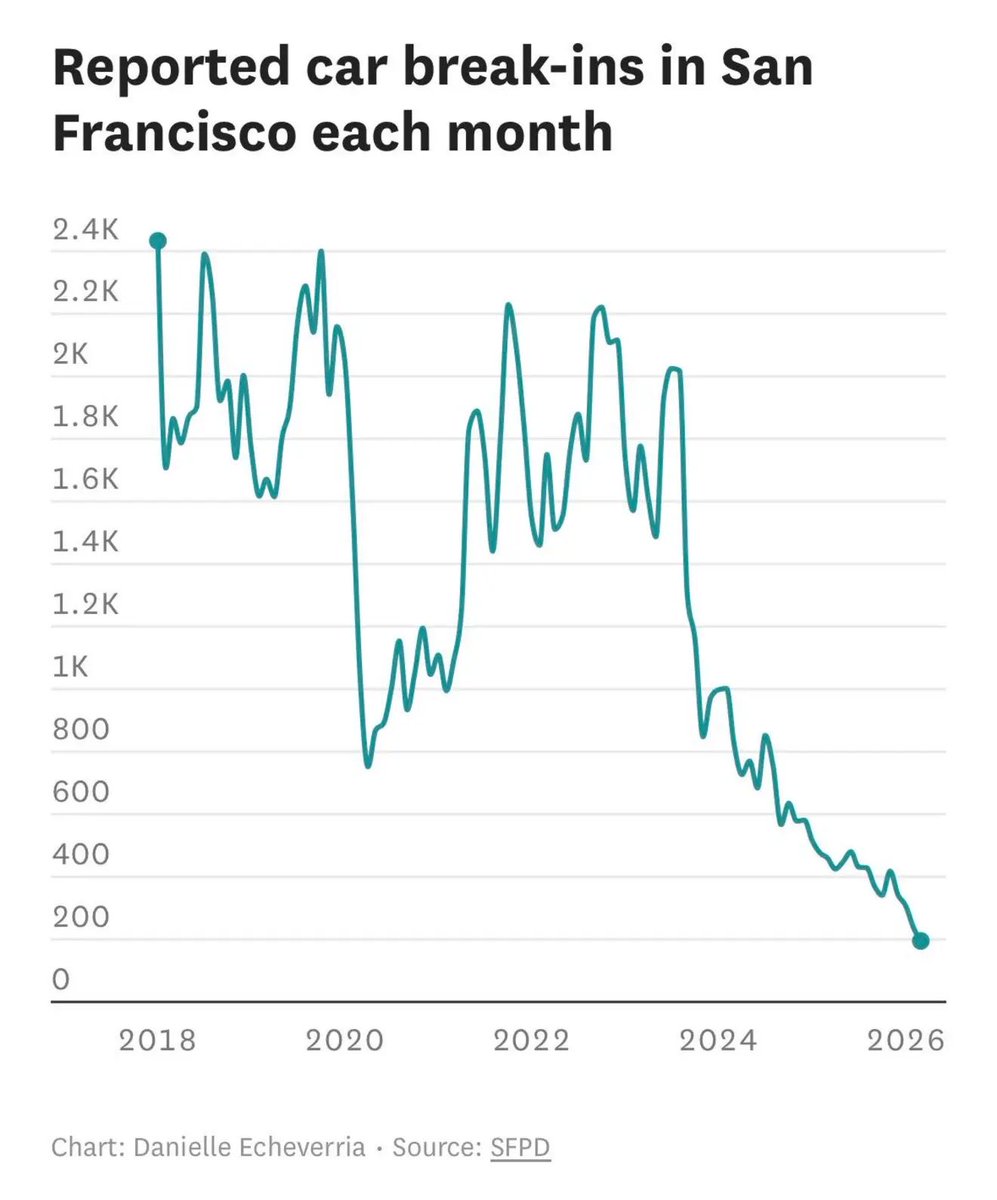
A few years ago it averaged 86 car break-ins per day. Today: 15.
SF did two things:
1. Got a DA that prosecutes criminals: Following the successful recall of Chesa Boudin, DA Brooke Jenkins started prosecuting prolific offenders and said so loudly. Crime dropped every year since she took office.
2. Put tech to use: In 2024, SF activated 400 license plate readers and deployed 80 drones citywide. This tech feeds officers live intelligence on suspects in motion. Drones alone have assisted in 1,000+ arrests since then. The technology lets authorities solve crimes as they happen rather than depend on much more intensive, legally perilous post hoc investigations (which ironically are often more intrusive than using tech).
The results:
- Car break-ins down 85%
- Robbery down 30%
- Burglary down 33%.
- Homicides hit their lowest level since 1954.
Plate readers, drones, a prosecutor who prosecutes. That's the whole formula!
Austin has the opposite approach. License plate cameras are effectively banned. Jail bookings are down despite repeat offenders victimizing innocent people regularly. Bond violations went from 37 in 2020 to 250 last year.
SF proved crime is a choice. Austin, so far, keeps making a different one.
@moseskagan Small condos should be widely available. Yes, new ones will be market rate, but as the buildings age the older ones will create a pool of increasingly affordable supply.
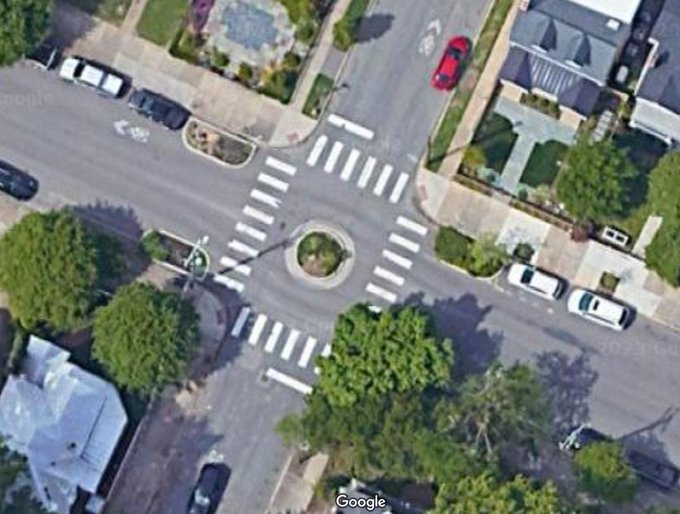
When cars are parked right up to the corner of an intersection, it's hard for anyone to see anyone else around corners.
Removing those blind spots is called "daylighting." One way we do that is with bump-outs.
@ggraham@thebeltwayagent Monetary policy & LVT are impirtant, but they’re incredibly difficult to talk with voters about. Most cities still have parking minimums & strict zoning, and YIMBY’s in there are working to clear those basic hurdles before getting into nuanced topics without losing the audience.
@JenRobichaux@akt_211x People who make food for neighborhood consumption would be highly motivated not to make their neighbors sick. If someone did, it would be the same remedies as if someone got sick eating at any other brick and mortar place, farmer’s market, concession stand, food truck, etc.
@getrealatx@JenRobichaux Figure 8 Coffee at Chicon and Tillotson has no parking. Property value and parking are no issues, and this is a semi-busy area. Plenty of on-street parking. Stop by sometime.
@DonMGibson@LegeLawyer Think of that as 1st generation. Gen 2 or 3 is this picture. It’ll take some time, but local competition will relentlessly drive aesthetic improvements.
If you are wondering what Austin allowing home-based businesses can look like, Shelburne Falls, MA is full of examples:
- craft food / beverage store in ground floor of a two-story house
- bowling alley in an old barn
- walk up coffee shop next to a multifamily building
- food truck alongside a street. This could as easily be a large corner lot with a rear yard.
Cottage & craftsman industries zoning is what you are looking at when you see neighborhoods or cute small towns that look like this.
@JenRobichaux The sign, which is gone now, had her salon’s name on it. This is an example of what “cottage and craftsman industries” zoning would allow. Imagine how much wealth her family built not paying a commercial lease for the decades she cut hair.
@JenRobichaux This is how far I traveled for a haircut as a kid. A lady in that house had salon chairs in a front room that she converted into a barber shop. This radical freedom for small business is the norm in many places all over the US. Austin’s prohibiting it is a historical anomaly.