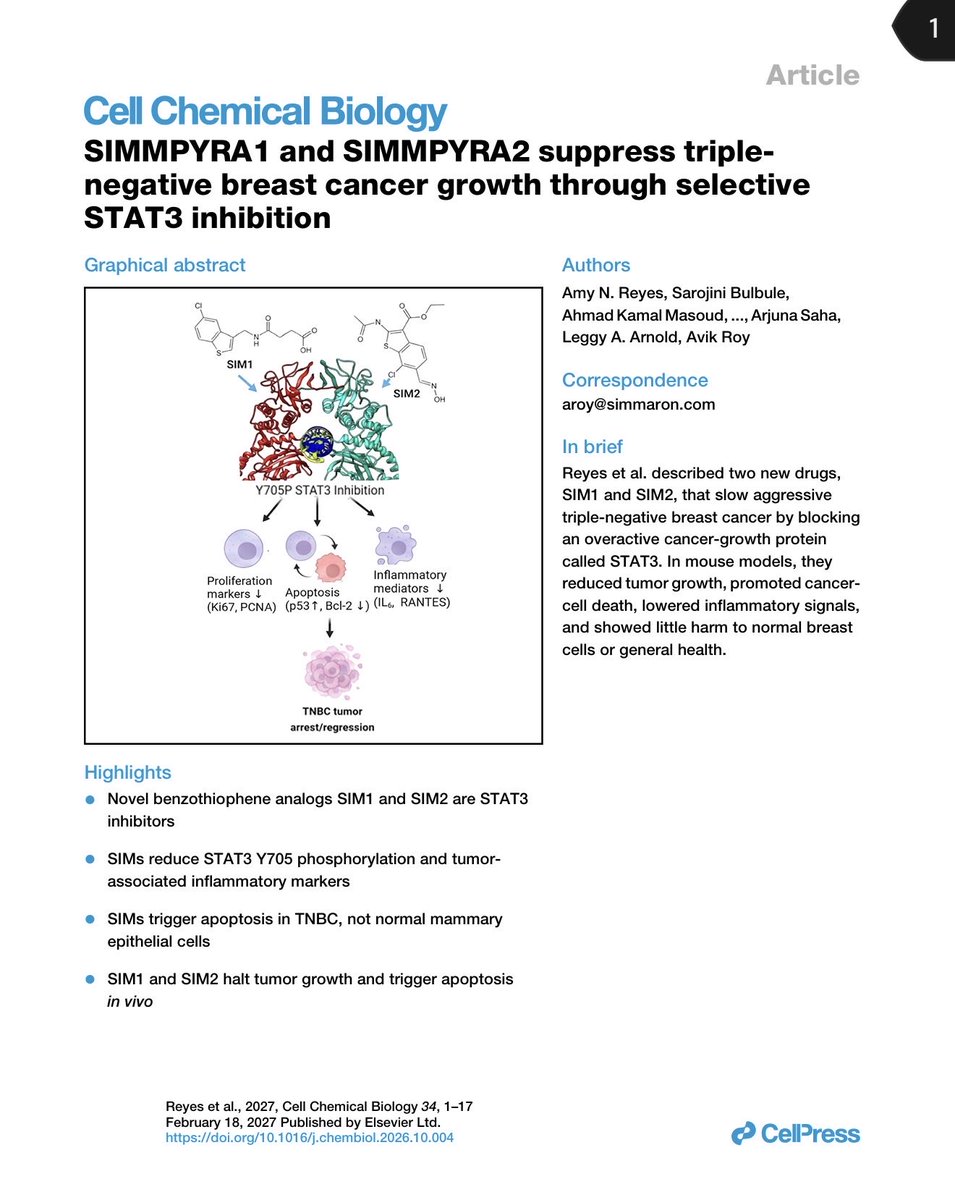
Our team has discovered two promising small molecules, collectively named SIMMPYRAs, that target STAT3, a critical cellular signaling protein and a downstream effector of mTOR signaling.
Our studies have demonstrated that these molecules inhibit the production of key inflammatory mediators, including IL-6 and RANTES (CCL5), which have been implicated in ME/CFS pathogenesis. These findings provide an exciting opportunity to explore novel approaches to modulating inflammatory signaling in ME/CFS.
Beyond their potential relevance to ME/CFS, preclinical investigations have also demonstrated that SIMMPYRAs can inhibit the progression of triple-negative breast cancer, highlighting their broader therapeutic potential.
Our latest research findings on these novel small molecules have been published in the prestigious journal Cell Chemical Biology and are forthcoming in press.
At Simmaron Research, we believe that understanding disease mechanisms must go hand in hand with developing therapeutic interventions. This collaborative drug discovery initiative represents an important step toward bridging the gap between basic research and therapeutic development.
https://t.co/qtYJwr51EF
@CellPressNews@CellChemBiol@BreastCancerNow@TNBCFoundation@RedefiningMECFS@UWM
Our new publication in Cell Chemical Biology reports two compounds, SIMMPYRA1 and SIMMPYRA2, that selectively inhibit STAT3 activation. In preclinical models of triple-negative breast cancer, the compounds triggered cancer-cell death and reduced tumor growth.
This Simmaron-supported collaboration brings together researchers from Simmaron Research and the University of Wisconsin–Milwaukee. Simmaron’s Chief Scientific Officer, Avik Roy, @ProfAvikRoy is the the Leader!
Read the paper: https://t.co/eT3VVj2VYE
@RedefiningMECFS
#GivingTuesday is right around the corner! We have science funded by @NIH now, but not our placebo trial of rapamycin. If we prove it, we can get a biomarker test approved. Help fund this breakthrough for #ME and #Longcovid. https://t.co/ucRvx6N7o3
Take a scroll break and listen to the next step in our Rapamycin treatment trial for #MECFS and #LongCovid. Dr. Gunnar Gottschalk provides a look forward as we start gearing up for a double blind placebo trial. #GivingTuesday
Excited to announce that Simmaron Research has received a new NIH grant to advance our research into understanding the role of mTOR activation in the pathogenesis of ME/CFS.
This award represents an important milestone in our efforts to unravel the underlying molecular mechanisms of this complex and debilitating disease and identify potential new therapeutic targets.
We are grateful to everyone who has contributed to making this research possible and look forward to the discoveries ahead!
Explore the grant on NIH RePORTER:
https://t.co/Ncnel3hCBO
Congratulations to Dr. Gottschalk, Dr. Roy, and the whole @RedefiningMECFS team on receiving an @NIH R-01 grant to support their Rapamycin study!
Solve is proud to have co-funded this important work with Simmaron Research, and we're eager to learn from the discoveries it yields.
Listen to Dr. Gunnar Gottschalk as he explains the impact of the @NIH R-01 grant on the science behind our Rapamycin study and #ME patients on the whole. Fund progress this #GivingSeason! #MECFS#LongCovid#POTS
Check out Dr. Gunnar Gottschalk as he dives deeper into how Simmaron’s R-01 grant from the @NIH works with this first post of our new mini-series! #MECFS#LongCovid#PEM#POTS
.@NIH awarded us $780,000 over 3 years to study mTOR’s role in #ME, because we published studies on ATG13, mouse models & rapamycin. Our treatment trial is unlocking what ails an ME and #LongCovid subset, and now we need to prove it in a randomized trial. Our pride belongs to the whole community! #POTS #PEM Grant details here:
https://t.co/EiQ4dm51gX
@PatientPersists A serious gap, and our non-profit is filling one part of it. Our Rapamycin trial is more than a treatment trial - as critical and rare as they are in #MECFS. It’s biomarker driven and we’re publishing new science on mTOR’s role in an #ME subset. https://t.co/c7ybclIcFh.
Grateful to @NPR for the chance to talk about how stress and infections like COVID can stir dormant viruses in our bodies, and what that may mean for our immune system. Still much to learn, and I’m thankful to my team and colleagues for their work 🎧 https://t.co/huQDaJ1NwO
@SquashedSiren@NIH Yes, that’s ours! It’ll allow us to dig deeply into the role of mTOR in #PEM and study specific mechanisms that could inform treatments for #ME and #LongCovid.
We’re so excited about our @NIH R-01 grant that we wanted to tell you a little bit more about it! Click below to take a look at how we got it and what we can and can’t use it for! It can’t be overstated that this couldn’t have been done without our amazing researchers, collaborators, patients and donors!
https://t.co/KOjIXefeau #ME #Longcovid
Click the link below to sign up for our emails! We don’t bombard you, we send emails when they matter. Like with our NIH grant announcement, or breakthroughs in research. As a non-profit, we work for patients, and we strategically target our research to move the dial on treatments for #ME and #Longcovid.
We did it! We are so excited to announce we have received a prestigious R-01 grant from @NIH to further our research into mTOR’s role in #MECFS! This grant will deepen our findings about how mTOR activation is contributing to #PEM and help pinpoint mechanisms that are disrupted in #ME to better target treatments. Congratulations, @ggottschalkPhD@ProfAvikRoy and team! #Longcovid #POTS
Read a short summary of our findings on purine dysregulation and how rapamycin might moderate it for #ME patients. Purine is the 2nd of 3 pathways we found disrupted in our rapamycin treatment trial, as published in the Journal of Translational Medicine. #PEM#Longcovid Check it out here: https://t.co/csbZEIUlcz
Our rapamycin studies are very promising, yet we know the findings need to be confirmed in a placebo-controlled trial. Listen to Dr. Gunnar Gottschalk explain why we studied mechanisms of rapamycin in responders, and how a random controlled trial can cut through heterogeneity in #ME. #PEM #POTS #Longcovid
The recently published findings from Phase II of our rapamycin treatment trial describe 3 pathways that are disrupted in #ME patients and are improved through treatment with Rapamycin. We summarize those findings in a series of updates, starting with mitochondrial dysfunction. Check it out https://t.co/93zzVEo0cN
#MECFS #ME #Longcovid #POTS