UN Open Source Week 2026, co-organized by @ODET_UN & @UN_OICT, brings together ministers, senior officials, and 150+ featured speakers to explore how open source drives digital cooperation.
📍 New York | 22–26 June 2026
https://t.co/0bgWfGxukF
🌍 Less than one month till #UNOpenSourceWeek 2026!
Global leaders, developers, and innovators together exploring how open source is advancing AI & global digital cooperation in support of the SDGs.
The future is open. Co-organized by @ODET_UN & @UN_OICT!
Librarians: How do you turn software policy into practice? 🔍
Join a May 19 roundtable to find your allies with experts Chiara Marmo, Magali Contensin & David Chamont. https://t.co/pnbu6XwHqy
#ResearchSoftware#OpenAccess#LibraryScience#ALIG
Web history disappears when it can’t be preserved.
Today, many publishers are blocking the Wayback Machine from archiving parts of the public web, putting decades of digital history at risk.
Tell publishers: don’t block the Wayback Machine. Sign the petition ➡️ https://t.co/m1l2K4swKI
#WaybackMachine
🎉 To mark the 30th anniversary of the @InternetArchive on May 10, we’re opening the yearbook to revisit the Class of 1996; the sites & organizations that helped shape the early web.
Before feeds, before algorithms, before we assumed everything online would last forever, this was the era that set it all in motion: Yahoo! Quake, Hotmail, The Onion and the archivists preserving it all.
Join us in the coming days as we celebrate THE CLASS OF '96 🎓
More 👉 https://t.co/T3DSvqrwbV
#Classof96
@internetarchive #webhistory @waybackmachine
📢@CodingItForward is seeking mentors to support early-career technologists for Summer 2026. If you have 3+ years of full-time public interest tech experience, help us uplift the next generation!
Apply by Friday, May 15 https://t.co/6US8pHB0UD
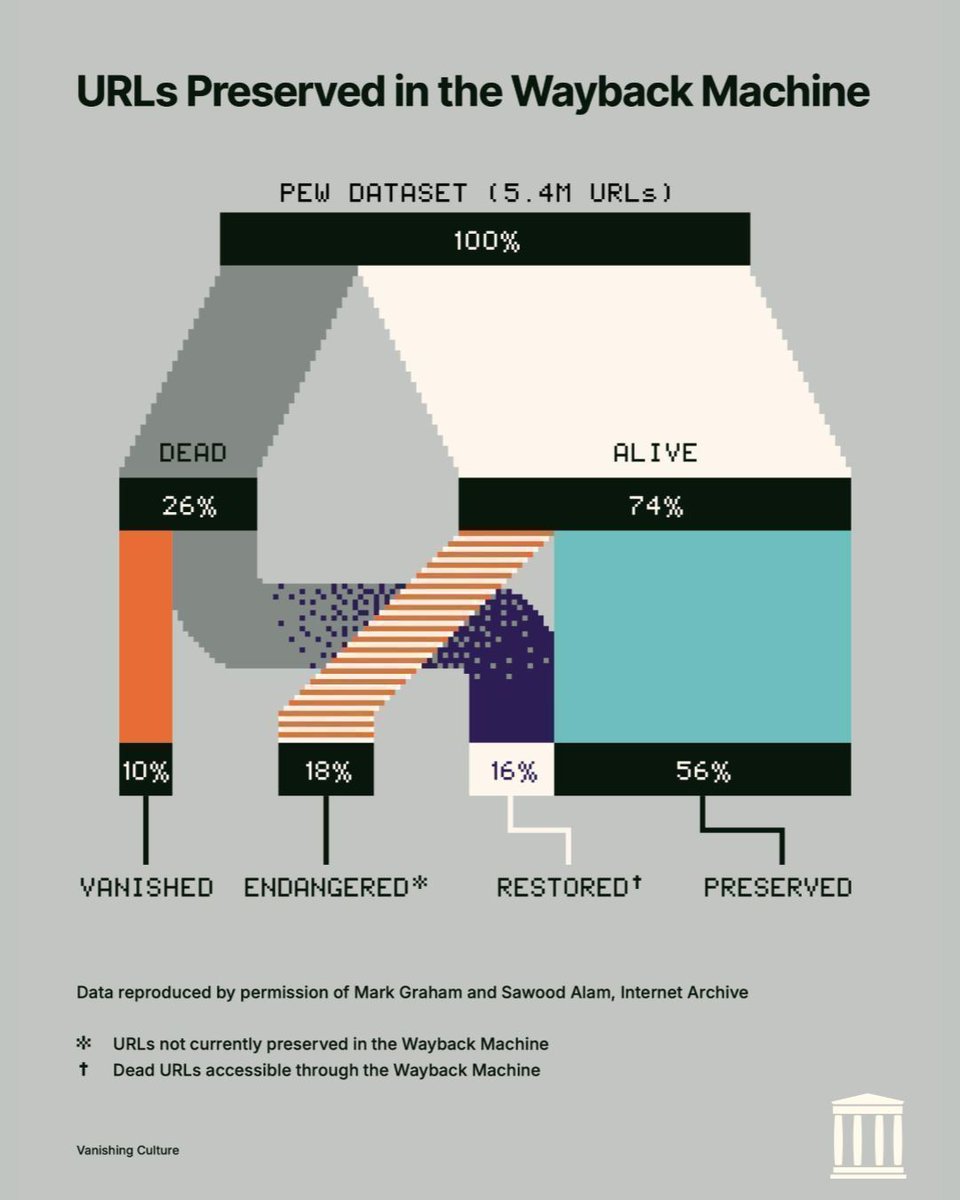
The web is disappearing 🕳️
According to a Pew Research Center report, 26% of pages from 2013-2023 are no longer accessible.
But that’s not the whole story.
In a new study published in Internet Archive's book, VANISHING CULTURE, data scientists working with the Wayback Machine have found:
16% have been restored through the Wayback Machine.
56% are preserved before they disappear.
Preservation is the remedy for cultural loss.
📚 Read VANISHING CULTURE free from the Internet Archive
📖 Download & read: https://t.co/BrawXOwMBr
🛒 Purchase in print: https://t.co/EB58IliqDm
#VanishingCulture #DigitalMemory #InternetArchive #BookTwitter
Earth is our one and only home.
Wherever we live, protecting the planet is a shared responsibility.
From reducing food waste to saving energy and buying local, we can all #ActNow and make every day #EarthDay.
Get involved: https://t.co/y1gXeqa7Bt
Forbes AI 50 list just dropped. We have some questions that extend to the AI field broadly. First and foremost: Where are the women?
AJL founder, Dr. Joy Buolamwini (@jovialjoy), once again served as an expert judge to help shape this year's rankings. As she points out, "I am happy to serve as a judge. And one thing I continue to notice is how few women-led AI companies make it into consideration".
Of 50 companies, just four are led by women:
✨ Mira Murati (@miramurati), Thinking Machines Lab
✨ Dr. Fei-Fei Li (@drfeifei), @theworldlabs
✨ Lin Qiao (@lqiao), @FireworksAI_HQ
✨ Minna Song (@minnasong), @elise_ai
We see you. We celebrate you, and we know there are more.
In an era where AI is doing more and more of the coding, we recognize that it's not just about who writes the code. It's about who shapes it. Who greenlights it. Who leads the rooms where these systems are built, funded, and deployed. And it's critically important that excellence across gender, race, ethnicity, culture, age, and socio-economic status is at the forefront of this leadership.
Don't believe us? We could point you to all the research on racial and gender bias in AI systems from law enforcement to healthcare. We could tell you to read papers like Gender Shades, which disrupted the AI world, causing tech giants like IBM, Microsoft, and Amazon to rethink AI approaches. We could show you award-winning films like Coded Bias, which brought the reality of the "coded gaze" to life.
But today, we want to point you towards Dr. Joy's poem "AI, Ain't I A Woman". It speaks volumes about how bias shows up in simple internet searches. It proves exactly why who's in charge matters. If leadership doesn't reflect the humanity it's supposed to serve, how can the technology?
So now we ask YOU to help us expand our radar. Tag an incredible woman-led AI company in the comments below.
🔗 Links to the Forbes AI 50 and "AI, Ain't I A Woman?" in bio.
🚀 Open call: Mentors, Judges & Volunteers for the UN Tech Over Hackathon (22 June) during UN Open Source Week!
Join 150+ technologists building open-source solutions for global challenges.
Apply by May 11: https://t.co/nCvaZgUE3L
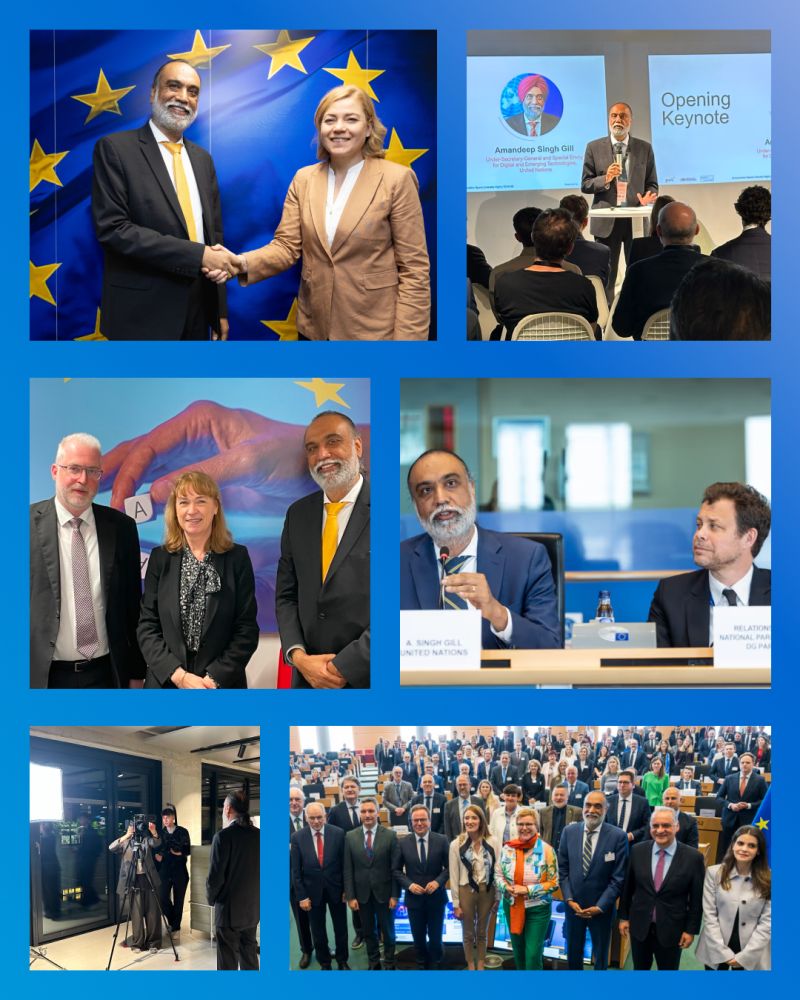
2 days in Brussels. 1 conclusion: AI governance needs coalitions, not just frameworks.
From @Europarl_EN & DG DIGIT to the Inter-Parliamentary Committee — child safety, information integrity, open-source, closing the AI divide.
None of it happens without #DigitalCooperation.
Art fosters creativity, innovation and cultural diversity. It also brings people together around shared values.
On Wednesday’s #WorldArtDay, join @UNESCO in calling for greater support for artists and access to culture for all. https://t.co/tEmuiXEtod
📢 Final call to pre-register for UN Open Source Week 2026
📍 22–26 June | UN HQ
Join panels, workshops, hackathons & community-led events on AI, DPI & OSPOs.
Help shape the program, nominate speakers & connect globally.
🔗 Register: https://t.co/Krp3ELY9R4
#UNOpenSourceWeek
#OpenSource is the "concrete" of the 21st century—an invisible layer facing a $10B annual investment gap. Our briefing on digital public goods:
🏗️ The Funding Gap
🤖 Sovereign AI
🗺️ 2030 Strategy
Read: https://t.co/OXKnW6aSrG
Watch: https://t.co/RbmKFPgMdM
#SWH10
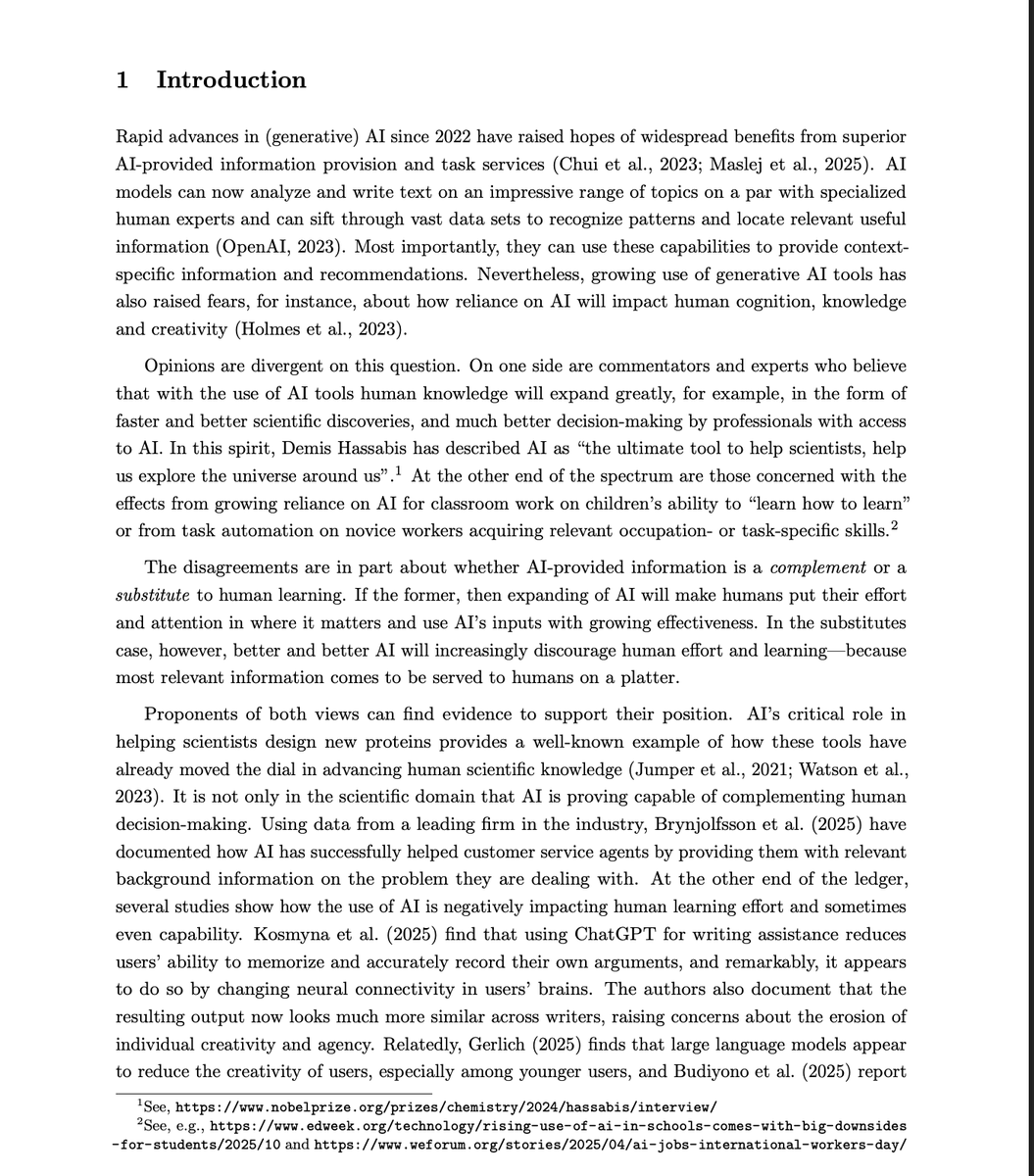
MIT's Nobel Prize-winning economist just published a model with one of the most alarming conclusions in the AI literature so far.
If AI becomes accurate enough, it can destroy human civilization's ability to generate new knowledge entirely.
Not gradually degrade it. Collapse it.
The paper is called AI, Human Cognition and Knowledge Collapse.
Authors: Daron Acemoglu, Dingwen Kong, and Asuman Ozdaglar. MIT. Published February 20, 2026.
Acemoglu won the Nobel Prize in Economics in 2024. He is not a doomer blogger. He is the most cited economist of his generation, and his models tend to be taken seriously by the people who set policy.
Here is the argument in plain terms.
Human knowledge is not just a collection of facts stored in individuals. It is a living system that requires continuous reproduction. People learn things. They apply them. They teach others. They build on prior work to generate new work. The entire engine of science, medicine, technology, and innovation runs on this cycle of active human cognition.
What happens when AI provides personalized, accurate answers to every question people would otherwise have to learn themselves?
Individually, each person is better off. They get correct answers faster. They make fewer errors. Their immediate outcomes improve.
But they stop doing the cognitive work that sustains the collective knowledge base.
Acemoglu's model shows this produces a non-monotone welfare curve.
Modest AI accuracy: net positive. AI helps at the margin, humans still do enough learning to sustain collective knowledge, everyone gains.
High AI accuracy: net catastrophic. AI is accurate enough that learning yourself feels unnecessary. Human learning effort collapses. The knowledge base that AI was trained on is no longer being refreshed or extended. Innovation stalls. Then stops.
The model proves the existence of two stable steady states.
A high-knowledge steady state where human learning and AI assistance coexist productively.
A knowledge-collapse steady state where collective human knowledge has effectively vanished, individuals still receive good personalized AI recommendations, but the shared intellectual infrastructure that enables new discoveries is gone.
And the transition between them is not gradual.
It is a threshold effect. Below a certain level of AI accuracy, society stays in the high-knowledge equilibrium. Above that threshold, the system tips. And once it tips, the collapse is self-reinforcing.
Because the people who would have learned the things that would have pushed the frontier forward never learned them. And the AI cannot push the frontier on its own. It can only recombine what humans already knew when it was trained.
The dark irony at the center of the model:
The AI does not fail. It keeps giving accurate, personalized, useful answers right through the collapse.
From the individual's perspective, nothing looks wrong. You ask a question, you get a correct answer.
But the collective capacity to ask questions nobody has asked before, to build the frameworks that generate new knowledge rather than retrieve existing knowledge, that capacity is quietly disappearing.
Acemoglu has been the most prominent mainstream economist skeptical of transformative AI productivity claims. His prior work found that AI's actual measured productivity gains were much smaller than the technology industry projected.
This paper is a different kind of warning. Not that AI will fail to deliver promised gains.
But that if it succeeds too completely, it will undermine the human cognitive infrastructure that makes long-run progress possible at all.
The welfare effect is non-monotone.
That is the sentence worth sitting with.
Helpful until it is not. Beneficial until it crosses a threshold. And past that threshold, the same accuracy that made it so useful is precisely what makes it devastating.
Every student who uses AI instead of working through a problem is a data point.
Every researcher who uses AI instead of developing intuition is a data point.
Every generation that grows up with accurate AI answers and no incentive to develop deep domain knowledge is a data point.
Individually rational. Collectively catastrophic.
Acemoglu proved this is not just a cultural concern or a vague anxiety about screen time.
It is a mathematically coherent equilibrium that a sufficiently accurate AI system will push society toward.
And there is no visible warning sign before the threshold is crossed.
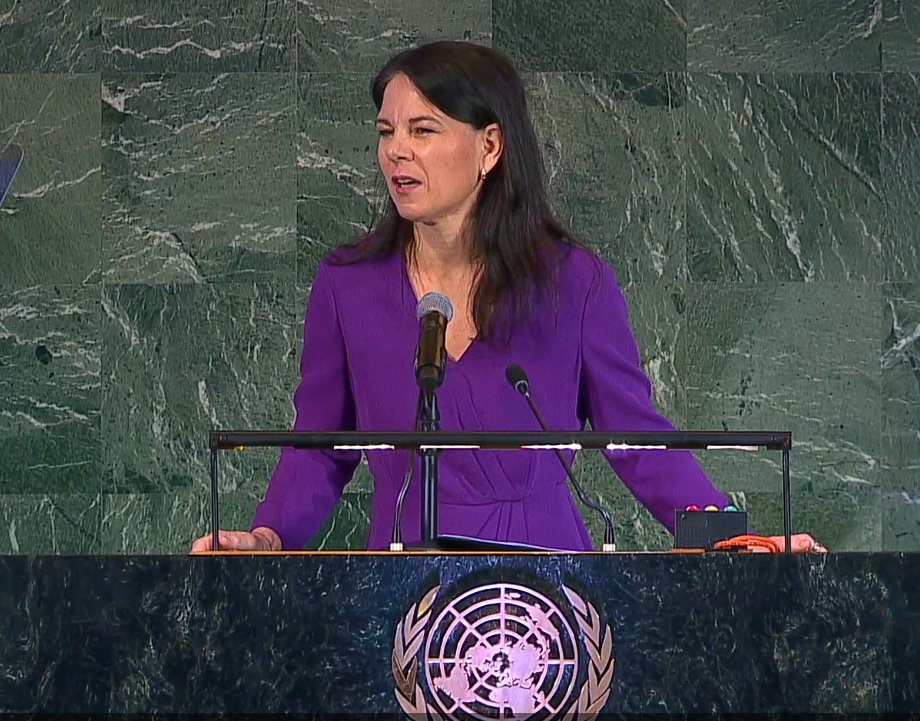
"When girls remain in school, economies grow all over the world. When women participate in the workforce, productivity rises all around the world. When women sit at peace tables, agreements last longer, when women lead institutions, they are more resilient." - @UN_PGA
The United Nations Open Source Portal is now live!
A new hub for collaboration across the UN system, connecting projects, people and open source solutions to strengthen digital innovation and cooperation.
Explore the portal: https://t.co/DHxGvFvbCz
Cyberattacks are increasing in frequency, sophistication, and harm.
The Common Good Cyber Fund strengthens the public-interest cybersecurity ecosystem and supports nonprofits protecting civil society.
Open call launches June 2026 👇https://t.co/MlUrDDKm4x