How we built forkable vm's in https://t.co/TQuSY4M9Bp
00:11 Architecture
00:35 Zooming in to a single worker
01:13 Forkable VM's
02:43 Demo
04:10 Results
04:24 Typescript sdk
Pattern Screamer: Subnet Discovery in Networks with Unknown Addressing
This article introduces Pattern Screamer, a reconnaissance tool that uses multi-protocol TTL tracing to discover routers, subnets, and network topology in environments with unknown addressing schemes. By combining heuristic subnet sampling with ICMP, TCP, and UDP probes, it dramatically reduces scan volume while enabling attackers and administrators to map network infrastructure without ...
https://t.co/vuvceGgia1
Anthropic engineer:
"You can build 5 assistants in one afternoon. Each one handles a task you've been doing manually every single day."
In 45 minutes he builds 5 focused agents from scratch on camera.
Most people are still doing code review, testing, and documentation by hand every single day
Watch the session, then save all templates below 👇
Your AI agent dies the second you close the terminal.
tmux fixes this...
Detach, walk away, come back hours later and it's still running like nothing happened
Watch this 25 video:
Amazon AI engineer just showed how to take Claude apps from prototype to production on AWS.
19-minutes. Free. By the Amazon AWS team.
Claude Code → Bedrock → fully deployed, scalable, secure.
Worth more than any $500 vibe-coding AI course.
🚨🚨Shunyu Yao is currently a Senior Staff Research Scientist at DeepMind. This interview was recorded around May 10 and runs nearly four hours in full. I selected the parts that I personally found most interesting, covering the following topics:
Anthropic engineer showed how one person can run 5 AI agents, that code, test, review, and deploy at the same time.
In 30 minutes they built the whole thing live in one session.
Here's what they cover:
> when to use one agent vs a full team
> how to split work so agents don't step on each other > the exact framework for deciding what each agent handles
that's exactly why, I put together a guide on building agent teams that actually work.
full guide in the article below 👇
Memory Corruption Attacks - The (almost) Complete History
https://t.co/VJbaN6lPf1
Memory Errors: The Past, the Present, and the Future⋆
https://t.co/Nsvx5F7llV
Why is memory safety still a concern?
https://t.co/2jdwirWXKc
A Senior AI Developer at Microsoft just showed exactly how they build AI agents with Claude.
34 minutes.
Completely free.
The stack:
- Claude Opus 4.7
- 1,400+ pre-built MCP tools
- production-ready agent workflows
The process is surprisingly simple:
→ connect Claude to an agent
→ give it access to tools
→ let it execute tasks
→ deploy to production
No hype.
No vague theory.
Just a practical walkthrough of how modern AI agents are actually being built inside enterprise environments.
Honestly, this is worth more than most $500 "vibe coding" courses selling agent-building secrets.
If you're serious about AI agents, MCPs, and real-world automation, this is time well spent.
Microsoft Senior AI developer just showed how they build AI agents with Claude at Microsoft.
34-minutes. free. By Microsoft team
Opus 4.7 + 1,400+ pre-built MCP tools
plug Claude into agent → give it tools → ship to production
worth more than any $500 vibe-coding course.
If you have always wanted to learn x86 assembly but thought it was too hard, take a look at these links. It is hard, no doubt, but once you learn that there's a logic behind it and that the opcodes weren't arbitrarily chosen, it might become a bit easier.
x86 Instruction Encoding
...and the nasty hacks we do in the kernel
https://t.co/PyLp6QEKxW
Borislav Petkov: x86 instruction encoding and the nasty hacks we do in the kernel
https://t.co/SXXk0UQKAJ
A Summary of the 80486 Opcodes and Instructions
https://t.co/KakN5JB9Hx
x86 and amd64 instruction reference
https://t.co/wYE5iyDAb2
Personal update: I've joined Anthropic. I think the next few years at the frontier of LLMs will be especially formative. I am very excited to join the team here and get back to R&D. I remain deeply passionate about education and plan to resume my work on it in time.
linux networking is so low level that you can sniff every packet your machine sees with a single raw socket.
without wireshark and libpcap the kernel handing ethernet frames directly to userland.
linux literally exposes raw layer-2 traffic to userspace.
the engineer who built Claude Code just dropped a 28-minute video on how to write prompts that actually work
I've seen $300 courses that don't cover what he shows in the first 10 minutes
CLAUDE.md files, memory shortcuts, parallel sessions, prompting patterns
all in one video and completely free
works whether you're a developer, a beginner, or someone who's been using Claude for months
based on this, I put together 18 things you can copy and use in Claude today
full guide in the article below
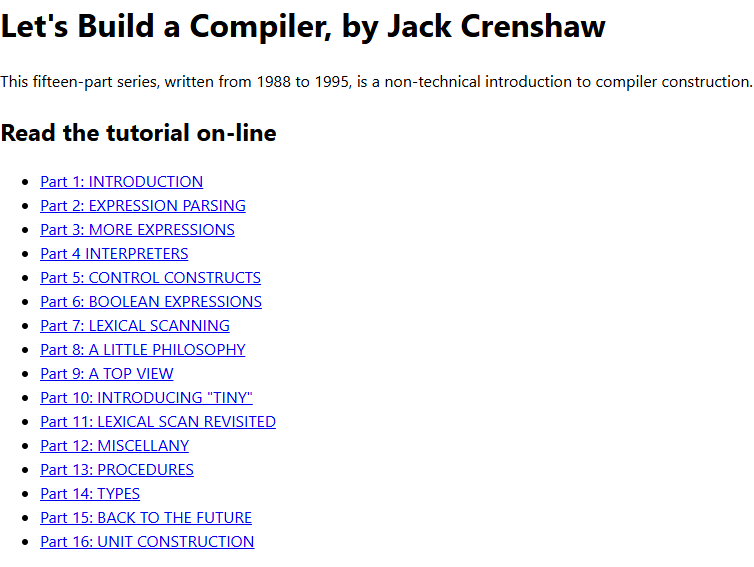
in 1988 a physicist named Jack Crenshaw got tired of compiler textbooks being unreadable
so he wrote his own tutorial on a BBS called "Let's Build a Compiler"
he starts from a parser that handles exactly one digit and adds one feature per installment until you have a real compiler at the end