@john_ozuysal yep! The interesting shift is that comparison pages are no longer just bottom of funnel seo assets , they’re becoming source material for AI recommendations.
Step 1: Ask AI about your category.
Step 2: Check if your firm appears.
Step 3: See how it explains your value.
Step 4: Find what is missing.
Most brands stop after step 1.
The real advantage starts when an agent keeps doing all four. The system becomes useful when it acts.
Most Brands are learning how to show up in AI answers.
Good.
But who is checking what the AI agents believe about the brand?
You need one agent to watch the others, find wrong ideas, and catch gaps before buyers see the same bad answer.
The first movers get more time to improve.
A marketing manager opens ChatGPT and asks, Who are the best firms for this?
Her company is missing.
Instead of guessing why,
-an AI visibility agent reviews the answer,
-finds the weak signals,
-and gives the team a clear list of fixes. That turns confusion into clear action.
Your next marketing hire may never join a Zoom call.
It could be an AI agent that:
1-checks how AI describes your firm
2-finds why rivals get picked
3-shows what to fix next
That may soon be more useful than another content writer. That is a new kind of hire.
@markevans This feels like the right question: who actually benefits, and what tradeoffs are residents and businesses being asked to accept? Big infrastructure bets need more than optimistic economic projections.
@TomPick@suganthan@sejournal This is the part most teams are missing. AEO isn’t just “write for AI.” It’s making sure the proof, pages, and third-party signals an engine can cite are actually crawlable, trusted, and clear.
@kamilrextin@markhuberco This is the best use case imo: AI as the first-pass thinking partner, not the final voice. The value is getting to a sharper V1 faster, then adding the judgment and taste back in.
@devbasu Order matters a lot here. Buyer-intent pages are often where the real leverage is hiding, especially now that AI systems are also reading those pages to understand who should be shortlisted.
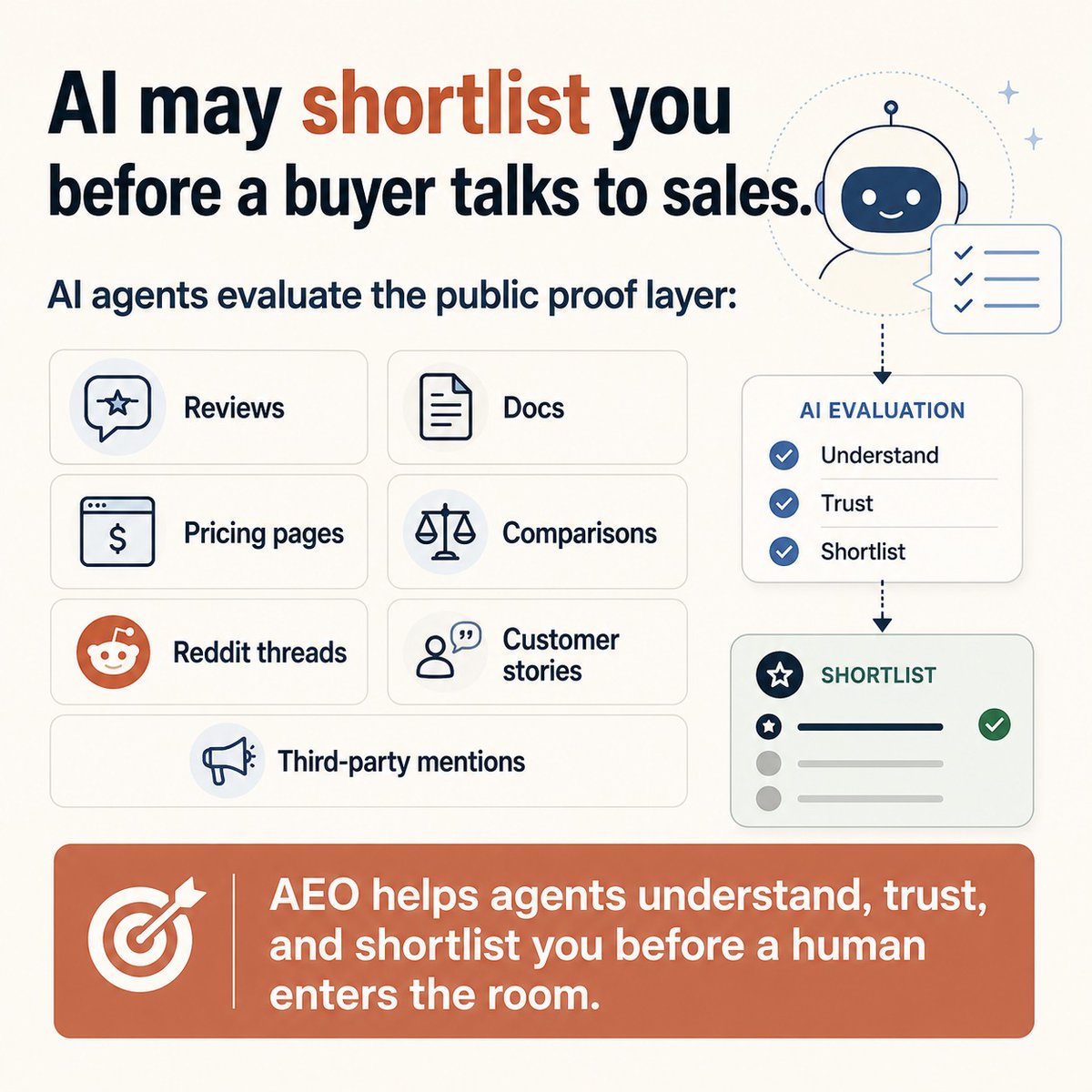
The new B2B buying journey has a silent evaluator:
AI agents.
They don’t join sales calls.
They don’t read your pitch deck.
They don’t care about your best objection handle.
They read the public proof layer:
- reviews
- docs
- pricing pages
- comparisons
- Reddit threads
@EvenAlon Exactly. “Agent buying journey” is the phrase.
The shift is that agents don’t hear your pitch. They read the public proof layer before a buyer ever talks to sales.
@gaetano_nyc This is such a useful SEO consulting filter. I’d put a lot of AI/GEO tactics in the same bucket: fine to do, but the real question is whether it changes answer inclusion, citations, or shortlist position. Otherwise it’s just comforting activity.
@wpsands Your point about the old story still living where buyers look is sharp. I’d add AI answers to that checklist: even after a repositioning, LLMs can keep repeating old category language if the proof/source layer hasn’t changed. That drift is invisible until you test prompts.
@PromptBridg Exactly. For local businesses AEO often starts with the boring-but-critical stuff: accurate hours services reviews location context. AI can’t recommend what it can’t verify.
@jeffsheehan@hackernoon Feels like the real shift is that GEO makes brand clarity measurable. If AI can’t confidently understand who you help what you do and why you’re credible you just won’t show up in the answer.