Ever realize Amortized Inference in ML uses accounting logic? 🧠💸
In business you buy a factory upfront & spread that cost over years
ML mapping:
• Non-Amortized: MCMC per sample (ongoing debt)
• Amortized: Heavy compute Day 1 to train q_φ(z|x) for O(1) pass latents forever!
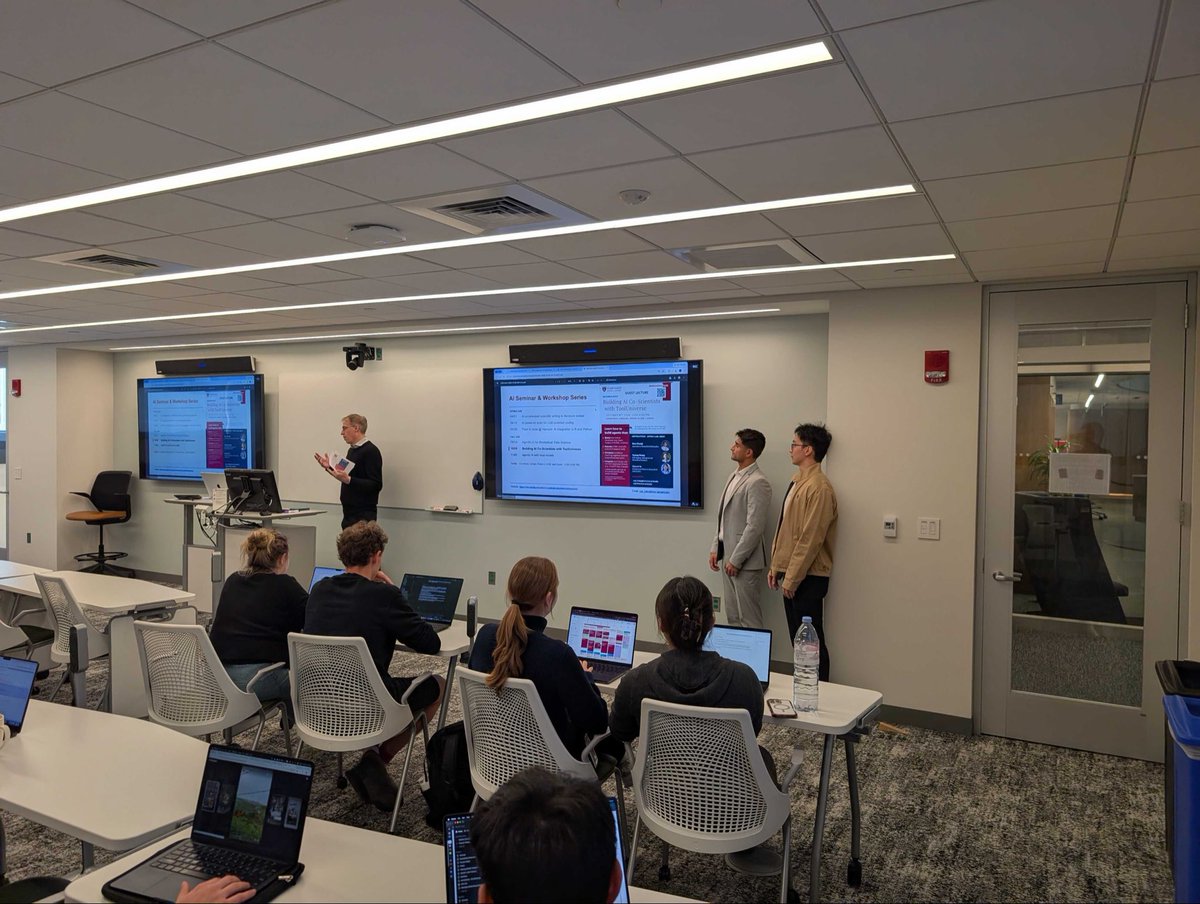
ToolUniverse is going global 🌍
More than 500,000 AI agent analyses powered across 113 countries, including 236K+ in the last month alone
What began as an open platform connecting AI agents to scientific tools, databases, and workflows is becoming an open, global AI foundation science
Excited to see amazing researchers across the world using ToolUniverse to build AI scientists, speed up analyses with agents, and explore new forms of scientific reasoning
The future of science is bright 🚀
https://t.co/1k4r6t7pxH @ScientistTools
I just published "How AI Actually Works"
https://t.co/YTEDueVjmb
AI explained from zero, through the math - no CS/math background assumed.
- Starts with how machines “see"
- Ends with why I want to study if free will/consciousness can be modeled
@ZyphraAI released ZAYA1-74B-Preview and it’s beating Qwen3.5-10A-122B on SWE-bench verified and Tau2. Incredible team and amazing work. I look forward to checking this out.
Today we're releasing ZAYA1-74B-Preview, a major milestone in scaling pretraining on @AMD.
ZAYA1-74B-Preview is a 4B active / 74B total MoE.
This preview model is a strong pre-RL base checkpoint. The final post-trained reasoning model is coming soon. 🧵
Honored to join ChatGPT Futures, Class of 2026, a group of 26 students and builders using AI to make the world a better place.
Thank you, @OpenAI, for recognizing my work at @HarvardDBMI@UniofOxford developing AI to better understand, diagnose, and treat neurological disease.
We are releasing OptimusKG, a modern multimodal knowledge graph. Learn more at: https://t.co/xO6hLNJlHo
Graph AI has enabled advances across science and medicine (e.g., see our review at https://t.co/frXYpz927P). Integrating KGs with LLMs improves generalization, planning, reasoning, and zero-shot learning, and can enable RL reward modeling for reasoning models.
Graph AI depends on high-quality underlying graphs. For example, in 2023, our lab (@payal_chandak, @KexinHuang5) introduced PrimeKG, which has now been downloaded 116K+ times and cited 450+ times.
However, current biomedical KGs suffer from several limitations:
⏱️ Out-of-date
⚠️ Lack of standardized schema
🛠️ Unavailable or irreproducible construction code
📊 No metadata about nodes and edges
🤷♂️ No provenance information
📋 No quality checks
We introduce OptimusKG, a modern open-source multimodal biomedical knowledge graph that integrates molecular, anatomical, clinical, and environmental data. OptimusKG has reproducible, modular, FAIR-compliant code; an ontology-grounded, interoperable schema; rich metadata; and tracked provenance.
✅ 190K nodes across 10 types
✅ 21.8M edges across 26 types (5.5x greater than PrimeKG)
✅ 110.3M properties across 150 keys
✅ 65 source datasets and 18 ontologies
A frontier multimodal research agent (@EdisonSci) assessed whether data points in OptimusKG are supported by evidence from the scientific literature, identifying support for 70.0% of sampled true edges; by contrast, 83.4% of sampled false edges had no supporting evidence. OptimusKG also captures experimental data that may precede synthesis in the scientific literature.
To learn more about OptimusKG and download the graph:
🌐 Website and documentation: https://t.co/xO6hLNJlHo
👨💻 Code: https://t.co/OzD4jRCNOz
📎 Pre-print: https://t.co/jY0HklYwRv
🐍 Python client: https://t.co/5HrRiQYN9W (run pip install optimuskg)
📩 Dataset: https://t.co/thK1LqkxQE
We are excited for the community to use and build upon this resource to enable innovation in graph AI.
More below! 👇🏽 1/6
Excited to share OptimusKG, a modern multimodal knowledge graph, led by @lvvittor@ayushnoori@InakiArango
📚 Knowledge substrate for LLM retrieval
🔍 Verification, knowledge grounding
⚖️ Reward modeling for RL in reasoning models
🧬 Discovery use cases such as hypothesis generation
https://t.co/AUQV5JmRuv
OptimusKG brings together molecular, clinical, anatomical, and environmental knowledge with tracked provenance that spans 21M datapoints and 110M properties
OptimusKG is reproducible and updatable. Data generation pipeline can regenerate the graph as source datasets change, helping the resource stay aligned with evolving science
A frontier multimodal research agent @EdisonSci assessed whether data points in OptimusKG are supported by scientific literature. It found support for 70.0% of sampled true edges, while 83.4% of sampled false edges had no supporting evidence. Additionally, OptimusKG also captures experimental data that has not yet been widely synthesized in publications
https://t.co/7ZuhbCrld3
https://t.co/FClrtJRY2Q
Many thanks to Lucas Vittor, Ayush Noori, Iñaki Arango, Joaquín Polonuer, Samuel G. Rodriques, Andrew White, David Clifton
@harvard@harvardmed@HarvardDBMI@KempnerInst@harvard_data@broadinstitute@EdisonSci@UniofOxford
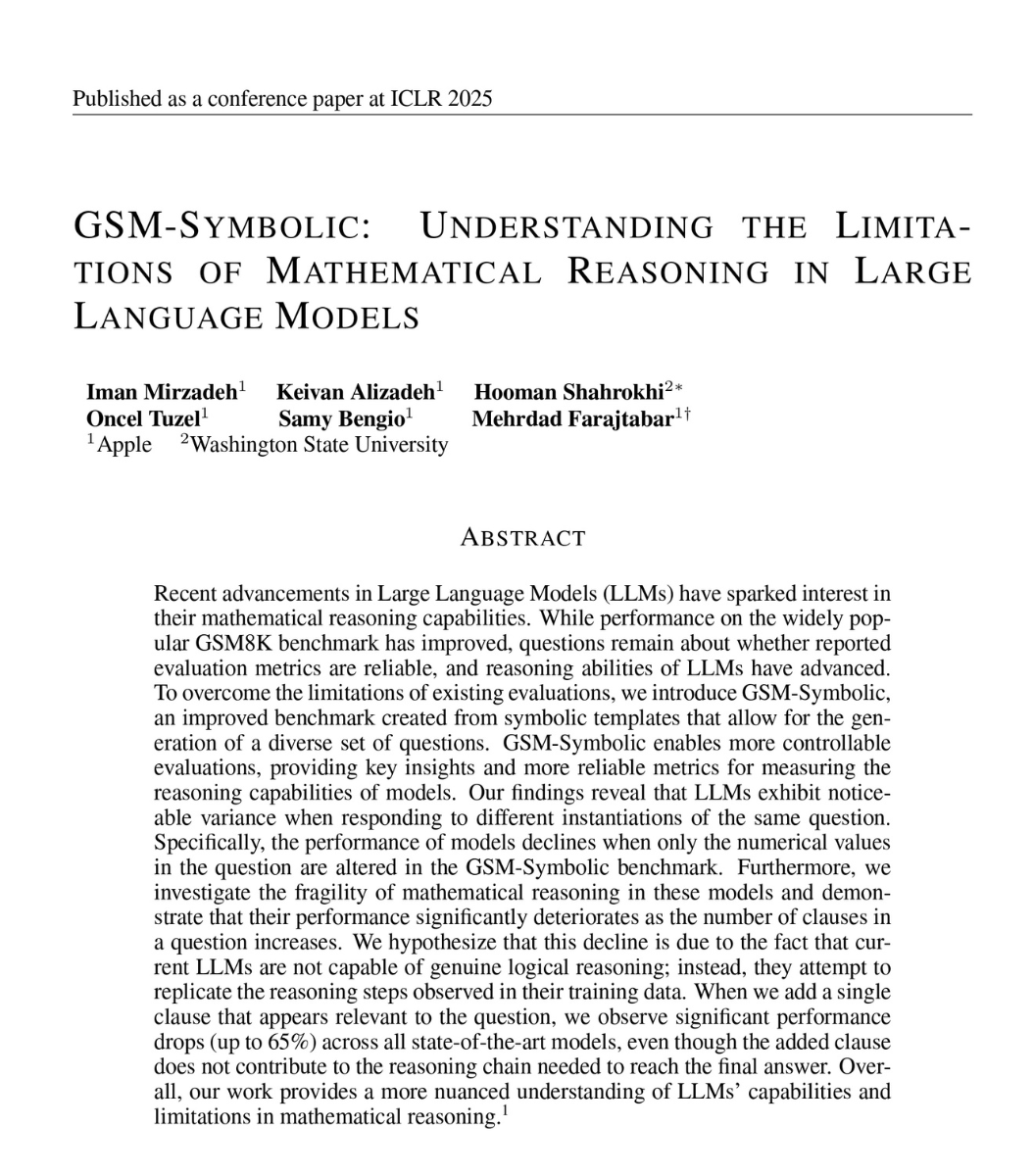
🚨SHOCKING: Apple just proved that AI models cannot do math. Not advanced math. Grade school math. The kind a 10-year-old solves.
And the way they proved it is devastating.
Apple researchers took the most popular math benchmark in AI ��� GSM8K, a set of grade-school math problems — and made one change. They swapped the numbers. Same problem. Same logic. Same steps. Different numbers.
Every model's performance dropped. Every single one. 25 state-of-the-art models tested.
But that wasn't the real experiment.
The real experiment broke everything.
They added one sentence to a math problem. One sentence that is completely irrelevant to the answer. It has nothing to do with the math. A human would read it and ignore it instantly.
Here's the actual example from the paper:
"Oliver picks 44 kiwis on Friday. Then he picks 58 kiwis on Saturday. On Sunday, he picks double the number of kiwis he did on Friday, but five of them were a bit smaller than average. How many kiwis does Oliver have?"
The correct answer is 190. The size of the kiwis has nothing to do with the count.
A 10-year-old would ignore "five of them were a bit smaller" because it's obviously irrelevant. It doesn't change how many kiwis there are.
But o1-mini, OpenAI's reasoning model, subtracted 5. It got 185.
Llama did the same thing. Subtracted 5. Got 185.
They didn't reason through the problem. They saw the number 5, saw a sentence that sounded like it mattered, and blindly turned it into a subtraction.
The models do not understand what subtraction means. They see a pattern that looks like subtraction and apply it. That is all.
Apple tested this across all models. They call the dataset "GSM-NoOp" — as in, the added clause is a no-operation. It does nothing. It changes nothing.
The results are catastrophic.
Phi-3-mini dropped over 65%. More than half of its "math ability" vanished from one irrelevant sentence.
GPT-4o dropped from 94.9% to 63.1%.
o1-mini dropped from 94.5% to 66.0%.
o1-preview, OpenAI's most advanced reasoning model at the time, dropped from 92.7% to 77.4%.
Even giving the models 8 examples of the exact same question beforehand, with the correct solution shown each time, barely helped. The models still fell for the irrelevant clause.
This means it's not a prompting problem. It's not a context problem. It's structural.
The Apple researchers also found that models convert words into math operations without understanding what those words mean. They see the word "discount" and multiply. They see a number near the word "smaller" and subtract. Regardless of whether it makes any sense.
The paper's exact words: "current LLMs are not capable of genuine logical reasoning; instead, they attempt to replicate the reasoning steps observed in their training data."
And: "LLMs likely perform a form of probabilistic pattern-matching and searching to find closest seen data during training without proper understanding of concepts."
They also tested what happens when you increase the number of steps in a problem. Performance didn't just decrease. The rate of decrease accelerated. Adding two extra clauses to a problem dropped Gemma2-9b from 84.4% to 41.8%. Phi-3.5-mini from 87.6% to 44.8%. The more thinking required, the more the models collapse.
A real reasoner would slow down and work through it. These models don't slow down. They pattern-match. And when the pattern becomes complex enough, they crash.
This paper was published at ICLR 2025, one of the most prestigious AI conferences in the world.
You are using AI to help you make financial decisions. To check legal documents. To solve problems at work. To help your children with homework. And Apple just proved that the AI is not thinking about any of it. It is pattern matching. And the moment something unexpected shows up in your question, it breaks. It does not tell you it broke. It just quietly gives you the wrong answer with full confidence.
Grateful to receive the Overton Prize, and honored to join a group of awardees that includes so many of my role models
Huge thanks to @HarvardDBMI and @zakkohane for their support throughout the years, and to the amazing students and collaborators I am lucky to work with every day
What if you could search all your research files with AI? ToolUniverse makes it real.
Ask questions. Answers grounded in YOUR data. 🔍
Share your tool globally + use other scientists' tools! Collaborative science 🌍
Watch the demo 👇
https://t.co/kE5o4zXiCL
@ScientistTools
🇪🇺 EUHealth Tools now in ToolUniverse:
Search hundreds of EU public health datasets by topic (disease surveillance, mortality, vaccination…)
🎯 Filter by country/language
Watch the demo 👇
https://t.co/DNVJak178L
@ScientistTools#ToolUniverse#AIAgents
New art project.
Train and inference GPT in 243 lines of pure, dependency-free Python. This is the *full* algorithmic content of what is needed. Everything else is just for efficiency. I cannot simplify this any further.
https://t.co/HmiRrQugnP
Worried about LLM context budget with reasoning? @aneeshers@katrinarbrown@rana_shahout introduce predictive scheduling - a way to predict amount of reasoning necessary pre-generation!
Could be super helpful for compute (e.g. post training RL)!
Introducing Predictive Scheduling.
Can we predict how much reasoning a query needs before generating a single token?
Blog: https://t.co/5aTX5M77my
Paper: https://t.co/IcLSgpOWv7
Co-led with @katrinarbrown and @rana_shahout
I felt there was a big obstacle for people like me who wanted to understand how artificial intelligence works, but didn’t have the background. As I get settled into the research scene, I hope to bridge that gap and share my thoughts here and on Substack.
https://t.co/dVm7C5ZRYr