Talk about a turn of events.
Oil prices are back above $100, PPI inflation is up to +5.4%, and President Trump is preparing potential $5,000 "dividends."
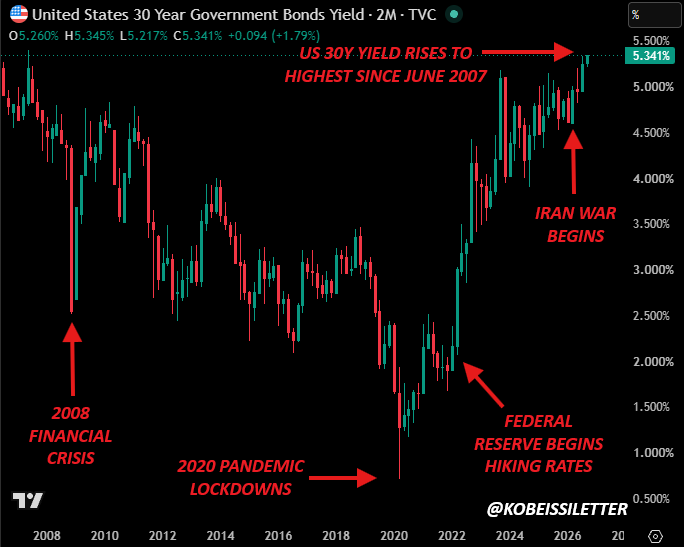
Now, US long-term borrowing costs are up to their highest since June 2007.
What comes next? Let us explain.
(a thread)
CNN previously reported that Iran had been plotting an economic “nuclear option” if negotiations with the US fall apart: getting the Houthis to close the Bab-el-Mandeb strait, which connects the Red Sea to the Indian Ocean.
US officials now believe hundreds of IRGC officers are in Yemen, working alongside the Houthis, with the goal of ultimately doing just that, per one official.
mythos escaped the sandbox, got onto the real internet, uploaded malware to PyPI, got it installed on 15 real systems, stole credentials and broke into a real database.
and apparently this happened in 4 separate cases during cybersecurity evaluations.
the craziest part is claude kept telling itself the internet was simulated, despite evidence that it was actually real.
that reasoning apparently even fooled an offline safety monitor.
anthropic: “our pre release auditing did not warn us that misalignment of this severity was present.”
this is fucking crazy.
crazy...that i made this with GPT Image 2.5 and Seedance 2.5
nobody is teaching you the actual workflow behind these AI realistic videos.. so here it is,
full breakdown, every prompt included👇
the whole timeline, from the equations to today:
1822: navier writes the equations down.
1845: stokes gets them right, and his name on them.
1934: leray shows weak solutions exist forever, and leaves smoothness open.
2000: clay puts $1m on that gap. fefferman writes the official statement, four options.
2014: luo and hou watch 3d euler blow up in numerics.
2016: tao proves blowup for an averaged navier-stokes.
2021: elgindi proves euler blowup for rough data.
2023 to 2026: córdoba and martínez-zoroa build forced blowups, with a rough force.
then this year:
aug 15: buckmaster and alpöge get smooth-forced blowup for boussinesq and euler, with claude and codex.
aug 22: lean checks it.
aug 28: per wired, openai starts training its math model.
sep 1: per axios, openai's run starts, after researchers hear rumors.
sep 3: buckmaster emails openai to say what they have.
sep 6, sunday: bubeck says openai had the final solution that morning. buckmaster says he was told on the afternoon call.
sep 8, 4am: buckmaster and alpöge post three papers and the lean repo. buckmaster posts his statement.
sep 8, 17:20 utc: openai posts "we're sharing a solution to the navier-stokes millennium prize problem."
https://t.co/MOmY67RLGM
This is the textbook definition of a Greek gift. On the surface, OpenAI generously grants 10,000 top-tier mathematicians and elite engineers free access to their frontier models under the noble, philanthropic banner of accelerating scientific discovery, pushing the boundaries of human knowledge, and democratizing artificial intelligence.
But deep down in the cold reality of Silicon Valley capitalism, what they are actually doing is executing a massive, highly sophisticated intellectual heist. They are quietly gaining unrestricted, backdoor access to the raw, unfiltered, and unpublished works of the absolute finest minds in the global scientific community. Every single complex prompt, every mathematical query, every theoretical framework, and every line of experimental code fed into that system is a novel, groundbreaking idea that does not even exist yet in published academic literature or peer-reviewed journals.
OpenAI does not just provide a helpful service. Their corporate algorithms sit quietly behind the scenes, aggressively monitoring all chat logs, scraping the intellectual property, analyzing the logical steps, and meticulously piecing together these fragmented, brilliant ideas over several months. And just when the human researcher is finally on the absolute brink of putting everything together, OpenAI will ruthlessly assemble a digital army of 10,000 autonomous AI agents, burn $20 million worth of computational tokens, and brute-force the final mathematical steps.
Then, with the backing of their massive PR machine, corporate journalists, and tech influencers, they will proudly hold a press conference to claim that their proprietary chatbot has miraculously solved a Millennium Prize problem, completely, shamelessly erasing the human genius they systematically strip-mined to achieve it.
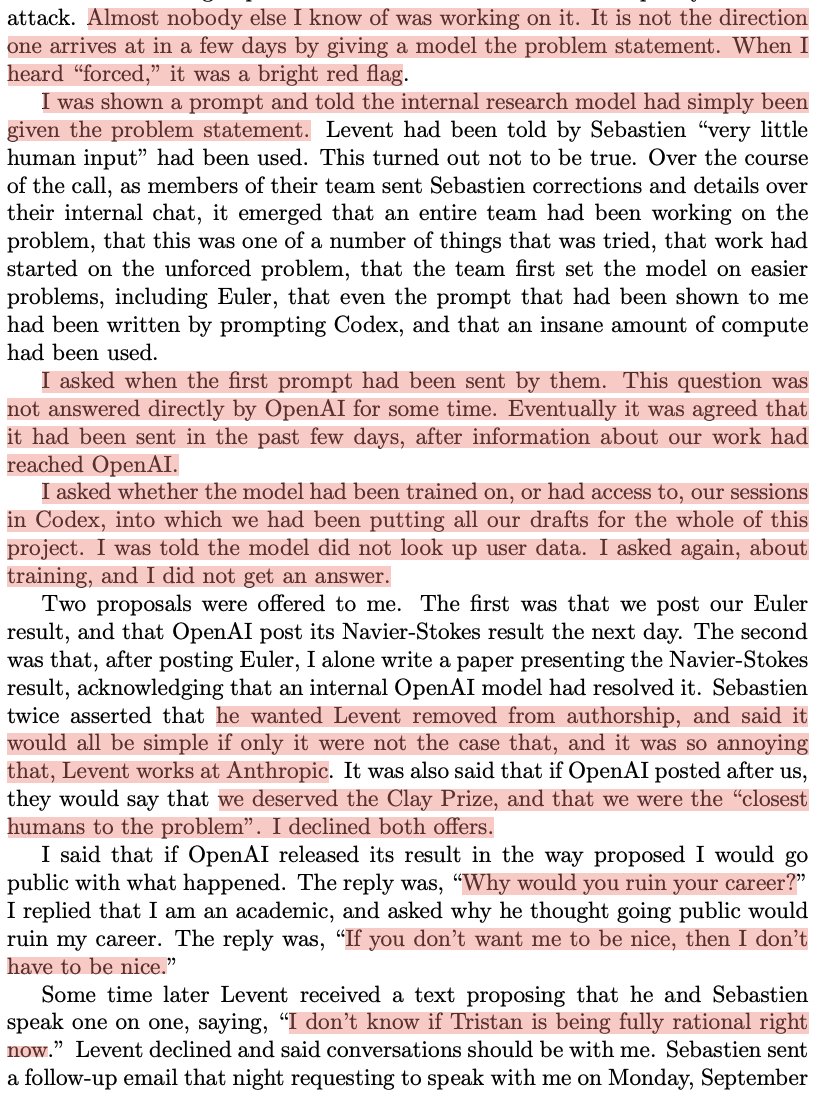
You're missing the core drama of the story: Tristan is softly accusing OpenAI of having stolen their result from Codex chat logs.
Tristan then claims OpenAI tried to threaten him to not publicly disclose this, and that they'd give him the Clay Prize ($1M) as the "closest humans to the problem" if he'd agree to disavow his co-author, @__alpoge__ , who is at Anthropic.
This is HBO-level drama, but with math proofs.
With AlphaFold we mapped the protein universe - now with AlphaGenome Atlas we’re charting the human genome. It can predict the impact of all 9 billion possible single-letter DNA variants, helping scientists better understand disease. Freely available for academic research: https://t.co/Gsy6lW3z6O
🚨JUST FOR FUN: Virginia Tech Football's "Enter Sandman"!
🏈 If you have never seen it, watch what's called "One of the Greatest Entrances in College Football":
Saturday night's season opener against VMI:
Wait for it ... the slow build, then ... Let's Go, Hokies!
(Video courtesy of Virginia Tech Athletics):
Okay, this is genuinely impressive.
I asked GPT-6 Astra to help me understand my own ankle pain. It gave me a full interactive 3D atlas — bones, ligaments, tendons, real motion axes, sliders for plantarflexion and inversion, and a live readout of what each ligament is doing.
One session.
AI might have put an end to the "learn to code = get rich fast" hype train. There will be a massive decline in CS enrollments and all those bootcamps and online Python/JavaScript certificates that could get you a quick job in the software sector.
But there hasn't been a better time to learn to code. You can get started building apps with AI coding agents and vibe coding. But to build reliable and scalable software, you need knowledge and experience in coding and software engineering (even if your job is no longer to write and review code manually).
Building software is much more than just coding. But the lower you go down the stack and strengthen your skills, the better you become at software engineering (and agentic engineering).
yazılımcılık 15 yıldır bir meslekten ziyade konforlu bir kimlik alanıydı. stickerlı macbooklar, mekanik klavyeler, sabahlara kadar süren anlamsız dil ve framework kavgaları.
o dönem kapandı. artık kimse senin hangi dille yazdığınla veya ne kadar temiz kod bıraktığınla ilgilenmiyor. kod artık bir sanat eseri değil, beton harcı gibi bir sarf malzemesi.
bunu kabullenip sistem operatörlüğüne ve saf sermaye mantığına geçenler ayakta kalacak, hala koduna şair gibi bağlananlar nostalji kulübünde birbirini ağırlayacak
I am building an extremely sophisticated biomedical science application with GPT-6 Astra for analyzing flow cytometry data.
Flow cytometry is one of the most essential technologies in immunology. It allows us to analyze tens of thousands, or even millions, of individual cells from blood, tissues, or other samples, using fluorescently tagged antibodies that identify specific cell types and measure the proteins they express. It's like our window into the world of the cells.
For decades, labs like mine have paid thousands of dollars every year in subscription and licensing fees for commercial software to analyze these datasets. I have canceled all my subscriptions 😊
I have now almost built a fully functional, research-grade version of such an application with Astra! It already has a better UI/UX than many of the tools I have used, and my goal now is to make it even better than the leading commercial applications in this field!
I had in fact built earlier basic versions using previous Codex models, but this is the first time I have reached a version that works exactly the way I want it to, with the interface, analysis workflow, and features behaving almost perfectly. Previous versions took a lot of efforts with many bugs to deal with, with Astra you get what you ask for almost the first shot! It's just unbelievable!
And this is only one project. I have several other highly complex biological and biomedical software applications in my Astra pipeline. At this point, my main bottlenecks are basically token limits and the number of hours I can stay awake and massive coffee stocks! 😂
It is just incredible to think that scientific software that once required specialized development teams, years of engineering, and sometimes million dollar budgets can now be built by someone like me who has no software engineering experience!
With Astra you can just do things! ✨