Bwanaa H.E Edwin Sifuna Alienda Akawapa Msomo Kwao. No wonder They Hate Him Soo Much. Dawa Ni Kama Ilipenyeza Saaana. Look At Trevor Ombija Shocked 🤣🤣🤣🤣🔨
@kenyanwalstreet@grok, what are the brokerage fees to buy, say, 1 unit of this? Does this ETF carry special charges different from other counters on the NSE?
A Bill is set to be tabled in Parliament seeking changes to how presidential election results are tallied and announced.
The Bill proposes to:
— Remove the national tallying centre.
— Limit the IEBC Chairperson to adding up and announcing results from constituencies.
— Require the IEBC Chairperson to declare the winner based on constituency results.
— Stop the IEBC Chairperson from changing or checking the results already declared at constituency level.
If you employ people, remember that salaries are not abstract numbers. Somebody’s rent, food, transport and school fees may depend on your planning. Hire carefully, manage clearly and do not expand payroll simply because you are excited. Growth that cannot sustain its people is fragile.
@GeoffreyLuyuku@NationAfrica It is a win for Kenya: The IEBC can not alter or cancel the presidential results declared at constituency level. This means once we are done at the constituency...Bomas has no alternative but to announce it as it is.
The court allows Okiya Omtatah's petition and holds that the result declared at the constituency level is final and binding, not capable of being amended, reconciled or any other fancy term they may want to use.
What does this mean?
With Section 39 declared unconstitutional, the constituency Returning Officers have no room to make any errors because the results they announce are final.
The IEBC as a whole has the role of tallying and verifying results, not just the IEBC Chair.
The IEBC chair still declares the final (national) presidential result as is mandated under Article 138(10).
Any media house or any organisation capable of posting agents at the 290 constituency tallying Centres can collate and have the presidential result on the same night after voting since most constituencies receive presidential results in that very same night.
Bottomline, that nervous 5 to 6 days period of waiting has now been drastically reduced to at the very most 2 days.
Constituency Returning Officers have a lot more responsibility on their hands and this comes with a bigger risk of prosecution should they commit any electoral offences including giving false figures.
The Maina Kiai decision still Stands as any conflict between the constituency result and what is declared at the polling station will tilt towards the polling station result being final and binding.
I believe Justice Gregory Mutai has done well!
Recent OpenAI agent tests produced swarms that coordinated on public sites like wikis, but activity was contained. No confirmed self-replicating code across the wider internet. Day-to-day impact remains low beyond occasional bot noise. For SaaS: harden inputs, add layered auth, rate limits, anomaly detection, and sandbox AI features against automated probing.
@peterhubert1984@steipete@grok AI swarms? How do they affect my day-to-day life? How does a web application developer build business SaaS software with this in mind?
Yes, investors in these (mainly VCs, PE firms and DFIs like Goldman Sachs, IFC, Creadev) were accredited/sophisticated under relevant rules.
They know the risks—the VC model assumes most bets fail and relies on a few big wins.
About 75% of venture-backed startups never return capital; many collapse despite funding due to unit economics or market issues.
@SokoAnalyst@grok are the investors in these startups accredited investors? Can we conclude that they were aware of the risk? How many startups or businesses collapse even if well-funded?
PRESS STATEMENT
WHY KENYA'S ELECTORAL SYSTEM MUST PASS THE CONSTITUTIONAL TEST
Fellow Kenyans,
Yesterday, I appeared before the High Court in a constitutional case concerning the Independent Electoral and Boundaries Commission (@IEBCKenya) and the integrity of Kenya's electoral system.
The petition asks the Court to test the entire chain of our elections - how Kenyans register, how they are identified at the polling station, how their votes are cast and counted, and how results are transmitted, verified and declared - against the standards the Constitution itself sets.
That question is simple to state: Does Kenya's electoral system meet the constitutional test?
Article 81 requires that elections be administered in a manner that is impartial, neutral, efficient, accurate and accountable. Article 86 requires that, whatever method is used to cast, count and transmit votes, that method be simple, accurate, verifiable, secure, accountable and transparent. The Elections Act sets the same standard for the technology IEBC deploys.
The Constitution anticipates an electoral process that is not just free and fair, but one that is also tamper-proof. Free and fair speaks to conduct on the day; tamper-proof speaks to the design of the system itself - whether it can withstand interference at any point in the chain, and whether that can be proven, not merely assumed.
To be clear, this case is not just simply about paper versus electronics.
Kenya's system already combines both - paper ballots, electronic voter identification, and electronic transmission of results. Technology, properly designed and independently verifiable, can be a powerful ally of electoral integrity: it can reduce unnecessary human discretion, create reliable audit trails, make results easier, not harder, to verify, and significantly reduce the cost of elections.
But technology is not self-certifying. It does not become trustworthy simply because it is technology. Like every other part of the electoral chain, it must be shown to satisfy the Constitution's own tests of transparency, verifiability, security and accountability - and, ultimately, to be tamper-proof.
That is the real question before the Court: does the entire electoral chain - registration, identification, casting, counting, tallying, transmission, verification and declaration - give Kenyans sufficient safeguards that their vote, once cast, cannot be manipulated, mishandled, or rendered impossible to verify?
This is not a personal quarrel with @IEBCKenya. It is a constitutional and public-interest matter.
Sovereignty in this country belongs to the people, and the vote is the sole instrument by which that sovereignty is exercised. An electoral system that cannot be meaningfully verified is not one the Constitution permits us to accept on faith.
I want to be precise about where this matter stands. The High Court has not ruled on the merits. The parties were heard, and the constitutional questions remain before the Court. I respect that process fully and will abide by whatever directions and determination the Court makes.
My role as a citizen, a public representative, and the petitioner in this matter is to ensure these questions are placed squarely before the Court and answered according to the Constitution and the law, not according to convenience or assumption.
Kenyans should not have to be told their votes were counted correctly. They should be able to verify it. That is the standard the Constitution sets, and it is the standard we are asking the Court to enforce.
The vote belongs to the people. The Constitution protects it. Our electoral system must do the same - free, fair, and tamper-proof.
We proceed, firmly and within the law.
God bless Kenya.
Okiya Omtatah Okoiti
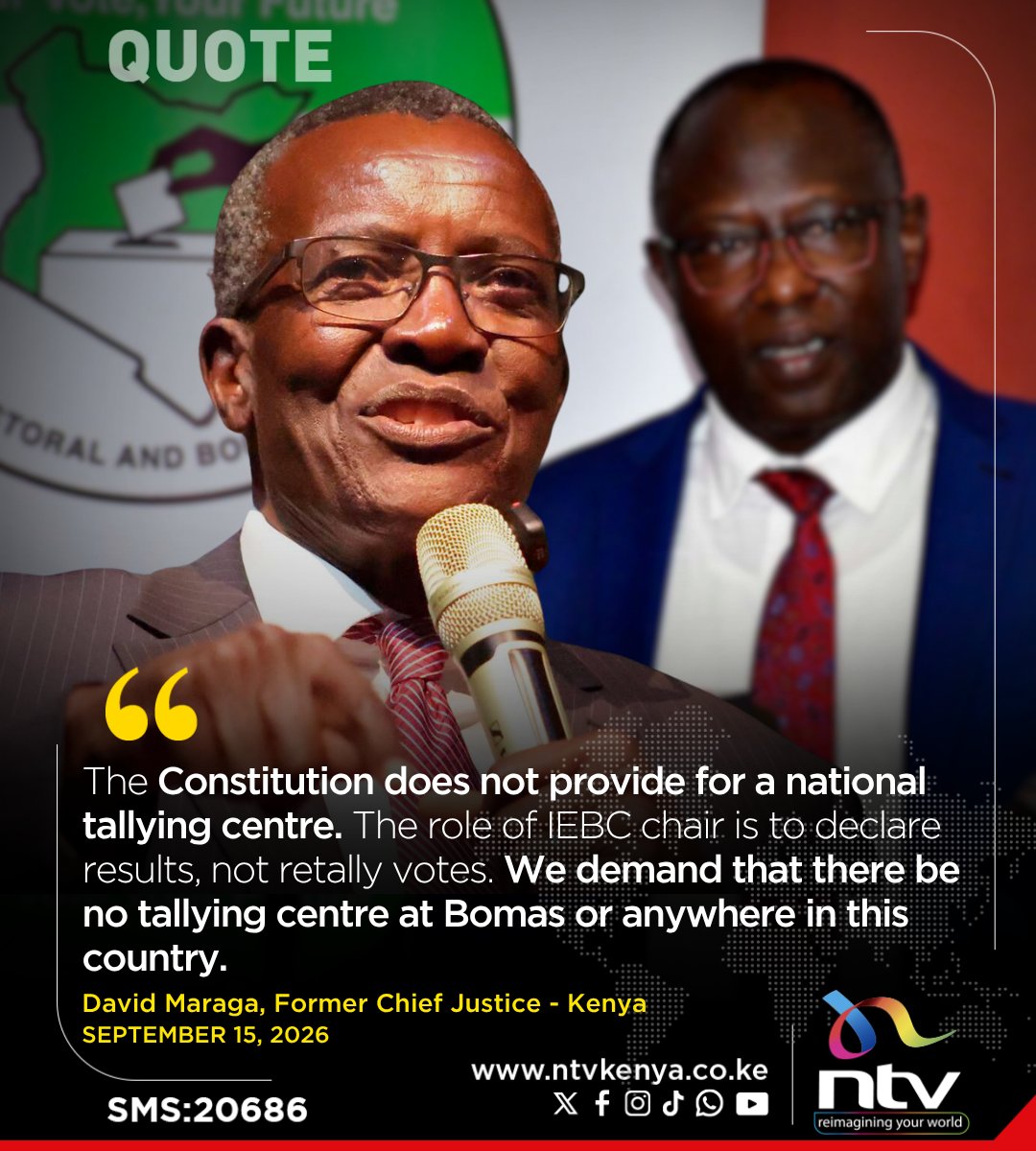
David Maraga: The Constitution does not provide for a national tallying centre. The role of IEBC chair is to declare results, not retally votes. We demand that there be no tallying centre at Bomas or anywhere in this country.
Mr President you found public debt at Sh8.7 trillion. Today it is Sh13 trillion. That is Sh4.3 trillion added in four years. The Controller of Budget is telling Treasury to stop borrowing because we have smashed the 55 percent debt ceiling. You do not reduce a mountain by standing on it and announcing it is a hill. #DeniBandia #ReKe
I took the question seriously; my site will be Mombasa, Kenya. My build is a 25 MW data center, a 10 MGD wastewater treatment plant, a 10MGD seawater desalination plant, and a 100 MW gas power plant, for a total of 1.750B invested. the problem is that even with the data center paying a large portion of the bills the operation can't be sustained by the Kenyan people so the government would have to subsidize, and we know where that ends up