$1,000.
That's what the Iran war has cost the typical American household so far — at the pump, at the grocery store, in higher mortgage rates, and in what we're spending as taxpayers.
And the total keeps climbing.
Full piece in The Philadelphia Inquirer: https://t.co/1a8IN4EFOy
🧵@SenWarren and @berniemoreno call lifting the payroll tax cap a “common-sense solution” to Social Security’s funding shortfall.
But it wouldn’t come close to eliminating that shortfall. And it would push top marginal tax rates to punitive levels.
The S&P 500 has surged 20% since the end of March, but the rally has been insanely narrow, with just 10 stocks accounting for 68% ish of the entire advance. As a result (passive Indexing), every new dollar flowing into the S&P 500 today is being allocated in a highly concentrated way: 20 cents to semiconductors (most expensive ever), 35 cents to the Mag 7 (near-record), and 39 cents to the top 10 stocks (also a record). Highly concentrated risk - S&P 500's performance has become heavily dependent on a handful of mega-cap names.
Cost-conscious Americans, beware:
If the Iran war drags on and escalates, the fiscal and financial costs will grow too, with downstream effects on Americans’ budgets, explains Cato’s @LettDominik.
https://t.co/cycBSmcZY3
Banks have tripled lending to private equity and credit since 2018 to over $300 billion. As a result, funds that invest in highly leveraged companies have themselves become leveraged. https://t.co/HbKAJUCFch
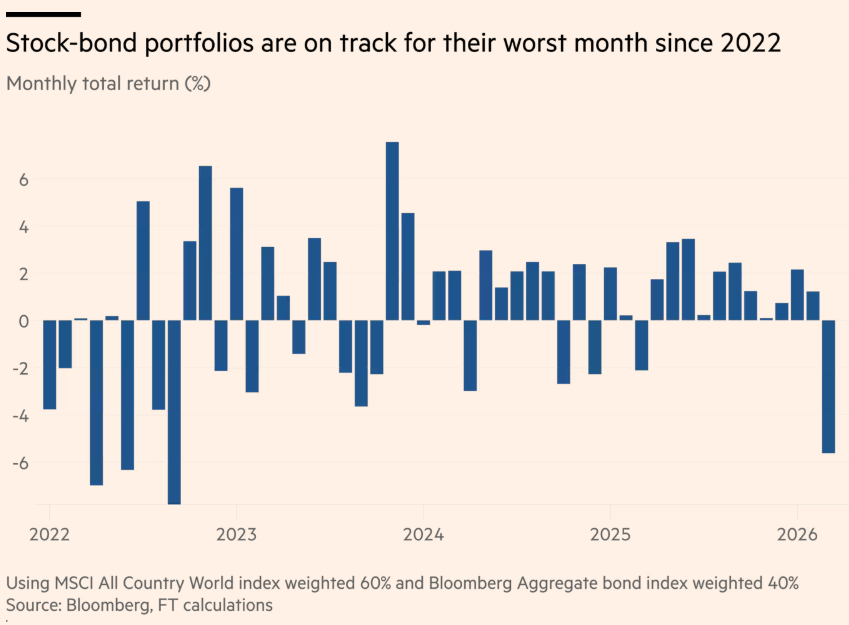
As a result of the US-Israeli war on Iran, the traditional '60-40' portfolio of equities and bonds is on track for the worst month since September 2022.
US-ISRAELI WAR = NOT WALL STREET'S FRIEND.
The Treasury just quietly admitted the U.S. government is insolvent. $47.78 trillion in liabilities. $6.06 trillion in assets. My Six Penny Plan would balance the budget in five years. But that would require the government to actually stop spending money it doesn't have.
https://t.co/uPf6TzAMHb
WELKER: Would the administration ever raise taxes in order to fund this war?
BESSENT: Again, Kristen, terrible framing
WELKER: It's a simple question
BESSENT: It's a ridiculous question
WELKER: Can you answer it?
BESSENT: Why would we do that? We have plenty. We have a trillion dollars.
Top rates under the Sen. Van Hollen and Sen. Booker tax cut plans would be 49% and 43%, respectively.
Top federal income tax rates exceeding 40% would place the US among countries like the Netherlands, Spain, and France, but with a key distinction—in those countries, top rates apply at much lower income levels.
Read more: https://t.co/pTfiH9pXii
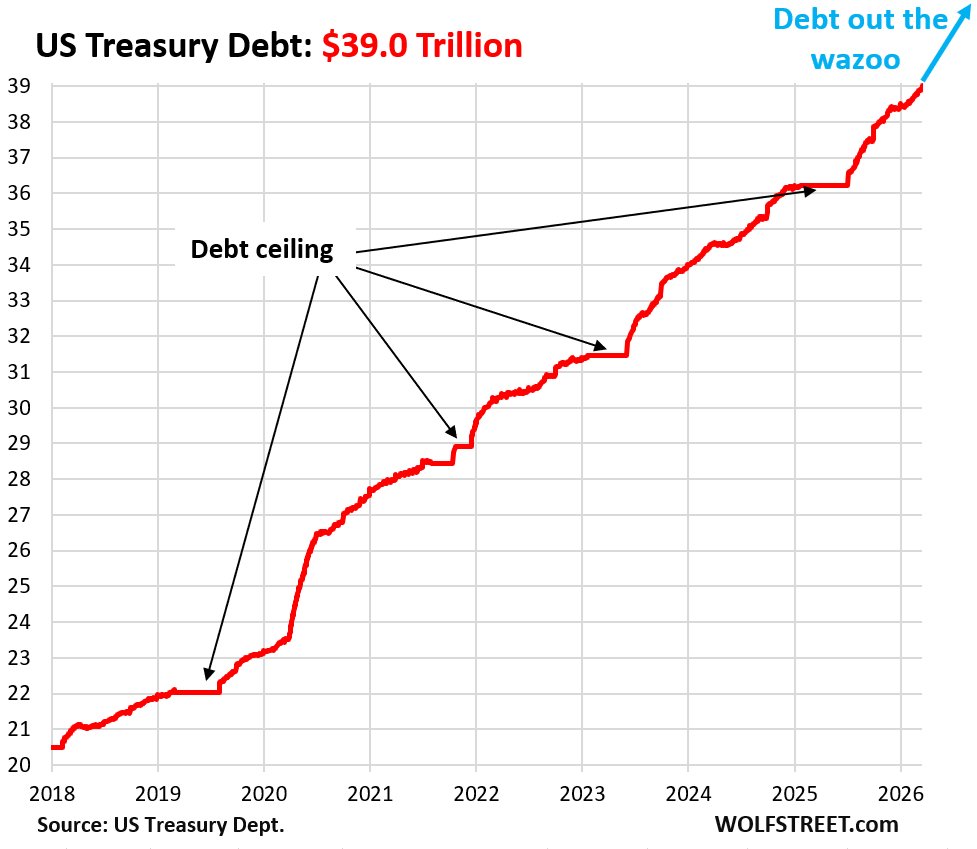
Bond Market Gets Edgy as US Treasury Debt Hits $39 Trillion, Spiking by $2 Trillion in 7.5 Months and Not Slowing Down.
But debt doesn’t exist in a vacuum: The Debt-to-GDP and Deficit-to-GDP ratios provide (ugly) context
https://t.co/0XZ6rkEoI5
The debt passed $39 trillion today.
Paying a trillion dollars of interest annually on this debt causes hardship for tax-payers and robs us of resources that could otherwise be used for infrastructure or national defense. And ultimately, this debt will enslave our grandchildren.
Former Goldman Sachs CEO Lloyd Blankfein said it a few days ago:
"It sort of smells like that kind of moment again. I don't feel the storm, but the horses are starting to whinny in the corral."
Then Jamie Dimon: "We did see this in 2005 and 2006 and 2007,almost the same thing. Everyone was making a lot of money. People were leveraging to the hilt. The sky was the limit."
These are guys who sat in the big chair at the biggest banks on Earth during the last crisis.
And they're both independently connecting the same dots.
Sizable credit bubble reversing.
Hedge funds getting hit with withdrawals.
Fund managers insisting everything is fine while gating investors.
Officials saying it's contained.
We heard all of this in 2007. Verbatim.
Now add an oil shock on top. Oil hit $120, dropped to $70, and is clawing back toward $100 despite governments releasing strategic reserves.
Sound familiar? It should. There was an even bigger oil shock in 2007-2008 that everyone's forgotten about because the credit crisis overshadowed it.
Doesn't mean 2008 is guaranteed. But the range of outcomes is narrowing in a direction nobody wants.
I'm going live March 26 at 6PM ET to walk through all of it. Where we are. What's accelerating. Where the signals point from here.
Register here
https://t.co/Ebs1EG1HOm
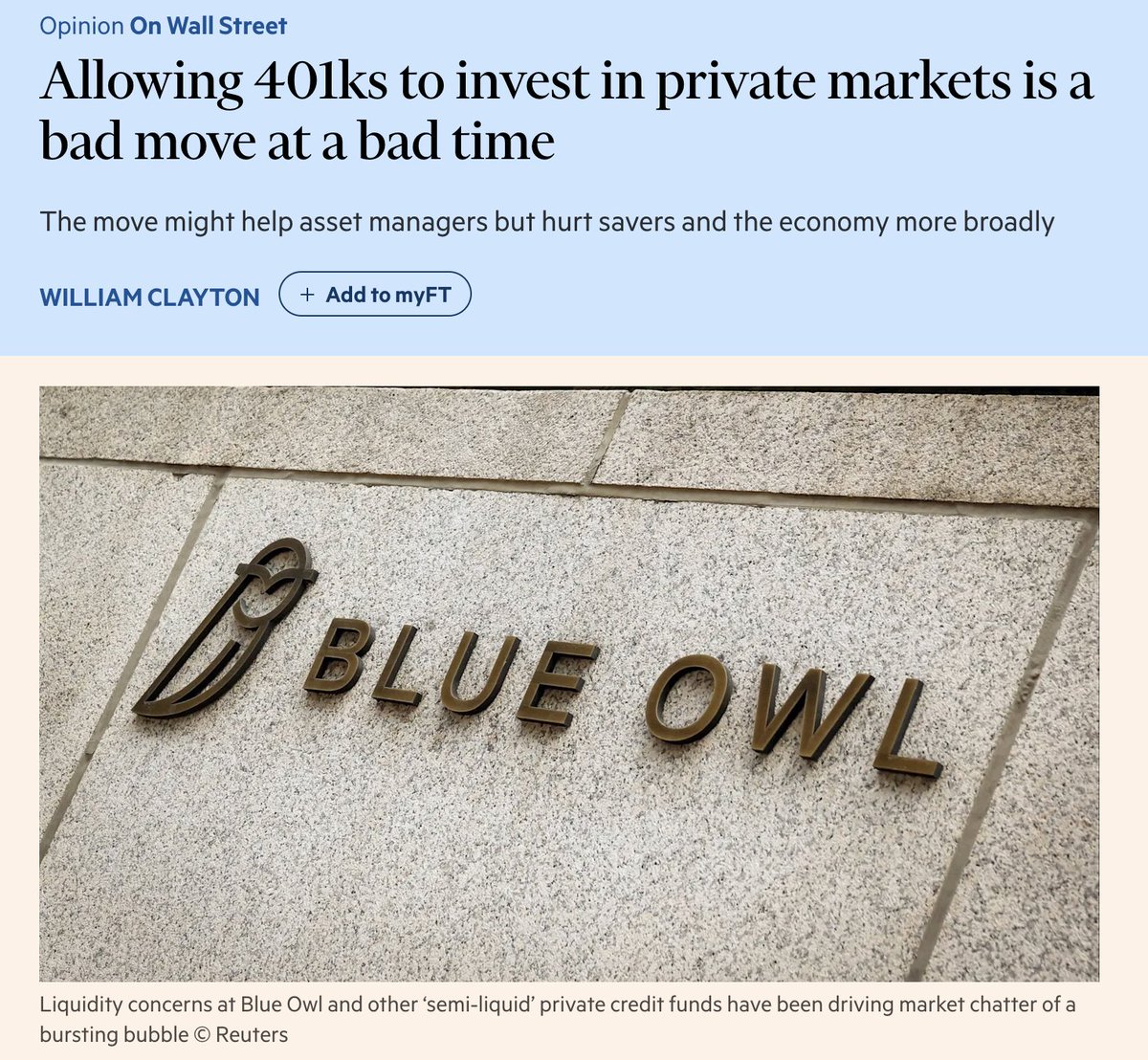
Trump signed an executive order letting 401ks invest in private markets. The industry spent months lobbying for this.
The timing is incredible. They’re opening the door to retail retirement money at the exact moment semi-liquid funds are gating redemptions, BDCs are cutting dividends, and the PC market is in a trust crisis.
The smart money needs exit liquidity. The 401k is the exit liquidity.
I was in a 2 hour briefing today on the Iran War. All the briefings are closed, because Trump can't defend this war in public.
I obviously can't disclose classified info, but you deserve to know how incoherent and incomplete these war plans are.
1/ Here's what I can share: