A closer look at the MET-PREVENT trial and what its null results reveal about aging interventions and trial design. Full article linked below.
https://t.co/2oD1n8DsbH
I stopped outsourcing my health to a counter
I walked into CVS today and watched two people standing in line waiting for their prescriptions.
I used to be one of them. Standing at that counter. Picking up my statin. Picking up my blood pressure medication. Believing that this counter was keeping me alive.
It was not.
I have nothing against pharmacies. Nothing against pharmacists. They are doing their job inside a system that was never designed to make you healthy. It was designed to manage your symptoms.
Nobody at that counter is going to test your fasting insulin. Nobody is going to check your inflammation. Nobody is going to ask what you ate today or how you slept last night or whether your stress is slowly destroying your arteries.
The pharmacy is not the problem. The problem is that we have been trained to believe the pharmacy is the solution.
It is not.
The solution is on your plate. In your bed at 10 PM. On the walking path at 7 AM. In the blood work your doctor refuses to order.
I take zero medications at 58. Not because I am lucky. Because I stopped outsourcing my health to a counter and started owning it myself.
The local drug store is not going to save us. We have to save ourselves. One meal. One walk. One night of sleep. One decision at a time.
The truth heals
@hormonedietdoc And your hyperinsulinemia is causing your kidneys to hold on to excess sodium, which retains water to maintain sodium concentration, which increases blood volume, which raises blood pressure.
NEW: Elon Musk wants a SpaceX IPO valuing the company at upwards of $1.75 trillion.
To get there he got the rules changed so that index funds, with millions of Americans' retirement savings, are forced to buy in.
Retirees could take huge losses, while insiders cash out.
Statins lower LDL. They do not remove plaque.
Arterial calcification is not a cholesterol problem. It is a metabolic signalling problem. Calcium ends up in the arterial lining because something drove it there.
Lowering a number on a blood panel does not address what caused the calcium to deposit in the first place.
The real drivers are almost never discussed in a standard consultation.
Chronic insulin resistance creating ongoing arterial inflammation.
Vitamin K2 deficiency, the nutrient responsible for directing calcium into bones and away from soft tissue.
Magnesium deficiency, which impairs over 300 enzymatic processes including those that regulate vascular tone.
Poor nitric oxide production, which means arteries cannot dilate properly and inflammation cannot resolve.
None of these show up on a standard lipid panel. That panel measures total cholesterol, LDL, HDL, and triglycerides. It tells you almost nothing about the conditions that drive calcification.
What reverses this process is fixing what caused it.
Not a statin.
Removing the foods that drive blood sugar spikes and insulin resistance.
Restoring K2 and magnesium.
Reducing the inflammatory load. Building the metabolic flexibility that allows the body to heal.
The body does not calcify arteries randomly. It does so in response to chronic injury and metabolic dysfunction.
Remove the injury and the dysfunction and further deposition stops. The conditions that drove the damage are gone. The body can begin to stabilise and heal.
That is not an alternative theory. That is the physiology.
What did your doctor tell you when they found calcification or high cholesterol? Did they explain what caused it?
Most cardiologists still tell patients: “Your cholesterol is the problem. Take this statin.”
After operating on thousands of hearts, I can tell you that’s incomplete at best — and dangerous at worst.
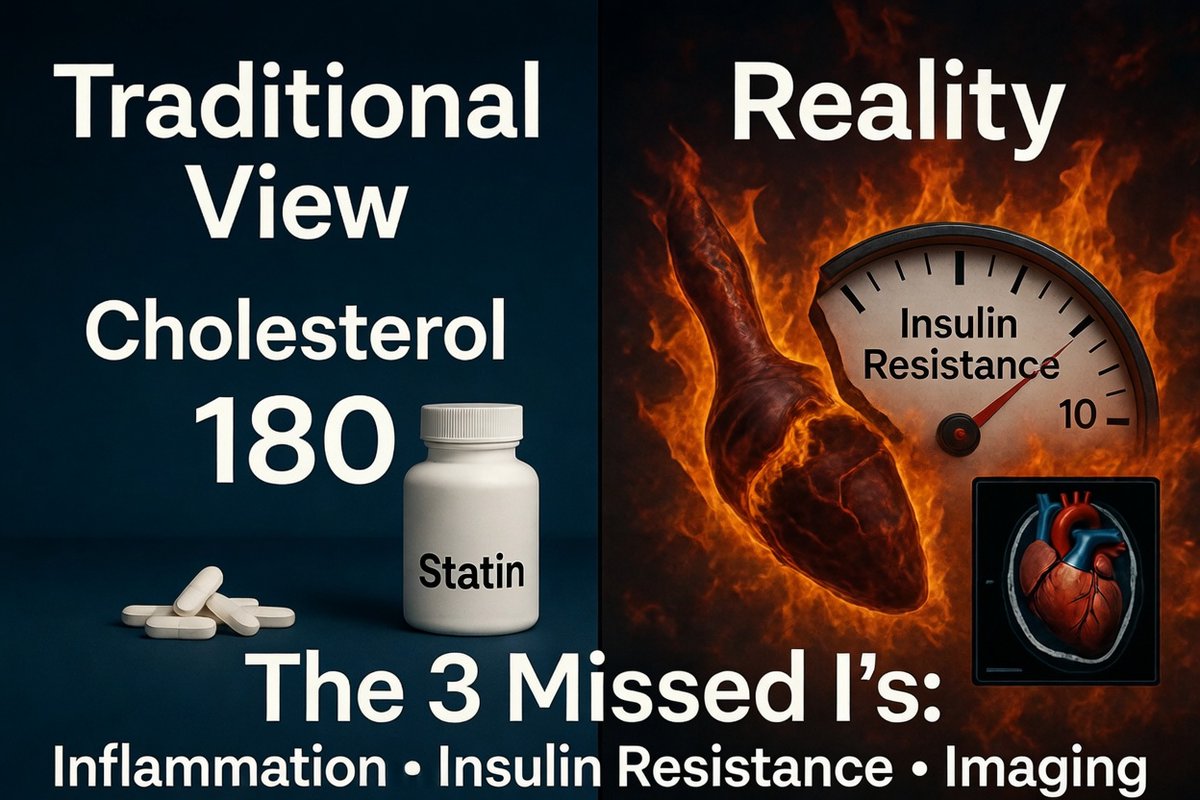
The real drivers of heart disease are what I call The 3 Missed I’s.
🧵 1/8
Calcium is good for your bones. So why does so much of it end up hardening your arteries?
Because calcium needs directing, and the thing that directs it is vitamin K2.
K2 switches on the proteins that pack calcium into bone and keep it out of the artery wall.
Where it lives:
- Egg yolks. The bit you were told to bin.
- Butter from grass-fed cows. The deep yellow is the point.
- Hard cheese. Gouda, Edam.
- The fat on the meat. The bit you were told to trim.
The plant form, K1, you barely convert.
The animal form, K2, your arteries actually use.
The Rotterdam study followed nearly five thousand people. Most K2 in the diet: far less heart disease, far less hardening of the aorta. Most K1: no effect at all.
Notice where the nutrient lives.
Egg yolk. Butter. The fat on the chop.
The exact three things you were told to fear.
1/9 I’m getting pretty tired of cardiovascular disease being presented as if it’s basically 'solved' if we just keep pushing LDL lower and lower - with LDL of
30 mg/dL now being talked about as though it’s some self-evidently sensible target.
/2
Nina Teicholz was a New York journalist on a strict low-fat vegetarian diet that was not really working.
Then a magazine sent her to review fancy restaurants in Manhattan. For the first time in her adult life she ate full-fat meat, butter, and cream. She felt better. Sharper. Steadier. And the weight she had been fighting for years started falling off.
So she did what a good journalist does. She started asking where the war on fat actually came from.
Nine years of research. Hundreds of interviews. Every major diet-heart study reread.
In 2014 she published The Big Fat Surprise. The conclusion was simple. The case against saturated fat had never actually been made. It had been assumed, then defended.
In September 2015 the BMJ ran her investigation of the US Dietary Guidelines Advisory Committee. Cherry-picked studies. Ignored randomized trials. Members with food and pharmaceutical funding. The committee had recommended a diet that no trial had ever shown to be safe or effective long-term.
The counterattack arrived in six weeks.
The Center for Science in the Public Interest organized a letter signed by more than 180 scientists demanding the BMJ retract her paper. The letter claimed eleven factual errors.
The BMJ did not retract.
They commissioned a year of external expert review. They corrected seven smaller technical points. They left her central thesis untouched. In December 2016 they confirmed the paper stands.
Teicholz pointed out something else in her response. Many of the 180 signatories had taken funding from the food and pharmaceutical industries she had criticized.
Since the book, study after study has confirmed her thesis. PURE. FASTER. The reanalyzed Minnesota Coronary Experiment. The official guidelines are quietly walking back their fat warnings without ever admitting why.
One reporter forced a peer-reviewed journal to publicly choose between her data and the establishment that funded the consensus.
When the establishment cannot refute you, they try to silence you.
It did not work.
#NSNG #NinaTeicholz #BigFatSurprise #BMJ #SaturatedFat #DietaryGuidelines #LowFat
I have twelve years of my own blood work. Seven panels. Every result, every flag, in the years before the heart attack that nearly killed me at 52.
My doctor circled one number every single time. LDL cholesterol.
He never said a word about the marker flagged four times on the same pages.
In 1976 a doctor named Broda Barnes called that marker the riddle of heart attacks. Mine was screaming. Nobody was listening.
Let me show you what they saw, what they missed, and what almost killed me.
🧵
I had an enjoyable discussion with Ken Berry this week about LDL cholesterol fears, a topic that is often expressed whenever low carb diet concerns are raised. I covered literature that’s not taught in medical school, such as the great health and longevity of those with familial hypercholesterolemia (FH).
I also critiqued the movie Cholesterol Code, which I think left the viewer with the impression that people with high LDL on a ketogenic diet may be at increased risk for developing CVD. The movie showed an individual with a psychiatric disorder which was reversed with keto diet, but her doctor had her add carbs to her diet to lower her LDL, presumably because high LDL on a keto diet is potentially harmful. Also, much to my sadness, one keto dieter went on a statin because he had such high LDL.
To any provider that would endorse either approach, which I abhor, there are two questions that should be asked which were not addressed in the movie.
1 - Is there any evidence that metabolically healthy people with extremely high LDL develop more coronary events and death compared to metabolically healthy people with low or intermediate LDL?
2 – Is there any evidence that lipid lowering in metabolically healthy people with extremely high LDL reduces coronary events and death?
The answer to both questions is “no”.
If not LDL, then what causes some FH people to die young? I covered some of the research on FH as a hypercoagulation disorder, which explains premature CVD in a subset of FH individuals.
I also addressed why LDL can be associated with CVD.
Last thing is the critical influence on blood vessel health is the glycocalyx, again, a topic that was not mentioned in the movie,
If you're on the fence about your high LDL and your doctor is pressuring you to take a statin, or any other kind of drug to lower LDL, then you should find this podcast of great value.
https://t.co/ZVYrZV1Nmt
@realDaveFeldman@nicknorwitz@DoctorTro@KenDBerryMD@SBakerMD@lowcarbGP@bigfatsurprise@LowCarbHealthMD@LowCarbMelb@lowcarbusa@SBakerMD@grahamsphillips@AdrianSotoMota@DominicDAgosti2@KetoCarnivore@ProfTimNoakes
1/8 Spend time in Lp(a) forums and you’ll see a striking pattern: people willing to do almost anything to drive it down. That response is understandable given how strongly Lp(a) has been framed as a cardiovascular risk factor. /2