You're not "supposed to believe" anything. It's in black and white in the lawsuit. The NY AG action covers and criminalizes event contracts like Kalshi's Fed interest rate swaps. Maybe you should give it a read.
We are supposed to believe it’s a slippery slope heading towards the NY AG criminalizing interest rate swaps because they’re scrutinizing a sports betting arbitrage you invented 18 months ago?
🚨 Kalshi Head of Enforcement @robertjdenault on New York's "far-reaching" lawsuit:
By New York's logic, "any federally regulated exchange that's operating with a federal license and overseen by a federal regulator can suddenly be subject to the whims of state criminal enforcement if the AG of a particular state wakes up and decides one day that these contracts actually come within New York state gambling law. That's not how any exchange in U.S. history has ever operated."
Kalshi Head of Enforcement @robertjdenault: "We don't run a casino where people can come in and drink and play card games. We don't run a sportsbook where we profit when people lose. What we do is run open marketplaces where users define the price point." 🔥
This is the baseline formula both the SEC and CFTC use in all cases. Penalties are typically proportional: 2x amount gained or lost. In this case, Santos made about $17.5k, so the fine is 2x that. It’s the same in securities.
Btw, this doesn’t capture the additional fines he will face directly from Kalshi. We use different formulas that are harsher than the feds use.
"The New York attorney general’s office is suing Kalshi, one of the largest prediction markets, alleging it’s running an illegal gambling operation in the state."
Really? Kalshi is a federally regulated Designated Contract Market. Federal preemption is going to win here, and the NY AG has to know that.
And in New York, of all places....
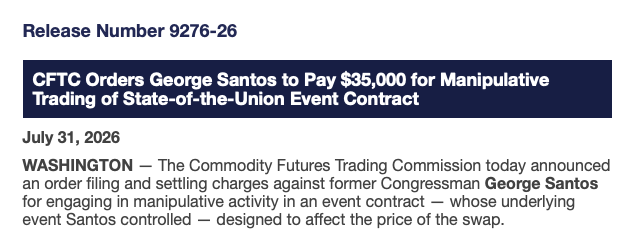
NEW: Former Rep. George Santos will pay $35,000 to settle the CFTC probe into his suspicious Kalshi trades. The agency said Santos made over $17,000 from "unlawful trading" and found that he was "engaging in manipulative activity" in the SOTU attendee market.
@bernardbulletin@weathershan As part of this settlement, Santos agreed to cooperate with exchange inquiries, including ours. We will work to distribute any penalties collected to traders harmed as a result of his trading activity.
In their haste to pass an unprecedented ban of a product they didn't understand, Minnesota's lawmakers would have made felons of media organizations, payment processing companies, and sports leagues. The first version of the law even criminalized weather derivatives, a traditional offering that Minnesotan farmers rely on.
We appreciate the Court's reasoned decision to stop this law, and we encourage Minnesota's legislature to educate itself about the markets that some of America's largest organizations engage with every day.
UPDATE: I spoke to Kalshi and they said they want @netflix to take down this trailer because it's "misleading." They also said they looked into one of the featured trades (at 0:29) and determined that it was placed in 2025, before the court order in Nevada.
Thank you to @CFR_org for having me, and to @MickMulvaney for the excellent discussion about prediction markets. We may disagree on some topics, but we do agree that prediction markets offer value and are governed by federal regulations. Glad we found some common ground!
Executive Director of Gambling is Not Investing & former Acting White House Chief of Staff @MickMulvaney, @Kalshi Head of Enforcement @robertjdenault, & CFR's @edwardfishman discuss risks, opportunities, & regulatory questions posed by prediction markets. https://t.co/102lsitxMH
Kalshi Head of Enforcement @robertjdenault talks about how prediction markets "cut through the noise" and "allow people to understand the world around them."
He details three major use cases:
1. Decision making tool
2. Hedging tool for small businesses
3. Antidote for misinformation
It likely runs afoul of the Commodity Exchange Act, the federal civil rights statute (Sec. 1983), as well as the First Amendment, the Due Process Clause, the Equal Protection Clause and the Supremacy Clause of the U.S. Constitution. It also attempts to define DCM trades as “wagers” or “bets,” despite the UIGEA explicitly carving trades out from those definitions.
The Wisconsin Elections Commission threatening to prosecute Wisconsin voters and strip away their voting rights for engaging in legal trading activity is unconstitutional and illegal. Election markets certified by the CFTC and available on federally regulated exchanges are legal. Wisconsin hasn't challenged them. And if Wisconsin believes election markets certified by the CFTC are improper, then it should sue the CFTC -- not try to prosecute voters and take away their voting rights. The Wisconsin Elections Commission should retract this guidance before courts are required to force them to do so.
New warning from Wisconsin election officials on betting on elections: “We want voters to understand that they cannot legally make a bet on an election and cast a ballot in that same election,” the state’s elections chief says in a new statement
"The law may be illegal, but it's the law." This happens all the time with dead letter law - and the legal system rightfully ignores it. The biggest DCMs (e.g., CME) have certified election contracts; no modern court has ever found trading them to lead to disenfranchisement. It's irresponsible to use this as a scare tactic.