editors of journals are complaining that they cannot find peer-reviewers for their manuscripts. It takes an hour to write a review and then another hour to navigate through their submission portal: creating accounts, filling silly forms, a total waste of time.
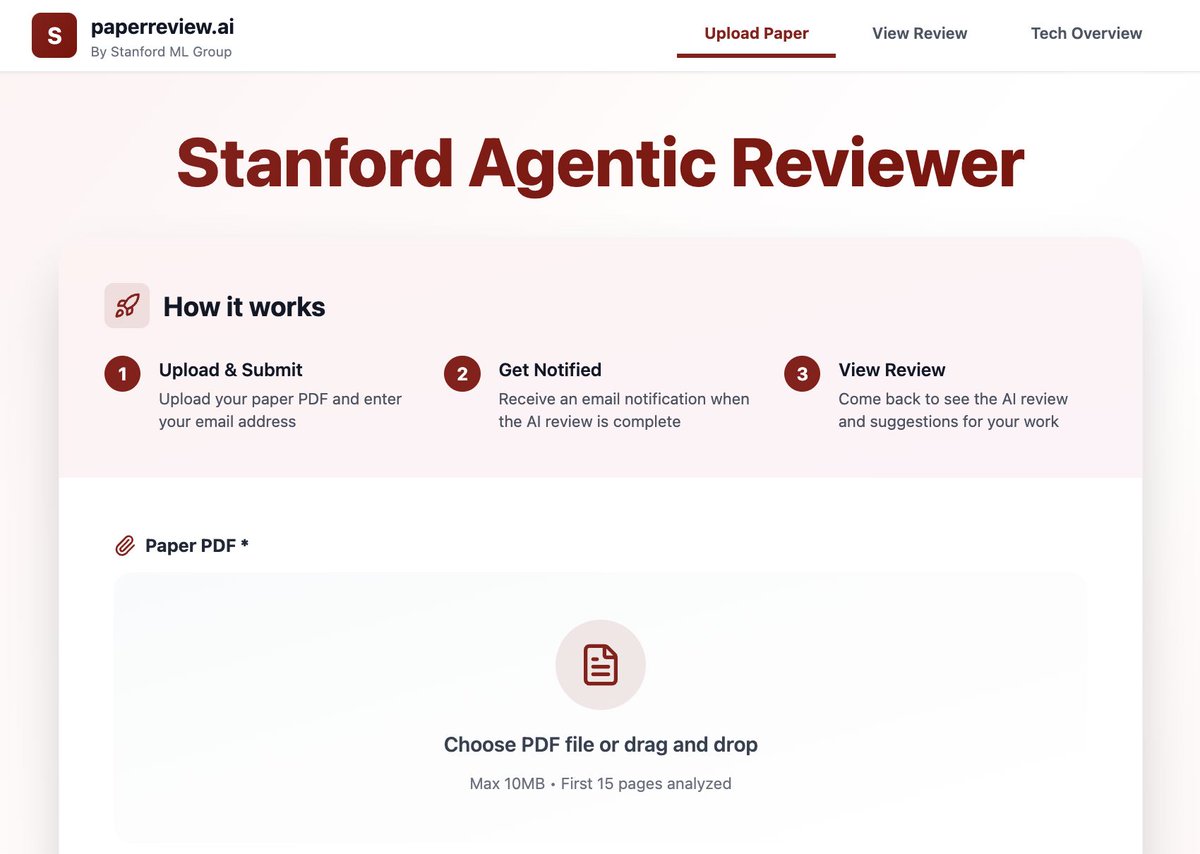
Releasing a new "Agentic Reviewer" for research papers. I started coding this as a weekend project, and @jyx_su made it much better.
I was inspired by a student who had a paper rejected 6 times over 3 years. Their feedback loop -- waiting ~6 months for feedback each time -- was painfully slow. We wanted to see if an agentic workflow can help researchers iterate faster.
When we trained the system on ICLR 2025 reviews and measured Spearman correlation (higher is better) on the test set:
- Correlation between two human reviewers: 0.41
- Correlation between AI and a human reviewer: 0.42
This suggests agentic reviewing is approaching human-level performance.
The agent grounds its feedback by searching arXiv, so it works best in fields like AI where research is freely published there. It’s an experimental tool, but I hope it helps you with your research.
Check it out here: https://t.co/n7ctnDilJJ
https://t.co/ceJ83r2ky5
If you are using vscode and stata, you should try out my extension. It uses interactive window which let's you write in a `.do` file but get a notebook type experience.
News from NIH and CDC are devastating. Cuts, layoffs, are the keywords these couple months. Politics aside, do we do enough work translating our research to the lay audience? May be we need more of Tik-Tok'able science?
I need people to understand how difficult it is to get an NIH grant. You spend months writing a proposal, following strict guidelines that include a detailed multiyear budget, bios of everyone on your team, plans for participant safety & ethical conduct. Then you send it off -1/n
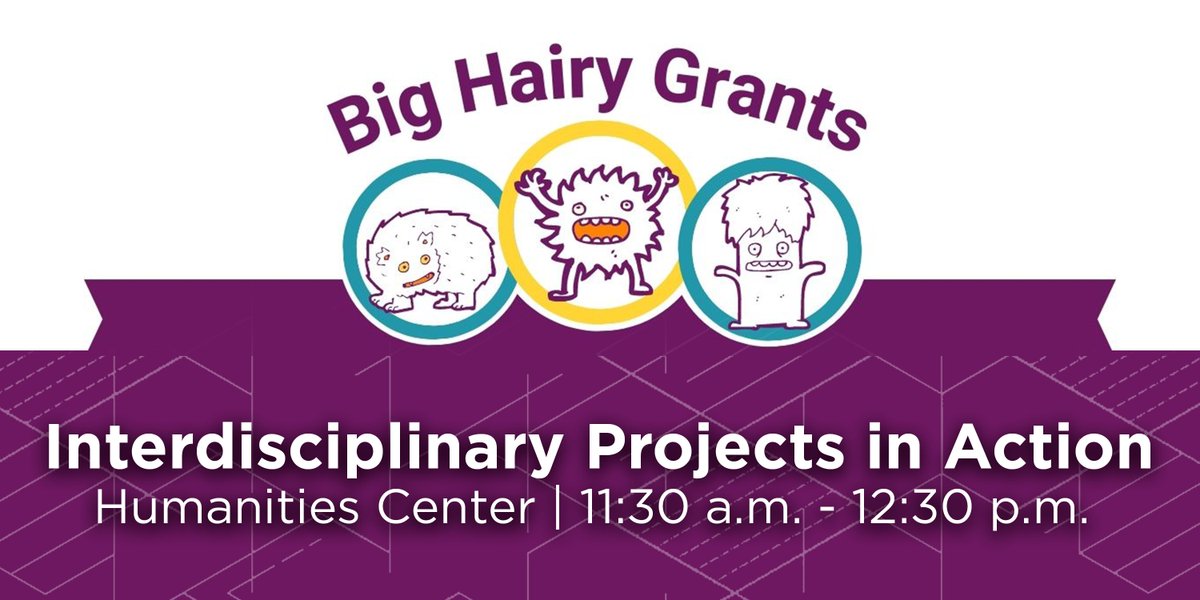
Reminder: Join us for a Big Hairy Grants Workshop: Interdisciplinary Projects in Action tomorrow, February 23. This workshop will be held at the Humanities Center from 11:30 a.m. to 12:30 p.m.
Register here: https://t.co/bjmVPVkQg6
New data from the Census shows that the 18-year-old population will shrink to around 3.8 million by 2039. It could mean a second enrollment cliff.
Experts project it could endanger tenure, and increase the need for colleges to become more affordable: https://t.co/h37PgjNmx1
# on shortification of "learning"
There are a lot of videos on YouTube/TikTok etc. that give the appearance of education, but if you look closely they are really just entertainment. This is very convenient for everyone involved : the people watching enjoy thinking they are learning (but actually they are just having fun). The people creating this content also enjoy it because fun has a much larger audience, fame and revenue. But as far as learning goes, this is a trap. This content is an epsilon away from watching the Bachelorette. It's like snacking on those "Garden Veggie Straws", which feel like you're eating healthy vegetables until you look at the ingredients.
Learning is not supposed to be fun. It doesn't have to be actively not fun either, but the primary feeling should be that of effort. It should look a lot less like that "10 minute full body" workout from your local digital media creator and a lot more like a serious session at the gym. You want the mental equivalent of sweating. It's not that the quickie doesn't do anything, it's just that it is wildly suboptimal if you actually care to learn.
I find it helpful to explicitly declare your intent up front as a sharp, binary variable in your mind. If you are consuming content: are you trying to be entertained or are you trying to learn? And if you are creating content: are you trying to entertain or are you trying to teach? You'll go down a different path in each case. Attempts to seek the stuff in between actually clamp to zero.
So for those who actually want to learn. Unless you are trying to learn something narrow and specific, close those tabs with quick blog posts. Close those tabs of "Learn XYZ in 10 minutes". Consider the opportunity cost of snacking and seek the meal - the textbooks, docs, papers, manuals, longform. Allocate a 4 hour window. Don't just read, take notes, re-read, re-phrase, process, manipulate, learn.
And for those actually trying to educate, please consider writing/recording longform, designed for someone to get "sweaty", especially in today's era of quantity over quality. Give someone a real workout. This is what I aspire to in my own educational work too. My audience will decrease. The ones that remain might not even like it. But at least we'll learn something.
Children on Medicaid saw subspecialists less often than those with private insurance
This may be b/c “differences in demand, health need, or access to care” depending on insurance.
💡Research like this uncovers current disparities to guide future action
https://t.co/hCPloubNwT
Our study of access to pediatric hospice care in Appalachian region has been published in the American Journal of Hospice and Palliative Medicine. @utknursing https://t.co/FOYsJL15A0
A new RAND analysis looked at more than 1.3 million inpatient hospital stays from March 2020 through March 2022 and analyzed the costs of providing care to patients infected with COVID-19. https://t.co/mCsJxgR9Ki
An interview of me in Wired with the unequaled Steven Levy.
"How Not to Be Stupid About AI, With Yann LeCun"
It’ll take over the world. It won’t subjugate humans. For Meta’s chief AI scientist, both things are true.
Excerpts:
- Steven Levy: In a recent talk, you said, “Machine learning sucks.” Why would an AI pioneer like you say that?
Yann LeCun: Machine learning is great. But the idea that somehow we're going to just scale up the techniques that we have and get to human-level AI? No. We're missing something big to get machines to learn efficiently, like humans and animals do. We don't know what it is yet.
- SL: Why did Meta decide that Llama code would be shared with others, open source style?
YLC: When you have an open platform that a lot of people can contribute to, progress becomes faster. The systems you end up with are more secure and perform better. Imagine a future in which all of our interactions with the digital world are mediated by an AI system. You do not want that AI system to be controlled by a small number of companies on the West Coast of the US. Maybe the Americans won't care, maybe the American government won't care. But I tell you right now, in Europe, they won't like it. They say, “OK, well, this speaks English correctly. But what about French? What about German? What about Hungarian? Or Dutch or whatever? What did you train it on? How does that reflect our culture?”
- SL: Couldn’t someone take a sophisticated open source system that a big company releases, and use it to take over the world? [...]
YLC: [...] It's the history of the world: Whenever technology progresses, you can't stop the bad guys from having access to it. Then it’s my good AI against your bad AI. The way to stay ahead is to progress faster. The way to progress faster is to open the research, so the larger community contributes to it.
- SL: But if computers get superintelligent, why would they need us?
YLC: There is no reason to believe that just because AI systems are intelligent they will want to dominate us. People are mistaken when they imagine that AI systems will have the same motivations as humans. They just won’t. We'll design them not to.
https://t.co/DQVcVK1vlp
New video🎄Exploring major features of the new v0.16 release of BERTopic!
In this early Christmas🎅video, we'll explore zero-shot topic modeling, merging pre-trained models, and more support for Large Language Models (LLM).
https://t.co/EDkHLmChq3
AI/ML cannot & does not discover anything, ever. Humans discover stuff. This is a very simple & defendable standpoint practically, logically, & philosophically speaking. AI/ML are tools…
I'm seeing the phrase "OLS model" crop up again, sometimes in high places. Remember, OLS is an estimator, not a model.
Consider two models for estimating a treatment effect, with x the controls, w the treatment indicator.
# On the "hallucination problem"
I always struggle a bit with I'm asked about the "hallucination problem" in LLMs. Because, in some sense, hallucination is all LLMs do. They are dream machines.
We direct their dreams with prompts. The prompts start the dream, and based on the LLM's hazy recollection of its training documents, most of the time the result goes someplace useful.
It's only when the dreams go into deemed factually incorrect territory that we label it a "hallucination". It looks like a bug, but it's just the LLM doing what it always does.
At the other end of the extreme consider a search engine. It takes the prompt and just returns one of the most similar "training documents" it has in its database, verbatim. You could say that this search engine has a "creativity problem" - it will never respond with something new. An LLM is 100% dreaming and has the hallucination problem. A search engine is 0% dreaming and has the creativity problem.
All that said, I realize that what people *actually* mean is they don't want an LLM Assistant (a product like ChatGPT etc.) to hallucinate. An LLM Assistant is a lot more complex system than just the LLM itself, even if one is at the heart of it. There are many ways to mitigate hallcuinations in these systems - using Retrieval Augmented Generation (RAG) to more strongly anchor the dreams in real data through in-context learning is maybe the most common one. Disagreements between multiple samples, reflection, verification chains. Decoding uncertainty from activations. Tool use. All an active and very interesting areas of research.
TLDR I know I'm being super pedantic but the LLM has no "hallucination problem". Hallucination is not a bug, it is LLM's greatest feature. The LLM Assistant has a hallucination problem, and we should fix it.
</rant> Okay I feel much better now :)
@stelifanie when you have a data on kids dying in hospice and receiving two different kinds of treatment, IV model is a blessing. My colleagues and I wrote a paper about it https://t.co/mm972Qdyt6
GPT-4 for radiology. Far from perfect, but state-of-the-art performance on some tasks: “Surprisingly, we found radiology report summaries generated by GPT-4 to be comparable and, in some cases, even preferred over those written by experienced radiologists”
https://t.co/bi6RwqgeHw