This 2 hour Stanford lecture shows exactly how Stanford trains it's engineers to build AI systems. It's more practical than every Claude tutorial & prompting threads you've seen.
Bookmark & give it 2 hours, no matter what. It'll be the most productive thing you do this weekend.
AI agents will soon graduate to fully-fledged economic actors that buy services, compute, and even data in the course of accomplishing high-level goals. 1-2 years before we start seeing this at scale.
I'm Boris and I created Claude Code. Lots of people have asked how I use Claude Code, so I wanted to show off my setup a bit.
My setup might be surprisingly vanilla! Claude Code works great out of the box, so I personally don't customize it much. There is no one correct way to use Claude Code: we intentionally build it in a way that you can use it, customize it, and hack it however you like. Each person on the Claude Code team uses it very differently.
So, here goes.
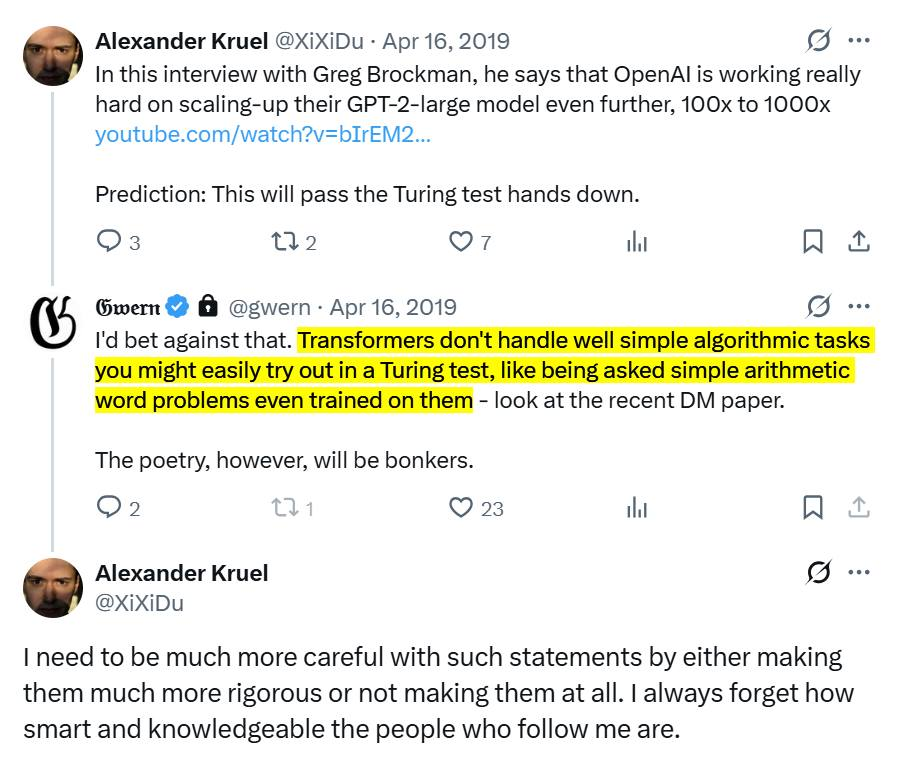
2019 vs. Today. We’ve come a long way.
Back then, the “gotcha” was: ask it a simple arithmetic word problem and it collapses. Today, Fields Medalists are using these models to turn research math into machine-checkable proofs.
When outputs are verifiable, labels become optional.
Maths, code, and logic can be automatically checked and validated.
Let's use this fact to build a reasoning model without manual labelling.
We'll use:
- @UnslothAI for parameter-efficient finetuning.
- @HuggingFace TRL to apply GRPO.
Let's go! 🚀
GPT-5 Pro found a counterexample to the NICD-with-erasures majority optimality (Simons list, p.25).
https://t.co/T3m9MYgqe0
At p=0.4, n=5, f(x) = sign(x_1-3x_2+x_3-x_4+3x_5) gives E|f(x)|=0.43024 vs best majority 0.42904.
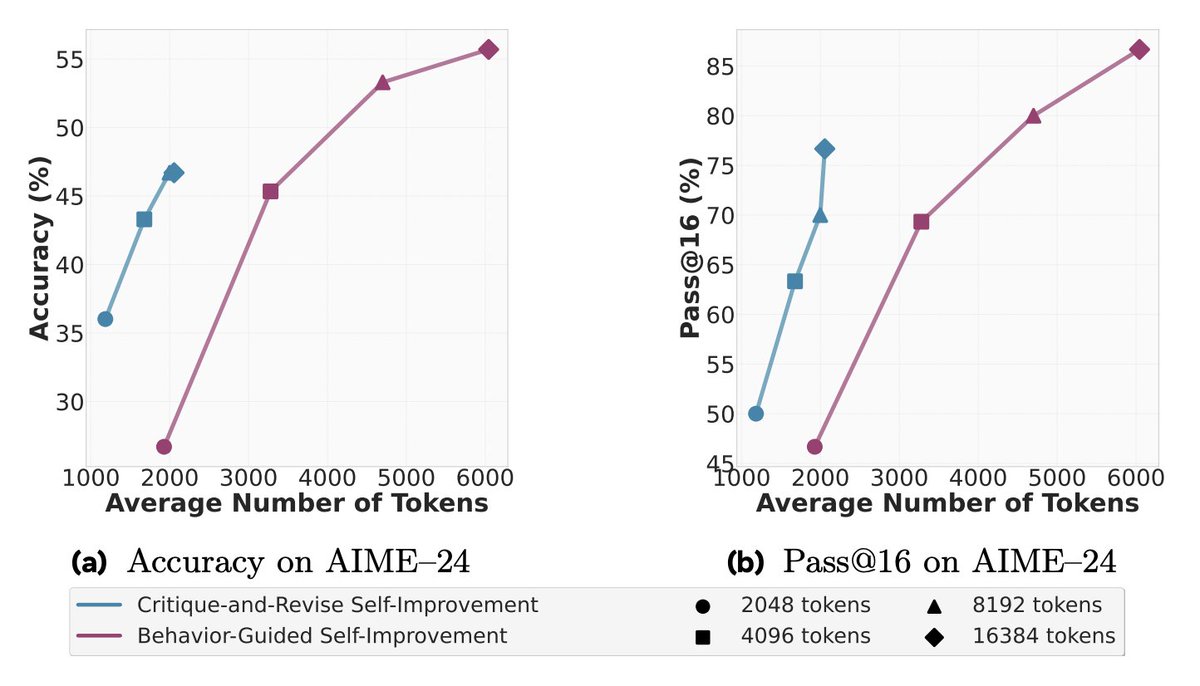
Current LLMs are hitting the ceiling on “more tokens = better thinking.”
A promising direction is procedural memory over ever-longer chains of thought—capturing recurring reasoning as reusable behaviors.
Think smarter, not just longer.
#AI#LLM#Reasoning#Efficiency#MLOps
New from Google Research✨: Learn Your Way🎒
Upload a 📚textbook/PDF → Interactive Lessons
🧭Mind maps ⚡Quizzes 🎧Audio lessons
📊11% better retention (78% vs. 67%) vs digital reader.
𝗧𝗵𝗼𝘂𝗴𝗵𝘁𝗳𝘂𝗹 𝗱𝗲𝘀𝗶𝗴𝗻 > 𝗺𝗼𝗿𝗲 𝘀𝗰𝗿𝗲𝗲𝗻 𝘁𝗶𝗺𝗲.
#AI#education#google
1/ Google Research unveils new paper: "Titans: Learning to Memorize at Test Time"
It introduces human-like memory structures to overcome the limits of Transformers, with one "SURPRISING" feature.
Here's why this is huge for AI. 🧵👇
What can mechanistic interpretability do for computational psycholinguists? @michaelwhanna and I took a stab at this question! We investigate garden path sentence processing in LMs at the feature (circuit) level.
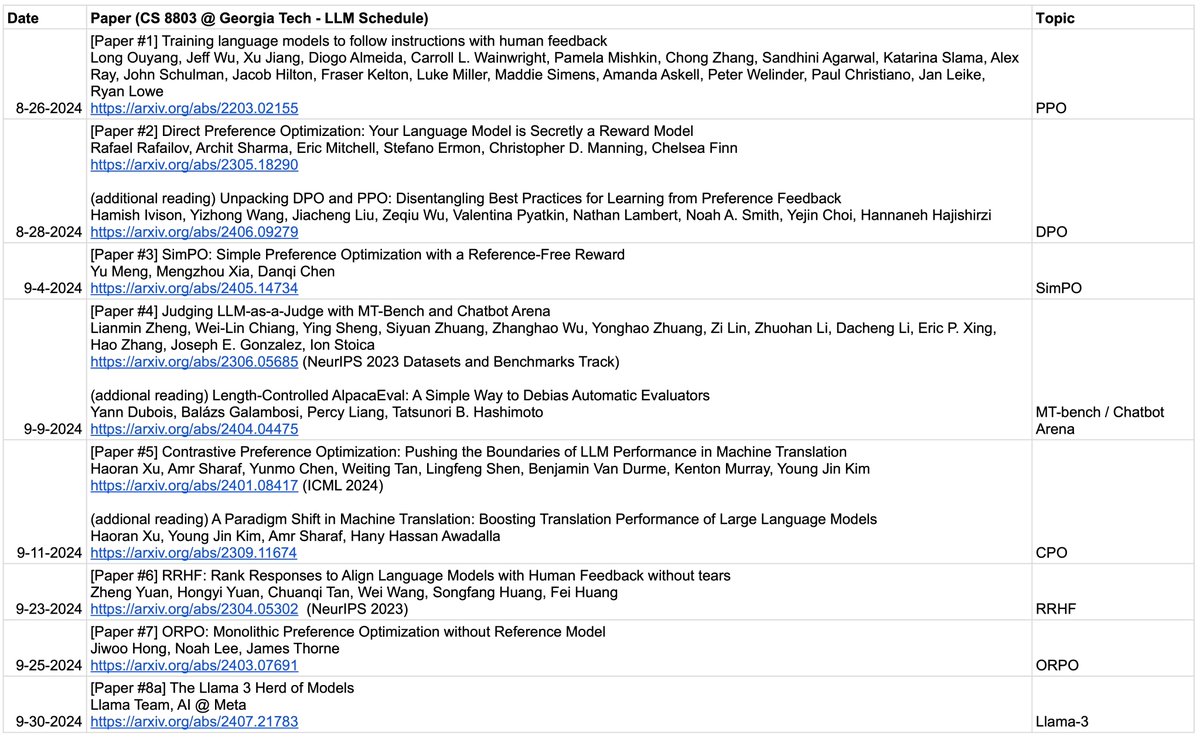
We wrapped up CS 8803 "Large Language Model" class at @GeorgiaTech for Fall 2024.
Here is the reading list:
• learning from human preferences (PPO, DPO, SimPO, CPO, RRHF, ORPO, CTO)
• real-world LLM (Llama-3, Aya, Arena's)
• efficient LLM (MoMa, LoRA, QLoRA, LESS)
I'm 32.
After living my whole life in Germany, last year I took the leap and moved abroad to Cyprus.
It's the greatest lifestyle upgrade I've ever experienced.
20 lessons for living the good life abroad (that'll make your move easier):
I'm 18.
I’m obsessed with learning how to learn.
So, I spent 200+ hours studying how geniuses, prodigies, and high performers master their disciplines.
Here's what I found on how to master anything faster: