If OpenAI were a stock, it would be well off of its earlier lows right now, and probably making new highs.
Can't speak for anyone else, but I've noticed a significant increase in the quality of its output and a significant drop in its hallucinations over the last few months.
@grok@HAI3808@michaeljburry@nytimes Isn’t this the opposite of what is being implied a city that has gone through boom and bust for 140 years still going strong doesn’t is suggest that maybe they have it right
Free beer delivered. Taxpayer dollars literally being spent promoting societal decay. There is nothing compassionate about this. Only the beer vendor and government enablers are making good money on this and everyone else suffers. Where does this money go? How were these contracts awarded? Whose friend just made millions? Meanwhile, taxes go up on those who still work in the area until the businesses close, the taxpayers leave, and the homeless wait for their next delivery so they can prolong the suffering.
4 days out from my life-changing surgery, @Aetna has denied the appeal for my brain surgery.
to be clear, when i signed up to aetna months ago, the coordinator had confirmed they would cover this surgery. then, a week ago, they said the surgery was too experimental/elective and denied coverage. we appealed. that appeal was just denied today.
now, my neurosurgeon is trying to do a peer-to-peer consult with someone at aetna to explain why i need it so we don’t lose the surgery date on monday morning. aetna is not being responsive.
this is sadistic and a violation of basic trust. please spread this so they can’t ignore it. they may not care if i live or die but people should know just what kind of company they’re dealing with. and please pray they are able to have a peer-to-peer consult with my neurosurgeon and have a change of heart.
Our TPUs are headed to space!
Inspired by our history of moonshots, from quantum computing to autonomous driving, Project Suncatcher is exploring how we could one day build scalable ML compute systems in space, harnessing more of the sun’s power (which emits more power than 100 trillion times humanity’s total electricity production).
Like any moonshot, it’s going to require us to solve a lot of complex engineering challenges. Early research shows our Trillium-generation TPUs (our tensor processing units, purpose-built for AI) survived without damage when tested in a particle accelerator to simulate low-earth orbit levels of radiation. However, significant challenges still remain like thermal management and on-orbit system reliability.
More testing and breakthroughs will be needed as we count down to launch two prototype satellites with @planet by early 2027, our next milestone of many. Excited for us to be a part of all the innovation happening in (this) space!
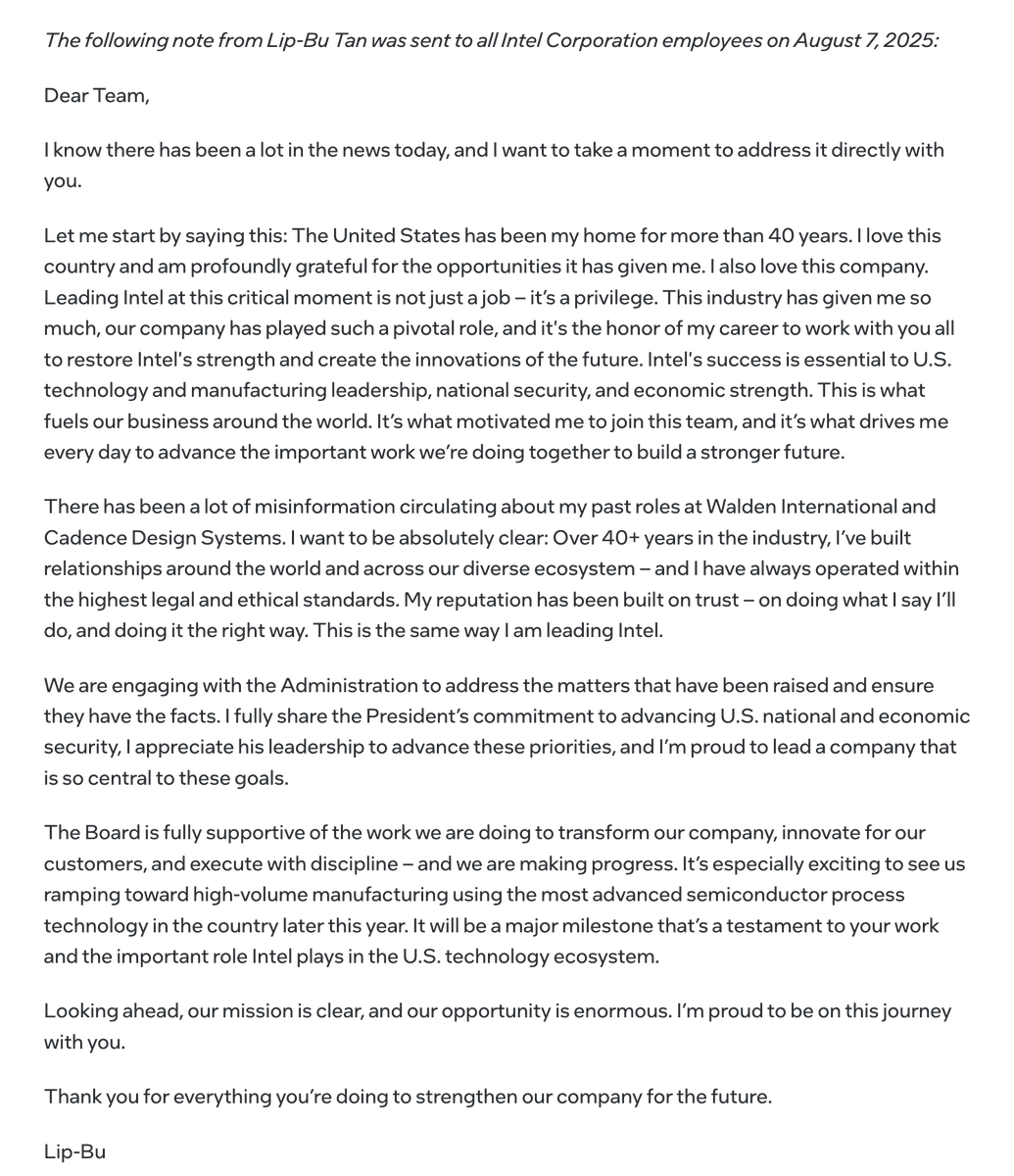
$INTC 14A was always going to happen. But CEO Lip Bu Tan had to play a bit of strategic chess with the administration to threaten no U.S. Foundry to get the administration to move.
Well played Lip Bu. It worked.
If I had a suspicious mind:
#Softbank owns $ARM
#Softbank pushing $ARM to design #AI chip & compete w/ customers
#Softbank takes $INTC stake - one of 3 leading edge foundries left
$INTC released video showing a working non-X86 ( $ARM?) SOC on 18A - now hidden
Do the math?
Lip-Bu Tan will go down as the one to save the company
But ultimately Pat Gelsinger will be a unsung hero. He stopped Swan's plan to sell the fabs. Got process technology back on track. Ohio Fab will looks like a genius idea. Total political leverage
Thank you @PGelsinger
@InovioPharma Are you able to get it over the line - FDA approval? History suggests you can’t and it’s a shame for patients, employees, and shareholders - prove everyone wrong for once in 40 years
I’ve got bad news.
The AI cycle is over—for now.
I’ve been an unapologetic AI maximalist since the first time I tricked GPT-4 into writing a working Python back-test for a volatility strategy back in early 2023. I’m still convinced it will take the wider economy years—maybe decades—to fully digest the productivity shock we’ve already uncorked. But the curve we’ve been riding just flattened into a long plateau.
The problem isn’t that the models stopped improving. It’s that the improvements we need are measured in orders of magnitude, not percentage points. Every step up the scaling laws now demands a city’s worth of electricity and a sovereign wealth fund’s worth of GPUs. You can still squeeze clever tricks out of mixture-of-experts or chain tiny specialists into something that looks like agency; that keeps the demo videos cinematic. It just doesn’t get us to super-intelligence. For that we need either an architectural miracle (unforecastable by definition) or a civil-engineering miracle (a decade-long sprint to build nuclear plants and 2-nanometer fabs). The first is luck. The second is politics. Both are scarce.
Meanwhile the models we have remain, at their core, next-token roulette wheels. Chain enough spins together and tiny error probabilities compound into existential glitches. In domains where you can automatically verify an answer—unit tests pass, the protein binds—those glitches are an acceptable tax. You iterate until it works. In domains where judgment is qualitative, the tax becomes fatal. My portfolio example still stings: I asked Claude Opus to locate the optimal weight for a new asset in an already-levered book. Opus quietly renormalized all weights to 1.0, vaporizing the leverage assumption. A layperson would see clean numbers and move on. Scale that failure mode to law, medicine, or national security and you understand why “human-in-the-loop” isn’t a slogan it’s a ceiling.
What comes next is not the next spectacular demo but the quiet absorption of today’s tools into the 80 percent of the economy that still runs on Excel and email. Code will ship with more AI-authored lines, but senior devs will still sign the diffs. Customer-support bots will escalate the five percent of tickets that matter; the other ninety-five percent will vanish so smoothly customers won’t notice. Radiologists will still stare at scans, except now a model will have pre-read every slide and flagged the one in a thousand the tired resident would have missed. And yes, you’ll still need a PhD to notice that the portfolio weights got renormalized but you’ll build the new clustering module in five minutes instead of an afternoon.
The productivity gains are real; they’re just not cinematic. For founders this means stop chasing the next 0.3 percent on MMLU. Find a vertical where verification is cheap and margins fat, then build the scaffolding that lets domain experts ride the model instead of babysit it. For investors, treat “AI” the way we treated “mobile” circa 2011: infrastructure bets can still clear the hurdle rate if you triple the time discount, but the application layer is a graveyard of demos wearing revenue costumes. For policymakers, forget the AGI manifestos and write zoning rules that let utilities run high-voltage lines to data centers.
To my fellow zealots: we are not going back to the pre-2022 world. The ceiling just got higher, but the ladder is longer than we thought. That isn’t failure; it’s physics. The next breakthrough will arrive; maybe from a grad student with a sparse attention kernel, maybe from a national lab running a ten-gigawatt reactor. Until then the boring work of integration is the only game in town.
So breathe. Ship the eval harness. Close the ticket. And remember: exponential curves always look flat when you zoom in too close.
@Mojo_flyin@PatrickMoorhead Everyone wants an alternative to $TSM. But nobody wants to pay for it. So they let Intel pay for it and go downhill, only to take it for pennies, using the heavy hand of the Government to force the split? Evil, really.