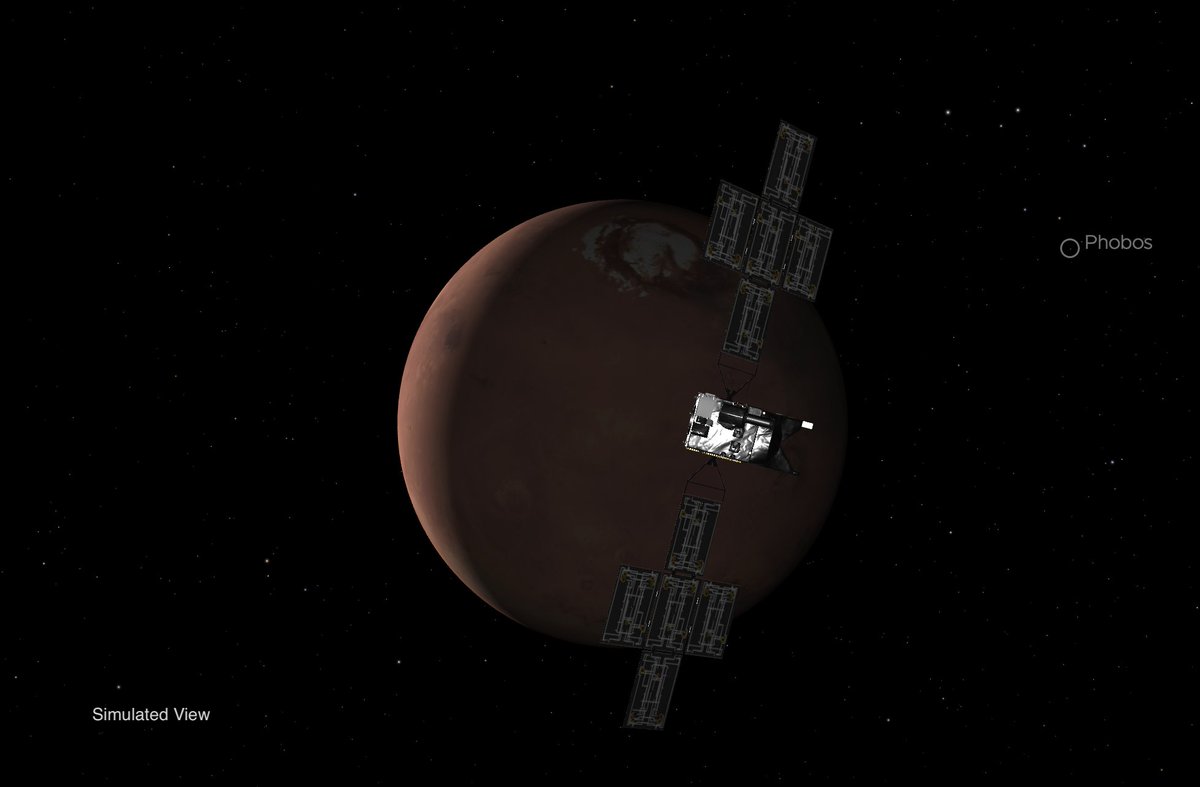
@NASAJPL Thanks for the boost, @NASAMars!
Next stop: the asteroid Psyche. There's still a long way to go – the #MissionToPsyche spacecraft will enter orbit there in 2029. Exactly what we will find remains to be seen...
Follow along at https://t.co/72ZvMmH72t and watch this space
This "gravity assist" flyby will use the Red Planet's pull to boost the spacecraft's speed and refine its trajectory on its way to explore the mysterious, metal-rich asteroid Psyche.
Details: https://t.co/v4t8DRi6XW
Current distance from Mars: 14,450 miles
Speed: 10,710 mph
Right now, NASA's #MissionToPsyche is approaching Mars.
Current distance: 29,780 miles
Current speed relative to Mars: 10,340 mph
This simulated view, based on actual trajectory data, comes from our Eyes on the Solar System experience.
Ride along: https://t.co/9xfOG4mRl4
Tag a friend!😆
Do you know an undergrad with a passion for both space and art?🎨🚀 #PsycheInspired may be the perfect opportunity for them! Don't let them miss out on this creative internship for all majors. Application link in bio!
One week ago: we set sail for Jupiter's ocean moon Europa. The spacecraft is now about 2.41 million miles (3.88 million kilometers) from Earth. Next up are a series of checkouts and instrument deployments, then a flyby of Mars. All about the mission: https://t.co/KX1yfEbiNu
One week ago, we said farewell to @EuropaClipper as it began its voyage to Jupiter's ocean moon.
Status update: It's already 2.4 million miles away from Earth! 🤯
It's always a good idea to listen to Coach Beard. Teamwork. Belief. Curiosity. Kindness. They can take us a long way. All the way to the moons of Jupiter!
One of the Giant Magellan Telescope's completed mirrors has successfully been installed into a support system prototype for the first time. The milestone marks the start of a six-month optical testing phase to validate performance. https://t.co/Z83IDUQqjj
We hear you, @EuropaClipper!
The Deep Space Network in Canberra, Australia, has acquired signal. This is the first indicator that we’re communicating with the spacecraft. Next up: Full telemetry!
⚡ Power move: @EuropaClipper's solar arrays flanking the body of the spacecraft have fully unfolded. This means that the spacecraft now has a reliable source of power for the rest of its journey to Jupiter and tour of the Jovian system! https://t.co/sEr1jgkbTt
Live: Could Jupiter's ocean moon Europa have conditions favorable for supporting life? Hear directly from scientists working to answer that question with our @EuropaClipper mission, set to launch Oct. 14. https://t.co/W6l4Efj1df
Oct. 13, 2023: #MissionToPsyche launched aboard a SpaceX Falcon Heavy rocket and began its journey to a metal-rich asteroid.🤘
The spacecraft, which will arrive at its target asteroid in 2029, is already more than 326 million miles from Earth!
Picture this: what might exist below Europa's surface? If you know creative kids, encourage them to submit to our new art challenge. Entries submitted by Sept. 30 may be featured online or during the launch broadcast in October! Get the full picture: https://t.co/aLytfiap1u
Manufacturing and assembly of the largest telescope mount built in the US has begun. The 39-meter-tall structure will be built over the next 6 years before being shipped to the Giant Magellan Telescope site in Chile for reassembly. https://t.co/tDDfPw8AyC
This year's 20 challenges are here + team formation is open. 💻👩🚀👨🚀✨
Explore challenge summaries for all skill levels, crafted by @NASA SMEs on heliophysics, exoplanets, climate, & more for your #SpaceApps team: https://t.co/JUA8BY6ogX
Full challenge statements Sept. 12!
Europa just keeps getting more intriguing...
Learn about the ingredients for life that may exist at this moon of Jupiter, and how our mission will investigate them: https://t.co/6i1zUygsMk