Been lurking here for a while so here goes:
I’m Ryan Murray an SMB Operator.
I acquired AAA Blind & Shutter Factory in Little River, SC through an SBA-backed ETA deal.
We manufacture and install custom plantation shutters + shades for residential + CRE customers in coastal SC & NC.
I talk about:
- SMB marketing & sales Ops
- Manufacturing optimization
- Using AI in an SMB
- Light-industrial Real Estate
Fellow operators, ETA searchers, & CRE folks, give me a follow!
@RandBusiness@bot I’m a heavy Claude user and have been testing duet since it came out. Claude is way smarter but grokbot is just a superior UI. I know it supposedly will use Opus on the background but if grokbot let you use any model, that would be game changing.
One big customer isn’t always worth the same as three smaller customers, even if they generate the same revenue. We’re changing our pricing strategy and sales motion in our shutter business to account for that.
You should consider this too if you run a home service business or agency 👇
Put simply, we’d rather sell 15 shutters to one homeowner than 5 shutters each to three separate homeowners.
This probably applies to your business too. Think about:
-One in-home sales consultation instead of three.
-One installation trip instead of three.
-One production setup instead of three.
-Less administrative work coordinating orders, scheduling, and communicating with customers.
Same number of shutters sold, but potentially VERY different economics.
We’ve been digging into our sales data recently and found that we close roughly 70% of our shutter jobs with 1–9 window openings. Once we get to 10+ openings, our close rate drops pretty significantly to around 40%.
This why looking at more than just overall close rate is important. You need to look at it by product and by other segments like cohort or unit size. If we had just rested on overall close rate, we would think everything is fine with our shutter sales process (but IT’S NOT!)
Those larger, whole-home jobs are exactly the ones we want MORE of. Not just because they’re bigger tickets, but because they’re more efficient for us to produce and install. So we need to take action to target that cohort specifically.
As a result, we’ve been rethinking how we price and sell these larger jobs. The obvious solution would be to start offering bigger discounts to win more business. Except that’s an expensive lever to pull if you don’t have to.
Since we manufacture our own shutters, we have a few premium upgrades we can offer customers, like hidden tilt rods and larger 4.5” louvers (basically a nicer, more modern-looking shutter).
On a whole-home job, offering both upgrades for free can represent roughly 10% in additional retail value to the customer. But the incremental cost to us is a FRACTION of what giving them a straight 10% discount would cost.
Therefore, we’ve decided to roll out a new sales approach. Full price is always the starting point. If a customer is shopping multiple quotes or we’re having trouble closing, our reps can offer free premium upgrades before discounting the price.
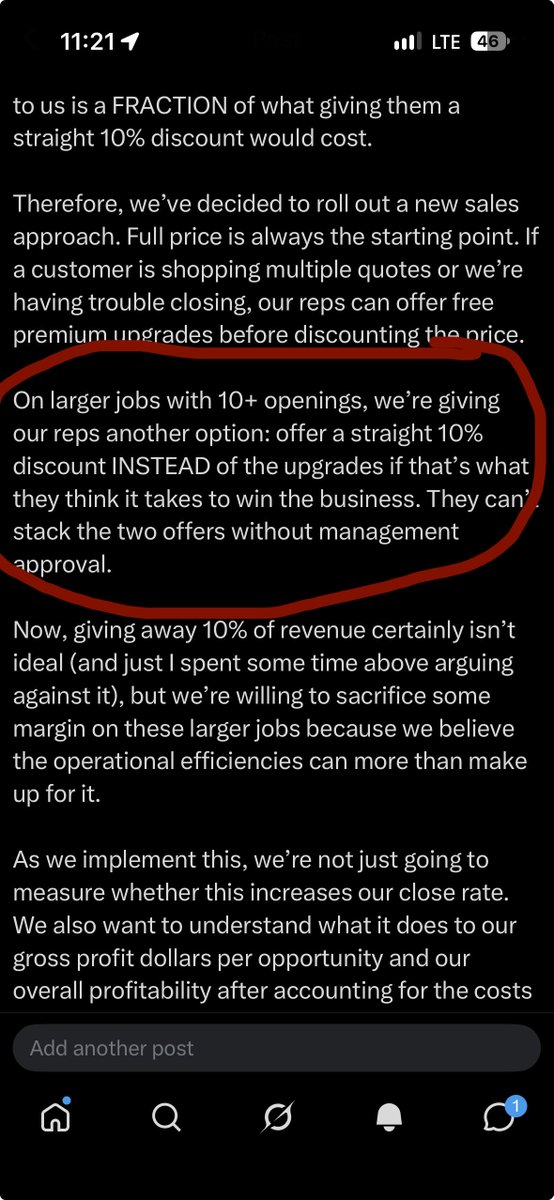
On larger jobs with 10+ openings, we’re giving our reps another option: offer a straight 10% discount INSTEAD of the upgrades if that’s what they think it takes to win the business. They can’t stack the two offers without management approval.
Now, giving away 10% of revenue certainly isn’t ideal (and just I spent some time above arguing against it), but we’re willing to sacrifice some margin on these larger jobs because we believe the operational efficiencies can more than make up for it.
As we implement this, we’re not just going to measure whether this increases our close rate. We also want to understand what it does to our gross profit dollars per opportunity and our overall profitability after accounting for the costs of selling, manufacturing, and installing these jobs.
Because if we increase our close rate and revenue but end up making the same amount of money for a bunch more work, what did we accomplish? We actually just made the business busier, not more profitable.
I suspect this applies to a LOT of businesses outside our industry. Not all customers, orders, or revenue dollars are equally profitable. Some jobs are simply much cheaper to service than others, and that should probably influence how aggressively you’re willing to price them.
We’re going to test this over the coming months and see what the numbers tell us.
I’d much rather discount strategically to win the RIGHT types of jobs than offer blanket promotions that give away margin on every job. Sizing and job type is key and you need good data to see this!
@thebaldogarza We don’t have any customer concentration so it’s not about that. It’s more about winning the bigger jobs since we do 1,700+ installs per year. The bigger jobs are more efficient and profitable.