U r what ur deep, driving desire is. As ur desire is, so is ur will. As ur will is, so is ur deed. As ur deed is, so is ur destiny.– Brihadaranyaka Upanishad
একদিকে মুক্তিযুদ্ধের চেতনা, গণতন্ত্র, অসাম্প্রদায়িকতা, আইনের শাসন, মানুষের ভোটাধিকার ও উন্নয়নের পথ। অন্যদিকে প্রতিহিংসা, মবসন্ত্রাস, মৌলবাদ, মুক্তিযুদ্ধের ইতিহাস বিকৃতি, রাজনৈতিক নিষেধাজ্ঞা ও অন্ধকারের পথ। বাংলাদেশের মানুষ কখনও অন্ধকারের পথ বেছে নেয়নি, এবারও নেবে না। - হাসিনা
US Deep State pawns: How do they look?
#Bangladesh:
1. They emerged as protesters seeking end of discrimination in government jobs
2. They called themselves 'Razakar' due to a remark of Prime Minister Sheikh Hasina
3. One key leader of the movement was wearing the jersey of Bangladesh cricket team
4. They received massive support from the Western media
5. They received funds through cryptocurrency
6. At one stage snipers (comprising some former military men as well as shooters from #Pakistan) entered the show and dramatically intensified the situation
7. Members of Jamaat-e-Islami, Bangladesh Nationalist Party, Islamist forces and madrassa students participated in the movement by concealing their identity
8. Protesters were provided 'Yaba' that turned them violent, desperate and crazy
9. TV talks shows and YouTube channels extended indirect and direct support to the protesters
10. #american and Western diplomats frequently met the anti-government protest groups
11. Minors were killed by snipers to generate huge public anger by branding such acts to be perpetrated by law enforcement agencies.
Do the cockroach gangs in #India and Pakistan look similar? Please remember, these aren't funny acts or demands for jobs. It clearly is regime change plots. Unless intelligence and law enforcement agencies don't handle these foreign mercenaries with an iron hand, it can destabilize the country at any time. Before they turn into monsters - just crush them!
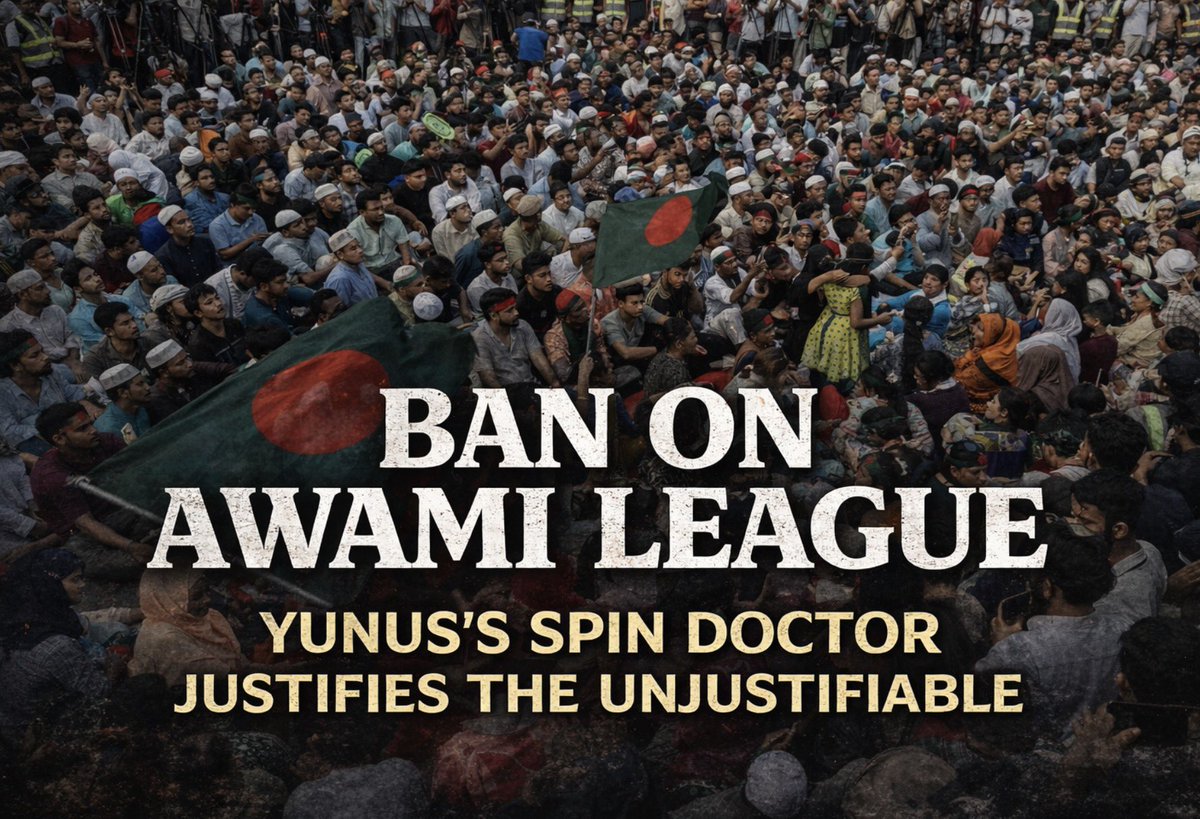
Despite the spin from #Yunus’s Press Secretary, the ban on #Awami League is clearly undemocratic and constitutes collective punishment.
In an interview with @AJEnglish, Shafiqul Alam defended the ban by citing the party’s “lack of remorse” and even dismissed its supporters as a “bunch of thugs.” The interviewer correctly pushed back, noting that banning an entire party is inherently undemocratic, that punishing hundreds of thousands for the alleged crimes of a few amounts to collective punishment, and that “remorse” is not a legal standard.
These justifications betray a troubling disregard for rule of law principles.
Faulty Legal Basis
The ban rests on a deeply problematic amendment to the Anti-Terrorism Act. The state now has the power to “temporarily suspend” organisations, without any defined time limits, creating a loophole for indefinite, arbitrary bans. This allows the government to effectively paralyse political parties without due process. Worse, the amendment criminalises almost all forms of expression or association linked to a suspended orgs, including social media activity. Journalists, academics, and citizens have already been arrested under this provision, chilling free speech and civic space.
Collective Punishment and Flawed Logic
Banning the AL because some leaders allegedly committed crimes violates the foundational principle of individual criminal responsibility under int’l #humanrights and criminal law. Historically, collective sanctions entrench revenge politics rather than deliver accountability. The argument that political exclusion must precede legal accountability is also misguided. Global experience shows such bans deepen grievances, delegitimise transitions, and often fuel further instability.
Manufactured Public Pressure
The ban followed roughly 48 hours of what appeared to be state-facilitated protests led by the National Citizen Party (#NCP) and its #Islamist allies, the #JamaatEIslami and #HefazatEIslam. Govt agencies were seen providing water and even cooling mist to protesters. This stands in stark contrast to the brutal crackdown on teachers protesting at the same location weeks earlier. Notably, the protest sites had officially been declared off-limits, rules enforced on everyone except these groups. This was not the government yielding to public pressure; it was the government manufacturing it.
Threat to Democratic Transition
Following the ban, the Election Commission cancelled AL’s registration, barring it from contesting the upcoming national election. Excluding a major political party from such a pivotal election jeopardises Bangladesh’s return to democratic governance. Around 30% of the electorate, long-time AL voters, now face effective disenfranchisement. Voting is meaningless when genuine choice is removed. An election without broad participation cannot reflect the true will of the people and risks entrenching an exclusionary political order.
…
#BangladeshCrisis #Democracy #Election2026 #Bangladesh
🚨MASSIVE! Global Apparel Giants Like Zara, Marks & Spencer, and H&M Are Taking Exit From Bangladesh And Shifting Their Sourcing to India, Bangladesh Leading Towards Economic Shut Down!
A major shift is underway in the global textile supply chain. Leading UK and European apparel brands—earlier heavily dependent on Bangladesh—are now moving their sourcing to India.
For years, brands such as Zara, Marks & Spencer, and H&M sourced most of their ready-made garments from Bangladesh. But, Political instability, labor unrest, and repeated factory shutdowns over the last 18 months have disrupted this model, forcing brands to look for safer and more reliable alternatives.
Why Not Vietnam or China—Why India?
The more important question is not why brands are leaving Bangladesh, but why India has emerged as the preferred alternative.
Since early 2024, Indian policymakers and industry leaders have proactively capitalized on this window of opportunity. The results are now visible in hard numbers: approximately ₹6,000 crore in new investments have already flowed into India’s textile sector over the past year alone.
Global brand executives are now actively visiting Indian garment hubs in Coimbatore, Tiruppur, Surat, Ahmedabad, Ludhiana, Jaipur, Noida, and the Delhi-NCR region—signaling long-term sourcing commitments.
Unlike Bangladesh, which is largely limited to low-cost ready-made garments, India offers end-to-end capabilities, including technical textiles, high-end apparel, medical and defense fabrics, and specialty sports textiles.
The final boost comes from trade deals. The upcoming India–UK FTA is expected to remove duties on 99% of Indian apparel exports, while the India–EU FTA could slash tariffs by 9–12%. This will eliminate Bangladesh’s long-held tariff advantage.
The result is clear: this is not a temporary shift, but a structural realignment.
Global apparel supply chains are moving closer to India, and the momentum is accelerating.
Let’s take a closer look at the Bangladesh Armed Forces’ (Army, Air Force, and Navy) current inventory of military hardware and weaponry.
• Tanks: There are 320 tanks in service, of which 281 are made in China.
• Multiple Rocket Launcher Systems: 77 units—49 from China, 28 from Turkey.
• Armored Personnel Carriers (APCs) and Other Vehicles: The majority are sourced from Russia, the United States, and Turkey.
• Artillery: The Army has 464 artillery pieces, most of which are Chinese-made.
• Small Arms & Ammunition: While all small arms and ammunition are assembled locally, 100% of the raw materials and components come from China.
• Navy: The Navy operates two submarines, seven frigates, and six corvettes—the largest share being gifts or purchases from China and Russia.
• Air Force: There are 212 aircraft in total, but only 44 are fighter jets. Of these, 36 are Chinese F-7s and the remaining 8 are Russian MIG-29s.
• Helicopters: The Air Force has 73 helicopters, including 36 Russian MI-series. Most training and transport aircraft come from Russia and the US.
Now, let’s discuss the core issue. Bangladesh’s arsenal is almost entirely dependent on China and Russia: Chinese tanks, rocket launchers, artillery pieces, submarines, warships; Russian helicopters, fighter jets, training aircraft. Even the raw materials for domestically assembled ammunition come from China.
At this very moment, the interim government is touting a so-called “Reciprocal Tax” agreement with the United States as a diplomatic win. They claim that tariffs have dropped from 35% to 20%, but in exchange, they’ve signed a Non-Disclosure Agreement (NDA) that now prohibits Bangladesh from purchasing any military equipment from China or Russia.
To enforce this condition, the US envoy has already visited military headquarters and delivered a threat—any deviation will result in sanctions! In other words, from now on, where our weapons come from and how our military operates will all be dictated by the United States!
This servile agreement puts not only our military but also our economy at extreme risk. Most of our industrial raw materials come from China. If China retaliates with strong countermeasures, famine, inflation, and supply shortages in Bangladesh will be inevitable.
Those who used to loudly accuse Sheikh Hasina’s government of “selling out” the country—will they speak up now? Because Sheikh Hasina never made deals against national interests. But this illegitimate Yunus government has secretly signed an agreement that mortgages the nation’s security, economy, and independence all at once.
They’ve sold out the soul of the country for a mere tax cut. We are doomed.
#BangladeshCrisis #YunusMustGo
https://t.co/kHxa7pAkW4
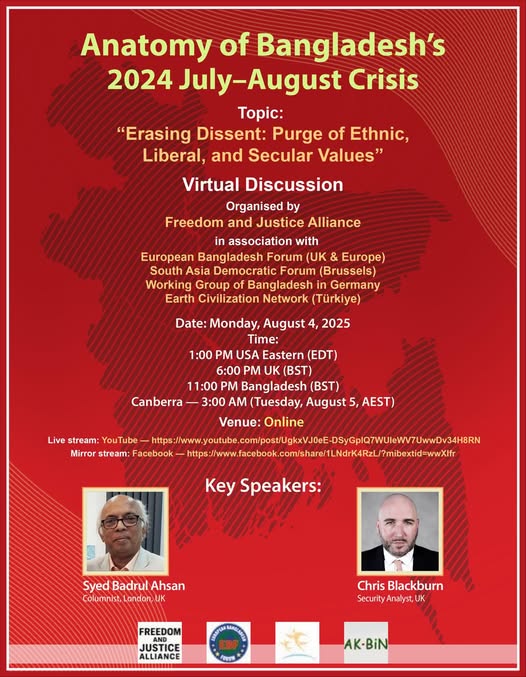
This will be an interesting event. Bangladesh is searching for its soul.
The Monsoon Uprising lost its sheen early on. I believe democracy is now under threat by radical extremists from all sides.
@bdbnp78 are positioning themselves as the liberal democrats. So, that's where we are.
#BangladeshCrisis
Pakistan's Defence Minister Khawaja Asif says 'Madrassa students are their 2nd line of defense.'
He lauded their readiness and potential role in national defence, saying: These children, deeply rooted in religious values, can be fully mobilized if needed.
https://t.co/dOvCWb2f9D
Are the various dramas that have taken place since yesterday, including the drama in front of the Jamuna, the arrest of mayor Ivy, all part of this illegal #yunus government's attempt to divert the public's attention elsewhere?
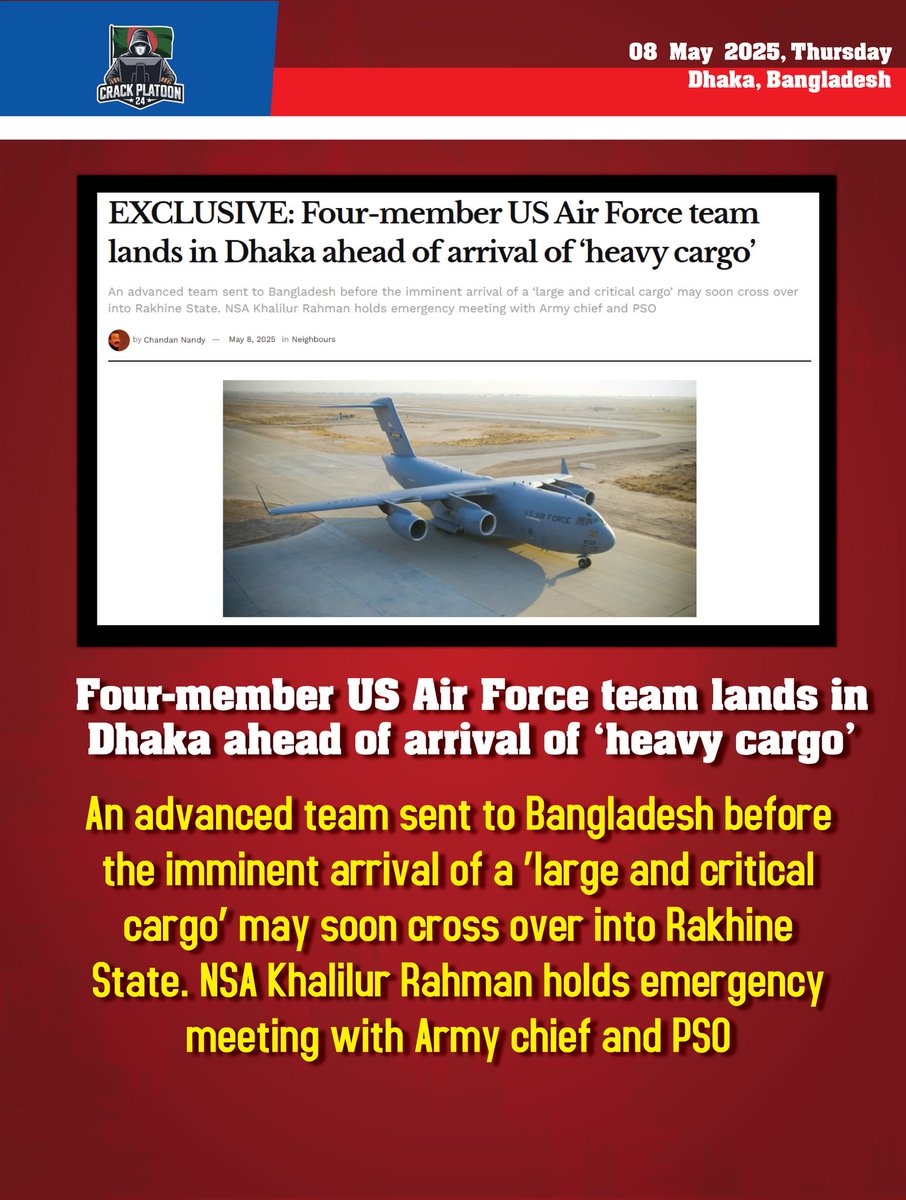
A 4-member US Air Force team has landed in Dhaka ahead of a “heavy cargo” plane’s arrival.
Under the pretext of providing a "corridor" to assist the Arakan Army, the Yunus government has allowed foreign military forces into our soil. This raises serious concerns about national security and transparency. Why is the public being kept in the dark? What exactly is this “critical cargo” that’s on its way?
Bangladesh must not become a pawn in regional or global power plays. We demand answers from Yunus.
#Bangladesh #USAirForce #NationalSovereignty #ArakanArmy #Geopolitics #StopForeignIntervention #Dhaka #IndiaPakistanWar #IndianNavy
@BBCWorld@AJEnglish@Reuters@dwnews@bdnews24com@thedailystar@ProthomAlo@IndiaToday@BanglaRepublic@narendramodi@rajnathsingh@AmitShah@myogiadityanath@myogioffice@BJP4Bengal@SuvenduWB@VikramMisri@MEAIndia