Replication and replicability are crucial for research reliability! Happy to have played a role in this project with a golden team - Synøve N. Andersen, @ntborgen, @STBorgen, @MichaelJFrith and @A_Gugushvili
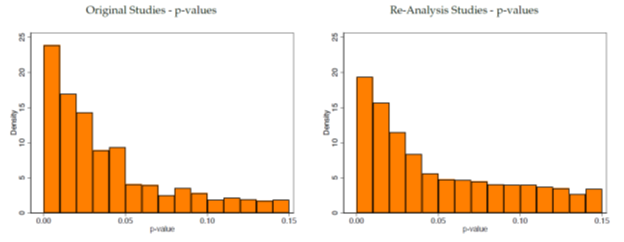
Our first meta paper is out!! This paper combines our first 110 completed reproductions/replications. This is joint work with 350+ amazing coauthors.
We summarize our findings below.
https://t.co/L2YwDDFMcE
🚨New pre-print! Why do ADHD parents tend to have ADHD children? Mainly because they share genes. Parental ADHD behaviours (F-path👇) had v little impact on their children’s ADHD behaviours. N=22k parents & 11k 8yo children https://t.co/QmpNNGdmeF
@ThomasKleppesto@farteinask 1/3
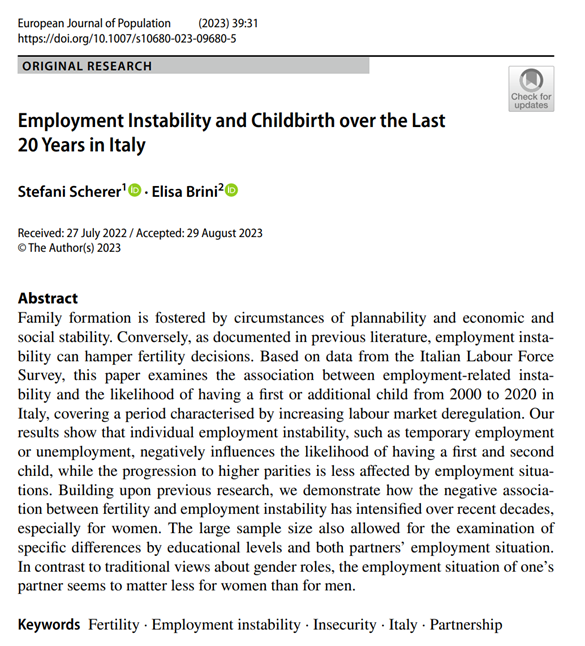
Does employment instability affect family planning? You bet!
📢 In a new paper with @SSch_SSS on European Journal of Population, we analyse the role of #employment instability on #fertility in #Italy, covering two decades characterized by increased labour market deregulation
1/4
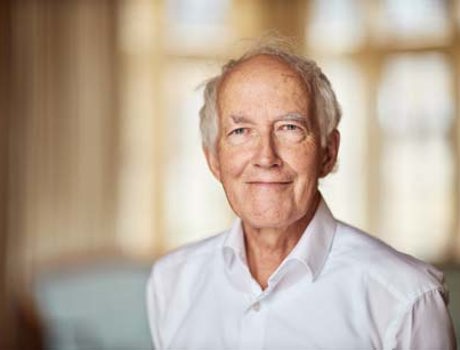
Congratulations to Emeritus Fellow Anthony Heath on receiving the inaugural David Butler Prize for Lifetime Contribution to the Study of Elections, Public Opinion, and Parties in recognition of his exceptional work over the last 50+ years. Read more at https://t.co/QeNbOip3aM
Gratulerer til forskertalentene våre som får prestisjemidler fra EU! 💫👏 Vi er spesielt spente på det videre arbeidet til Nicolai Topstad Borgen som skal forske på årsaker til marginalisering sammen med forskere ved #CREATE Senter for likhet i utdanning.
https://t.co/egAVw7I3Cw
@DanielSpiro1@ReadDemography@aresherman ... fear of discrimination, focus on instrumental rather than intrinsic value of educ (Xie and Gouyette, 2003), or emphasize so-called materialistic/survival values as opposed to self-expressive values (Inglehart 1997).
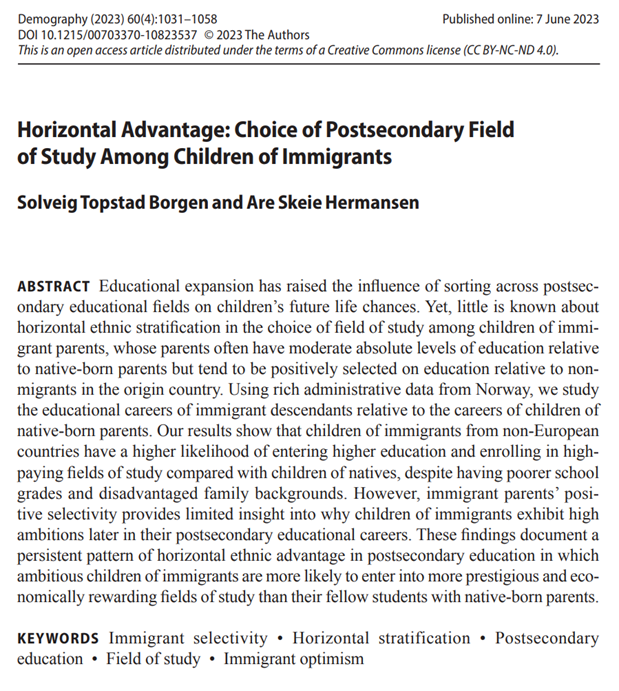
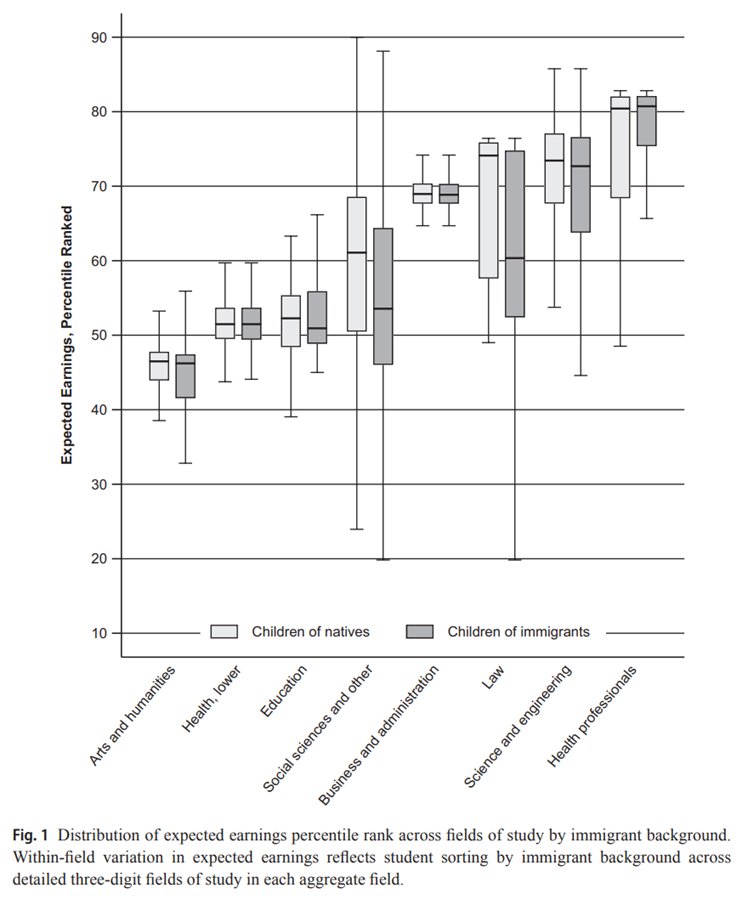
In the latest issue of @ReadDemography, me and @aresherman show that children of immigrants are more likely to enter prestigious and high-paying fields of study than their fellow students with native-born parents. Why, you ask? A short🧵... (1/5)
@DanielSpiro1@ReadDemography@aresherman We are not able to separate between this explanation, I think, and the other proposed mechanisms of high educational ambitions, such as ...
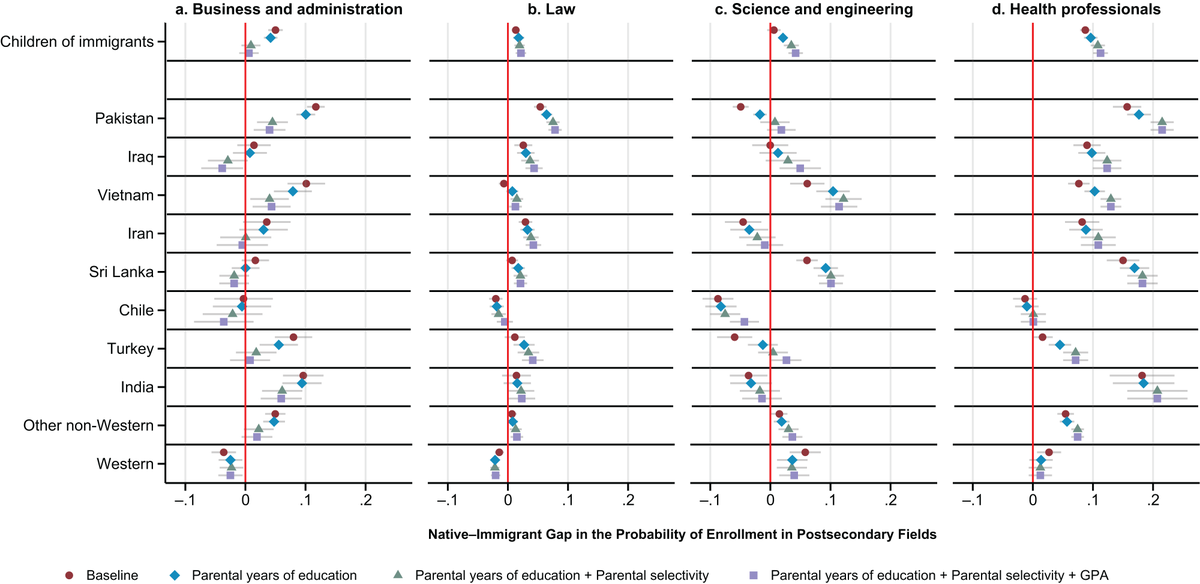
@AndreaCanalesH@aresherman ... the picture changes when we adjust for these characteristics, and there are variations according to origin, as shown in Figure 5
@AndreaCanalesH@aresherman Thanks for showing interest! Overall, children of immigrants seem not more likely to choose what we categorize as Science and Engineering compared to children of natives - according to our baseline model without controls for academic achievements and parental resources. But...
In a new study in Demogrpahy, @STBorgen and I show a persistent pattern of horizontal advantage where children of immigrant are more prone to enter high-status, economically rewarding fields of study than children of native-born parents. 🧵in original tweet!
... there are few economic barriers to education, allowing high-aspiring children to advance into prestigious postsecondary education. Thus, educational choices are likely less constrained than in less egalitarian educational systems. (5/5)
Open Access:
https://t.co/WzhbqpUfWW
… a yet-to-be-explained immigrant optimism seems to manifest as a horizontal ethnic advantage in education; children of immigrants pursue fields of study with high expected economic returns, despite lower earlier achievements and parental resources.
Notably, in Norway ... (4/5)