An inequitable geographic distribution of students who are even trying to get into specialized high schools. Awareness of, and desire to attend these science and math-focused schools must be brought to the Bronx and central-eastern Brooklyn. @BPEricAdams @rubendiazjr
@vkoganpolisci@AaronChalfin@ycinnewyork That experiment design won't measure the benefits of attending a SHS, which are mainly the peer effects that come from the way students are selected. The SHSAT admissions exam is the very thing that makes these schools special.
NYC Councilman Frank Morano gives his take on the new lawsuit on DOE’s policy that sets aside 20% of seats to kids who didn’t make the standard cutoff for the Specialized High Schools.
@frankmorano unapologetically defend merit and touts what is actually working in NYC education. 👏👏👏
Transcription:
“Hello everyone, I’m Frank Morano. Let me talk to you about something that goes right to the heart of what New York City is supposed to stand for: fairness, opportunity, and merit.
There’s a lawsuit right now challenging changes to the admissions process for our specialized high schools like Stuyvesant, Bronx Science, and Brooklyn Tech. And at the center of it is a simple question: Should hard work and achievement still matter?
According to the complaint — and look, you could say anything in a complaint, but this is a complaint that I think has some merit — according to the complaint, a student who scored in the top 5% on the entrance exam was still denied admission while seats are being set aside through a separate pathway with different criteria.
Now look, I want to be very clear: expanding opportunities is a noble goal. Every child in this city deserves a great education. But the way you do that is by lifting more students up, not by pulling the ladder away from others.
And I’ll tell you something personal: My father went to Brooklyn Tech. One of my brothers went to Brooklyn Tech. I took that same test, and let’s just say Brooklyn Tech did not roll out the red carpet for me. And you know what? It’s okay. Because the standard was the standard. I didn’t meet it. That didn’t mean the system was broken. It meant I had to find a different path. And I got a great education at Tottenville High School.
That’s what makes the SHSAT so important. It’s objective. It doesn’t care who you are. It rewards preparation, discipline, and ability.
For generations, especially for immigrant families — including many in the Asian American community — that test has been a ladder to success.
In New York, we have seen generations of immigrants, new immigrants, go from poverty to wealth in one generation. And that test and the ability to get into these schools has been the key to that, among other things. But it’s been the key.
And let’s be honest, these schools are working. With all the complaints about public education around the country, around the state, around the city, these schools are a model for what schooling should be. These are the best schools in the country. They produce some of the best students in the country. They change lives.
So instead of trying to remake them, we should be asking: How do we create more schools like them?
Here’s a line worth remembering: You don’t fix excellence by lowering the bar. You fix inequality by helping more people clear it.
If students need more support, let’s invest in earlier tutoring, mentorships, real preparation. Give every child a fair shot to compete. But what we should never do is send the message that merit doesn’t matter.
As a City Council member, I’m going to stand for fairness in education. And I think that means supporting the SHSAT, supporting specialized high schools, and standing with families who have played by the rules and just want a level playing field.
Because this isn’t about one test. It’s about whether New York City counts merit. And that’s something, at least in my judgment, is absolutely worth fighting for.”
@AaronChalfin@ycinnewyork Yes but there's also no evidence they generate worse outcomes. This is because we can't see how you would've turned out had you not gone to a SHS. We can see the benefits of peer effects and economies of scale. This is just observational, not a proof, but good enough for me.
@vkoganpolisci@AaronChalfin@ycinnewyork Unfortunately, no one can prove this scientifically with data. We cannot perform randomized controlled social experiments on humans. We'd have to take these high-scoring students and randomly assign them to either a SHS or another HS, which is immoral.
https://t.co/l0iiSzxg0o
@AaronChalfin@ycinnewyork A SHS is where you finally find your people, to be inspired by driven, like-minded classmates to achieve more. We can't do a controlled experiment to disprove that they'd do just fine without a SHS, but they deserve a social group to be with peers who share the same interests.
@AaronChalfin@ycinnewyork A SHS is where you finally find your people, to be inspired by driven, like-minded classmates to achieve more. We can't do a controlled experiment to disprove that they'd do just fine without a SHS, but they deserve a social group to be with peers who share the same interests.
@AaronChalfin@ycinnewyork The article you cite shows negligible benefit ONLY for students scoring close to the cutoff: it compared those just below to those just above the cutoff, saying nothing about the vast majority scoring significantly above cutoff. So, it only argues against the Discovery program.
@AaronChalfin@ycinnewyork The article you cite shows negligible benefit ONLY for students scoring close to the cutoff: it compared those just below to those just above the cutoff, saying nothing about the vast majority scoring significantly above cutoff. So, it only argues against the Discovery program.
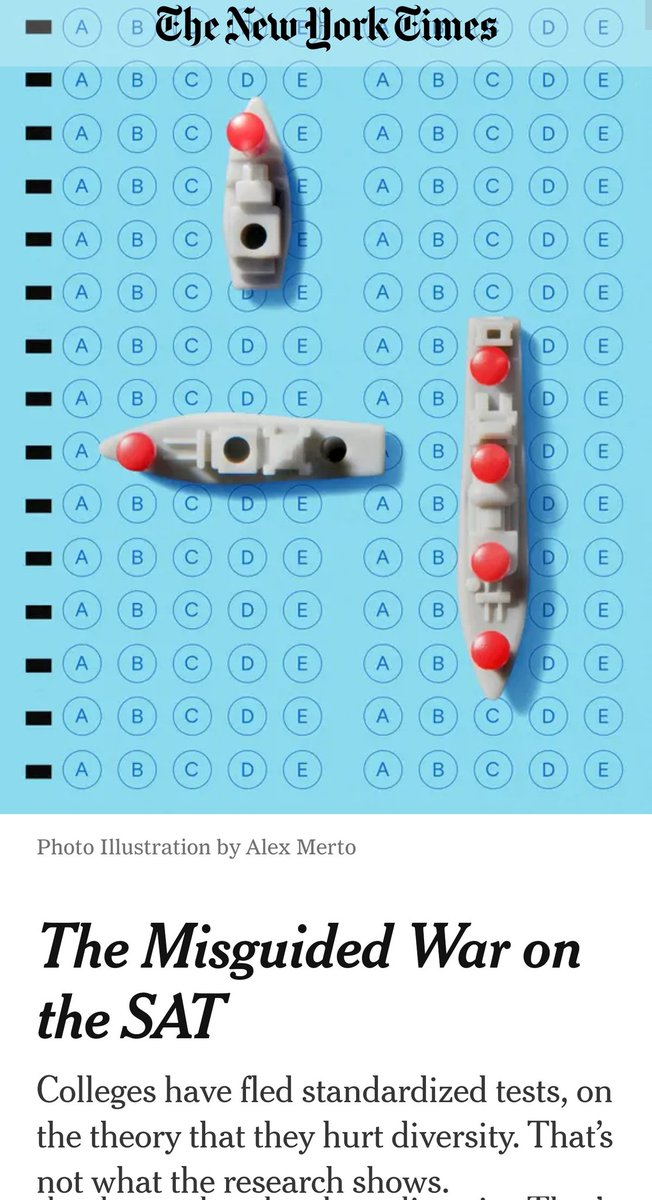
.@nytimes now trusts the science. Tests are the canary in the coal mine. They don't create racial gaps; they merely expose them. A decade of test-blind is a decade lost to address K-12 failures. You can't cure cancer by stopping cancer screening.
In today’s New York Times, the full Editorial Board writes removing the SAT “has damaged the [UC] mission of fostering social mobility and training the next generation of scholars. Some of the world’s greatest research institutions must increasingly focus on remediation.”
@AkilahObviously You just made a racist stereotype about white people, with no evidence to back your claim.
You just proved that, while historical racism needs no solution, present-day racism lives on in DEI supporters like you.
The idea that "being able to go to literally any school" is "segregation" may be the classic example of the skillfully crafted but totally meaningless slogan.
PS25 in Bklyn D16 has just 55 kids in the entire school. Class sizes ranged from 6-18 kids for past 6 years, w/declining enrollment. With low student to teacher ratio and funding at $45K per student, only 1/3 are grade level proficient in reading and math.
The problem is NOT large class size or inadequate funding so why are we always trying to solve for those.
Mandating that standardized tests be the sole admissions criterion is the best way to fight corruption and bias.
Every state should have laws like New York's Hecht-Calandra Act!
Keep the #SHSAT
https://t.co/5Ymo7kNRVo
This article showcases the downsides of placing qualitative factors over quantitative factors in the admissions process. Read more on the article and support the cause in the link in our bio! #merit#education#admissions#supportthecause#fair#justice





![minilek's tweet photo. In today’s New York Times, the full Editorial Board writes removing the SAT “has damaged the [UC] mission of fostering social mobility and training the next generation of scholars. Some of the world’s greatest research institutions must increasingly focus on remediation.” https://t.co/j8OQOkWm9H](https://pbs.twimg.com/media/HMitQBObEAAJh75.jpg)