Excited to share our new manuscript in @NatureMicrobiol uncovering a novel mechanism by which viruses orchestrate their survival in the host. We show that #HIV inherently induces the formation of a latent reservoir of viruses, guaranteeing its long-term survival 🧵 #HIVresearch
Published today in @NatureBiotech, @LaineGoudy. @LukeGilbertSF, Alex Marson, and colleagues report a new epigenetic editing platform that safely reprograms multiple genes in human T cells without many of the challenges & risks associated with traditional gene editing approaches.
Microglia: Super-heroine that had a DGAT2-blocking beverage (cans) so she could break the chains from lipid droplets holding her back (weights) & lift the amyloid load (beams) that trapped the neurons, thereby rescuing them in the aged Brain (City sign)! #NotTheCover@ImmunityCP
For decades, HIV has hidden in plain sight—until now. CWRU researchers have uncovered how the virus reprograms cells to evade detection, revealing a new target for a potential cure. Check out their work: https://t.co/AzvKqubp5n
@RobertMCle@cleveland19news Hi, to clarify, overcoming the conceptual hurdle to a truly effective cure strategy has been the biggest problem. Working on translating the concept to an effective cure has already started.
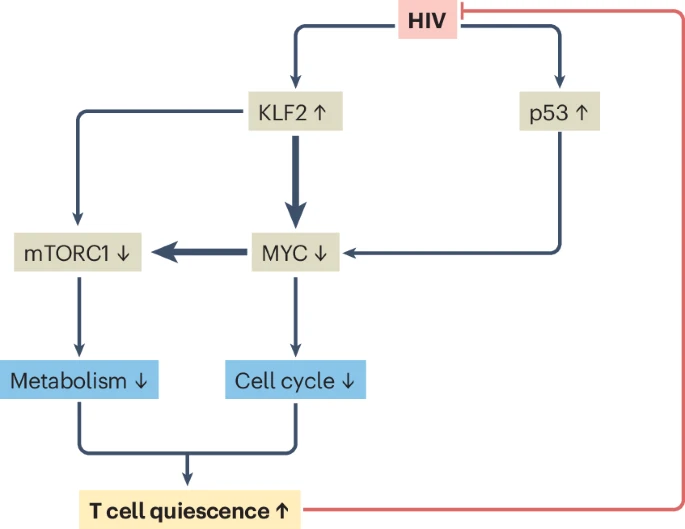
In Nature Microbiology We show how #HIV hijacks CD4+ T cells, activating p53–KLF2 program to push them into quiescence—seeding the latent reservoir that sustains infection.
Understanding this mechanism opens new doors for cure strategies.@SValadkhan
🔗 https://t.co/B6fXEzg5D7
Why is HIV so hard to cure?
Our new study in Nature Microbiology shows HIV can “put T cells to sleep,” hiding in the body for years.
This explain why the virus persists—and points to new ways forward in the search for a cure.@SValadkhan@LeahPlasek
🔗 https://t.co/B6fXEzg5D7
Findings from my work at @CWRU are now published! An effective HIV cure is prevented by the persistence of latently infected cells. We set out to understand how HIV becomes latent and found that it's an outcome promoted by the virus through manipulation of the host transcriptome.
This manuscript is accompanied by a News and Views in Nature Immunology. Many thanks to Drs. Melanie Ott and Zichong Li @TheOttLabfor authoring it. Here is the link: https://t.co/nuHct6m0Ke
Excited to share our new manuscript in @NatureMicrobiol uncovering a novel mechanism by which viruses orchestrate their survival in the host. We show that #HIV inherently induces the formation of a latent reservoir of viruses, guaranteeing its long-term survival 🧵 #HIVresearch
This work was a collaboration between Valadkhan lab and Dr. Jonathan Karn's lab, with @LeahPlasek and @persilon doing most of the experimental heavylifting, and funded by @NIDAnews and @NIAIDNews. Link to the manuscript: https://t.co/FfPpPmxxpC https://t.co/uyperskXCy
Out Now! HIV infection reprogrammes CD4+ T cells for quiescence and entry into proviral latency https://t.co/Ha8nB3eIwM #HIVResearch#CD4TCells#ProviralLatency
HIV infection of CD4 T cells drives KLF2 and p53 signaling, which downregulate MYC and proliferation pathways, resulting in proviral transcriptional silencing to enhance latent reservoir formation @NatureMicrobiol@SValadkhan@CWRUSOM@LeahPlasek 🇺🇸
https://t.co/DnEFQePmB3
Out Now! HIV infection reprogrammes CD4+ T cells for quiescence and entry into proviral latency https://t.co/Ha8nB3eIwM #HIVResearch#CD4TCells#ProviralLatency