Scientist, principle investigator @sabanciu, studying SUMOylation in health and disease; @BrownUniversity, @MSKCancerCenter, @institutpasteur, @Inserm alum
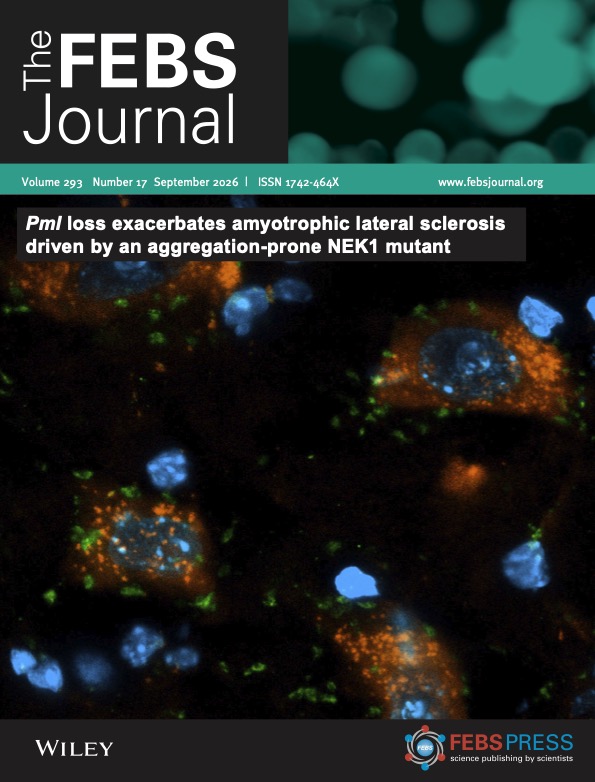
Happy to see our work featured on the cover of @FEBSJournal. This confocal image shows mutant NEK1 aggregates (orange) in motor neurons of the mouse spinal cord, ultimately driving ALS pathology ++
@Amit_Kumar_PhD I fully sympathize with this. Unfortunately, too many editors today act as little more than intermediaries between authors and reviewers, rather than exercising genuine editorial judgment.
More troubling is when editors act as mere secretaries, unwilling or unable to filter out reviews that clearly miss the point. A journal recently rejected our manuscript based on such reviews, then published essentially the same story from another group.
After seeing how our last manuscript was handled by a few journals, I’m increasingly OK with AI reviewing papers. At least AI will read the manuscript & engage with its core concept, rather than produce a 20-point wishlist of irrelevant experiments, each worthy of its own paper++
If you’re letting AI do a review of a manuscript for you, just know that (A) it’s super obvious to anyone reading it, (B) it’s dishonest - as you’re explicitly instructed not to do so, and (C) it’s careless - because you’re uploading someone’s confidential material to an AI app.
Thrilled to share our new review in @emboreports !
@CytoLabKoc and I explored an emerging concept in neuroscience: the centrosome/cilium/centriolar satellite axis may represent a fundamental, yet underappreciated, contributor to neurodegeneration
https://t.co/IlaOetKduT
Happy to see our recent paper highlighted through this insightful commentary by Stefan Müller. Read the full piece highlighting our findings, their implications for neurodegenerative diseases, and broader relevance across multiple fields here
https://t.co/PpZkH6SfnZ
Scientific publishing needs to change. In a new preprint, HHMI President Erin O'Shea and Bodo Stern argue that the incentives are misaligned. Researchers should be evaluated on what they choose to share, not what journals select. I’m proud that @hhmi_science is leading the way. Read the preprint here: https://t.co/CV1iiwgIvY
Talked to someone who failed to cite our preprint that showed an AlphaFold model with lots of experimental validation when he submitted cryo-EM paper of exact same sytem in Nature with no bio. data 6 months later. He said as a matter of policy "I don't cite preprints." Unethical.
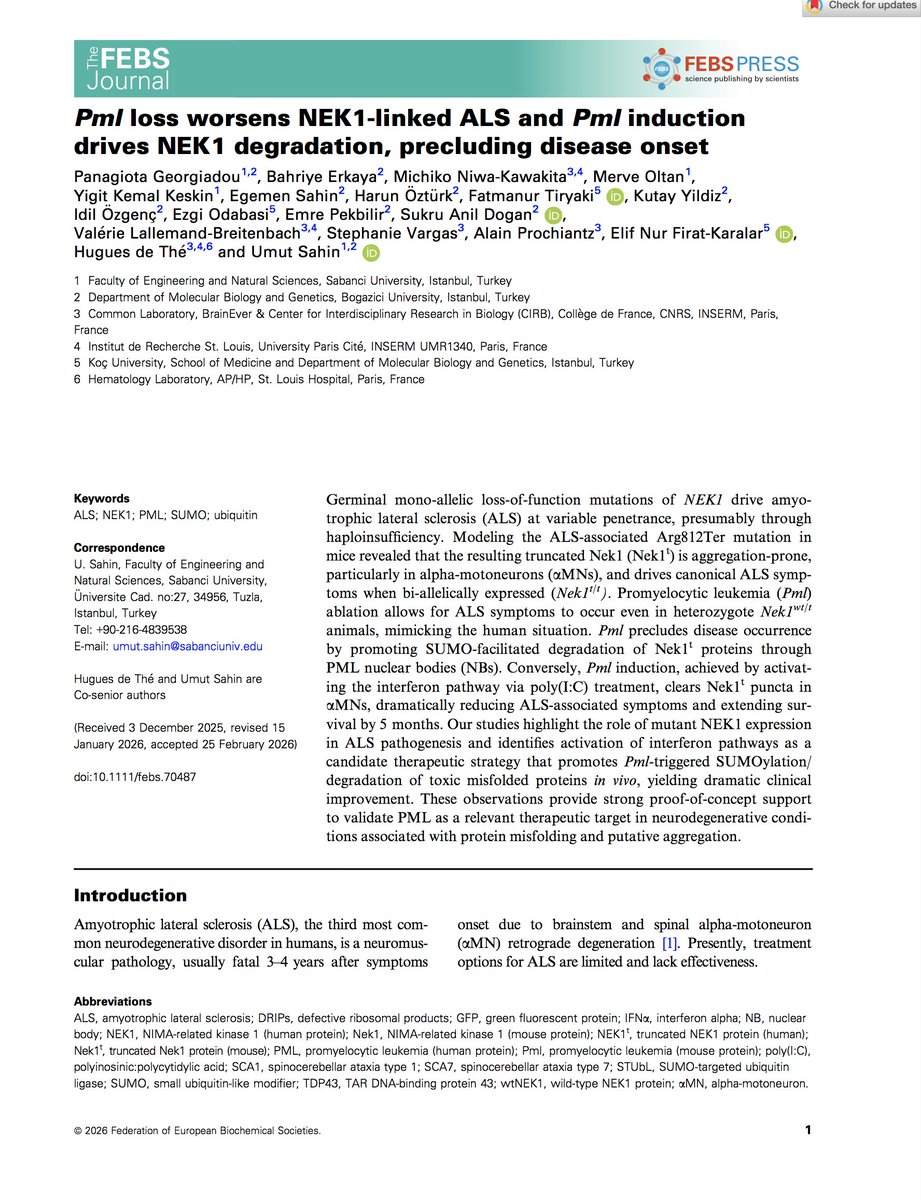
Our new paper demonstrates for the first time the in vivo feasibility of PML-based therapeutic strategies for neurodegeneration. Focusing on ALS, we provide strong proof of concept evidence that inducing PML to clear disease-causing proteins is a promising therapeutic approach
Sadly, the rate publication inflation is likely to get worse!
The slicing of what should be a supplemental figure into entire separate papers, and then slicing again, and again is now standard practice
It threatens scientific quality and actually may slow real progress
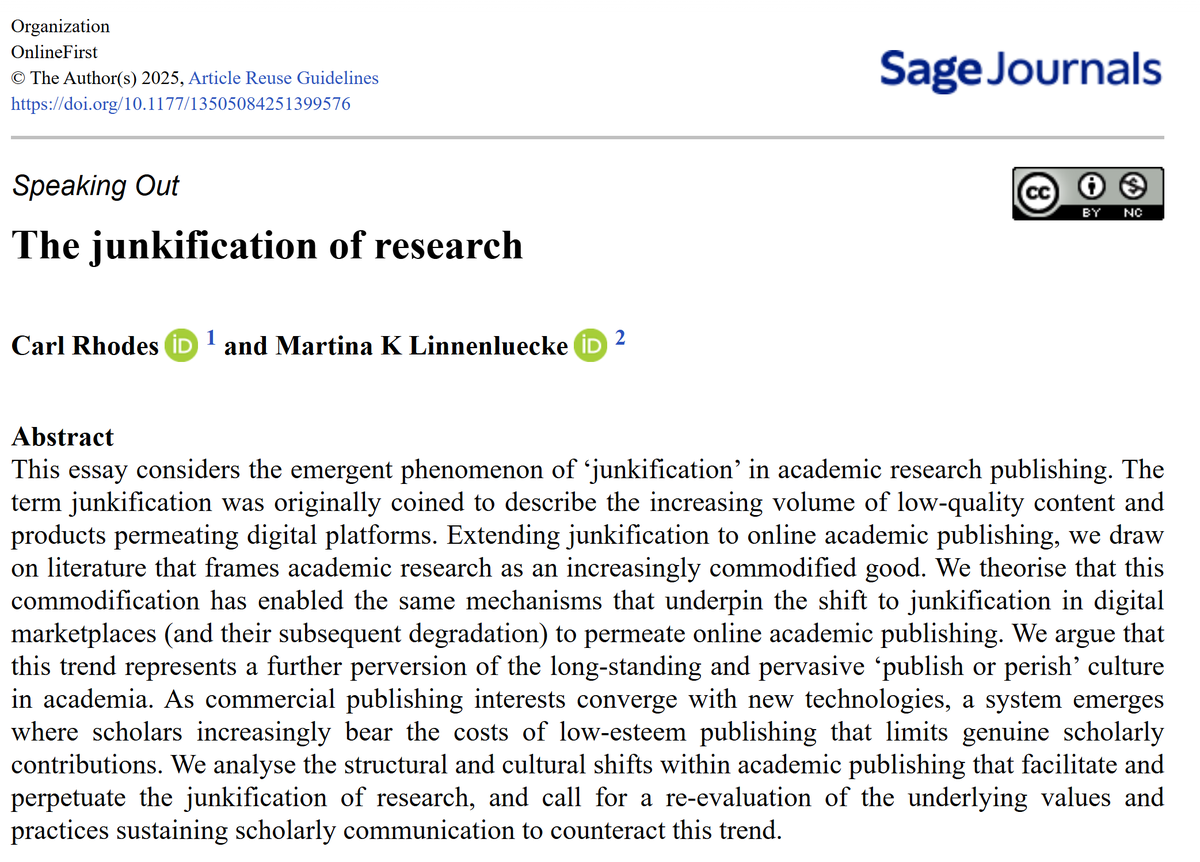
Two business school professors from the University of Technology in Sydney have sounded the alarm on the declining quality of academic literature in a new publication titled “The junkification of research”.
Drawing parallels to the “enshittification” of online platforms, they argue that similar forces are now overwhelming scholarly publishing. The key drivers are threefold: 1) relentless “publish or perish” pressures in academia, 2) scientific publisher’s incentive to publish more to make more money, and 3) AI making paper production faster and easier. Taken together, they say, these drivers are a recipe for disaster. The authors call for a shift to not-for-profit models of scientific publishing and better evaluation systems.
I strongly doubt either is going to happen.
The problem is of course not new, and you all know that I have been drawing attention to this trend for more than a decade. It is interesting to see, however, that the awareness for the issue is increasing.
Paper: Rhodes, C., & Linnenluecke, M. K., “The junkification of research” Organization (2025).
New paper out ! In this Viewpoint article, I explore a bold and provocative idea: that Cas9, the catalytic engine of the CRISPR gene editing platform, may also possess a previously unrecognized effector-like role in eukaryotes during bacterial infection
https://t.co/IOewVaeFUK