In order to impose a ban on Awami League, the Interim Govt had to pass a new Ordinance amending the Anti-Terrorism 2009 to arrogate the power of banning activities of a political party and then published S.R.O. 137Ain/2025 on the basis of new power.
Article 93(2) of the Constitution requires the new BNP Govt to lay this Anti Terrorism Ordinance before Parliament at its first meeting.
The Ordinance shall cease to have effect at the expiration of thirty days after it is so laid unless a validating Act is passed within that period.
Within this thirty-day constitutional window, the BNP-led government may either allow it to lapse or approve the Ordinance through legislation (thereby incorporating the ordinance and the S.R.O.-based powers into the permanent text of the Anti-Terrorism Act, 2009), in the latter case the Ordinance and all executive measures that depend on it—including the proscription of the Awami League as an “entity” and the derivative Election Commission deregistration, would be unconstitutional and shall be subject to judicial review.
Should the BNP government secure parliamentary approval of the amendment in its existing form, this would signify an intention to endorse and continue the interim administration’s abuse of anti-terrorism law as a basis for banning political parties and undermine democracy, thereby normalising an extraordinary proscription regime and entrenching the exclusion of the Bangladesh Awami League from political and electoral process. Conversely, if the BNP Govt. does not take step for endorsing the Ordinance, this would indicate a positive stance on their part to distance them from the hostile interim government’s approach, to restore a narrower, rights-compatible anti-terrorism framework. To reopen space for pluralistic party competition and inclusive democracy, BNP must not allow endorsement of the Ordinance by the new Parliament and let it lapse after 30 days of first sitting of Parliament.
#Bangladesh
It is now July 2026, and #Bangladesh is under the rule of the #BNPJamaat coalition. During the first six months of the year alone, 61 people have died inside prisons, according to data from ASK (Ain o Salish Kendra). Of those, 37 were undertrial detainees. In other words, these were individuals whose guilt had not been established and who, under the law, were still presumed innocent. Yet they left state custody as corpses. The Dhaka Division alone accounted for 36 deaths, including 19 convicted prisoners and 17 undertrial detainees. The pattern bears a striking resemblance to the prison death toll witnessed during the 2001-2006 period.
👉https://t.co/1LnX72mMs7
#DeathInCustody #BangladeshCrisis
According to data compiled by Ain o Salish Kendra (ASK), at least 61 people died in jail #custody across #Bangladesh during the first six months of 2026.
Of those who died in prisons between January and June 2026, 37 were under-trial prisoners or pre-trial detainees, while 24 were convicted inmates. This means that more than 60% of all reported jail custody deaths during the period involved individuals who had not yet been convicted of any offence.
Source: https://t.co/oyJYKD9hwq
Custodial deaths in prisons, particularly those involving political detainees, have emerged as one of Bangladesh's most serious human rights concerns since August 2024.
Between September 2024 and June 2026, a total of 59 leaders and activists of the #AwamiLeague and its affiliated organisations reportedly died while in the custody of law enforcement agencies and/or prisons. More than 95% of these deaths occurred while the deceased were under prison custody.
List: https://t.co/DD7InokJ6J
To date, not a single reported custodial death has been subjected to an independent, prompt, impartial, and effective investigation, despite serious concerns regarding the treatment of detainees, conditions of detention, access to adequate medical care, and the accountability of state authorities.
According to family members in many of these cases, the deaths were preceded by custodial torture, other forms of cruel, inhuman or degrading treatment, or the denial of timely and adequate medical care.
Several families have also alleged that they were unable to file criminal complaints because of a lack of cooperation from the police and other authorities.
In numerous cases, authorities have reportedly attributed the deaths to sudden "heart attacks" or natural causes, while post-mortem examinations were allegedly delayed, omitted, or conducted under circumstances that failed to inspire the confidence of the victims' families.
The continued absence of credible investigations not only denies victims' families their right to truth and justice but also reinforces a climate of impunity, increasing the risk that similar abuses will continue without accountability.
#Bangladesh #HumanRights #CustodialDeaths #RuleOfLaw #Justice #Impunity
….
@amnestysasia@AgnesCallamard@omctorg@meeganguly@PearsonElaine@StateDRL@justiceinfonet@S_Asian_Rights@HannahEP@ESandersFCDO@AFP@CIVICUSalliance@BonaveroIHR@forum_asia@HRF@UN_SPExperts@DoughtyStIntl@volker_turk@UN_HRC@omctorg@FreefromTorture@TheDavidBergman@cnni@MujMash@CharlieCamp6ell
“The BNP leaders killed him.”
---
Parvin Begum, the widow of Md. Ilias Gazi, alleges that her husband, Vice President of the Rampal Union Awami Jubo League, was beaten to death by BNP activists on 31 May 2026 after leaving home to work as a day laborer.
According to her testimony, the attackers accused him of continuing to support the Awami League before assaulting him. She says he left behind three children, and the family now has no home, property, or means of support.
#AwamiLeague #Bangladesh #HumanRights
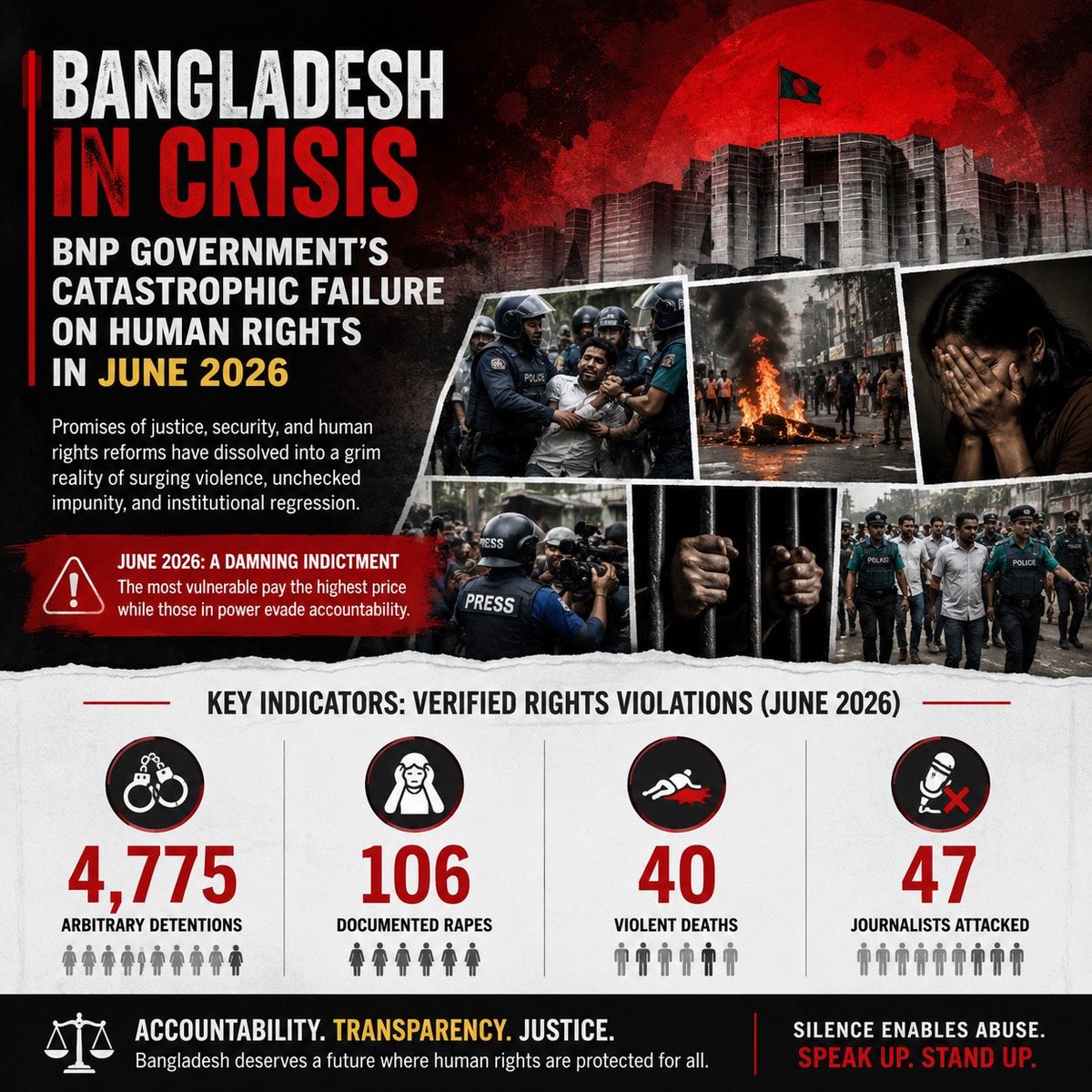
June 2026 marked a significant deterioration in Bangladesh's human rights situation as the @bdbnp78-led government failed to protect fundamental rights and maintain the rule of law.
Just look at the numbers,
📌 177 politically motivated attacks and clashes
📌 More than 2,700 people injured in political violence
📌 Hundreds of arrests targeting political opponents and activists
📌 Dozens of incidents of mob violence, attacks on journalists, and assaults on minority communities
These are not just statistics—they represent a growing human rights crisis in Bangladesh during June 2026.
🔗 https://t.co/QeQ83jLNfr
#Bangladesh #HumanRights #BNPMisrule
311 High-Risk Islamist Terrorists and Extremists on the Loose in Bangladesh.
According to #Bangladesh Police's own statistics, at least 311 high-risk violent #Islamist#extremists and #terrorists are currently at large across the country.
These individuals have either escaped from prison or been released on bail (particularly since August 2024). In many cases, law enforcement agencies reportedly have no information on their current whereabouts or activities.
Those currently at large include 185 members of Jamaatul Mujaheedin Bangladesh (JMB), 83 from Ansar Al Islam, 16 from Harkat-ul-Jihad, 16 from neo-JMB, nine from Allah's Dal, one each from Jamaatul Ansar Fil Hindal Sharqiya and Imam Mahmud's Kafela, and 59 from Hizbut Tahrir.
The situation has become increasingly alarming since August 2024.
On 5 August 2024, nine convicted terrorists escaped from Kashimpur High Security Prison and remain at large.
Although the release of detained extremists on bail was not unprecedented, the scale of releases since August 2024 has been unusually high.
Over the past 22 months, 380 detained members of banned extremist and terror organisations have reportedly been released on bail.
According to available information, police have been unable to locate or monitor many of those who either escaped custody or were released on bail.
This has naturally raised concerns among the experts working in security and counterterrorism in Bangladesh.
These concerns are further compounded by the fact that a substantial quantity of arms and ammunition looted from police facilities during the 2024 protest remains unrecovered.
The combination of hundreds of violent Islamist extremists and terrorists at large and a significant cache of unrecovered weapons presents what many security observers would regard as a serious national security challenge for the South Asian nation.
The real question is whether the BNP Govt will acknowledge the problem and act on it, or whether it will continue, as it has on so many other issues, to follow the Interim Govt's lead by dismissing the threat of violent Islamism as nothing more than a boogeyman invented by the Awami League Govt.
Source:
https://t.co/TrVsGYu80E
....
#BangladeshCrisis #Terrorism #NationalSecurity #Extremism #Islamism #SouthAsia @Chellaney@CJBdingo25@paulocasaca1
"We destroyed and set fire to the Awami League party offices across the country"
This casual admission of guilt by the President of Chhatra Dal demonstrates the adverse consequences of granting indemnity for criminal acts due to political considerations.
At a recent event, the President of #BNP's student wing, #ChhatraDal, openly boasted about the violence carried out by protesters aligned with BNP and its student and youth wings during the July–August 2024 protests in #Bangladesh.
Remarkably, this admission was made in the presence of the party's chairman and Prime Minister #TariqueRahman.
This is not the first time that individuals associated with political parties opposed to the Awami League have publicly acknowledged their role in strategically targeted violence during the protests.
Individuals linked to BNP, #JamaatEIslami, the #NCP, and the Students Against Discrimination (#SAD) Movement have openly claimed responsibility for, or boasted about, acts including:
- Killing law enforcement personnel;
- Burning down police stations;
- Attacking key point installations, including the Dhaka Metro Rail and the BTV headquarters;
- Breaking open prisons and freeing convicts;
- Looting police arms and ammunition;
- Attacking statues, memorials, structures, and landmarks associated with the Liberation War of Bangladesh;
- Killing Awami League activists and supporters;
Among others.
The latest admission by Chhatra Dal President Rakibul Islam, therefore, should come as no surprise. Violence committed by the protesters remains one of the least discussed aspects of the July–August protests.
Why? Because those crimes have already been indemnified; first by the #Yunus-led Interim Govt and subsequently by the BNP Govt. As a result, victims have effectively been denied legal avenues to seek accountability from the perpetrators.
This contradiction, pursuing accountability for one group while indemnifying another, is one of the principal reasons why the justice processes currently underway in Bangladesh, even if regarded as legally valid, remain unfair, unjust, incomplete, and inequitable.
....
#BangladeshCrisis #Politics
Bangladesh’s International Crimes Tribunal was created for justice, not political revenge.
We call on international human rights organizations, UN bodies, press freedom groups, and democratic governments to urgently monitor due process, judicial independence, and the targeting of journalists and political opponents.
Justice must be impartial. Accountability must never become a weapon.
#Bangladesh #HumanRights #RuleOfLaw #PressFreedom #DueProcess #Justice #Democracy #GlobalJusticeNetwork
Ten years ago, the #HoleyArtisanAttack shook #Bangladesh and the world. It was a defining moment that tested the nation's resolve against violent extremism.
#SheikhHasina's government's response in the aftermath—combining decisive security operations, intelligence-led counterterrorism, institutional reforms, and community engagement—became a model for combating militancy while restoring public confidence and international trust. The strategy not only dismantled extremist networks but also helped safeguard economic stability and regional security.
👉https://t.co/qZRBIYPK3S
#Bangladesh #Terrorism
@JapanGov@MofaJapan_en@italyinbd@ihcdhaka@usembassydhaka
Is Bangladesh Trading Food Safety for Cheap Imports?
Bangladesh’s decision to import 50,000 metric tons of white rice from Pakistan has sparked serious public debate after reports that similar shipments were rejected by the European Union over concerns about excessive pesticide residues.
Affordable food is important—but food safety is non-negotiable. Every imported food product should undergo rigorous scientific testing to ensure it meets international safety standards before reaching people’s tables.
Public health must always come before short-term cost savings.
Read ➡️ https://t.co/FxqKZzecyf
#Bangladesh #FoodSafety #RiceImports #PublicHealth #Pakistan
Questions That Demand Answers
- BBC Bangla Investigative Report on Turag Murders - Missing Incident of Awami League Activists.
Seven Awami League activists were reportedly detained after a procession. Others allegedly jumped into the Turag River while fleeing. In the days that followed, multiple bodies were recovered.
According to a BBC News Bangla investigation, conflicting accounts from witnesses, families, lawyers, and police have left critical questions unresolved. While police deny that anyone disappeared during the operation or that any attack occurred, human rights advocates say only an independent investigation can establish the truth.
When people go missing, bodies are recovered, and public confidence is shaken, transparency is not optional. The facts must be established through a credible, impartial investigation. Accountability begins with uncovering the truth.
Source: BBC News Bangla investigation by Abul Kalam Azad.
#Bangladesh #AwamiLeague #Turag
One Case to Punish All Enemies: How Protest-Related Cases Have Become Tools for Personal Vengeance in #Bangladesh
Jahangir Alam filed a case at #Chattogram's Kotwali Police Station alleging an attack on anti-quota protesters on 4 August 2024. However, the list of accused extends far beyond those allegedly connected to the incident. It includes former colleagues, neighbours, relatives, and individuals with whom Jahangir had longstanding personal and property disputes. In other words, people who have had no connection whatsoever to the alleged events.
The case is yet another striking example of how the July–August 2024 protest-related criminal cases in Bangladesh have become instruments of corruption, personal vengeance, and political persecution, rather than mechanisms for delivering justice.
At BD Watch, we have monitored 1,868 criminal cases filed across the country in connection with the violence of July–August 2024. Collectively, these cases have implicated more than 225,000 people, either as named or unnamed accused. Yet investigations have been completed in only 242 cases, approximately 13% of the total.
Over the past 22 months, we have repeatedly documented how these cases have been abused by police officers and politically influential individuals to extort money from innocent people, while simultaneously targeting individuals associated with the #AwamiLeague and its affiliated organisations.
Jahangir Alam's case illustrates a third and equally troubling form of abuse: the use of protest-related cases to settle personal scores.
A Case Built Around Personal Grievances
Jahangir named 18 individuals as accused. Among them is former AL minister Saifuzzaman Chowdhury Javed, who appears as the principal accused. The remaining individuals, however, are people drawn from Jahangir's own personal and professional life.
The inclusion of a prominent Awami League figure appears to serve a strategic purpose. Naming a well-known political leader as the principal accused lends an appearance of legitimacy to what might otherwise be readily identified as a vexatious complaint driven by personal motives.
Beyond Javed, the accused include:
- Former colleagues and members of the governing body of a college where Jahangir previously taught before losing his position after being found guilty of misconduct.
- Individuals with whom he has ongoing property disputes.
- Family members and relatives.
- Neighbours with whom he reportedly has strained relationships.
There are also allegations that Jahangir has demanded money from individuals named in the case in exchange for removing or omitting their names from the proceedings.
News: https://t.co/TdRuh6qLgX
A System Open to Abuse
It would not be an exaggeration to describe the July–August 2024 protest-related cases as having become a cesspool of injustice. Over the last 22 months, these cases have come to symbolise three interconnected forms of abuse: corruption, political persecution, and personal vengeanc.
An Unfulfilled Promise of Reform
The BNP Govt's Home Minister, Salahuddin Ahmed, has publicly stated that his ministry would review these protest-related cases. However, no meaningful review process has been initiated to date.
Given that politically influential individuals continue to benefit from these cases, whether through extortion, pressure tactics, or the targeting of political rivals, it remains difficult to see how the Home Minister's commitment can be realised without an independent and comprehensive review of every protest-related case.
Until such a review takes place, the criminal justice system will remain vulnerable to abuse, leaving both genuine victims and those wrongfully accused without meaningful justice.
…
#BangladeshCrisis @amnestysasia@AgnesCallamard@meeganguly@PearsonElaine@StateDRL@justiceinfonet@S_Asian_Rights@ESandersFCDO@CIVICUSalliance@BonaveroIHR@forum_asia@UN_SPExperts@volker_turk@UN_HRC@omctorg@SRjudgeslawyers@IBAHRI
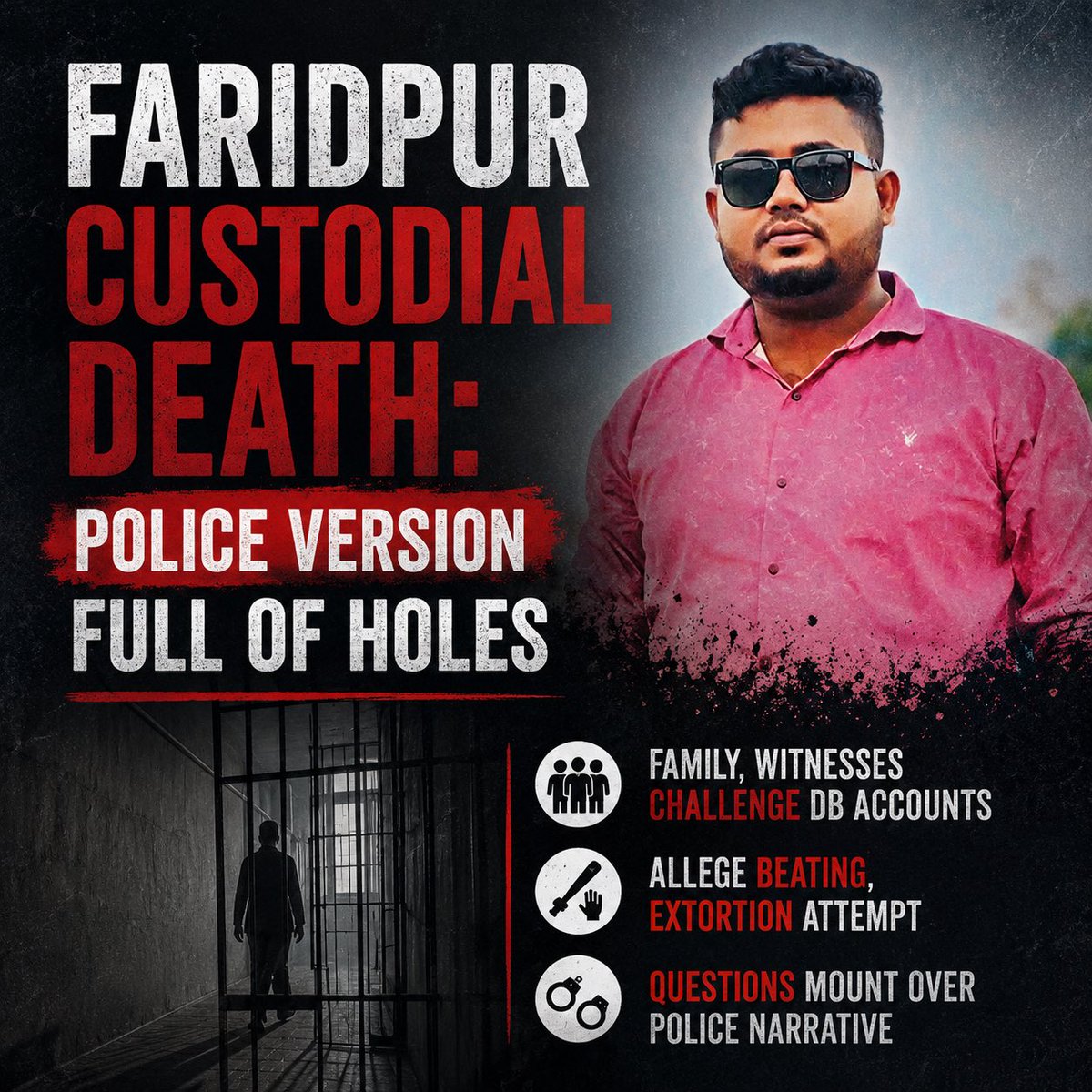
Faridpur Custodial Death: Police Version Full of Holes.
A @dailystarnews investigation raises serious questions about the official account surrounding the custodial death of Istiak Ahmed Pranto, a 24-year-old law student from #Faridpur, who died on 21 June 2026, less than 24 hours after being detained by the Detective Branch (DB) of police.
Police claim Pranto was arrested with cannabis, treated "politely and cordially," and became ill after offering Fajr prayers while in custody. According to the DB, he was taken to hospital but died despite medical treatment.
However, Pranto's family, neighbours, and eyewitnesses strongly dispute this version. They allege that DB officers assaulted him outside his home during the arrest, continued beating him after searching the house, and ignored repeated pleas from his family. Multiple witnesses corroborated seeing officers slap and assault him before taking him away.
The investigation also details allegations of extortion. A relative claimed DB officers demanded money in exchange for Pranto's release, initially seeking Tk 65,000 before increasing the demand to Tk 100,000. During this encounter, Pranto reportedly complained that officers had beaten him and that he was suffering from severe head pain.
Family members further allege that when they saw Pranto's body, there was blood coming from his nose, mouth, and ears. Relatives who prepared his body for burial also claimed they observed injuries on the soles of his feet, raising further questions about possible custodial #torture and abuse.
The report identifies several inconsistencies in the police narrative. Although police filed a narcotics case alleging that cannabis was recovered from the pocket of Pranto's trousers, his family maintains he was wearing a “lungi” when detained. A video recorded shortly before his arrest reportedly supports this claim. The article also notes discrepancies regarding the circumstances of his detention and the events leading to his death.
Report: https://t.co/sxgdkIQuH1
Following widespread public outrage and protests, Faridpur police formed a three-member committee to investigate the incident.
However, given the current highly politicised state of law enforcement in #Bangladesh, it is doubtful whether this committee can objectively seek answers and ensure accountability.
Hence, we had demanded an independent judicial inquiry from the outset.
…
#JusticeForTheInvisible #BangladeshCrisis @amnestysasia@AgnesCallamard@omctorg@meeganguly@PearsonElaine@StateDRL@justiceinfonet@S_Asian_Rights@HannahEP@ESandersFCDO@AFP@CIVICUSalliance@BonaveroIHR@forum_asia@HRF@UN_SPExperts@DoughtyStIntl@volker_turk@UN_HRC@omctorg@FreefromTorture@TheDavidBergman@cnni@MujMash@CharlieCamp6ell
After conducting 13 heavily controlled bar association #elections that forcibly excluded pro-#AwamiLeague and independent #lawyers, the #BNP, #JamaatEIslami, and the #NCP have now moved to avoid holding elections for the #Bangladesh Bar Council itself.
Instead, they have jointly facilitated the formation of a one-year ad hoc committee composed entirely of lawyers aligned with their own political parties.
The Bangladesh Bar Council, the principal statutory regulatory authority governing the legal profession in the country, was scheduled to hold elections on 19 May 2026 to elect its executive committee. However, the election was indefinitely postponed, with the authorities citing the fuel crisis and the ongoing district bar association elections as the reasons for the delay.
Following the suspension of the election, the BNP Govt on Tuesday constituted a new 15-member ad hoc committee through a gazette notification, appointing Attorney General Ruhul Quddus as its chairman. According to the gazette, the unelected committee will serve for one year from 1 July 2026.
The composition of the committee reflects overwhelming partisan control. Of its 15 members, 12 are lawyers affiliated with the BNP, two are affiliated with Jamaat-e-Islami, and one is associated with the NCP.
As with the recent bar association elections, where lawyers outside the ruling coalition were effectively prevented from participating, the Bar Council itself is now being subjected to what many view as a hostile political takeover by lawyers aligned with the ruling BNP and its “friendly” parliamentary opposition.
This development comes after at least 13 bar association elections that were widely criticized for being neither inclusive nor competitive, with pro-Awami League and independent lawyers allegedly excluded from contesting. Now, the same model of political capture is being extended to the country's highest professional regulatory body for lawyers.
The legality of the ad hoc committee has already been challenged before the High Court. Independent lawyer Yunus Ali Akhand has filed a writ petition seeking suspension of the ad hoc committee and an order directing the authorities to hold a free, fair, and competitive Bar Council election within the next 30 days.
News: https://t.co/P4oh4zqWYV
The establishment of a politically dominated unelected ad hoc committee in place of an elected Bar Council raises profound questions about the independence of the legal profession in Bangladesh.
If, following non-inclusive and restrictive elections in at least thirteen bar associations, the country's principal regulatory body for lawyers is also brought under the effective control of the BNP, Jamaat-e-Islami, and the NCP without an election, what does this mean for the autonomy of the legal profession, self-governance of lawyers, and the future independence of legal institutions in Bangladesh?
….
@LSHumanRights@IBAnews@lincolnsinn@HonSocGraysInn@SRjudgeslawyers@middletemple@TheInnerTemple@hrw@UnionIntAvocats@ILA_official@ILAW_Network@ABAesq@JusticeMakersBF@barandbench@LawyersComm #CBA @TheLawSociety@IBAHRI@CCBEinfo@cla_lawyers @LAWASIA_alert @hrw@amnestysasia@UNHumanRights
Death Without Trial in Bangladesh: Over 100 Custodial Deaths Documented
The Global Center for Democratic Governance (GCDG) presents this report to document custodial deaths in Bangladesh during the 22-month period from September 2024 to June 2026. The report records more than 100 custodial deaths and raises serious concerns regarding the protection of the right to life, due process, judicial oversight, and accountability within the criminal justice system.
Read Report ➡️
https://t.co/o3hZOPAb0I
#Bangladesh #HumanRights
With the death toll surpassing 700 and the total number of reported cases exceeding 100,000, many are questioning why the #BNP Govt has signalled its unwillingness to seek answers and accountability for the hundreds of families who have lost their #children during the ongoing deadly #measles outbreak in #Bangladesh.
Since mid-March, Bangladesh has recorded more than 100,000 measles cases, resulting in the deaths of 716 young children.
Public health experts and international organisations have attributed the outbreak to a #vaccine shortage stemming from the disastrous policy decisions made by the Interim Govt led by Muhammad #Yunus. According to available reports, 92% of the children who died had not received a measles vaccine.
Source:
https://t.co/0ni5k3k9Oc
Against this backdrop, it is difficult to understand why the BNP Govt appears to have taken a firm position against pursuing accountability for the deaths of so many children and the devastating impact the outbreak has had on their families.
The government's apparent reluctance to seek answers or accountability has been reinforced by comments made in recent days by senior health officials.
On 21 June, Prime Minister #TariqueRahman's Health Affairs Adviser, S. M. Ziauddin, stated that there was "no need to investigate negligence regarding vaccine procurement and supply." While acknowledging that failures had occurred under the previous administration, the remarks raise an obvious question: if failures are acknowledged, why is the government unwilling to initiate a formal accountability process?
The same official also stated that the BNP Govt's efforts to control the measles outbreak should be "celebrated."
News:
https://t.co/TcLoy5nsZK
https://t.co/ZdAi8A7ist
But celebrated for what?
On 15 June, we highlighted a @bbcbangla report in which public health specialists argued that many of the deaths could have been avoided had there not been serious mismanagement by the BNP Govt.
According to the experts cited in the report, the failure to declare a measles epidemic and implement nationwide public health emergency measures constituted a major policy mistake that contributed to the disproportionately high number of deaths.
Report:
https://t.co/HfbZzrxMlt
This raises an important question:
What is the principal reason behind the BNP Govt's apparent unwillingness to seek answers and accountability?
Is it to shield the Interim Govt from prosecution for criminal negligence?
Is it to avoid scrutiny of its own handling of the outbreak after assuming office, which exacerbated the crisis?
Or is it both?
…
#BangladeshCrisis #PublicHealth #Measles @UNICEFBD@WHOSEARO@UNICEFBD@ScienceMagazine@NPRHealth
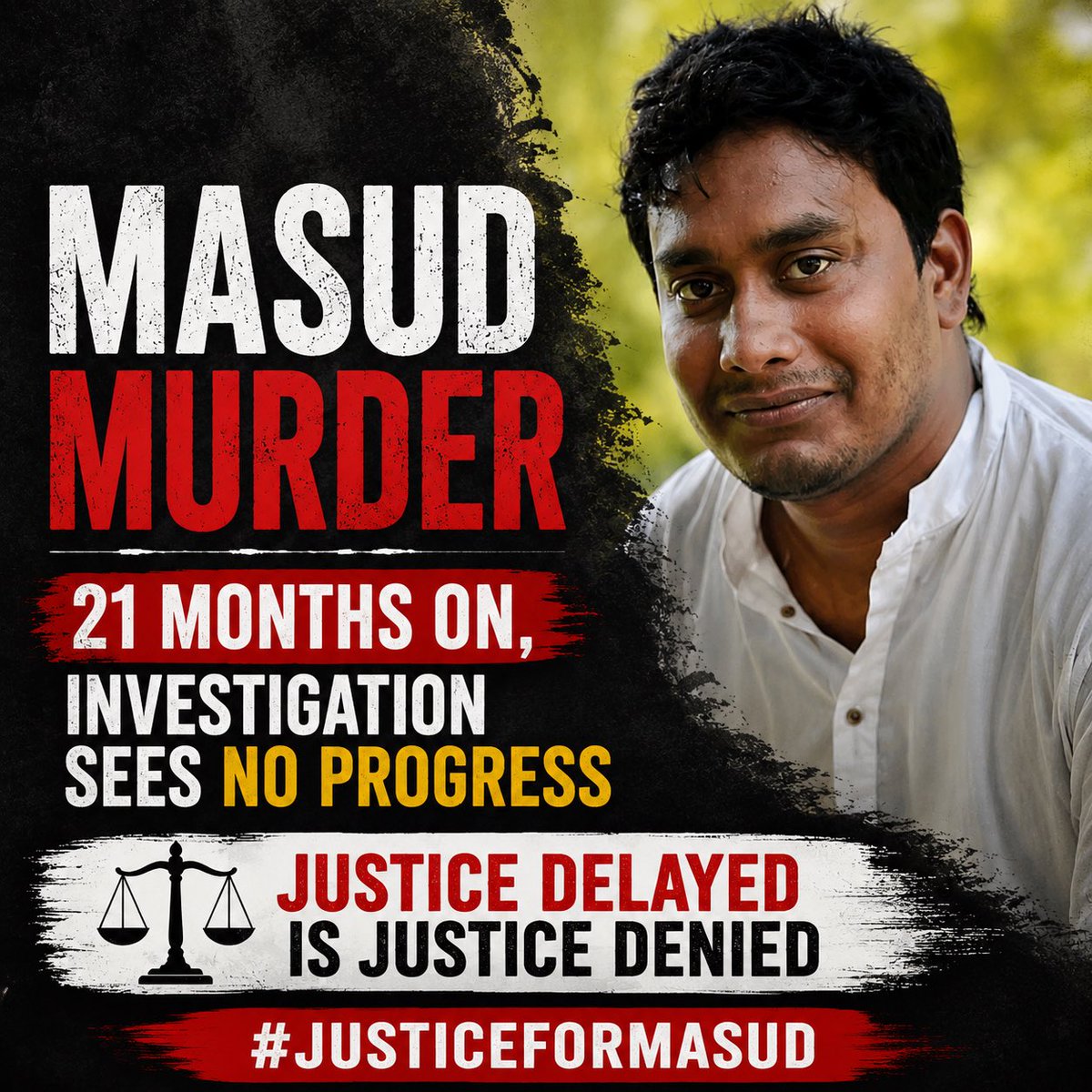
A person with a disability. Beaten to death in public. The identities of the perpetrators are known. A murder case has been filed. Yet, nearly two years later, the police appear to have no interest in investigating the brutal killing.
Almost two years have passed since the murder of former #Rajshahi University #ChhatraLeague leader Abdullah Al Masud. His family, however, remains deeply uncertain whether they will ever see justice for the horrific killing of their loved one.
Masud's brother, Ayatullah Behesti, filed the murder case as the complainant. Speaking to the media recently, he spoke of his frustration over the complete lack of progress in the investigation. According to him, the police have never contacted either him or any member of his family regarding the case.
Behesti further alleged that, when he went to file the case, the police instructed him not to name anyone as an accused and instead keep the case open-ended. He pointed out that video footage of the assault clearly exists and that the perpetrators are known and identifiable. Despite this, not a single arrest has been made.
One of the principal accused is Salahuddin Ammar, the Islami Chhatra #Shibir (the student wing of #JamaatEIslami)-backed General Secretary of the Rajshahi University Central Students' Union (RUCSU). At the time of the incident, he also served as the Convener of the Students Against Discrimination (#SAD) Movement at Rajshahi University.
The other alleged perpetrators are also known to have been associated with Shibir and the SAD movement.
The fatal attack on 7 September 2024 was not the first act of #violence Masud had endured.
On 29 April 2014, he lost one of his legs in an earlier attack allegedly carried out by Shibir. Since then, he had been living with a prosthetic leg.
Just four days before his death, Masud had become the father of a baby girl for the first time. On the day of the attack, he had left his home to buy medicine for his newborn daughter from Binodpur Bazar.
He was assaulted by a group of people, who reportedly broke his remaining leg. Instead of being treated as a victim, he was taken to Boalia Model Police Station by the “mob” attackers themselves.
This was however, not uncommon in the "new" #Bangladesh following the fall of the #AwamiLeague Govt. People are assaulted because of their political affiliations, while law enforcement, instead of arresting the attackers, arrests or detains the victims based solely on those same affiliations.
One particularly heartbreaking video, recorded inside the police station while Masud was gravely injured, captured him saying:
"I came to Binodpur Bazar to buy medicines. They attacked me because I was once part of the Chhatra League. But they severed my leg back in 2014. All my tendons were slit. I have not been with the Chhatra League for a long time."
None of that mattered.
Masud later died in hospital.
He left behind his four-month-old daughter, his wife, his brother, and countless other loved ones.
Nearly two years after his killing, the investigation appears to have made no progress.
Will his family ever receive justice?
As things stand today, that remains an increasingly distant prospect.
News: https://t.co/WAZGwR3Fsc
…
#BangladeshCrisis @amnestysasia@AgnesCallamard@omctorg@meeganguly@PearsonElaine@StateDRL@justiceinfonet@S_Asian_Rights@ESandersFCDO@AFP@CIVICUSalliance@BonaveroIHR@forum_asia@HRF@UN_SPExperts@DoughtyStIntl@volker_turk@UN_HRC@omctorg@FreefromTorture@TheDavidBergman@cnni
Questions Raised Over Police Account After Seven Awami League Supporters Reportedly Killed
The deaths and disappearances of Awami League supporters following a police operation during the party’s anniversary procession in the Turag area of #Dhaka, have sparked widespread discussion on social media. While police have dismissed claims surrounding the incident as “baseless”, eyewitnesses have given accounts that differ significantly from the official version.
No confirmed figure has emerged for how many people jumped into the river or remain missing. However, several eyewitnesses said they saw a number of #AwamiLeague supporters jump into the #Turag River near Ashulia Bazar on 22 June while fleeing a police chase. They also alleged that police detained some individuals after they came out of the water and continued searching the area afterwards.
The police account and eyewitness testimony present conflicting versions of what happened.
Key questions remain unanswered:
👉 How many people entered the river that day?
👉 How many returned safely?
👉 And what happened to those who did not?
So far, four bodies have been recovered from the river, while relatives claim that several others remain missing.
The police have denied allegations of wrongdoing, and the circumstances surrounding the reported deaths and disappearances have not been independently verified. Families of those who died or remain missing continue to seek answers about what happened and whether those responsible, if any, will be held accountable.
Read Full News from @bdnews24com
https://t.co/DTUT3vhtKS
#Bangladesh #HumanRights
📷 “They killed my mother. Their plan was to kill our entire family.”
These are the words of Anwar Hossain, whose mother, Monowara Begum of Katli Village, Netrakona, was killed on June 1, 2026.
According to his testimony, his family had faced repeated threats for months because of his political activities and social media posts. He says he was forced to leave home after August 2024, and when he returned during Eid, their family was allegedly targeted. He further alleges that after his mother was killed, his father and brother were also attacked.
Every allegation of politically motivated violence deserves an independent, impartial, and transparent investigation. Justice must prevail, regardless of political affiliation.
#AwamiLeague #BNPJamaatViolence #HumanRights
In the early hours of 27 June, Zubayer Hossain Parvez, Organizing Secretary of Gopal Union Jubo League in Feni’s Chhagalnaiya Upazila, was brutally killed near his home after reportedly being attacked with sharp weapons.
According to the allegations, the attackers were linked to BNP and Jamaat. Parvez had been released only four months earlier after spending 15 months in prison.
Political disagreement can never justify murder. If these allegations are true, those responsible must be identified through a credible investigation and held fully accountable under the law. Violence has no place in democratic politics.
#Bangladesh #HumanRights
Targeting of #Students Based on Political Affiliations Continues in #Bangladesh: #ChhatraLeague Activist Arrested During Master's Viva Voce Despite No Criminal Complaints.
The policy of targeting and persecuting students solely on the basis of their political affiliations, initiated under the #Yunus-led Interim Govt, appears to be continuing under the #BNP Govt led by Prime Minister #TariqueRahman.
On 28 June, 24-year-old Shojib Ali, a Master's student in the Department of Islamic History and Culture at #Rajshahi College, was apprehended by fellow "students" and handed over to the police while appearing for the final oral exam (viva voce) of his Master's programme.
His alleged offence? Being an activist of the Chhatra League, the student wing of the #AwamiLeague.
Shojib reportedly has no criminal cases or complaints against him. Nevertheless, he was unlawfully apprehended by civilians before being arrested by the police solely because of his political affiliation.
News:
https://t.co/cWfhnku1Zn
A few weeks ago, we highlighted the plight of students associated with the Chhatra League. Hundreds of university and college students affiliated with the organisation have reportedly been expelled or suspended without hearings, investigations, or any meaningful opportunity to defend themselves. In many cases, students were not even informed of the specific allegations against them.
The human cost has been equally significant. Many affected students reportedly find themselves socially ostracised and treated as outcasts. Others have gone into hiding out of fear of arrest, harassment, or retaliation.
One student reportedly has not returned home for two years. Another was unable to attend the funeral of a close family member. In numerous cases, criminal proceedings have been initiated not only against students but also against their parents, extending the consequences far beyond the individuals directly involved.
The psychological toll also appears severe. Living under constant uncertainty, social stigma, and fear has reportedly left many students struggling with anxiety, isolation, and despair. Some have even experienced suicidal thoughts.
Report:
https://t.co/y95tqkOzFi
These incidents raise serious concerns about the continuing use of political affiliation as a basis for punitive action within Bangladesh's higher education system, with profound implications for academic freedom, due process, and the fundamental rights of students.
…
#BangladeshCrisis @UNESCO@UNHumanRights@hrw@volker_turk@amnestysasia@StateDRL@ESandersFCDO@BonaveroIHR@EURightsAgency@Kennedy_HRC@HRF@forum_asia@GEMReport@PearsonElaine@paulocasaca1