Faculty Research Ast at the Center for Quantitative Life Sciences.
Focused on genome assembly, gene annotation, and identifying R-genes. Vining & Deluc Lab.
I’m very proud to announce my first publication. Featured on the cover of G3 Genes | Genomes | Genetics. The haplotype-resolved genome of European hazelnut will be a valuable resource for the plant breeding program here at Oregon State University.
https://t.co/iyXvAq5wKU
@amiralito_ Nice work! Question. Did the team look into accuracy of the helixer predictions? We’ve found even BRAKER3 has trouble over NLR regions due to high TE density.
@parmita It’s going to take a lot more people than Demis. It will require a consortium similar to the human genome project, but maybe another order of magnitude. Our datasets aren’t enough and the metadata isn’t there, but with earth biogenomes project there will be the backbone for it.
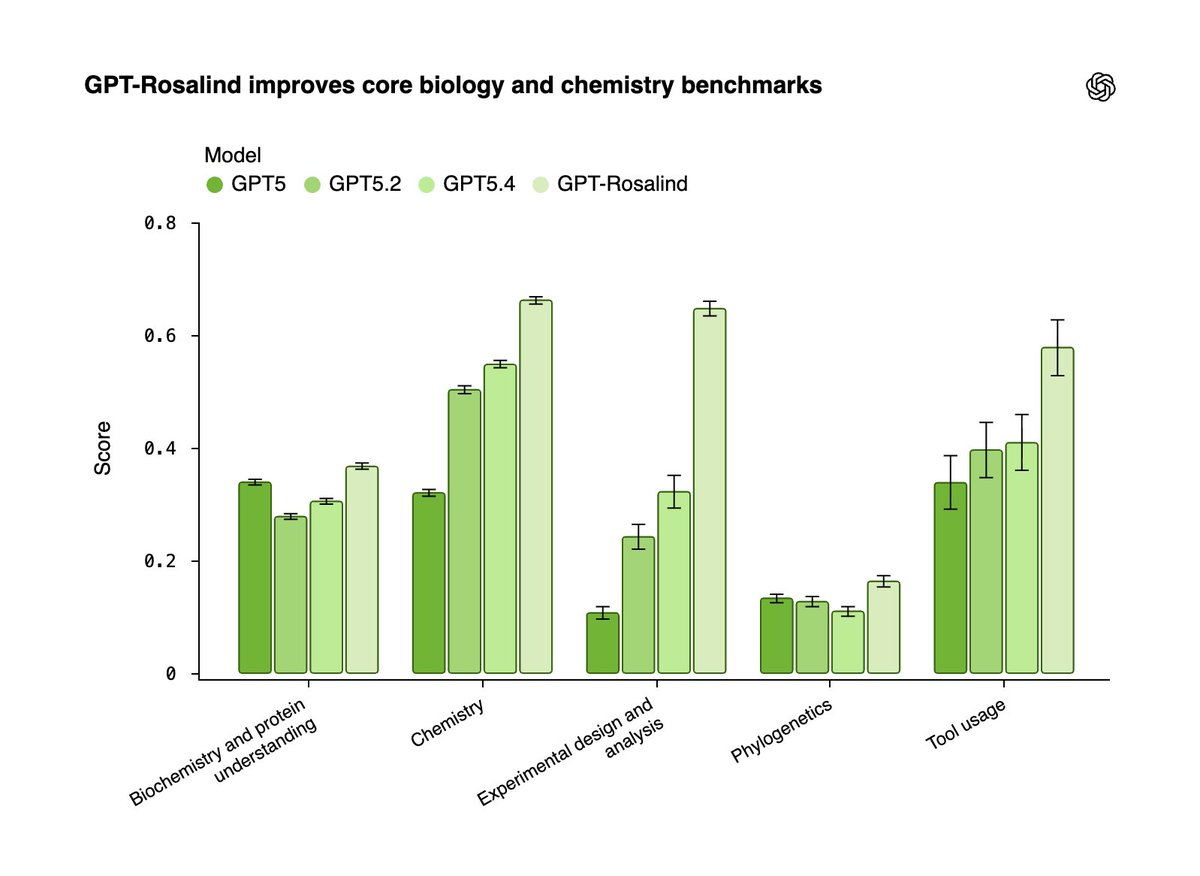
GPT-Rosalind, our Life Sciences model series, is optimized for scientific workflows, with stronger performance in protein and chemical reasoning, genomics analysis, biochemistry knowledge, and scientific tool use.
@yutang_mpb_eth Thank you!
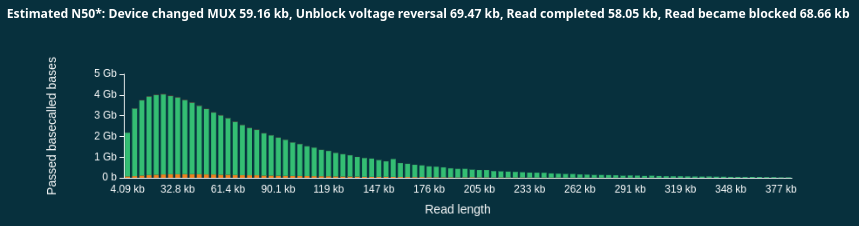
The plot shows all read level Q10, not the per base Q score. This was with basecall v5, after rerunning using v5.2 we recover more UL reads. But yes as reads get larger you can expect read error to increase, although i’m not sure by how much.
A Nanopore ultralong run we just did for Hop! Nearly 110Gb off a single flow cell with the true N50 probably >70Kb. Very excited for this one 🚀🧬
#ONT
@agus3260 All thanks to our team here. It’s mostly a dna extraction problem. There are so many variables it’s hard to pin it down on one thing. The most important part is minimizing transfers, and being extremely gentle. Dark treat your plant tissue too!
Finally using pixi to write up all code for a project. Multiple sub environments, with underlying tasks and scripts + singularity container calls within. Excited to just include the .toml + .lock with publication and be done with it. Should have done this months ago!
DNA 🧬 has been out a week and it’s been amazing to see how it’s landing. Big thanks to everyone who’s listened, shared or danced to it with me. Huge love to @genesiofc and Aya Anne for making this one with me. 🖤
Download / Stream → https://t.co/eXLHQkEqfZ
Can we make it easier to submit gff files to genbank? It is so convoluted and time consuming compared to a genome upload. I’m still seeing papers say “check figshare” tempting me to do the same.
Pleased to share this free link to our new review of genome annotation in @NatureRevGenet, which just appeared today. Co-authored with Hyunjoo (Hayden) Ji and Mihaela Pertea @elapertea. We focus particularly on human annotation: https://t.co/4uv2FRUiyY
Preparing a 20min talk for a broad audience interested in AI and GPUs. Three case studies: metagenome assembly binning (LORBIN), gene prediction model generation (Tiberius) and pangenome variant calling (DeepVariant).
Yes, I will be speaking fast. 1 slide for installs though!
@acarroll_ATG@EBPgenome@Googleorg Excited about this for the VGL! What would be really cool is to use trio assemblies to support a truth set model for implementing deepvariant calls across some of these specific endangered species of interest. Might be hard to get that parental data but still !
@Psy_Fer_ I can’t speak to the P2i but, it seems good? The p2S took a lot more configuring, and prices of GPU have only increased. That said p2S seems potentially more durable long term…