The CEO of Chainalysis and the Global Head of Policy for TRM Labs have named TraderTraitor, a hacking group tied to North Korea, as the party responsible for the Binance hack. Sources: https://t.co/NmfLT9dq59 https://t.co/r9bPflYYCh
There are 3 really simple things you can do to protect yourself against 90% of social engineering attempts. Most of these operations are casting a big net and just trying to scoop up unsuspecting fish. So make yourself a slightly harder target and they will pass right over you.
1. Don’t ever answer the phone for unknown numbers. Even when the location says Mountain View, CA, or the caller ID says Google. It’s fake! To ensure you don’t get tricked, set your phone setting to Silence unknown numbers automatically. On iPhone it’s Settings ➡️ Phone ➡️ Screen Unknown Callers ➡️ Silence (see screenshot). Many times, bad actors are using fear over the phone to get you to do things you shouldn't - like give them control of your email.
2. Add 2FA to your main email account, and make sure it uses a unique, strong password. Use either an authenticator app or a Yubikey (better) as your 2FA. https://t.co/66IU1dr4JC ➡️ Security & sign-in ➡️ Turn on 2-step verification. Then make sure your password is a unique password that isn't used anywhere else. If you are using the same password in more than one place, it's highly likely that it's been leaked. Just go to https://t.co/TczLKPVWyk, put in your email address, and look at how many leaks its been in.
3. If you use Google Authenticator, turn off the cloud sync. When you have cloud sync on, if someone compromises your Google account, they can steal your 2FA. It makes 2FA ➡️ 1FA, and that is bad.
These are the basics that you can do to protect yourself against a huge amount of social engineering. And then if you want extra protection for your BTC, check out the next post 👇
This was the second time we ran the Research Experience for Undergraduates program at @bitcoinpolicy and I think we improved on last year and made the experience a memorable and impactful one for our interns. Our internship is designed to produce work with an immediate impact on policy and education around bitcoin. It is also a way to introduce and integrate the next generation of bitcoiners into the industry. Our interns are prepared for the real world, not just for academia.
I'd like to grow the program a bit more next year. If anyone out there would be interested in sponsoring our interns, please DM me.
Hi, we are currently seeing a new wave of phishing. We have confirmed that attackers are using a combination of data from various database leaks across different crypto services. It's possible that some KYC information may have been compromised, and attackers are trying their luck.
We also experienced a security breach involving our third-party tool and the email addresses of our newsletter subscribers some time ago. This could be related. We reported the incident and took measures to prevent it from happening again. We understand it's bad, and we sincerely apologize for this. You can read more in this article: https://t.co/SBub2IVEjt
When I was younger (ages 21-24) I would literally spend half of my monthly paychecks on Bitcoin. Sometimes more.
If you’re young and single, I suggest learning to be frugal and doing the same as I did.
I am in a position to never worry about money again the rest of my life.
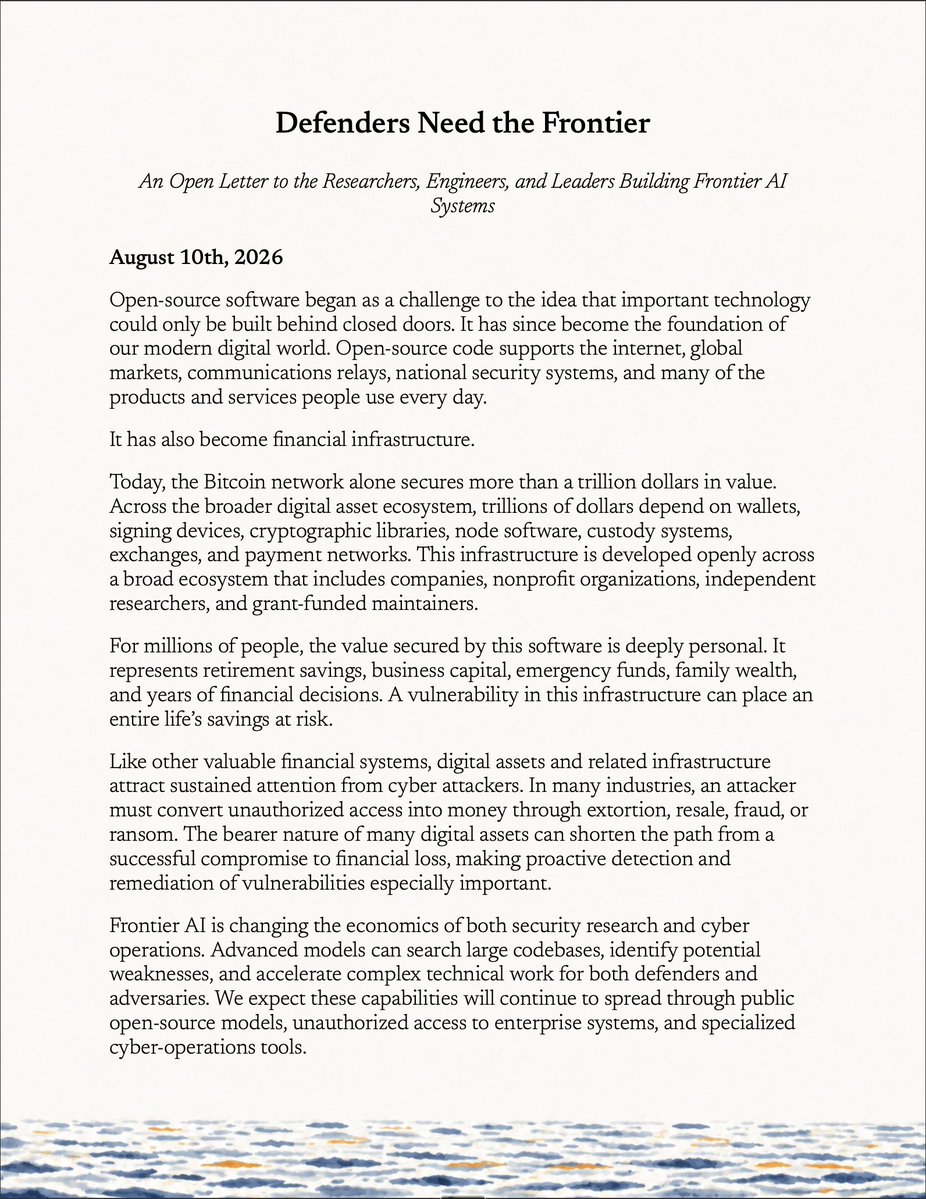
Today, Bitcoin Policy Institute and a broad coalition from across the digital-asset ecosystem are publishing an open letter calling on the world’s leading AI labs to provide qualified open-source defenders with trusted access to frontier AI models.
The past several weeks have made the need for this abundantly clear. The people defending digital-asset infrastructure and open-source software need access to the latest AI capabilities to perform comprehensive security reviews and stay ahead of increasingly sophisticated adversaries.
The coalition includes open-source development organizations, major custodians, treasury companies, payment services, security firms, capital allocators, and others whose businesses and customers depend on the integrity of open-source infrastructure and libraries.
Open-source defenders often occupy the least privileged position in the AI security landscape. They have limited access to the strongest internal cyber models and are frequently blocked by guardrails when using publicly available frontier systems for legitimate security research. As a result, they often resort to less capable open-weight alternatives.
We are urging frontier AI labs to establish a clear, trusted pathway for qualified open-source and digital asset defenders to access their strongest capabilities, with sufficient compute and secure environments to conduct meaningful security reviews. Frontier AI could become one of the most powerful defensive technologies ever developed, but only if defenders get fair access to those systems.
It’s time to give defenders the tools they deserve.
Read the open letter, add your organization, or sign as an individual on our website at https://t.co/cUTwQ5ugXJ