This increases demand when we need to be decreasing it. It boosts already high inflation when we need to be decreasing it. It makes the budget deficit worse when we need to be making it better. And this government has an abysmal record of ending subsidies. Other than that I really like it.
Well, that didn't take long.
Yes, halving fuel excise would be dumb.
It'd increase demand for fuel *and* the savings would be spent somewhere else in the economy, increasing inflation *there* instead.
Populist policies are not helpful.
It’s unpleasant to see mainstream frame the issue in this way. Instead of turning young Australians against older Australians, we should be asking harder questions about the policies that inflated our asset prices and eroded purchasing power in the first place. It wasn’t the “boomers” who designed tax incentives, monetary expansion, or deficit spending. It was governments and the central banks. When currency is expanded faster than productivity grows, purchasing power falls. Asset holders benefit. Wage earners fall behind. That’s not a generational war, that’s a conscious policy choice.
Young and old Australians have more in common than the childish headlines like this suggest. Most retirees aren’t living large at all, they’re also struggling with higher energy bills, food prices, insurance premiums and growing healthcare costs.
The real debate shouldn’t be age versus age. It should be:
- How do we restore purchasing power?
- How do we align immigration, housing supply and infrastructure?
- How do we stop inflating asset prices through structural incentives?
- How do we grow productivity instead of just paper GDP growth?
Divide and distract is politically convenient for the duopoly. Structural reform is much harder. Don’t fall for these cheap political tricks.
Agree with the Governor, at no time has the RBA been responsible for house prices - although it can influence them. It has always been politicians and the regulators that could define prices, they are they ones that can limit lending, define risk, reduce tax incentives/concessions etc.
Similarly they also define supply and demand. They former moves too slowly and they won't do anything about the latter.
Populist central bank bashing does nothing to help affordability. We wouldn't worry so much about what the RBA does if politician had not allowed houses to become so expensive and the debt needed to purchase one so onerous.
https://t.co/Qj3UGtWi8u
Yield on US 10-yr bond, now 4.44% following the trade war "pause" was 3.60% in September, when Fed began *cutting* rates. Fed controls overnight rate, but not the long end of yield curve, which usually determines the rate on new and refinanced UST debt, and thus interest expense.
You would struggle to find a more depressing election campaign. No one has any vision or ambition for the future it’s all just bribing voters and kicking the can down the road.
Another band-aid, that'll aid sellers far more than buyers and does absolutely nothing to address underlying affordability.
But they can say 'at least we're doing something' and hope people don't think more deeply.
Politics, huh?
#auspol#qldpol#ausbiz
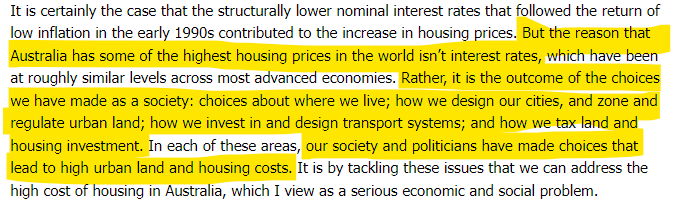
Wise words from RBA Governor Lowe on why we have such expensive housing in Australia - hopefully we can one day fundamentally address the issues referred to by him.
We need to stop the 'RBA Governor is out of touch' rubbish
Sustained high inflation is much worse than temporarily high(er) interest rates
You want his head on a pike for looking after the country?
Yet you're not taking the pollies to task for fiscal policy?
#ausbiz#auspol
The boom in commodity prices is very, very welcome.
And should have been used to fortify the national balance sheet, not frittered away on handouts.
Just like the wasted mining boom in 2011.
#Budget2022
Someone feel free to let me know how 'responsible economic managers' can justify - if it happens - not acting to bring the budget back toward balance with unemployment at 4% and the economy growing?
More *net* tax cuts is simply awful national economic policy.
*Reads "Nuclear Energy" Wikipedia article for 5 minutes*
Here's my take on how this nuclear power plant situation will play out, and what it means for global energy markets: ���👇
The more nervous the market gets, the more it overweights the short term and underweights the long term.
That, right there, is the opportunity for the patient, stoic, long term investor.
#ausbiz#ausinvest#investing