New post: "Go-to-Market" is the most bastardized concept in enterprise tech and SaaS. The answer lies not in the high falutin polished powerpoint deck but rather, in the nooks and crannies of your operating machinery. https://t.co/GZ3kgZsLpi #saas#ensw
If you’re a founder, every time a key employee leaves your competitors, you should pick up the phone and call them.
They will always talk to you.
They are building their networks.
They could be a good hire.
Or a great source of intel.
Either way, to them the war is over.
When I was at Outreach, the Sales leader of my competitor left. I immediately reached out to him to congratulate him on a great fight.
Through chit chat, I quickly learned how he won deals against me. I learned his product positioning “we are basically like Outreach but cheaper”.
And the strategy of the company?
Their strategy was to not fight us on product, just claim that the products are undifferentiated and beat us on price. So we were immediately able to figure out how to adjust our sales playbook so we can anticipate that objection.
We would always ask who else are you talking to, and when this competitor’s name came up, we would warn our buyer “they will tell you our products are the same, but here is where they are not the same …”.
Having that line in our sales process helped us deal with the “products are the same” objection our competitor would plant in our buyer’s head.
Our competitor would follow through with their playbook, but the buyer was now warned and informed - so it was our competitor who lost credibility.
This raised our win rate for the next 2 quarters.
Until they changed tactics, and back at it we went.
The difference between wars and businesses, is that wars end …
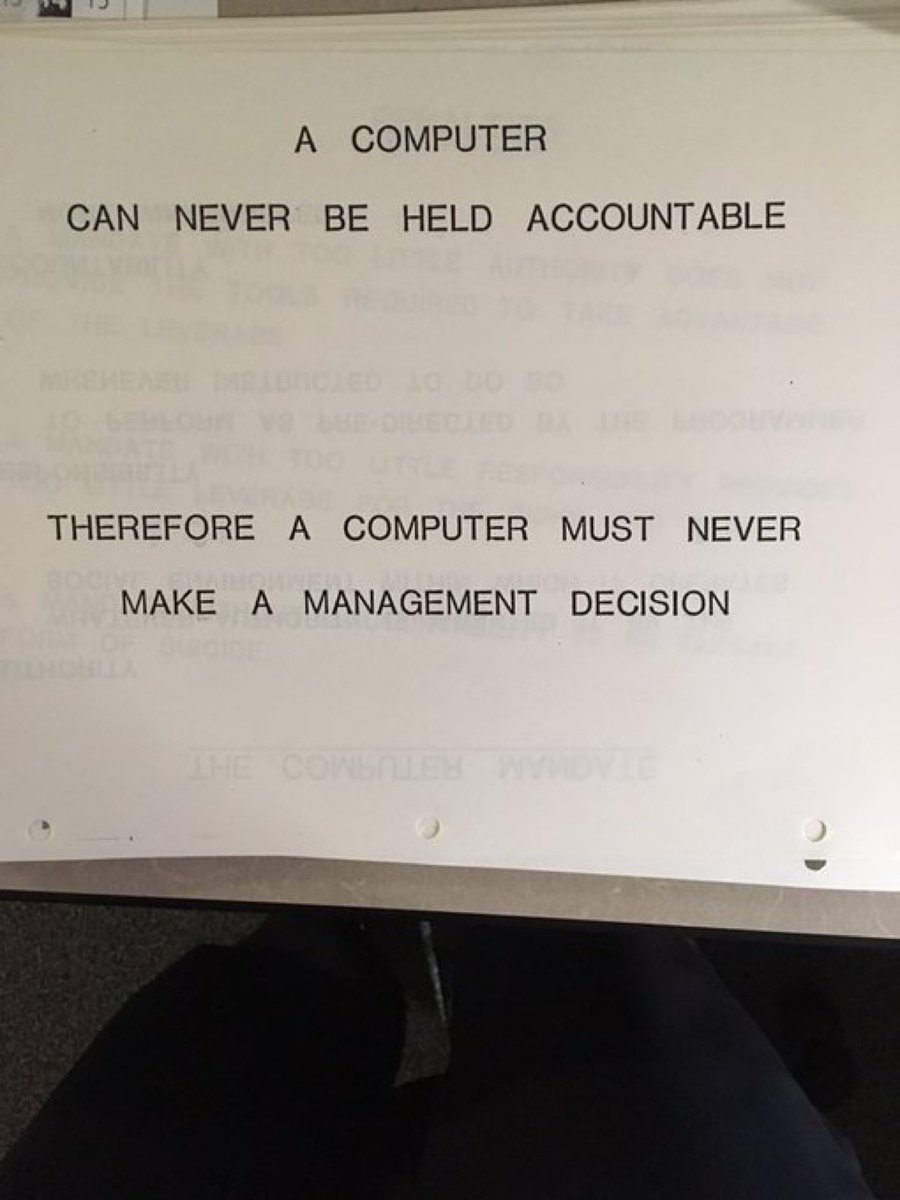
Imagine replacing 90% of your employees with a team of geniuses who have no idea how your company operates.
Total chaos. Nothing works.
That’s what AI feels like today.
The missing piece is extracting all the domain knowledge from people’s heads and providing that as structured context to the models.
Germany is a sleeping giant of physical AI
everyone's been writing Germany off in the AI race because there's no German OpenAI and no big data center story.
but theres actually two AI races happening:
the first is software. chatbots, LLMs, data centers. US/China are winning that, not even close.
the second one is physical. robots that pick up boxes, weld cars, carry groceries, stack pallets.
and on this one Germany is one of the top contenders in the world
this stat might convince you (it convinced me):
Germany is 3rd in the world for robots per factory workers (449 robots per 10,000 human workers).
only South Korea (1,220) and Singapore (818) are ahead.
Japan is behind at 446. the US is all the way back at 307.
so Germany already runs more of its economy on robots than almost anywhere else on earth.
and the German companies building this next wave of physical AI are some global heavyweights.
a few worth knowing...
> Neura Robotics in Metzingen is building humanoid robots and raising €1B from Tether at a €4B valuation (this was March 2026). Volvo already in from an earlier round.
> Sereact in Stuttgart raised $110M in April 2026 to build the software brain that lets robots see and grab things. already runs 1 billion+ real-world picks for BMW, Mercedes, and Daimler Truck.
> Agile Robots in Munich was the worlds first robotics unicorn. revenue doubling yearly, around €200M now, heading for €1B.
>RobCo in Munich raised $100M in early 2026 at a ~$500M valuation. their robots learn new tasks by watching a worker do it once instead of getting programmed line by line. already pushing into the US and aimed at the small and mid-size factories that make up most of german industry.
> Fraunhofer (Germany's network of 76 applied research labs) built the evoBOT in the video below. self-balancing, two arms, carries 100kg of cargo, being tested at Munich Airport right now.
but why is Germany specifically well positioned for physical AI though?
three things stack on top of each other.
first, the factories. Germany has thousands of family-owned precision manufacturing shops that have been logging sensor data for decades.
that data is basically the training fuel for physical AI and almost nobody else has it at this depth.
second, the customers are already there in-country.
VW, BMW, Mercedes, Porsche, Bosch, Siemens. a robotics startup in Stuttgart can ship its first commercial deployment to a brand everyone recognizes in year one.
that's why Sereact's customer list reads like a german car show lol.
third, the engineer pipeline. Fraunhofer spins out companies like Agile Robots straight from its labs. KUKA built the first 6-axis electromechanical robot arm back in 1973. they've been doing this for 50 years.
so the chatbot race is mostly settled and Germany lost spectacularly
but the robot race is still early innings. and i think Germany's well positioned
The CEO of Goldman Sachs is taking the other side on the pessimistic takes on AI and jobs.
If you looked at what work looked like a few decades ago and saw how much faster everything is or easier it is to produce the same thing as before - even before AI - you’d certainly have been convinced there’d be no jobs left.
What happens is we constantly just demand more from everything. Instead of automating a task and delivering the same value proposition, but cheaper, we just expect more from the overall product or service. Because some players in the market decides to do more with the automation, and it raises everyone’s expectations. So those that don’t respond can’t compete.
We get more financial analysis from analysts. We get much more comprehensive legal advice. We get more tailored financial services offerings. We get better software in niches we never thought we could automate. Our healthcare providers offer more tests and deeper medical advice. This just goes on and on.
When you move from believing the world is static and you’ll have a better view of how jobs evolve due to AI.
According to the @microsoft 2026 Work Trend Index, 66% of AI users say AI has allowed them to spend more
time on high-value work.
58% say they’re producing work they couldn’t have a year ago. That rises to 80% among Frontier Professionals, the most advanced AI users in their research.
The explosion of agentic AI and compute shortages are pushing up prices: Average LLM token costs are now $2.12/mil tokens,+12% this week alone and +65% since end of Feb.
🇮🇳 India's Airbound unveiled their autonomous drone that takes off like a helicopter and flies like a plane, and weighs less than a bag of sugar.
It is built from carbon fibre and covers up to 40 km on a single charge.
Two titles and squash world ranking points to play for on the road to #LA28. 👀
Get up to speed on the 2025-26 PSA World Championships with 128 of the world's best squash players competing in Egypt. ↔️
📸: @PSASquashTour / @WorldSquash
My biggest regret as founder of Outreach: I stopped trying to kill the competition.
Early on, I had no choice.
We raised 2M. Yesware had raised 30M. ToutApp had raised 60M. It was either they lived and we died. Or the other way around.
So we out-innovated them. And it worked.
But then I got talked into getting soft.
"Focus on your own race."
"There will be many winners."
"They can own X, you can own Y."
"Focus on employee engagement and Glassdoor reviews."
"Focus on brand and culture."
That was all bullshit.
Your job as a VC-backed founder is to win. And to win big. Full stop.
You need to be a multi-x returner to your VCs. They hired you to do that job. If you split the market, the most likely exit is a PE acquisition. Not great for your VCs, not great for you. That’s how you get fired.
Killing your competition IS your job description. If you're not up for it, don't be a founder.
Let's be real. We all want to create monopolies. No one actually wants to compete.
The founders who pulled it off had incredible runs. Made fortunes for themselves and their investors. They got disrupted eventually. But while they held the monopoly, it was untouchable.
Here's how they did it:
1- Acquire your competition
DiscoverOrg bought its two biggest rivals (ZoomInfo and RainKing) and became what is now ZoomInfo. They were the only contact data solution for almost a decade.
OneTrust bought every top player in trust and privacy. They reigned uncontested for 10 years.
2- Drown your competition
Salesforce was not the first CRM to move to the cloud and take on Siebel. But they outspent every other cloud CRM into irrelevance. Marketing. Advertising. Feet on the street. By the time competitors looked up, Benioff was on CNBC and no one had heard of Act or Goldmine.
3- Have dumb competitors
ServiceNow was the first ITSM to move to the cloud. The incumbents (BMC and HP) just didn't follow. Who the fuck knows why. ServiceNow destroyed them.
The playbook after that is simple: become #1 and kill #2. Then watch for any challenger coming from the side. Especially ones with momentum. Copy their offering. Bundle it into your product. Suffocate them before they scale.
Apollo would not exist if Outreach had bundled data with workflows.
Gong would not exist if Outreach had bundled call recording.
Those are billion-dollar companies built in gaps I left open. Because I listened to people who told me to "stay in my lane."
I watched Apollo hit a $1.6B valuation selling data to my own customers. I have to live with that every day.
Founders who stick to their knitting end up splitting markets.
Founders who expand to conquer everything touching their business live on.
That's why Uber's market cap is 30x Lyft's. Uber was run by a maniacal visionary who would not stop at anything. I don't even remember who ran Lyft.
Do you?
Winners are expansive, aggressive, and they play to win.
That's the job.
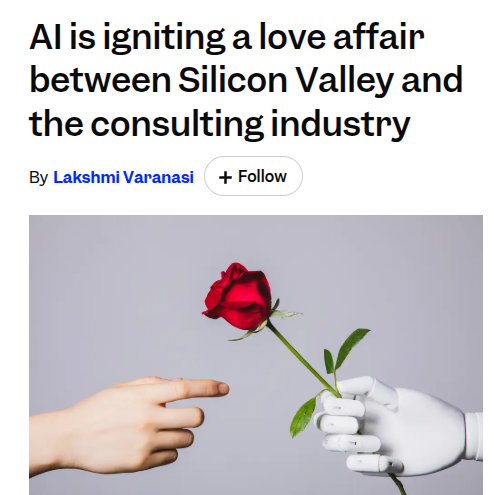
Google is turning consultants into its AI delivery network with a $ 750M fund for firms like McKinsey, Accenture, and Deloitte to help companies build and scale agentic AI.
Consulting firms need this because classic consulting work, such as research, slide drafting, process mapping, and software planning, is exactly the kind of work AI systems are starting to automate.
AI startups need consultants because big companies rarely buy new tools just because the model is powerful, since they need someone to connect it with data, workflows, security rules, and staff habits.
Agentic AI means software that does not only answer questions, but can plan steps, call tools, move through business systems, and complete tasks with less human steering.
So Google’s bet is that McKinsey can find the business problem, Google can provide the AI stack, and the client can turn a pilot into a working system across teams.
OpenAI’s reported push to sell Codex through Accenture, Capgemini, and PwC points to the same shift, where AI coding tools become enterprise software only after consultants package them into training, governance, and rollout plans.
---
businessinsider. com/consulting-mckinsey-accenture-bcg-ai-silicon-valley-enterprise-partnerships-2026-4
3 of the top 10 Gross Revenue Retention SaaS Companies focus on the Physical World
Procore - 95%
ServiceTitan - 95%
Costar - 89%
Tough markets to crack
Great markets to win
President of @Blackstone Jon Gray says LLM spend among the company's portcos is up 15-fold in Q1 of this year over last year.
At the same time, the pace of implementation is frustratingly slow, so it still feels like we're in the very early days of the AI cycle:
"It's sort of the beaker-to-bedside problem in clinical trials — 'We've got this great medicine. How do we get it to the patient?'"
"That is the challenge. But we are definitely finding more and more use cases."
"At our companies, their LLM spend — by the way, we have 270 companies, 13,000 pieces of real estate, it's massive in its scale — was up 15-fold in Q1 of this year over last. It's off a small base, but it tells you what's happening. And all of these companies are trying to find ways to be more efficient."
"To us, on the compute side, it still feels like it's very early days in the implementation. But we can see, particularly in rules-based businesses — transaction processing, legal, etc. — this feels like the path of travel in a big way."
"But I think it's taking more time than most of us would hope."
Did you know between 1957 and 1976, there was a regular bus service between London and Calcutta, India.The 32,000km, 50 day, 2-way bus route is the longest in the world.
The bus had sleeping bunks and even a kitchen! For just £145, you get to travel with food & accomodation. The bus would stop at attractions and for shopping in Vienna, Istanbul & Iran
The bus ride took passengers from England to Belgium, West Germany, Austria, Yugoslavia, Bulgaria, Turkey, Iran, Afghanistan, Pakistan and Northern India.
The $1.9T enterprise AI slice isn't the interesting number — it's the *revision* that matters. Citi had to mark up its forecast by $700B because enterprise adoption is outpacing the model. The question isn't whether enterprise AI is real anymore. It's whether the GTM infrastructure (GSI practices, partner ecosystems, deployment playbooks) is scaling fast enough to capture it.
https://t.co/SFd79eElbC
🇺🇸 Un emprendedor estadounidense corta botellas de whisky recogidas de la basura para fabricar vasos de lujo que vende a 200 dólares cada uno. Además, casi sin coste.