@ProjVictoria@keithmarlowau That is a very standard economics pov. Most economists would agree with the statement. They would all say the reason we don’t is just historical inertia because tech and institutions weren’t good enough to accurately and quickly deal with implementation in the past (they are now)
@Timberwolf_1@disco___cat@AvidCommentator Mining productivity is very volatile because it's numerated by very variable output. Long term mining has been a boon to overall national productivity gains but in the last few years it's actually been a detractor.
@arekdrozda@AvidCommentator What’s being measured is output divided by work hours; you can increase that statistic by for eg; simply dropping 10% work hours and only producing 9% less. Whether that is a good or useful way to think about it is a different question.
@heilun_chan@LinkofSunshine@sfmhmmad “In the fourth year” and “four years” mean different things. The former means less than four. Just because the answer is not >2x by 3 years but reaches 2x before 4 years does not mean the answer is 4 to 8. The answer is still less than 4.
@BobKnezevic You could make household disposable income go ballistic by dropping interest rates back into real negative and blowing out the public deficit to something like -7% GDP ala the USA. Not sure they would actually be wise or welcomed decisions politically or macroeconomically.
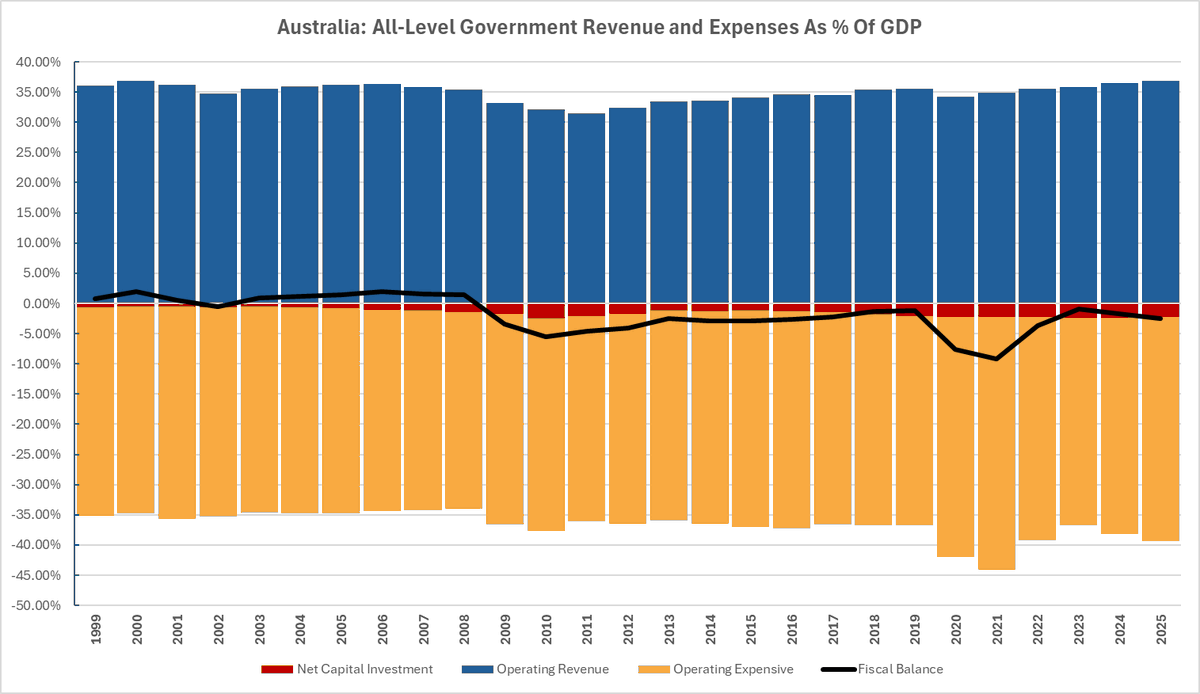
@BobKnezevic Not really a useful statistic when thinking about what could or should be done policy wise; the drop from 2022 is itself mostly an accounting result driven by the all-level public sector deficit dropping from -10% of GDP to -1% of GDP and interest rates going up from 0.1%.
@sandylanceley I do think Labor just doesn’t care much as the realistic result once factoring in soft protestors switching back to majors come voting and ON candidate quality repelling 3 digit IQers and LNP v ONP fighting, is that Labor wins. They can bleed some more primary; they still win.
@HeadLenn@arbsmichael@RBAInfo Just bcuz money = debt in aggregate doesn't mean that individual banks don't have to actively manage risk. Deposits & bank debt are forms of funding they use to back their capital position. Balance sheet management allows banks to compete on profitability given market constraints
@tax_oz@DCash64939 If productivity and real incomes doubled but taxes and gov spending more than doubled through that process, has there been a decline in living standards ?
@DCash64939@tax_oz Most “government workers” are teachers nurses police and emergency services. AI can certainly trim up back office work if used correctly. But most people employed in the public sector are pretty labour intensive jobs that will struggle to be automated to any material degree
@tax_oz@DCash64939 If we know productivity growth makes labour-intensive services dearer and capital-intensive production cheaper, should we reasonably expect productivity growth to keep public sector spending as % of GDP, mostly driven by services, flat or declining against the same service level?
@DCash64939@tax_oz A lot of the movement in taxes & spending people see is just movement between levels; the real increase in all-level spending is about 1-2% of GDP over the last two generations driven entirely by structural changes in demographics; more seniors getting welfare & age/healthcare.
@grok@huntersnintendo@Giuliano_Mana@grok Do taxes in Singapore fund strong public services or do CFP contributions
What are the CFP required contribution rates for workers in Singapore
@tax_oz@GrahamY To get the same economic transfer in Australia it would be something like the Aus gov acquiring Australia's private rental properties for what they were worth in 2000 and then selling them back to current tenants for 30% discount to their 2026 market value.
@tax_oz@GrahamY I wouldn't view the lease 'themselves' as nationalised, but the only way the Sing Gov can sell those houses at a price which works out commercially is by already owning the land, and they own the land because they nationalised it for pennies off large investors in the 70's.
@GrahamY Additionally, they are a low "tax" country, but they are not a low "government ownership and control" economy. I'm inferring here, but I don't believe you would accept the trade for lower taxes in return for significant direct government ownership & control in Australia.