Managing Partner&Wealth Manager, Passionate Investor, Rotarian ,Market Cycles, Meditation, Philanthropy, Music Lover &
Actor. Make the world a better place.
39 years of growth. Built by our people. Fuelling wealth, building careers, creating tomorrow.
Proud to share MOFSL ranked 61st in India's 100 Best Companies to Work For by Great Place To Work.
#BeMOreAtMOFSL#PeopleFirst#GreatPlaceToWorkEffect#MOFSL#MOPW
Driven by people. Defined by culture.
Proud to be recognised at ABECA 2026 as:
• Top Rated Mid-Sized Company for Women
• #1 Financial Services Company
• #2 Mid-Sized Company
Thank you to our employees for making this possible.
#ABECA2026#MotilalOswal#MOPW
Really good and sensible points by @Nithin0dha
The KYC, Round tripping and Tax monsters that the Indian system is obsessed about are total capital flow killers from NRIs.
India needs a national objective of attracting USD 100 Billion per year and then systematically removing each and every micro process that obstructs this objective.
If INR of 96 to USD doesn’t trigger a deep examination of our IT/KYC/Round tripping obsession, nothing will @FinMinIndia@PMOIndia
13 consumer categories in India that are either blowing up or about to-
1/ Pet care doubled from $1.8B to $3.6B in 4 years. projected $7.5B by 2028. supertails raised $20M+. Drools is at ₹40K Cr. but nobody's doing fresh pet food delivery (huge in the US via Ollie, Farmer's dog), pet insurance, or pet-friendly travel. The pets have moved from the balcony to the bed; they are dependents now
Wars, Conflicts and Markets: The 100 year story
Just before the Russia Ukraine war started in 2022, we did a study of every single major geopolitical event going back 50 years: the two Gulf Wars, Afghanistan, 9/11, US bombing Libya etc
And what we found was that in every case there was turmoil in the markets just before and after the incident but in 6 months to one year, the stock markets (of countries not in the conflict) had forgotten about the disruption.
Obviously there were not enough data points for a statistical study but the study did not need to be statistical, because it happened every single time.
I could not find an exception to this pattern.
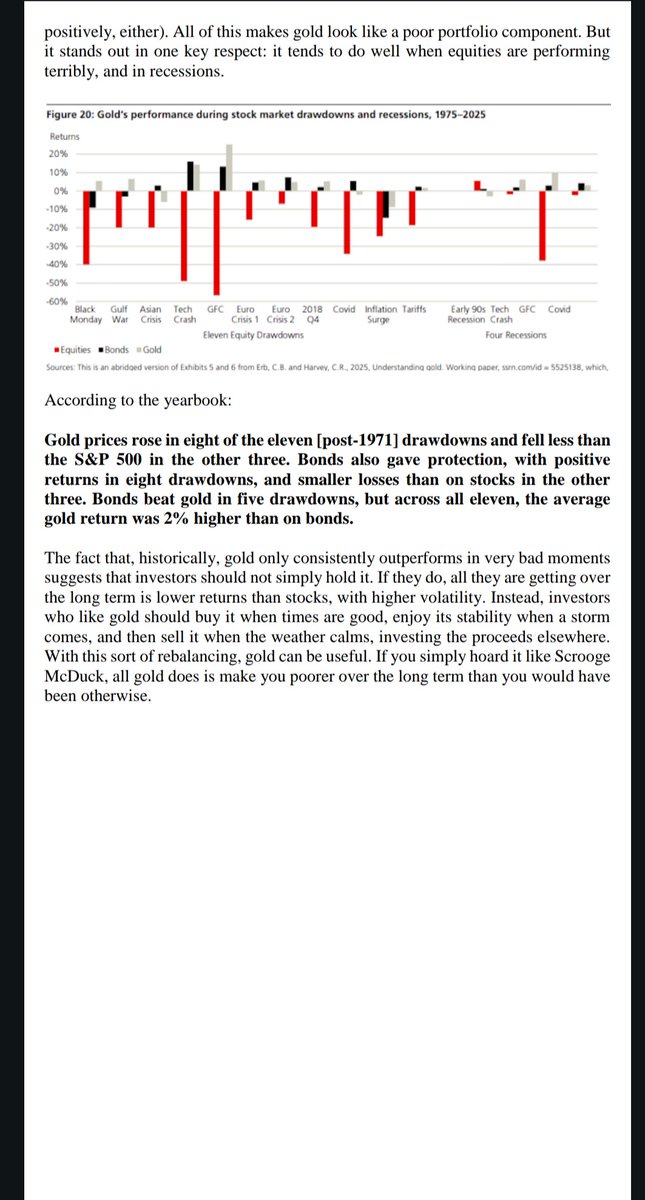
While we had done the exercise going back little over 5 decades, a recent piece in Financial Times entitled, ‘On ignoring geopolitics, buying
bubbles and hoarding gold’ went back to 1900.
This included the two world wars which killed crores of people (the second World War literally KILLED 8 crore people - 3% of the world population, nearly two thirds of them civilians) only to come to the same conclusion: that it is not worthwhile selling out due to geopolitical upheavals. It has an impact only if the countries are directly in conflict and especially if they are defeated (think Germany and Japan)
Otherwise, the big dislocations in the markets have not been due to geopolitics. The extreme crashes were due to other reasons, from the 1929 depression to the 2000 Tech crash to the 2008 Global financial crisis.
More on this in my column in Mint tomorrow
And yes what about Gold?
As I have repeated many times in the past, the FT piece also concludes that gold over the long term gives lower returns AND higher volatility than equities.
It is not a safe haven, nor is it a good inflation hedge. Stand alone its value is mainly at times when equities are doing terribly. How it works as a part of a Portfolio is a story for another day.
Want to understand this further from a practical view point? Send a DM to @firstglobalsec@livemint@FinancialTimes
The most important chart in the Middle East right now isn’t about oil. It’s about missile math.
Zineb Riboua’s “Iranian Missile Stockpile vs U.S. Interceptor Capacity” shows a brutal asymmetry: Iran’s missile inventory and annual output climb steeply through 2030, while U.S. interceptor stocks stay almost flat. In a prolonged exchange, the side that can keep firing longer wins – and that curve increasingly favors Tehran, not Washington.
We just saw a live stress test of this model. In the 12‑day Iran–Israel war last year, the U.S. fired around 150 THAAD interceptors – roughly a quarter of its entire inventory – and interception rates fell as magazines emptied. Rebuilding those stocks at current output will take years, not months.
Marco Rubio put it in plain language this week: Iran is producing “over 100 missiles a month,” while America can only build “six or seven interceptors a month,” on top of thousands of Iranian one‑way attack drones. That’s not a tactical problem, it’s a structural one. At some point, volume beats precision.
Layer on the supply chain: high‑end interceptors depend on rare earths and critical minerals where China still dominates mining and processing. Beijing has already tightened export controls and Washington is now scrambling to build a strategic stockpile and spend up to $1B securing non‑Chinese supply. Without that, you can’t truly scale U.S. missile defense production.
Put together, the chart is more than a visual. It’s a warning: Iran’s arsenal is increasingly underwritten by Chinese materials and manufacturing resilience, while U.S. deterrence is capped by magazine depth and mineral dependence. Fixing this means treating interceptors and critical minerals as the core of 21st‑century defense industrial policy, not an afterthought.
A Day 3 recap of the war (with focus on Iranian strategic narrative):
🔹CENTCOM confirms that U.S. strikes on Iranian missile bases used B-1 bombers. The U.S. is trying to dismantle Iran’s fortified underground missile facilities.
🔹Iranian reports suggest Tehran has rejected multiple mediation attempts. Tehran’s apparent assessment is that it can sustain high-intensity conflict for 60-90 days, making early ceasefire acceptance strategically disadvantageous.
🔹Ali Larijani explicitly framed the war as a contest of endurance, stating Iran – unlike the United States – is prepared for a prolonged conflict. The objective appears to be altering Washington’s cost-benefit calculations over time.
🔹Iranian strategic discourse increasingly describes the conflict as a “war without rules” or a “game without red lines,” signaling deliberate unpredictability intended to reshape deterrence dynamics after leadership decapitation failed to halt Iran’s response.
🔹A related concept emerging in Iranian messaging is operating “one level above” adversary actions, i.e., delivering escalatory responses even to indirect threats in order to redefine escalation thresholds.
🔹This logic appears reflected in Iranian strikes toward British facilities in Cyprus, interpreted domestically as retaliation for London allowing U.S. access to Diego Garcia despite not joining offensive operations.
🔹One of the most consequential developments was the loss of three U.S. F-15 aircraft, initially claimed by Iran as shootdowns but later attributed to friendly fire from Kuwaiti air defenses, highlighting the growing risks of coalition battlefield congestion.
🔹Analysts close to Iranian security circles describe a layered missile strategy: first targeting radar systems, then launching low-cost drones and missiles to exhaust air-defense interceptors before deploying advanced weapons later.
🔹Iran’s continuous missile launches therefore appear designed less for immediate damage and more for attritional depletion of U.S. and Israeli defensive systems over time.
🔹Uncertainty over the size and dispersal of Iran’s advanced missile stockpiles may explain intensified U.S. and Israeli strikes against underground facilities and missile infrastructure.
🔹President Pezeshkian expanded emergency authorities across ministries and provincial administrations to ensure continuity of governance, deepening wartime decentralization already initiated before the conflict.
🔹Israel’s targeting pattern has become clearer: strikes now heavily focus on intelligence ministries, police headquarters, IRGC district bases, and internal security institutions, suggesting systematic erosion of regime coercive capacity.
🔹Parallel strikes against western border regions and Kurdistan province have fueled Iranian fears that external actors may seek to enable insurgent infiltration as an alternative to direct ground invasion.
🔹Iran has responded by striking areas in Iraqi Kurdistan while increasing pressure along its borders, indicating concern about a potential indirect ground dimension to the war.
🔹Iran-aligned Iraqi resistance factions – including Kataib Hezbollah, Harakat al-Nujaba, and Kataib Sayyid al-Shuhada – continue their operations on a limited scale, opening another attritional front against U.S. forces.
🔹Hezbollah formally confirmed its participation, firing rockets toward Haifa, though involvement remains limited due to degraded capabilities and domestic political constraints in Lebanon.
🔹Iranian sources claim prewar coordination between the Quds Force and regional partners defined phased entry into the conflict, suggesting activation of the “axis of resistance” is proceeding gradually rather than simultaneously.
🔹The IRGC has reportedly begun enforcing a de facto closure of the Strait of Hormuz, warning commercial vessels against transit and threatening missile strikes. This is a major escalation targeting global energy flows.
🔹Simultaneous attacks on Gulf energy infrastructure, including an Aramco facility near Ras Tanura and gas infrastructure in Qatar, indicate an effort to raise global energy prices and increase economic pressure on Washington.
🔹Iranian authorities signaled zero tolerance for dissent. IRGC intelligence warned that actions undermining stability during wartime would be treated as collaboration with the enemy, implying harsh internal repression.
🔹Negotiation signals remain contradictory. While Trump suggested a potential deal was possible, Larijani publicly rejected negotiations, reinforcing Tehran’s view that talks can occur only after strategic calculations shift.
🔹Iran’s sustained missile tempo against Israel appears designed to impose psychological as well as military pressure, keeping populations under prolonged shelter conditions while conserving firepower for a longer conflict.
🔹Overall, Day 3 shows the war evolving into simultaneous military, economic, psychological, and regional escalation far beyond bilateral confrontation.
🔹The key question now is whether expanding proxy involvement and energy warfare will force external powers into deeper participation or instead accelerate pressure for negotiated containment.
---
P.S: Not sure how long I can keep doing this!
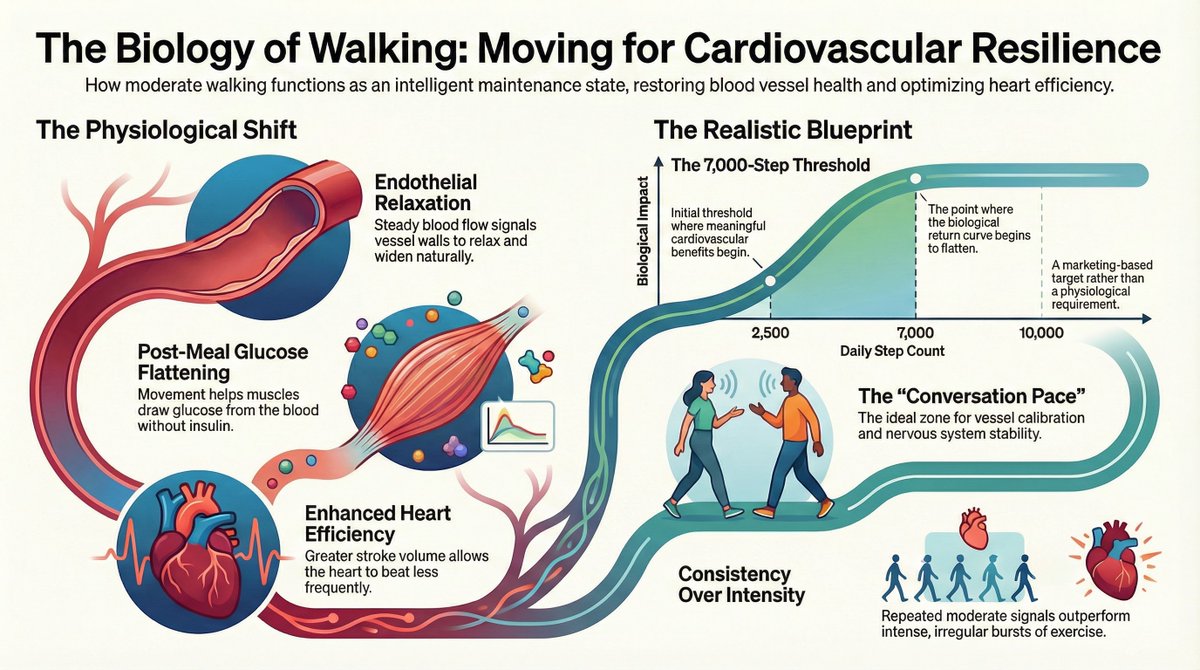
WHAT WALKING ACTUALLY DOES
Your heart isn't the problem. The pipes are.
Most cardiovascular disease starts with stiff, resistant blood vessels forcing the heart to push harder against mounting pressure. The pump itself works fine until the system wears it down.
Walking fixes this at the source through steady flow stimulating vessel walls to relax and cooperate.
Blood vessels have an inner lining called endothelium. When blood flows consistently past it, the endothelium releases signals that make vessels widen.
No force required. Just regular use preventing stagnation. As vascular resistance drops, each heartbeat becomes less strained. The heart stops fighting its own infrastructure.
This happens fast. Within minutes of walking, blood flow patterns shift. Vessels detect the change and begin adjusting. Not dramatically. Quietly.
The nervous system stays calm because the body doesn't interpret moderate movement as threat. You're not triggering alarm responses. You're entering an intelligent maintenance state where efficiency improves without drama.
THE STEP COUNT FALLACY
Biology doesn't care about 10,000 steps. That number is marketing, not physiology.
Large observational studies show meaningful cardiovascular benefits starting around 2,500 to 2,700 daily steps. For sedentary people, that tiny increase produces disproportionately large gains.
First steps carry the highest biological return. The curve flattens past 7,000 steps, where the cardiovascular system gets most signals it needs for flexibility and resilience.
This matters because fixation on arbitrary targets creates unnecessary pressure. People cycle between intense bursts and burnout instead of building sustainable rhythms.
The body doesn't track your calendar. It integrates signals over time. Even hitting higher step counts one or two days weekly offers protection compared to nothing.
Walking stops being a task and becomes collaboration with your own biology. That's where durable benefits emerge.
PACE TEACHES PRECISION
How you walk matters nearly as much as how much. A moderately brisk pace creates gentle challenge space where heart and vessels must coordinate more precisely while staying fully controlled. Not suffering. Calibration.
Faster cadence produces stronger, smoother blood flow. Vessel walls expand more dynamically. The heart fine-tunes rhythm and contraction strength to maintain stability.
With repetition, the cardiovascular system learns to handle above-normal conditions gracefully, preparing infrastructure for peak loads while everyday operation remains quiet.
A pace allowing short conversation signals the ideal adaptive zone. In this range, the cardiovascular system receives clear learning signals while the nervous system stays stable enough to support recovery.
Advanced, highly efficient walking is interval walking, where a faster pace alternates with an easier pace.
THE POST-MEAL WINDOW
After eating, blood glucose rises and the body redirects flow toward digestion. For people with metabolic dysfunction or sedentary habits, this becomes quiet vascular stress. Sharp glucose spikes directly affect endothelium, creating less favorable environments for vessel function.
Light walking after meals intervenes remarkably gently. No intensity needed. Movement allows muscles to draw glucose from blood through insulin-independent pathways, flattening post-meal peaks and reducing metabolic stress on vessels. Blood flow redistributes evenly. The endothelium receives its familiar signal: steady, moderate flow without shock.
This protects vessels at their most vulnerable moment. Even healthy people experience cumulative stress from repeated daily glucose spikes. Walking after meals doesn't erase modern eating patterns but softens metabolic edges enough to reduce unnecessary cardiovascular strain over years.
It uses a window that already exists. A few minutes of movement after eating sends a powerful biological message. The system is supported, not overwhelmed.
WHAT CHANGES OVER TIME
Consistent walking produces measurable traces. Blood pressure drops modestly, but over years this reduces cumulative vessel strain and translates into tangible cardiovascular risk reduction.
Resting heart rate lowers not pathologically but because each beat becomes more efficient. With greater stroke volume, the heart beats less often to meet resting demands.
Large population studies show walking habits correlate with lower rates of cardiovascular events and all-cause mortality at moderate activity levels. Not extremes. Biological consistency.
The deeper change is harder to chart. Everyday movements trigger less alarm. Heart rate rises less dramatically for the same effort. Breathing steadies faster after exertion. Stress recovery improves as the cardiovascular system becomes flexible and confident rather than locked in prolonged alert mode.
These aren't flashy shifts. They quietly reshape how heart, vessels, and nervous system coordinate daily. From that stable foundation, the most durable cardiovascular health builds through intelligent repetition, not intensity.
THE EVOLUTIONARY FRAME
Humans evolved moving frequently at moderate intensity throughout the day. Not to train. To survive. Our cardiovascular systems optimized for that environment: steady movement, manageable demand, minimal prolonged alarm.
Walking is the closest modern behavior to that evolutionary template. It doesn't trigger excessive survival responses or force the heart into battle. Instead it sends a familiar signal: environment safe, demand reasonable, efficiency preferred.
Modern science confirms what intuition suggested. From sustained blood pressure reductions and lower resting heart rate to improved vascular flexibility and faster stress recovery, walking doesn't just improve numbers. It re-educates how the cardiovascular system responds to life itself.
A body not constantly over-activated recovers better, tolerates stress more effectively, ages more slowly. Walking doesn't grant immortality but allows systems to operate as designed. That alignment is the foundation of long-term health.
Perfection isn't required. Not 10,000 steps. Not pain. Not force. Just small, correctly timed, repeatedly delivered signals. Biology rewards consistency, not extremes.
Walking is a daily message to heart and vessels that the world is manageable. In an era defined by chronic pressure, that message might be one of the most powerful forms of medicine we still underestimate.
Nifty mid cap has rallied from 56126 to 60800 today in just 7 days up 8% ! The small cap index has also moved up in similar fashion.
Lagging portfolios will catch up soon as the broad market is now performing, if not already.#nifty#Midcap#smallcap#marketrecovery
Last one on this topic, and I have been holding this in myself for a while.
For centuries, class divides kept the labor of the poor invisible to the rich. Factory workers toiled behind walls, farmers in distant fields, domestic help in backrooms. The wealthy consumed the fruits of that labor without ever seeing the faces or the fatigue behind it. No direct encounter, no personal guilt.
The gig economy shattered that invisibility, at unprecedented scale.
Suddenly, the poor aren't hidden away. They're at your doorstep: the delivery partner handing over your ₹1000+ biryani, late-night groceries, or quick-commerce essentials. You see them in the rain, heat, traffic, often on borrowed bikes, working 8–10 hours for earnings that give them sustenance. You see their exhaustion, their polite smile masking frustration with life in general.
This is the first time in history at this scale that the working class and consuming class interact face-to-face, transaction after transaction. And that discomfort with our own selves is why we are uncomfortable about the gig economy. We want these people to look our part, so that the guilt we feel while taking orders from them feels less.
We aren't just debating economics. We are confronting guilt. That ₹800 order might equal their entire day's earnings after fuel, bike rent, and app cuts. We tip awkwardly, or avoid eye contact, because the inequality is no longer abstract. It's personal.
Pre-gig era, the rich could enjoy luxury without moral discomfort. Labor was out of sight. Now, every doorbell ring is a reminder of systemic inequality. That's why debates explode. It's not just policy. It's emotional reckoning. Some defend the system (“they choose it”), others demand change (“this isn't progress, its exploitation”).
And here’s the uncomfortable twist: the unsaid ask of clumsy ‘solutions’ isn’t dignity. It is about returning to invisibility.
Ban gig work and you don’t solve inequality. You remove livelihoods. These jobs don’t magically reappear as formal, protected employment the next day. They disappear, or they get pushed back into the informal economy where there are even fewer protections and even less accountability. Over-regulate it until the model breaks, and you achieve the same outcome through paperwork instead of slogans: the work evaporates, prices rise, demand collapses, and the people we claim to protect are the first to lose income.
And then what happens?
The rich get their old comfort back. Convenience returns without faces. Guilt dissolves. We go back to clean abstractions and moral posturing from a distance. The poor don’t become safer, they become invisible again: back in cash economies, back in backrooms, back in shadows where regulation rarely reaches and dignity isn’t even debated.
The gig economy just exposed the reality of inequality to the people who previously had the luxury of not seeing it. The doorbell is not the problem. The question is what we do after opening the door.
Visibility is the price of progress. We can either use this discomfort to build something better (which we keep doing continuously as delivery partners are our backbone), or we can ban and over-regulate our way back into ignorance. One of those choices improves lives. The other simply helps the consuming class feel virtuous in the dark.