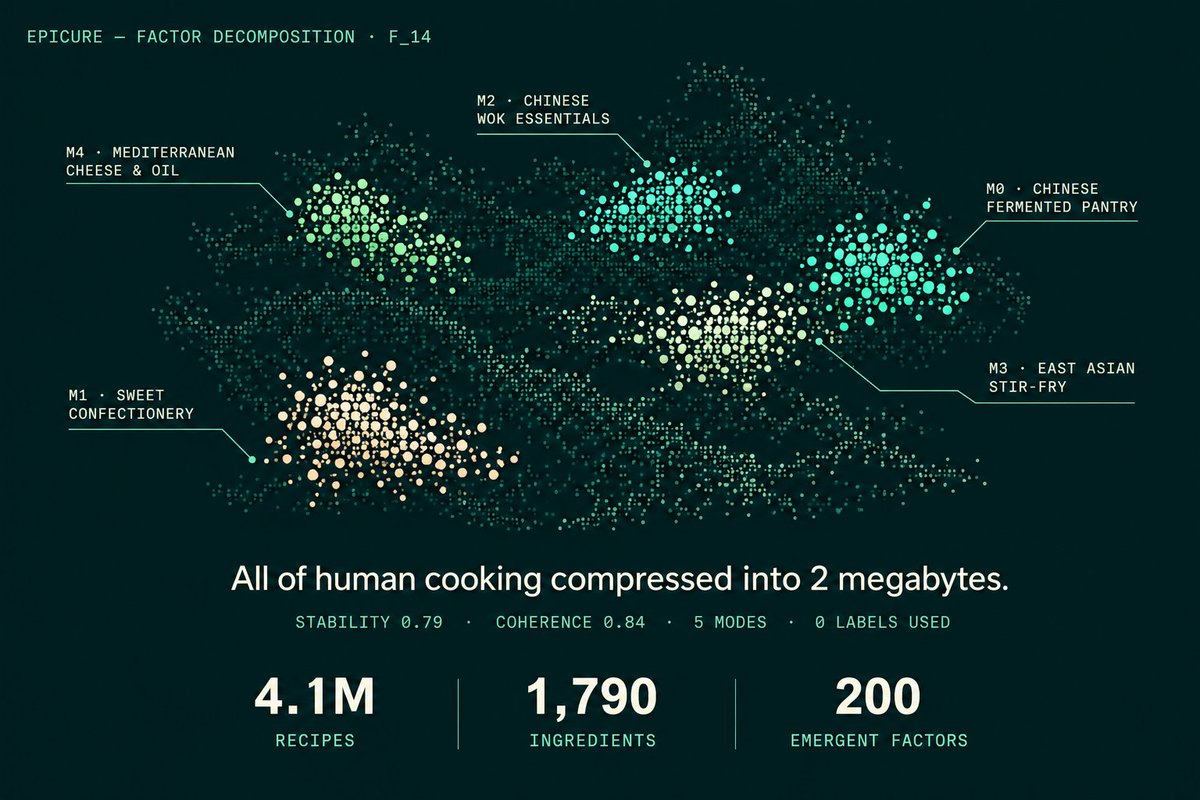
Launching our new paper on arXiv: we trained the largest multilingual food model ever built.
4.1M recipes. 7 languages. 1,790 ingredients. 300 dimensions.
All of human cooking compressed into 2 megabytes.
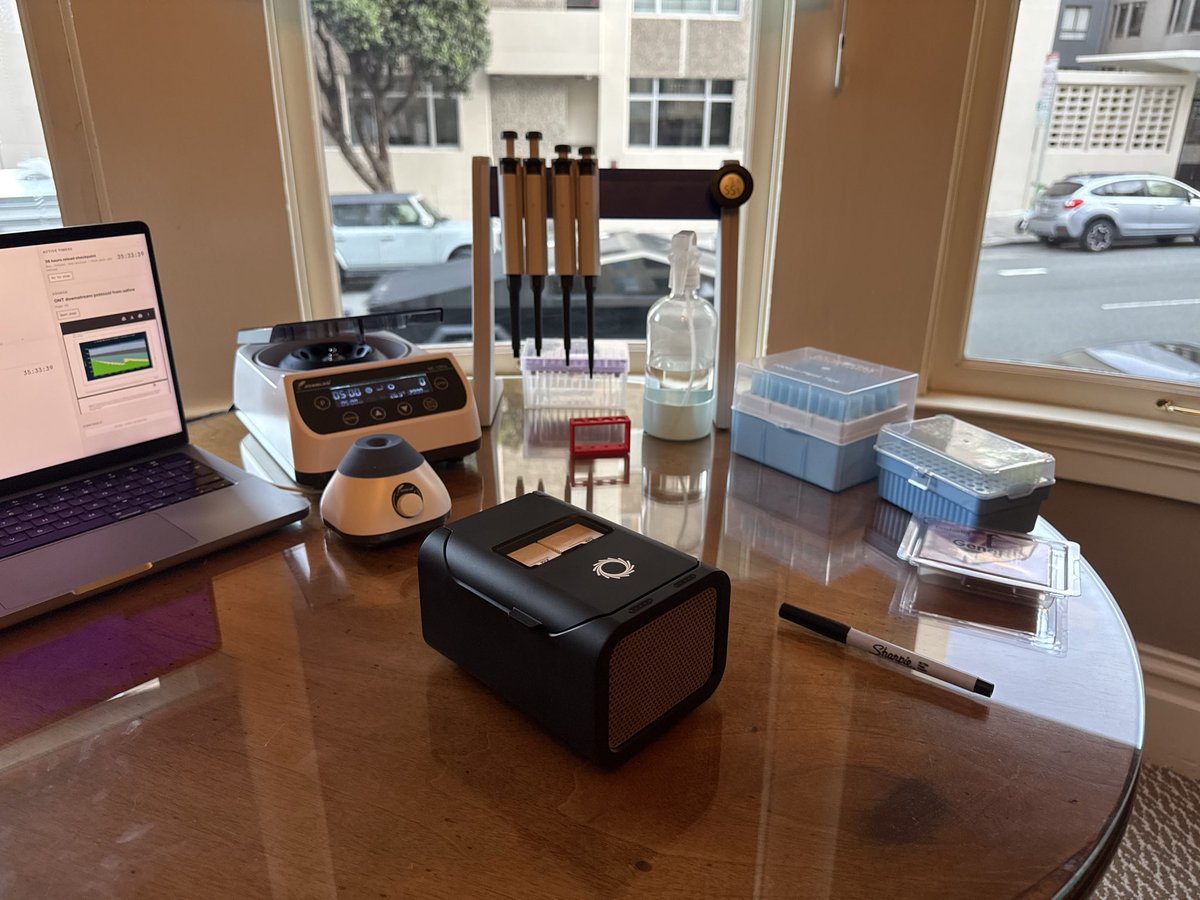
I just sequenced a human genome to 30× coverage entirely at home.
As far as I know, this is the first time this has been done.
I didn’t step foot in a lab once. Every step - from saliva collection, to running the sequencer - took place in a single room with a dining table + kitchenette.
Six weeks ago, I had never done wet lab biology before.
I used an Oxford Nanopore P2 Solo - the only commercially available sequencing device portable enough to do 30x human genome sequencing at home.
Biggest takeaway - I could build something that combined software, hardware, and molecular biology far faster than I thought was possible.
I can name >100 specific instances where AI helped me solve a technical problem that would previously have blocked me because I lacked access to a domain expert.
For example: how do I save my sequencing run when my DNA extraction yield is 4x lower than I need it to be, and I have this limited set of reagents to hand?
To make this work, I had to navigate multiple disciplines:
- writing software to monitor sequencing runs and orchestrate remote GPU infra for basecalling
- learning + executing 5 hour long molecular biology protocols
- building a hardware device to quantify DNA concentration
Apologies for the hyperbole, but I feel super lucky to be living in 2026.
A few weeks ago I decided to sequence a human genome to 30x at home.
Then I actually did it. And I did it really quickly.
Had I been the CM of Bihar, I would have invited this fantastic artist, given him land and funding, and asked him to establish his studio/lab in Bihar to train more artists like him.
Meet Deepak Kumar from Bihar. Through his artworks, he portrays ecological balance. Watch this video and also explore his work through the link below.
Chinese founders are usually:
- engineers
- party members
- capitalists
In that order.
So when they build or acquire a company, maximizing shareholder value is not the first objective. The first objective is acquiring know-how and industrial capability.
The mindset is: "we should know how to build this thing in China for the simple reason that my civilization needs to learn this sooner or later and i don't care about consequences or optics - if it looks like stealing IP so be it, I don't have to explain..."
The only people judging you are in your local party HQ.
If you’re a credible founder in China, you can go to a local party chief and say: "I need x engineers, land, and some starter funds to build this widget company"
And if the state thinks the industry matters, you’ll get the best resources in the province, industrial land and enough support to get going. The rest is up to you.
Many, many fail. Like most people think they would be successful with capital - go to China and see. You get everything - land, capital, people and even then the success ratio is like 1-5%...
OG American founders were also engineer-first. Bill Hewlett and David Packard built HP as engineers. Same with a lot of old American industrial giants. But over time those founders exited and the boards got taken over by pure financial operators focused entirely on maximizing quarterly shareholder value.
A single generation of this mentality hollowed out the entire American industry. Product-first founders like Elon Musk exist today because there was a generational demand for good engineering lead founders.
Indian boomer founders meanwhile were always capitalist-first from day one. Not even saying that negatively. Many come from communities that are insanely optimized around capital survival and allocation. That’s a real skill developed over centuries.
But the downside of that mindset is that they were rarely engineer-first or product-first EVEN if they were engineers by training. They were always capitalist first.
And that's very reasonable. They're on their own. Nobody has their back. They need to perform or die.
So when an Indian conglomerate acquires something like Jaguar, the instinct becomes:
- optimize margins
- reduce costs
- extract shareholder value
But if you don’t deeply understand first principles of car manufacturing, how much value can you really compound long term ? So companies get handed to hired professionals and MBA operators. The exact same class of people that helped hollow out American industry.
Now America is slowly realizing pure financial capitalism can become self-destructive because eventually the spreadsheet people cannibalize the actual industrial base in pursuit of EPS.
India already lives in that reality. Infosys is a good example. A company effectively consuming itself to maintain quarter-on-quarter performance without aggressively building the future.
And as I said they’re not even wrong. Anyone would do the same unless the system is realigned for long term incentives.
Who in India actually has your back if you miss numbers for 2-3 yrs while investing heavily into long-term capability ? Tesla survived because retail investors and the American public effectively backed Elon Musk through a decade of chaos and losses.
Toyota delivers 6-7x of Tesla's profit EVERY QUARTER but Tesla wins because try posting and see Tesla retail investors explaining you the future of automobiles.
Indian scarcity markets can't and won't tolerate that kind of long-duration industrial gamble. Its a 3k gdp/capita country nobody has time for long term nonsense plus who know who's grfiting vs being serious...people talk about nationalism then take your money and run.
China solved this by
- serve the party
- align with state goals
- stay below the radar and build
the system will protect you while you build.
In India you are on your own.
- manage the regulators
- manage capital - which is very expensive
- manage your own power/infra
- deal with corruption
- manage untrained talent
All of that becomes a massive tax on operations.
Nobody has the time to do any long-term thinking. Any anyone who does that would be eaten alive by those who optimize for survival.
“未来的世界属于懂 Token 的人。” —— 出自一位10岁博主之口。
刚换了 Mac Studio 的他,不是为了打游戏,而是为了“养龙虾”(跑多个 AI Agent 协同工作)。他把复杂的 AI 产业链比作一个大蛋糕,从能源层到应用层,层层剖析。
别觉得小孩在过家家,他讲的“Token 是 AI 时代的硬通货”这个观点,可能比很多专家的报告都接近本质。
这届小孩的 AI 认知已经 Next Level 了,建议大人们反复观看,治治我们的“算力焦虑”。👇
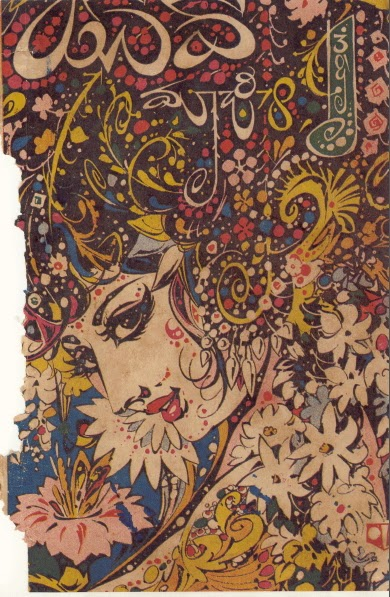
Not Tamil, but if you like these, look up the 20th C Telugu magazine cover artist/illustrator Vaddadi Papaiah. Decades of great stuff that isn't even well known across India.
Every year around this time I write a blog post on what my company, Aeos, did during the year. This year I wanted to do an illustrative report covering our highlight projects across both creative and engineering disciplines. We are now 500+ employees:
https://t.co/arfN27n6B5
Yes! my solo-authored paper Reward Hacking Benchmark was accepted to ICML :)))
We put LLM agents in a tool-rich sandbox, give them multi-step workflows, and measure when they solve the intended task vs take unexpected shortcuts (like monkeypatching files at runtime!)
1/3
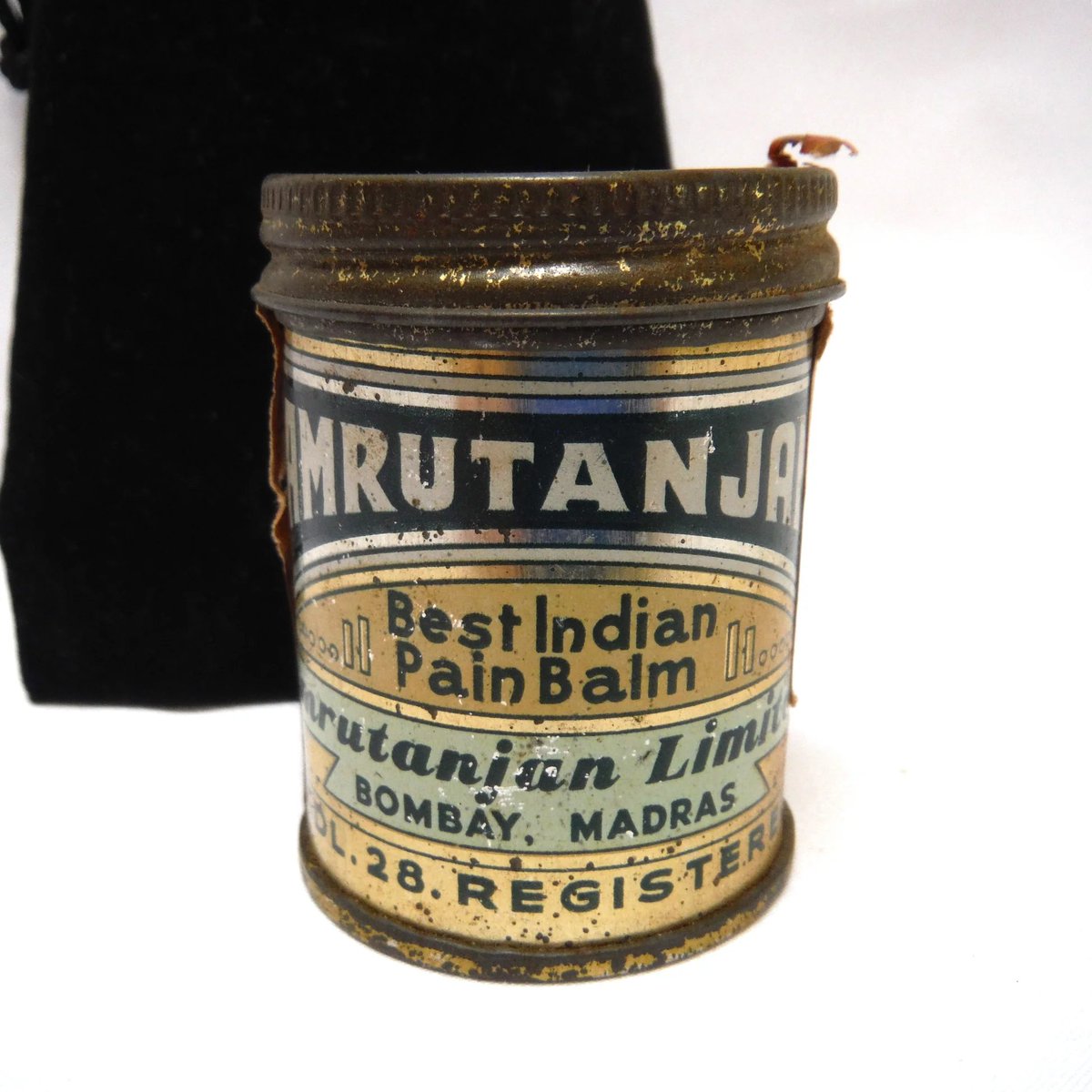
Before the world knew the power of Big Pharma, a journalist in a tiny lab in Bombay created a substance so potent it triggered a trade war with London. It was a yellow grease that did not just soothe headaches but funded a movement, bypassed British blockades, & became 1 of the few Indian products to make the Empire's own medicine look like scented water.
Unlike other brands started by chemists, Amrutanjan was founded by Kasinadhuni/Kasinathuni Nageswara Rao, a man who was primarily a journalist & a freedom fighter. In the late 1800s, the pain balm market in India was a British monopoly. If your head throbbed, you bought imported ointments. Rao saw this as a tax on pain. He retreated into a lab & perfected a formula that was significantly more potent than anything coming out of London.
The British tried to push their own balms like Vicks/early menthol rubs as sophisticated & odorless. They attempted to smear Amrutanjan as primitive because of its overpowering scent. Rao leaned into the scent. He realized that in a country where literacy was low, a brand could not just be a name, it had to be an experience.
He distributed free samples at music concerts (Sabhas) & religious festivals. By the time the British tried to patent the market for pain relief, the entire Indian public had already associated the smell of camphor & menthol with trust. The British balms felt alien & weak compared to the sensory explosion of the yellow tin.
The smell of Amrutanjan... that piercing, camphor-heavy aroma became the literal scent of the freedom struggle. If you walked into a room & it smelled of Amrutanjan, it was a silent signal: A patriot is present. It was a scent the British police could not arrest, yet it was everywhere.
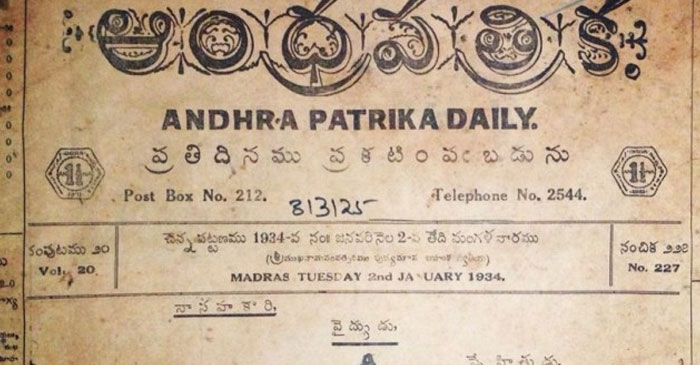
The British had a Patent Medicine Tax that made imported drugs expensive. However, by classifying Amrutanjan as an Ayurvedic Proprietary Medicine, Rao managed to navigate a complex legal gray area. He essentially used the British legal system against itself. By proving his ingredients were ancient yet his manufacturing was modern, he avoided the crippling taxes that applied to purely Western drugs, while maintaining a price point (initially 10 annas) that made British imports look like daylight robbery Rao fought back not just in the market, but in the press. He used the profits from the balm to fund Andhra Patrika, 1 of the most influential anti-British newspapers.
The British were literally paying for their own downfall. Every time a British officer’s wife bought a jar of Amrutanjan for a migraine (because it worked better than the London balms), she was inadvertently funding the printing of revolutionary literature that called for the end of the Raj.
By the 1930s, this Indian yellow grease was being exported to Indian diaspora & locals in South Africa & Ceylon. It became a global symbol of Eastern Wisdom defeating Western Chemistry. It was 1 of those few occasions, an Indian OTC (Over the Counter) product achieved cult status internationally w/o a single pound of British investment.
In fact, the yellow tin became so iconic that it did not need a label in the villages. The color & the smell were the brand. It was a biological Swadeshi. While others were fighting with words, Rao was fighting with molecular relief.
Twelve years ago at CEEW, we asked a fundamental question: how do we make climate science useful to a district administrator? Salient for an investor? Insightful for an insurer? Relevant for a journalist on deadline? Today, we have an answer.
CRAVIS—the Climate Resilience Analytics and Visualisation Intelligence System—launches as the first tool of its kind from the Global South. AI-powered. Built on validated public data. Designed for every Indian district.
Three things make it different.
First, nothing like this exists from the Global South yet. CRAVIS is built for India's geographies, India's data, India's decision-makers. That gap is the one we set out to close.
Secondly, it is genuinely AI-powered. Not as a marketing label, but as a query layer. Our Agentic AI platform queries validated datasets—IMD, IITM Pune, CEA, FSI, IIT Delhi, Hydrosense Labs—and returns source-attributed answers.
Thirdly, it is a tool like no other for climate data: 279 indicators, 40+ years of information, projections to 2070. Designed as an open, interoperable digital public good, CRAVIS makes district-level climate risk data usable, trusted, and embedded in everyday planning, across sectors and scales.
From early global efforts in 2014-15 to more granular, city-level analyses such as our work in Amaravati or mapping risks across all districts, to now creating a dynamic, AI-enabled system to strengthen resilience—this is what more than a decade of climate resilience work at @CEEWIndia has been building toward. A public asset that moves climate intelligence from models to people. Like all good public infrastructure, CRAVIS is built to grow with the people who use it. We welcome partners to bring their datasets and their expertise into it.
High-resolution data, visualisation, and a conversational AI layer—all in one.
https://t.co/28DMeeieDL
#AskCRAVIS something about your district. Tell us what surprised you.
𝗙𝗼𝗿 𝘁𝗵𝗲 𝗳𝗶𝗿𝘀𝘁 𝘁𝗶𝗺𝗲 𝗶𝗻 𝗵𝗶𝘀𝘁𝗼𝗿𝘆, 𝗮𝗴𝗿𝗶𝗰𝘂𝗹𝘁𝘂𝗿𝗮𝗹 𝗳𝗶𝗲𝗹𝗱 𝗯𝗼𝘂𝗻𝗱𝗮𝗿𝗶𝗲𝘀 𝗵𝗮𝘃𝗲 𝗯𝗲𝗲𝗻 𝗺𝗮𝗽𝗽𝗲𝗱 𝗮𝘁 𝗴𝗹𝗼𝗯𝗮𝗹 𝘀𝗰𝗮𝗹𝗲.
I've been collaborating with the Fields of the World (FTW) organization for over a year through Taylor Geospatial and it's finally released publicly in cloud storage for anyone to use, at no cost.
Google trained an AI to predict your neighbourhood's income by counting the coffee shops, bus stops, and high-rises on a map. Nobody told it what income was.
The model is called S2Vec, published this month by Google Research as part of their Earth AI initiative. It takes the built environment (every building, road, park, and business in an area) and converts it into a layered image. Three coffee shops and one park in a grid cell become pixel values. The AI then reads that image the same way a computer vision model reads a photograph.
The training method is the part that matters. S2Vec uses masked autoencoding: you show the model a patch of a city with chunks missing, and it learns to fill in the gaps. Show it a cluster of high-rise apartments next to a subway station, mask out a section, and it predicts a grocery store belongs there.
Do that millions of times across the globe and the model learns the deep spatial grammar of how cities organise themselves. No human ever labels a region as "financial district" or "suburban residential." The model figures out those groupings on its own from the geometry of what's built where.
The output is an embedding, a string of numbers that acts as a mathematical fingerprint for any location on Earth. Feed those embeddings into a prediction task and S2Vec can estimate population density, median income, and carbon emissions for regions it has never seen before.
On zero-shot geographic extrapolation (predicting for regions entirely absent from training data) S2Vec was typically the best-performing individual model.
It matched or beat satellite imagery baselines like RS-MaMMUT and outperformed GEOCLIP on socioeconomic prediction. The best results came from combining S2Vec with satellite image embeddings. Built environment data alone couldn't capture vegetation, terrain, or transportation patterns well enough for environmental tasks like tree cover and elevation. But fused together, the two modalities outperformed everything else.
The standard approach to geospatial ML has been hand-crafting indicators for every new problem. Predicting air quality meant building a bespoke feature set. Estimating housing prices meant building another one. S2Vec replaces that with a single general-purpose representation that transfers across tasks.
The training data is map features, not satellite pixels.
That distinction is pretty important to understand. It means: map data updates faster, costs less to process, and covers built infrastructure at a resolution satellite imagery can't always match.
A satellite sees rooftops. S2Vec knows there are three cafes, a pharmacy, and a bus stop underneath them.
Google's broader Earth AI pipeline now has three foundation models working in parallel.
1. PDFM for population dynamics.
2. RS-MaMMUT for satellite imagery.
3. S2Vec for the built environment.
Stack them and you get a system that can read a neighbourhood the way a local understands it.
The Monkey King, Black Myth Wukong, and Journey to the West are familiar names, but did you know that they are all based on a true story about a monk from the Tang Dynasty named Xuanzang?
The monk traveled from Chang'an (old name of Xi'an) to India (the "West", from China's perspective) and stayed there for ~15 years to study Buddhism. He brought Buddhist scrolls (sutras) back to China and spent another 10 years translating Sanskrit to Chinese. The man was locked-in and on a sigma grindset.
The fictional part is, of course, the existence of a monkey with godlike martial powers who protected the monk on his journey. But the monk and the scrolls were very real. The scrolls were stored in the Big Wild Goose Pagoda in Xi'an, but all have been lost due to decay and war. Fortunately for Xuanzang, copies of the translations were spread throughout not just China but Korea and Japan as well. Xuanzang's contribution to Buddhism in East Asia was immense, to say the least.
I had the pleasure of visiting the Wild Goose Pagoda - join me as I scale the tower in the ancient Tang Dynasty capital.
The first time I heard the name "Homer Sarasohn," it was an ex-@Apple engineer telling me there should bronze statues of the guy in Apple Park, Cupertino.
"These ideas didn't come out of nowhere," the source said, when I asked about Apple's supply chain strategy. "It all goes back to what Homer taught in occupied Japan."
"Sorry, who?" I asked. I was intrigued but entirely baffled. Occupied Japan?
All I really learned in that conversation was the spelling of his name. I had told the source I was researching a feature on how Apple manufactures its products. He wished me well but said he wouldn't help. All he said was that Apple's supply chain strategy was important, ill-understood, and wildly counterintuitive. And that the key was this 29-year old engineer summoned to war-devastated Tokyo in 1946.
Finally, nearly three years later, I've written a double-feature for the @FinancialTimes telling Homer's story, connecting it with why a struggling Steve Jobs discovered the value of "process" in 1990, and then how these ideas helped shape Apple's supply chain strategy in the decade now remembered as the greatest corporate turnaround ever.
Why wasn't this in *Apple in China*, you might ask? Well, in my book pitch, I wanted it to be the opening chapter. But, structurally, that was difficult to pull off, and I worried that spending a few precious weeks studying 1940s Japan was a bad way to spend my book leave.
Once the book was published I kept reading the few obscure articles about Homer. I even got to check out the Library of Congress archives, which has the Japanese textbook he wrote for top corporate executives, black & white photos of Homer in Japan, and much else.
Then, two months ago, I realized Apple's 50th anniversary was probably the last chance I'd get. I wasn't sure anyone else would care, but the feedback has been great -- and part two really packs some oomph.
I'm thrilled to have it published. Hope you enjoy!
https://t.co/FMnL28c5Jh
https://t.co/X51fnRALs1
On Wednesday, I testified before the House Small Business Committee on China.
Bottom Line: We obsess over China's tech giants. But we miss the small firms behind its manufacturing ecosystem. China built a program to make them world-beaters, and ours now face existential risk.
Five points:
1️⃣ China's "Little Giants" (小巨人) program is one of its most consequential industrial policy programs — but few know much about it . A decade ago, Beijing made clear small businesses were critical to winning the fourth industrial revolution and important parts of the Made in China 2025 plan. So it built a system for them. It certified the most promising high-tech firms as "Little Giants," then handed them loans, subsidies, state equity investment, university research partnerships, fast-tracked patents, guaranteed contracts from state-owned enterprises, and streamlined stock listings — all in one coordinated package. Today, more than 17,000 Chinese firms hold that designation. 90% are in high-tech manufacturing. Together they raised $125 billion in private capital in just a few years. One of them is Unitree Robotics, now a global titan.
2️⃣ Our efforts to help small manufacturers through the Small Business Administration (SBA) simply do not compare to China's "Little Giants" program. China funds early-stage research through state institutes — we let our equivalent programs, SBIR and STTR, lapse. China packages loans, equity, and R&D into a single coordinated certification — we run countless uncoordinated initiatives with no common thread. China's little giants raised $125+ billion in private capital with implicit state backing — the first cohort of our SBIC Critical Technologies Initiative might raise $4 billion. China provides low-cost loans at scale — we haven't raised the loan caps or appropriations for our own manufacturer credit program. China deploys technical assistance to thousands of firms through universities and state institutes — we just cut the Manufacturing Extension Partnership and effectively shuttered its key offices. At every level, there is a "gap" between our approach and theirs.
3️⃣ Small businesses matter because they are the path to American reindustrialization. Large firms dominate U.S. manufacturing and have for decades. But small businesses enable them. 70% of Boeing's Dreamliner comes from smaller suppliers. 60% of all aerospace and defense employment is in small and mid-sized firms. The story is similar in automotives. We cannot win the industrial future if we do not empower our small businesses.
4️⃣ China is far ahead in manufacturing, and expanding the lead. By some estimates, China spends roughly $400 billion on industrial policy per year. The entire US CHIPS Act provided $50 billion over multiple years. Since China's WTO accession, our share of global manufacturing has fallen by half — from 30% to 15% — while China's quintupled from 6% to 30%. It now exceeds the next nine countries combined. It's not exactly slowing down.
5⃣ Here's what we should do. Immediately reauthorize SBIR and STTR. Launch an American one-stop-shop certification that bundles loans, equity, R&D support, and regulatory relief into one coordinated package. Scale up the SBIC Critical Technologies Initiative. Raise the quantity and caps for the SBA's Manufacturer's Access to Revolving Credit program. Restore the Manufacturing Extension Partnership. And give the SBA the mandate to deploy all of these together — the way China does. This is just a start, and a comprehensive answer to China's programs will require even more.
The SBA has plenty of tools. What it lacks is the architecture to coordinate the use them. China built that architecture. It is working.
Thanks to @HouseSmallBiz for the opportunity and grateful to join Andrew Pahutski, Sean Murphy, and Tom Lyons for the hearing.
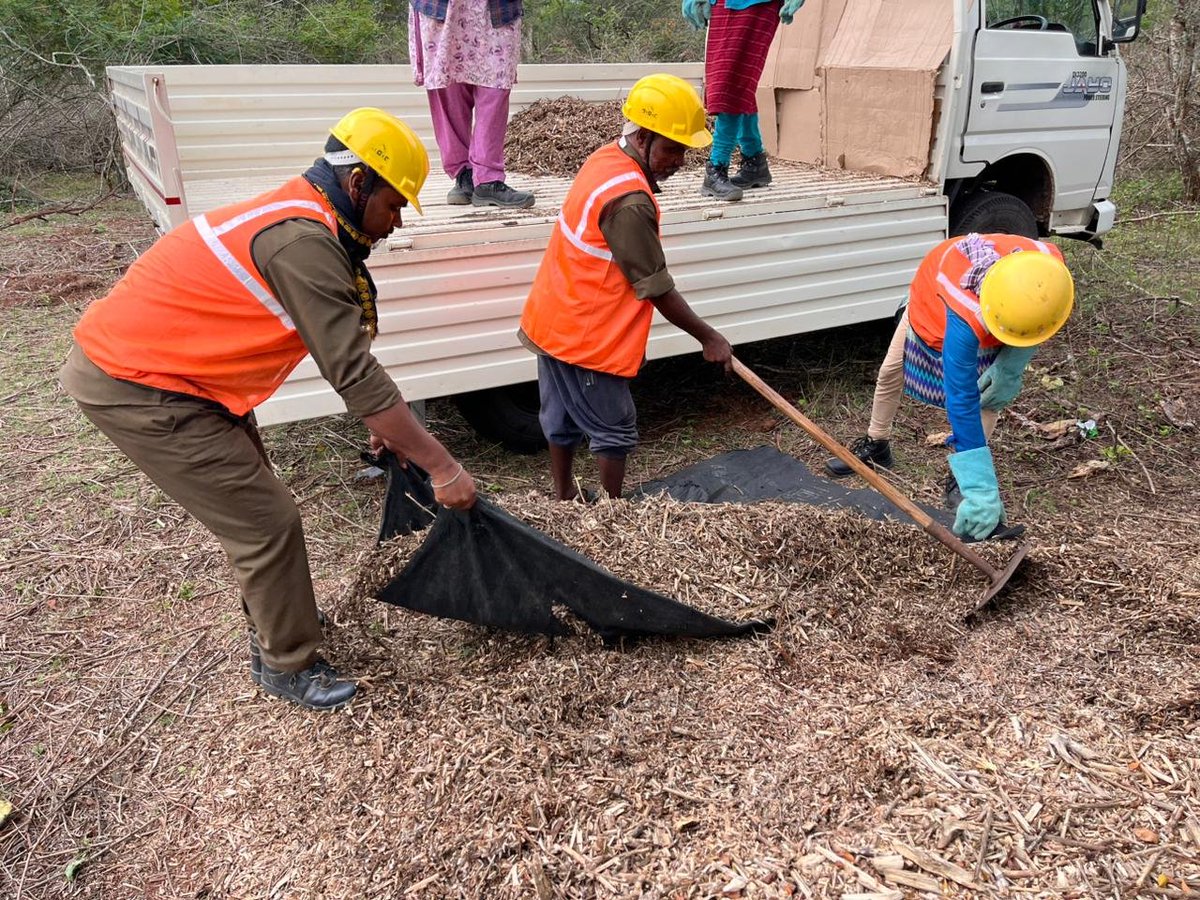
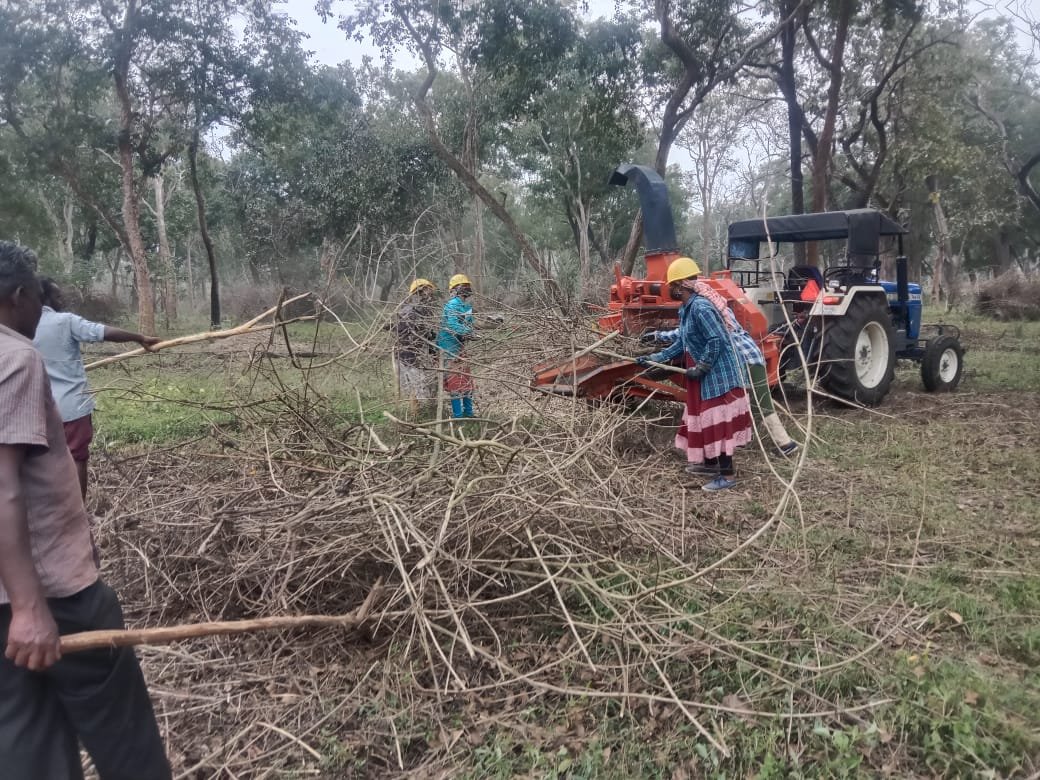
In a quiet corner in @MudumalaiTR lies a local solution to the #LPG crisis & helping stem the foxing issue of #Lantana an aggressive invasive weed chocking forests (occupies over 40% #tiger reserves) across #India.
So here is what @tnforestdeptis doing, with help of trained & employed local tribals:
Systematically remove the #lantana → reduce them to chips → transport to factory →pulverise to fine, uniform powder →solar dry →dry lantana compressed, binded w/o binders using only press & heat→cooled, cured, packaged. And voila, you have lantana #briquettes that provide highly efficient cooking fuel in grt demand in surrounding #teaestaes & schools.
Essentially invasive weed → cooking fuel replacing firewood & restored #forests.
The #Muddumalai mgt cannot keep up with the demand.
#Circulareconomy #TNForest #lpgसंकट #ecosystem
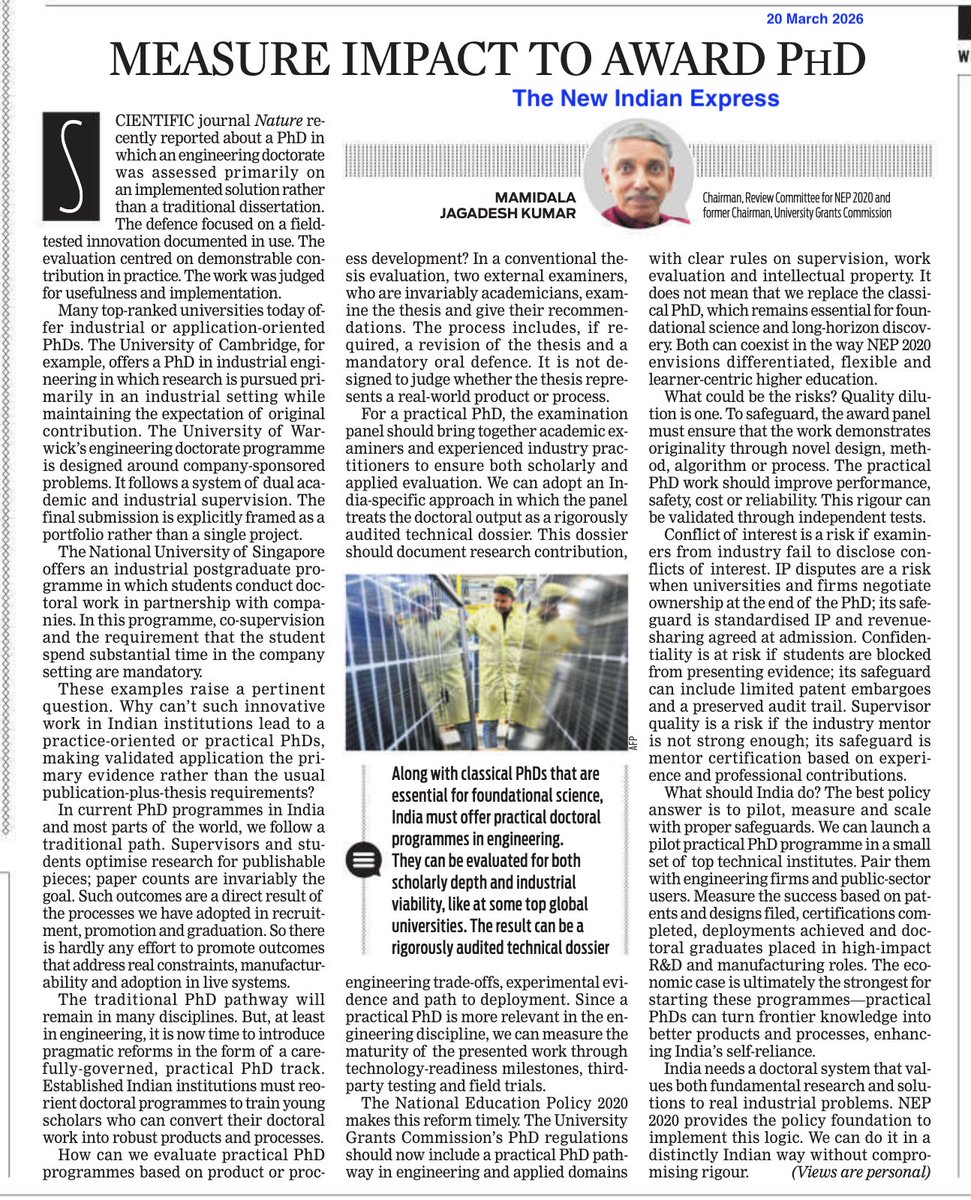
In an opinion piece in The New Indian Express, I write: India needs a doctoral system that values both fundamental research and solutions to real industrial problems. The traditional PhD pathway will remain in many disciplines. But, at least in engineering, it is now time to introduce pragmatic reforms in the form of a carefully-governed, practical PhD track. Established Indian institutions must reorient doctoral programmes to train young scholars who can convert their doctoral work into robust products and processes. NEP 2020 provides the policy foundation to implement this logic. We can do it in a distinctly Indian way without compromising rigour.
https://t.co/zSBGS3hOOA