I wrote, requested SEBI Chairman to review & inquire about #CAS Manipulation & Volatility in last few minutes.
27 August BSE during last 12 minutes of trading at NSE/BSE Sensex crashed over 2,200 points & than recovered 2,000 points.
Want Action against Manipulators
India’s new closing-auction system was meant to improve end-of-day prices. In the options market, however, the mechanism is producing extreme swings that are creating and wiping out gains in minutes https://t.co/vF9CuhAGYk
To @FinMinIndia@PMOIndia
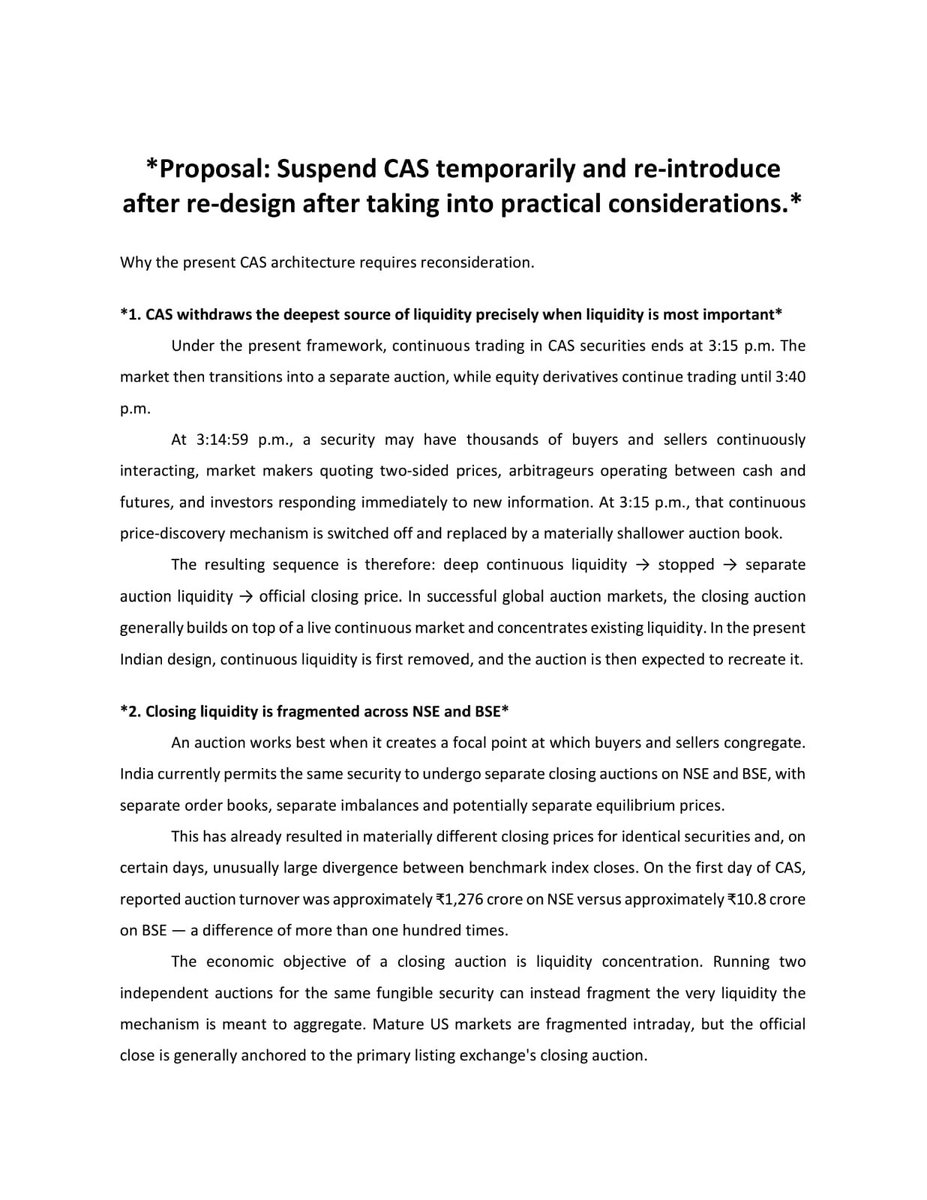
SEBI is potentially in breach of its statutory duty under Section 11 of the SEBI Act, 1992, by permitting Closing Auction Session (CAS) in which inadequate liquidity can produce disproportionate movements in the official closing price, thereby compromising orderly price discovery, market integrity and investor protection.
Mrityunjoy Chakraborty, IIT Kharagpur professor:
"Jane Street pays a 22 year old $500,000 a year for one skill: turning uncertainty into a number you can bet on. that number is the first thing this professor teaches, and it is free"
this free lecture is the foundation every quant bot and hedge fund model is secretly built on.
before the AI, before the strategy, there is one question. what is the chance this happens, exactly.
get that number right and every bet after it is just math. get it wrong and no model, no bot, no amount of compute can save you.
Chakraborty builds probability from the axioms up, on a blackboard, in notation a 15 year old can follow.
Wall Street sells this as a $500,000 edge. an IIT professor hands you the source code for nothing.
My recommendation to Mr. Tuhin Kanta Pandey is to implement a strict, Nasdaq-style, no-cancellation policy for the closing auction window, specifically incorporating rules analogous to Nasdaq Equity 4, Section 4702.
The sheer arrogance and apathy of the Finance Minister and SEBI toward retail investors and traders are astonishing.
Hardworking citizens deserve a regulatory body that protects them, not one that ignores them.
Instead, they are killing the markets.
By aggressively hiking Securities Transaction Tax (STT), crushing F&O trading with massive margin requirements, and slapping an unfair flat taxes(LTCG/STCG) they have made trading and investing unviable.
They are suffocating liquidity, killing market depth, and driving capital out of the country—all while corporate scams go unpunished.
@SEBI_India@NSEIndia@BSEIndia@FinMinIndia
#OptionsTrading #trading #nifty #sensex #stockmarket #trader #SEBI #NSE #BSE #CAS #RollbackCAS #IndianStockMarket #AbolishSTT #RetailTraders
*Nifty Sep 26 Rejig <A winners Index> (Final Predictions) Inclusion : BSE | Exclusion : Wipro*
• The Nifty Indices Sep-26 Rejig announcement is expected today post-market hrs. Re-iterating our final predictions across Nifty 50, Next 50 and other broader indices.
• The September 2026 index rebalance is expected to be a significant event, with stronger-performing stocks likely replacing underperformers across India’s most widely tracked domestic indices. Based on our analysis, we expect BSE to replace WIPRO in the Nifty 50. While BSE is transitioning from the Nifty Midcap 150 to the Nifty 100, its substantially higher free-float market capitalization supports a strong likelihood of inclusion in the Nifty 50.
• Nifty 50 : This reshuffle could lead to significant inflows into BSE, with estimated value of USD 741 million. On the other hand, the exclusion of Wipro is likely to result in outflows of USD 246 million. _In case the Nifty Indices Committee makes any methodology changes to the Nifty 50 index today, we believe TVS Motor could be a probable contender to replace Wipro. Otherwise, BSE, as per the latest methodology, ticks all the boxes for inclusion in the Nifty 50._
• Nifty Next 50: The likely inclusions in the Nifty Next 50 index are Wipro, Vedanta Aluminium, Hitachi Energy, Idea, Polycab & BHEL*. Meanwhile, we anticipate the following stocks to exit: Indian Hotels, REC Ltd, United Spirits, Shree Cement, Lodha & Mazagon Docks*
Source: Nuvama
Let’s stop trading option for a few months.
If u all are agree then spread this as much as possible and bring down volume.
I don’t have any position today.
There has been a lot of discussion about the sharp closing moves since the new Closing Auction Session went live.
CAS itself is not a bad idea. Most large global markets have some form of closing auction. A large amount of institutional activity, especially from passive funds and other benchmark-tracking investors, happens near the close. Instead of the closing price being determined based on the average traded price during the final 30 minutes, CAS brings these orders together in an auction to discover one closing price.
The goal of CAS is to enable better price discovery and make it easier to execute large orders without moving prices abruptly. But the price dislocations we have seen over the last few days highlight some of the structural problems that are specific to the Indian markets.
Closing auctions work well when there is deep liquidity and a large and diverse ecosystem of market participants, including market makers and arbitrageurs. Whenever prices diverge between the cash market, futures, ETFs, or different exchanges, participants step in and arbitrage the differences away.
This ability to arbitrage is much more limited in India.
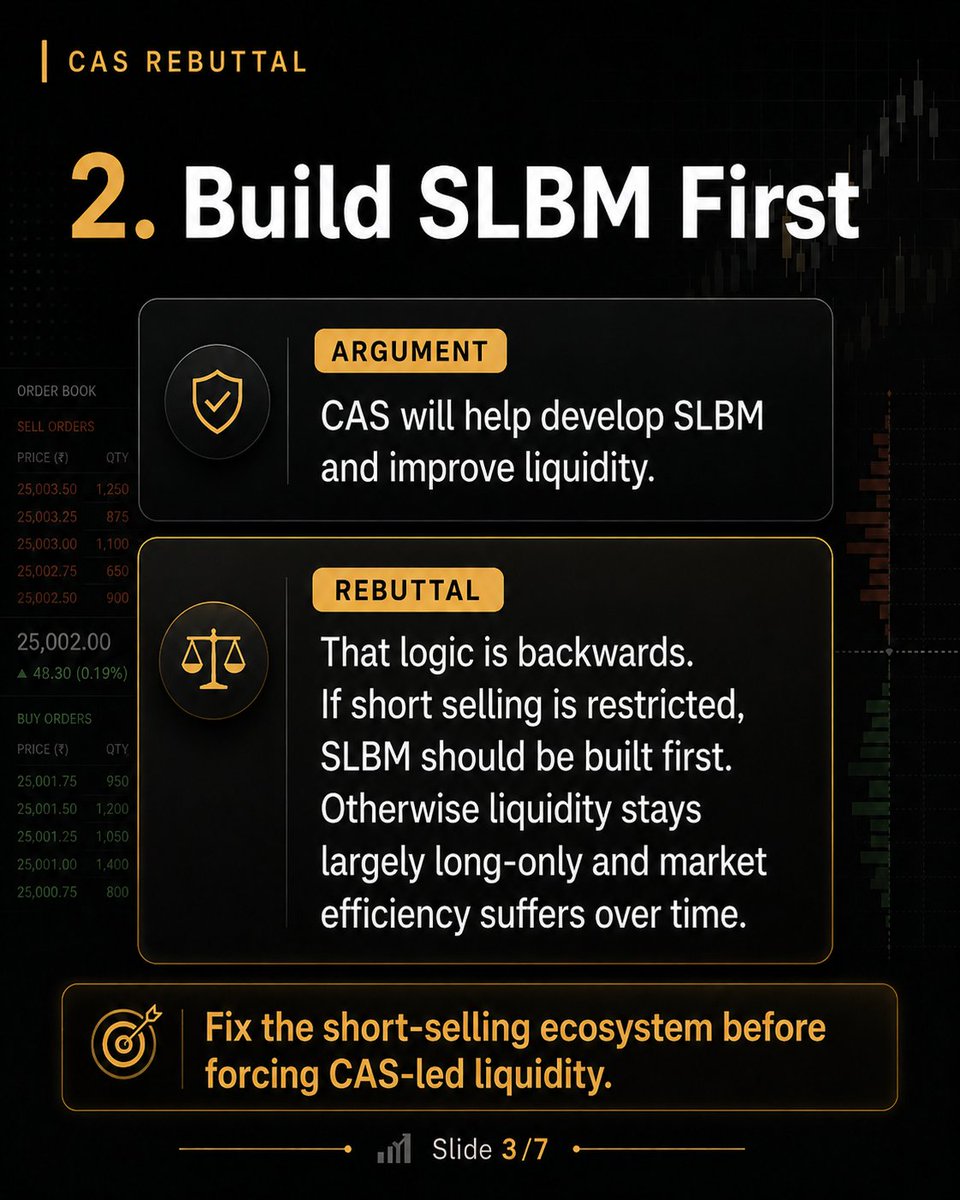
For one, it is impossible to express a short view in the cash market. We have a securities lending and borrowing mechanism, but it isn’t deep or easy enough to use. Unless borrowing stocks and shorting them becomes easy, there is bound to be structural upward pressure in the markets.
Then there is the difference in the cost of trading an option versus a futures contract. In April 2026, STT on futures was increased to 0.05% of the entire contract value, while STT on options is charged on the premium. So even though the STT rate on options is higher, trading futures is more expensive.
Once you add STT, exchange charges, spreads, and impact costs, the trading opportunity has to be quite attractive before a futures arbitrage trade is worth doing. The same directional view can often be expressed more cheaply through options. This leads to traders preferring options over futures.
India has over 13 crore registered investors, but only about 20–30 lakh traders trade actively on any given day. That’s it. We don’t have a large enough committed ecosystem providing two-sided liquidity across the cash market, futures, ETFs, and closing auctions.
CAS is not the reason for these structural limitations, but it makes them more apparent. The timing of its rollout is also unfortunate, because the RBI’s new norms on capital-market exposure, which limit banks’ exposure to capital-market activities, are going live at the same time.
When one instrument is more attractive than another, or when participants cannot express both bullish and bearish views easily, distortions are inevitable.
There might be tweaks required in how CAS itself works. But the larger issue of our markets being shallow is a complicated problem to solve. It requires building an ecosystem that encourages all kinds of traders and investors, with different time horizons, to participate easily.
Making shorting and securities lending easier, reducing distortions between instruments, and encouraging genuine market-making would be a good place to start.
Today has been an absolute nightmare, probably one of the worst days we have faced in a while
We were carrying directional positional strategies.
The market closed around 0.6–0.7% higher yesterday. The market opened normally today, but IV exploded right from the morning, causing a massive loss in our Sensex positions.
Even after the RBI policy announcement, the premiums did not cool down.
From April last year until today more than 400 days, our maximum daily MTM swing from options trading had never crossed 0.7%. The overall drawdown from options was also below 2% for the entire period.
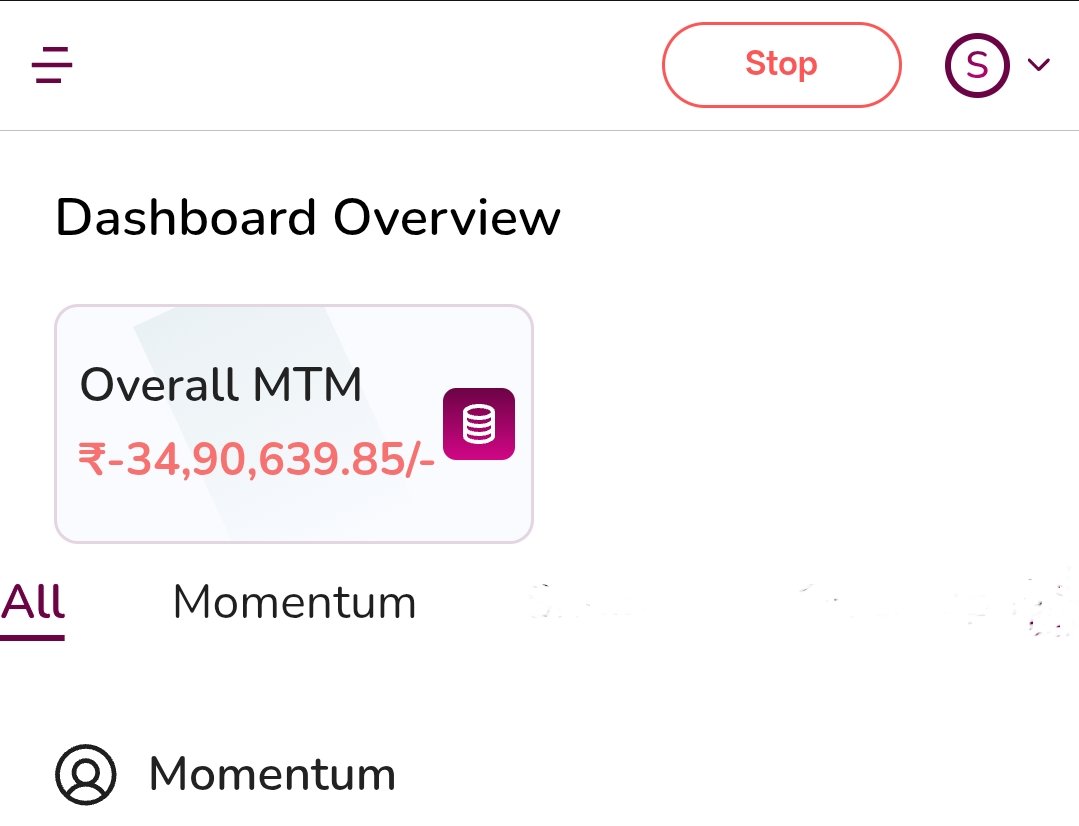
But today alone, we lost close to 1.7% on our positional trades.
I had initially considered avoiding expiry trades and continuing only with positional strategies. But after today, I don’t think even positional trading makes sense without understanding what has changed.
For now, we are completely stopping all option trades until we get more clarity on how the market and option premiums are behaving.
One important correction: the screenshot I shared does not show the actual extent of the options loss.
The options loss was significantly higher. A large part of it was recovered through a few futures trades