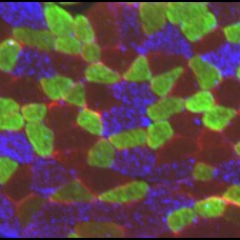
Our new work regarding to the relationship between the number of myonuclei and anabolic capacity to muscle contraction was published on the JEB. @riki_tor
https://t.co/OeIg8p83ba
Ready for @BiochemExercise 🚀
Grateful for the opportunity to share the findings from the project developed with @Kohei_Kido during my research stay in Japan.
Always thankful to @FACDEPORTEUCLM, @uclm_es, and @idiscam for the support and opportunities along the way.
#IBEC2026
0.33 g mitigates muscle atrophy while 0.67 g preserves muscle function and myofiber type composition in mice during spaceflight
https://t.co/wNcHBD9sD1
“The Age-Dependent Resident Myonuclear Multi-Omic Response to an Acute Skeletal Muscle Hypertrophic Stimulus in Mice”. A big effort by PhD candidate PJ Koopmans! #myotwitter https://t.co/SRTZY2324X
Our latest work showing that GLUT4 exofacial antibodies can measure translocation in humans and rodent skeletal muscle fibers and is impaired in TBC1D4 KO rats despite rescued GLUT4 expression. DM me for open access version: https://t.co/wCzuHjCCqW
Thought-provoking work here! “Myonuclear loss, rather than senescent myonuclei, associates with fiber type-specific atrophy in aging human skeletal muscle” #myotwitter
Thrilled to share our new @ScienceAdvances paper where we provide evidence that mechanical stimuli drive skeletal muscle growth through TWO distinct mechanisms—and use BONCAT to visualize where the growth occurs. Take a look: https://t.co/Hk6SpXK5aJ
Skeletal muscle myosin heavy chain fragmentation following exercise may be linked to post‐exercise inflammation and remodelling - Tiede - Experimental Physiology - Wiley Online Library https://t.co/aCJPY3V0q2