Awesome Trading Agents catalogs open-source projects where LLMs research markets, make trading decisions, and connect agents to market data and execution tools.
https://t.co/4SnUKH0JTH
Whoa, Meta released a new open-weight LLM yesterday, something that hasn't happened since the good old Llama days.
Their Meta Muse Glimmer model is a 30B multimodal reasoning model with a Gemma-like architecture design. (“Glimmer” is probably a wordplay on “Spark,” the more likely capable model from which Glimmer was distilled. Muse Spark is only available through Meta’s Model API, though.)
Architecture-wise, here are some of the main points:
1. "Only" a 131k context window, compared to Qwen3.6 and Gemma 4, which support 2x that natively; it's reasonable, but maybe on the shorter end in the age of agent harnesses
2. It's a dense model, not a mixture-of-experts. (So, it's fairer to compare it to Qwen3.6 27B than Qwen3.6 30B-A3B.)
3. Hybrid attention with grouped-query attention (GQA) and sliding window attention (SWA); the SWA:GQA pattern is a 3:1 local:global ratio. Other models like Gemma 4, which uses similar components, have a 5:1 ratio for comparison.
4. It adopts gated attention for both GQA and SWA; gated attention has become quite common in recent months. It basically applies a sigmoid gate to the attention output to decide how much of the attention information enters the residual connection. The interesting point is that it uses relatively standard GQA and SWA rather than hybrid attention mechanisms such as Nemotron or Qwen3.6.
5. A very extreme GQA ratio: 32 query heads and only 2 KV heads; for comparison, Gemma 4 31B uses 32 Q / 16 KV in the local heads and 32 Q / 4 KV in the global heads. This means that Meta Glimmer has a very small KV cache.
Overall, the probably most similar architecture is Gemma 3 27B (including the Gemma-style pre/post RMSNorm placement) and Gemma 4 31B, but with some tweaks like SwiGLU instead of GeGLU activations, gated attention, and the more extreme GQA:SWA pattern mentioned before.
What stands out is its extreme KV-cache efficiency.
I.e., the KV CACHE / TOKEN ratios (in BF16) are:
- Muse Glimmer: 52 KiB (lower is better)
- Qwen3.6 27B: 64 KiB
- Gemma 4 31B: 840 KiB
Modeling-performance-wise, their own benchmarks show that it's mostly ahead of Qwen3.6. According to the independent composite benchmarks on the Artificial Analysis Intelligence Index, it's slightly behind Qwen3.6 (see figure below). So, a few days of using it will tell where it really ranks.
Overall, it looks like a solid model, particularly for agentic workflows. What stands out most is its very low memory footprint and also pretty fast prefill and decode speed. It’s also just great to see Meta releasing open weights again :).
I’m the actual human who made every single one of these videos they keep gluing together without asking. They love calling me ‘ex-Google engineer’ or ‘this guy’. Follow this guy and let’s actually chat. Original post is right here:
https://t.co/w7LSp04suO
Want the real AI Agent Harness System (Loop + Memory + Eval) instead of the mash-up? Grab my open-source Waku Agent (almost 1k stars): https://t.co/ujKqBC2y9o
Original YouTube channel: https://t.co/rMP0jaxHK1
(Better for your eyes. Trust me:))))
I also run a community where I host live biweekly Q&As and share all the original system-design files:
https://t.co/ISbbjGUy01
@X@elonmusk@benjitaylor@singhai@dinkin_flickaa please fix the theft on X.
@vattybear thanks so much for the constant support my friend! 🔥
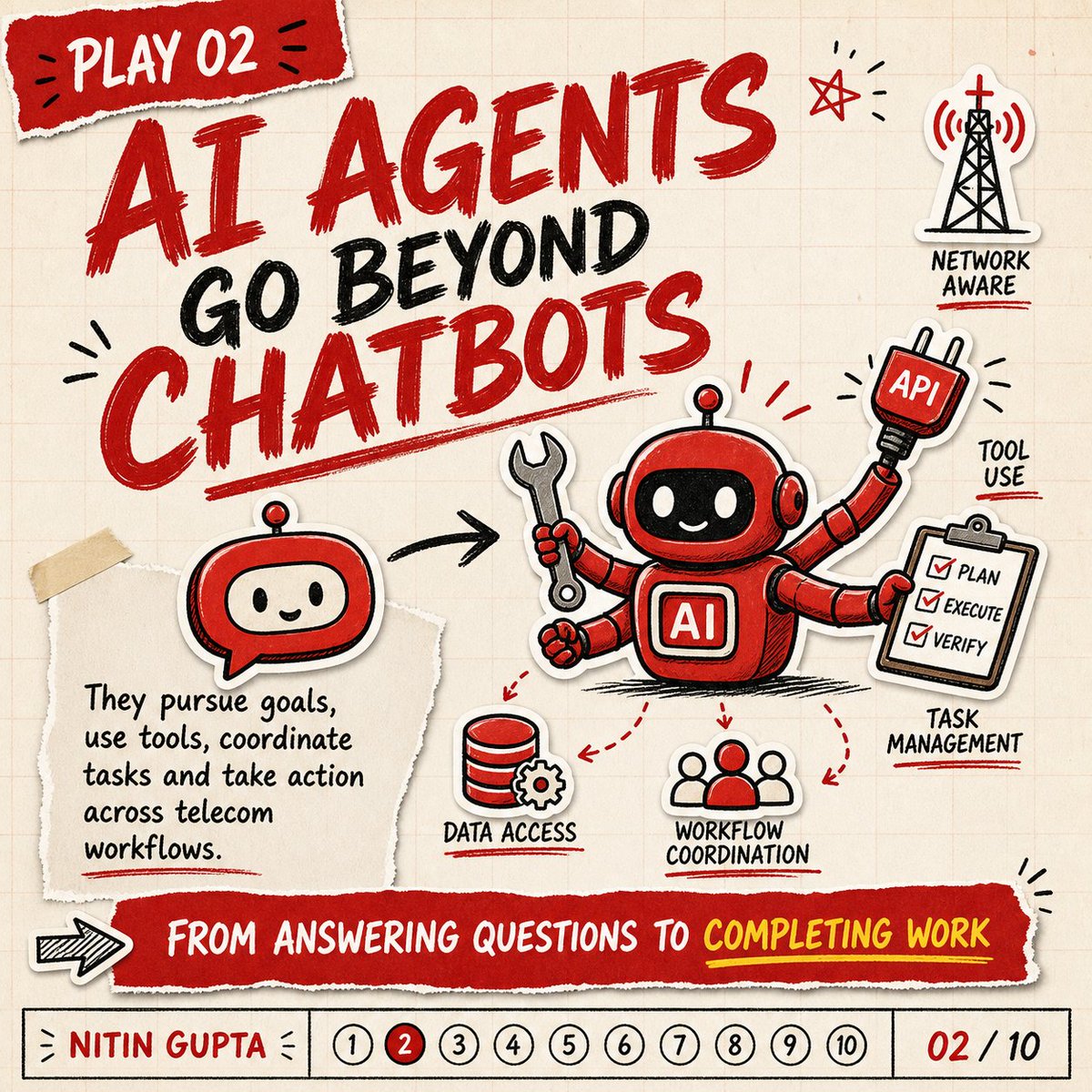
Telecom automation is entering the agentic AI era.
The shift is from systems that only generate alerts to agents that can:
• Observe network conditions
• Correlate alarms, logs and topology
• Identify likely root causes
• Coordinate workflows and tools
• Recommend or execute corrective actions
• Verify whether service was restored
This is not simply another chatbot.
It is AI moving from answering questions to completing network operations work.
I’m sharing four pages from my Agentic AI Telecom Playbook today.
Want the complete 10-page PDF?
Comment Full Guide and I’ll share it with you.
Daniel Kahneman, Nobel laureate and author of "Thinking, Fast and Slow":
"A Wall Street firm paid its traders millions in bonuses for skill. I checked eight years of their data. It was pure luck. The skill they were paying for did not exist."
> the article above is about telling a real edge from luck. kahneman won a nobel partly for showing how often, in markets, there is no edge at all, only luck we dress up as skill.
a firm handed him eight years of performance records for its advisors. he lined up each year against the next, and the correlation was essentially zero.
one good year said nothing about the following one. they were being rewarded, lavishly, for randomness. he called it the illusion of skill, and the firm did not want to hear it.
and they weren't frauds. they genuinely felt skilled, because the mind manufactures that story on its own. an entire industry runs on the confident feeling of skill inside a game that is mostly chance.
kahneman published this decades ago, it's in every copy of his book, and the interview is free. same point as my article: a track record feels like proof and usually isn't.
> this doesn't mean skill never exists. it means it's rare, small, and buried so deep in noise that your confidence is a terrible guide to it.
the edge isn't feeling skilled. it's the humility to demand real evidence before you believe your own results.
In 2005, Jeff Bezos gave a 1-hour lecture on how to build a company that never stops inventing.
It might be the clearest blueprint for building a trillion-dollar company ever recorded:
1. Reject either/or thinking. It sits at the heart of most impediments to innovation. Amazon wanted better customer service and lower costs, which sounds like a tradeoff. But if you eliminate the defects that make customers contact you in the first place, you improve the experience and save money at the same time. No tradeoff. The closer you fix things to the root cause, the more both improve together.
2. The best self-service can beat the best service. Embassy Suites often wins best customer service awards in hotels, and Bezos says the secret is they have almost no service; it is nearly all self-service. When people serve themselves, they think the service is terrific. Put the buffet out; the food is free, you take it and leave, and there is very little that can go wrong. Amazon used this thinking to cut customer contacts by 85% over seven or eight years.
3. Maximize the rate of experimentation, which means making experiments cheap. If experiments are expensive, you can only run a few a year, which forces global prioritization and requires Bezos's personal permission. And Bezos, in his words, is not scalable. That becomes a massive bottleneck on invention. The whole game is driving the cost of experimentation low enough that anyone can run one without institutional approval.
4. On the web, you can often just know the answer instead of arguing over it. In the physical world, high experiment costs force you to rely on judgment and intuition, so you end up debating. Amazon ran a test where half of the customers saw a countdown to order for next-day delivery and half did not, and simply measured the effect on sales. No arguing. The data settles it.
5. Your intuition is often wrong, which is the whole point of testing. It seemed obvious that adding images to "customers who bought this also bought" would make it work better. It made it work worse. Bezos says you have your prior guesses, but you validate them with real data, because even counterintuitive results are the reason you run the experiment in the first place.
6. The most important invention happens at the finest granularity. It is not just grand whiteboard ideas. Amazon's fulfillment centers are half a mile on a side with over a million items in stock, and any two items you order might sit on opposite ends. Making the pick-path algorithms modestly better every single day, at low cost, is where enormous value is created. Small, separate, empowered teams do this without being tangled in dependencies.
7. Most teams cannot answer whether they are getting better at the thing they do. Bezos says this is shockingly common. You cannot tell a team to go drive free cash flow, because it is too distant to be actionable. The trick is choosing the right granularity to measure, something specific enough that a team can actually move it day to day.
8. Sometimes you overrule the data with judgment. Amazon's instant order update, which warns you that you already bought something, measurably reduces sales in a statistically significant way. They kept it anyway, betting that customers would love it so much it would be a reason they keep coming back. Bezos admits he personally falls prey to rebuying things, and the anecdotal gratitude from customers confirmed the bet.
9. Amazon turns customer experience into a fixed cost instead of a variable one. In physical retail, high-touch service is a variable cost, so doubling your sales doubles that cost. Amazon builds a feature like instant order update once, and it costs the same whether they have one million or 47 million customers. With enough scale, you can have your cake and eat it too, offering a premium experience at the lowest cost.
10. Be customer-obsessed, not competitor-obsessed. Close-following strategies can work in stable industries, but in a fast-changing space, they do not work as well, and Amazon's DNA attracts people who like to invent and pioneer, not follow. Competitor focus also forces you to change constantly because the competitive set keeps shifting.
11. The most important question is not what will change, but what will not. Bezos says he rarely gets asked this, and it may matter more. Amazon knows customers will always want selection, low prices, and convenience. No one will wake up in 10 years asking Amazon to be slower or more expensive. You can confidently pour energy into things that will still matter in a decade, which is why customer-centric strategy is so durable.
12. Watch what technology makes newly cheap, then invent to use it. Disk space became 30 times cheaper in five years, and humans are bad at thinking in those exponential terms. That abundance is almost a problem because you have to figure out what to do with it. Amazon's answer was "search inside the book," which stores full-page images of over 200,000 books and soaks up the now nearly free storage while genuinely helping customers.
13. The most pernicious obstacle to invention is learned helplessness. Humans are so adaptive that if a problem persists long enough, we stop seeing it entirely. Before 1913, when it rained, drivers pulled over, wiped the windshield with a rag, drove a mile, and repeated, and they thought nothing of it. Mary Anderson looked at that and said it was ridiculous, invented the windshield wiper, and was widely mocked. Within 10 years, it was standard on every car.
14. Great inventors are bothered by ordinary things everyone else has accepted. They wake up, take a shower, and think this shower is terrible. The skill is pushing through the numbness that makes the rest of us stop noticing friction. The problems worth solving are often the ones everyone has quietly decided to live with.
15. Sometimes you invent by working backwards from a solution to find the problem. Bezos says a lot of high-tech innovation comes from this direction. Carbon dating is an example. People always wanted a way to date ancient things, but it was impossible until the understanding of radioactive decay entered the world. A new concept appears, and then you hunt for the problem it solves.
16. Persistence is a core ingredient, and WD40 is named after 40 failed attempts. A three-person company got a government contract to stop Atlas missiles from rusting in their silos. It took them 40 tries to find the right compound, and the name comes straight from the lab book: water displacement, 40th attempt. The name is a permanent record of how many times they failed before it worked.
17. The best ideas can look absurdly simple. Liquid paper was just white paint. Betty Nesmith Graham was a great executive assistant but a poor typist, and she was annoyed that she could not erase her mistakes. So she invented it, sold it to Gillette in 1975 for $47.5 million, and there was no clever chemistry involved at all. It was an extraordinary observation of a problem paired with a simple solution.
18. Do not let critics, the media, or Wall Street set your strategy. When Barnes & Noble launched online, a research firm coined "Amazon. toast," and it was widely picked up. Amazon had $60 million in revenue and 125 employees against Barnes & Noble's 30,000. Bezos held an all-hands and asked everyone to wake up terrified, sheets drenched in sweat, but afraid of customers, not competitors, because customers are the only ones who will ever give them money.
19. Invention always leads you down paths people think are weird. That is almost the definition of it. You can listen to outside criticism and look for kernels of truth, but you cannot enter a siege mentality or become too responsive to external noise. The only way to invent is to reexamine your strategy, make sure you truly believe it is right, and then stick to it.
20. Hiring the right people matters even more than cheap experimentation. The single most important thing for an innovative company is selecting for people who love to build and invent, at every granularity. Beware the ones who only want to invent at the grand whiteboard level and cannot figure out how to mount the camera on top of the truck, because mounting the camera on the truck turns out to be incredibly important.
Data Science and Machine Learning – Mathematical and Statistical Methods
• Save 100+ hours on research
It's 100% FREE!
To get it, just:
• Like and retweet
• Comment " math"
• DM me in the message for the link
One playlist I would use as a structured pass through Stanford CS229: Machine Learning Full Course taught by Andrew Ng | Autumn 2018: this Stanford course.
Good save when you want the path, not a one-off video: Machine Learning → Backprop & Improving Neural Networks.
𝗙𝗼𝘂𝗻𝗱𝗮𝘁𝗶𝗼𝗻𝘀:
↳ Lecture 10 - Introduction to Neural Networks | Stanford CS229: Machine Learning (Autumn 2018)
𝗠𝗼𝗿𝗲 𝘁𝗼𝗽𝗶𝗰𝘀:
↳ Stanford CS229: Machine Learning Course, Lecture 1 - Andrew Ng (Autumn 2018)
↳ Stanford CS229: Machine Learning - Linear Regression and Gradient Descent | Lecture 2 (Autumn 2018)
↳ Locally Weighted & Logistic Regression | Stanford CS229: Machine Learning - Lecture 3 (Autumn 2018)
↳ Lecture 4 - Perceptron & Generalized Linear Model | Stanford CS229: Machine Learning (Autumn 2018)
↳ Lecture 5 - GDA & Naive Bayes | Stanford CS229: Machine Learning Andrew Ng (Autumn 2018)
Best use: treat it as a map of the field. Watch once for the arc, then revisit the parts where you need implementation depth.
Link is in the first comment 👇
♻️ Share this with your network if you found it useful or insightful.