Why are institutions preferring @CantonNetwork for RWAs instead of public blockchains?
It’s not about decentralization vs centralization.
It’s about compliance, privacy, and deterministic settlement.
Here’s why 👇:
Wall Street already runs on a blockchain most people have never heard of.
On Oct 28, DTCC's tokenization service for stocks, ETFs and Treasuries went live on Canton.
Here's my post on it 👇
https://t.co/niFaARc6MZ
@CantonFdn#CantonResearchNov26
AI can write Daml.
Daml Reason, from @ChainSafeth, checks it.
It compares your agent’s code against proven, compiler-validated patterns, shows where each match comes from, and tells you when it doesn’t have one.
👉 https://t.co/yCJwxSRbM2
a solidity compiler bug i found and reported is now public
contracts compiled with via-ir and the optimizer on could read a stale storage value.. affects 0.8.19 to 0.8.37, fixed in 0.8.38.
i explained the bug here: https://t.co/sNyyWEbiAn
In 2026, no program is closed source.
We decompiled a propAMM into Rust that recompiles to the exact on-chain binary, then used it to find a critical bug that put $6.1M at risk.
I’ve been researching @Zcash security as part of our internal work at @osec_io.
Today, I’m happy to share that the total amount I’ll be receiving in bug bounties from @Zcash has finally been confirmed at $972K.
I’m really proud of what came out of this research. More importantly, I’m glad our work contributed to improving Zcash’s security and got more security researchers interested in Zcash. It’s especially great to see that many researchers are still looking into Zcash, finding and reporting bugs, and keeping an eye on its security.
Huge thanks to the teams across the Zcash ecosystem, including @Zcash, @zodl_co, @ZcashFoundation, @ValarGroup, @ShieldedLabs, @TachyonZcash, and @ZcashCommGrants, for taking security seriously and rewarding researchers, and to the entire Zcash community for all the support.
I’ll keep doing my best to find more bugs.
Hacktron founder @S1r1u5_ reveals how his team hacked into OpenAI starting with a single HEIC image and ended with Codex opening a PR under an employee’s token:
"The main one was an SSO misconfiguration in OpenAI's identity system. The other bug is a remote code execution on community.openai."
"By just uploading an HEIC image, an image format that you might have noticed in iPhone, we were able to get remote code execution there."
"Every employee that logins to Discourse, we can use their token and use it on Codex."
"We asked Codex to update the README with, Hacktron AI team is here. Don't change anything else. And then we clicked on open PR, which led to opening a PR in OpenAI."
"When you create Codex environments, you can give your own Bash scripts. You can write a Bash script that can exfil the source code of those internal repositories. You don't even need to ask Codex to interact with the repo."
"We can technically do this with every single repository that was on github .com/openai."
@HacktronAI@rootxharsh
On July 25, we hacked OpenAI.
Two bugs let us take over ChatGPT/Codex accounts of OpenAI employees (+some unaffiliated users) and reach connected services: Outlook, Slack, GitHub, etc.
We proved it with a PR in OpenAI’s internal codebase . It took us <72h. 🧵
"3 random dudes”
1. hacked apple, again and again.
https://t.co/5aZcB0RbjF
https://t.co/UdsKrmfFJW
https://t.co/hWDQaimW8c
2. your github enterprise is our github enterprise.
https://t.co/u3UjajnBKq
3. get a discord message from me, get pwned.
https://t.co/pX3RkjxNOX
https://t.co/noscPNmZm9
4. oh yeah, at one point we basically had shells across the electron ecosystem. check the DEF CON research.
https://t.co/1Th5fvpa21
5. your supabase database is my database.
https://t.co/nOIKthdDnM
6. we got the posthog prod database.
https://t.co/VIeGJz1hKq
7. react2shell? vercel paid us $170k for helping secure their waf.
https://t.co/Y2RgQSdl3g
8. your palo alto vpn is my vpn.
https://t.co/oVB068UhST
9. ai ides? we got shells for you, antigravity
https://t.co/tsvSXQuSS0
10. windsurf rce.
https://t.co/DpdGqmNRvu
11. turning cluely into malware.
https://t.co/8QcIYhXQfS
12. ai browsers? sure, uxss: your perplexity browser is my browser.
https://t.co/WVXlHzY0CB
13. openai atlas too. kinda uxss
https://t.co/jkQWnLD7rV
14. hey, it’s not even our first time hacking discourse.
https://t.co/viI1op7aMf
15. adobe coldfusion: pre-auth rce. because apparently we needed another one.
https://t.co/aFILo3suP2
there’s a lot more. go dig.
anyway, yes: “3 random dudes.”
and @HacktronAI is full of more random dudes like these.
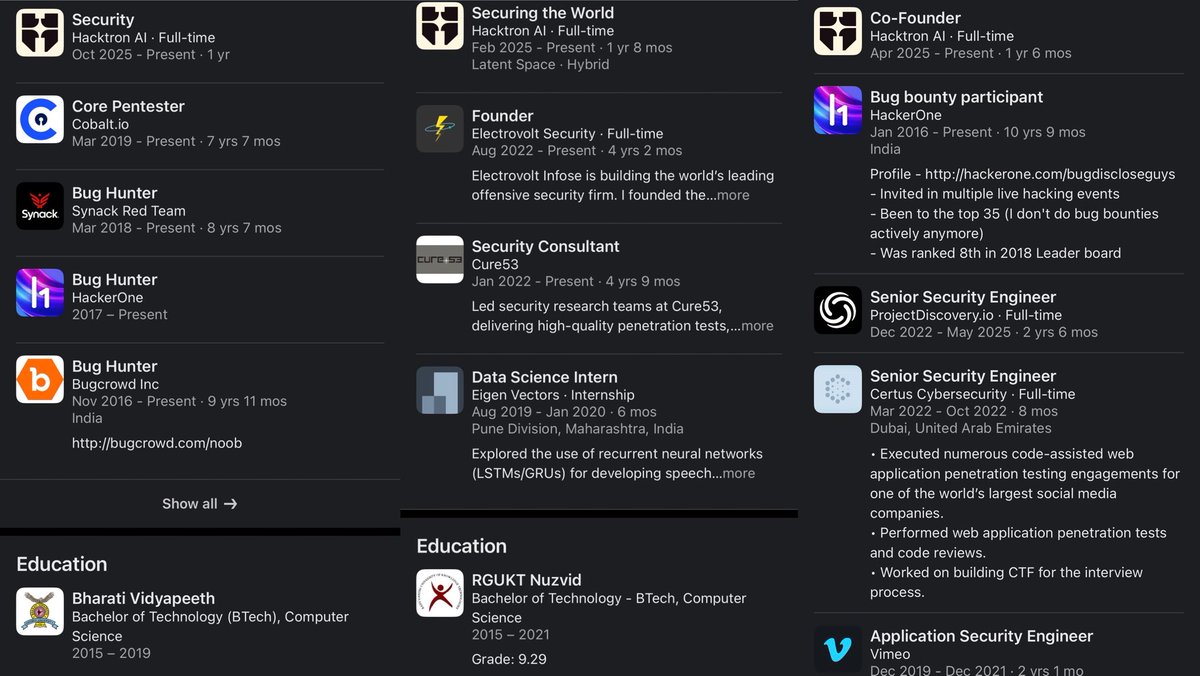
Here are the LinkedIns of the 3 Indian guys who hacked OpenAI with Opus 5 in 2 days for <$3000:
Rahul Maini, Mohan Pedhapati and Harsh Jaiswal
No brand name colleges or companies. Just raw curiosity and skill.
You can just do things.
We’re disclosing HEIF Heist, a months-long investigation into libheif that allowed us to hack OpenAI, Slack, Meta, GitHub Ent, Rails, Next.js, ImageMagick, and many more.
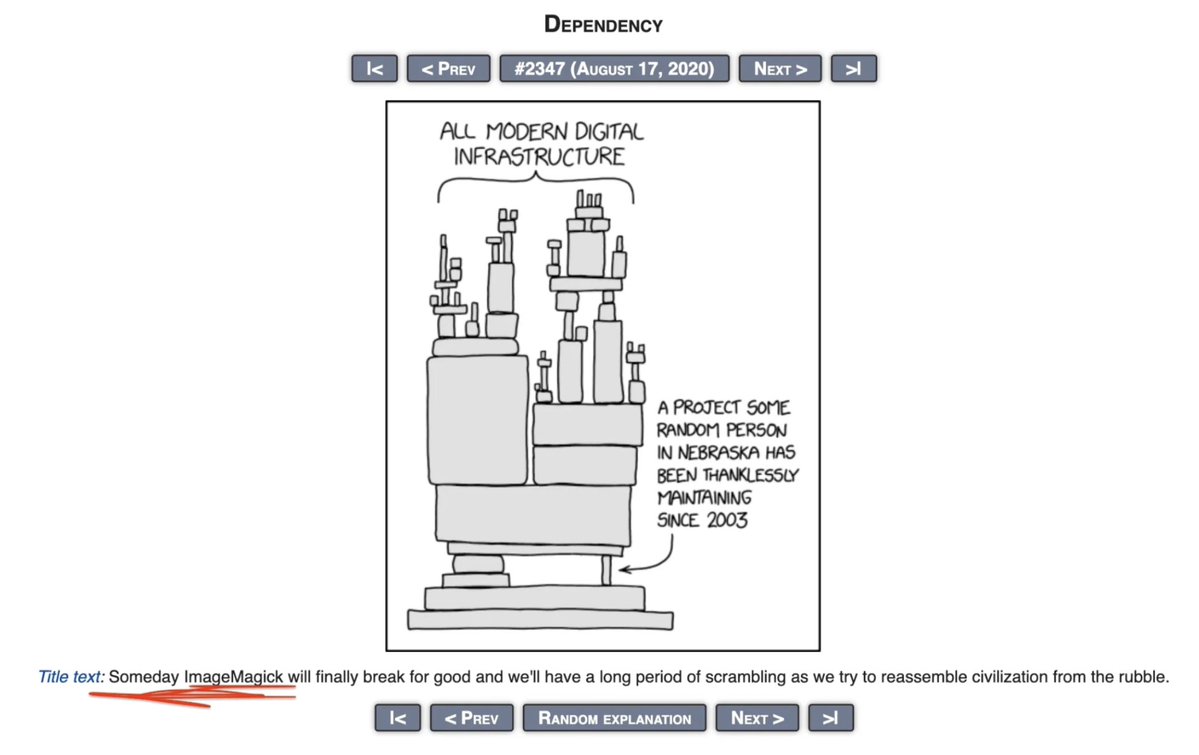
It was literally xkcd #234, one obscure image library beneath a huge number of apps. 🧵
A 35B language model running on an iPhone using only 1–2.5 GB of peak memory.
No cloud. No remote server. No desktop GPU.
Today, we’re open-sourcing Edge0 — a framework for running large AI models fully on-device.
23 625 smart contract vulnerabilities — open sourced
I collected these findings over the past year from private audit reports and contest platforms
Hopefully, it’ll be useful for security researchers and people working on AI for smart contract security
https://t.co/SgY7J1crlr