@LidskyLidsky I've also loved this one, though it isn't about professional relationships - tell the people who make time for you that you value their presence in your life, and their existence in this world.
Anyone who has worked with NSS data (National Sample Survey, India)? I have a few questions about their Employment-Unemployment Surveys. If I could connect to anyone, would be of great help!
@EmilyNix100 @lsThisMyWorld @MontonenJerry Interesting, thanks! My intuition before seeing this was that the gains might be smaller — this is a cool surprise.
@Simon__Galle @Linnea_Lor It does, thank you! I was mostly wondering, if in this framework, one can incorporate some form of non-homothetic demand? To let the distribution of expenditures affect welfare?
@Simon__Galle @Linnea_Lor Hi Simon, how should we think about incorporating income effects into this model? I think changes in the distribution of income after the shock might have important effects on the distribution of welfare gains.
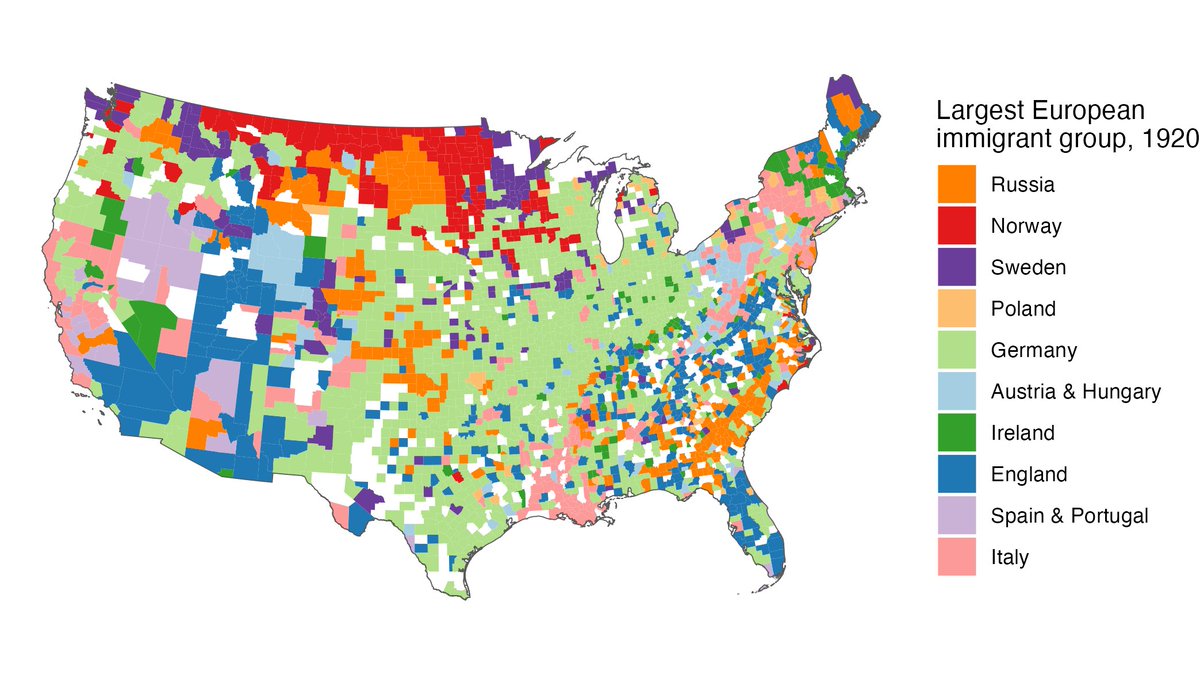
Ever wonder why so many Norwegians ended up in Minnesota? Or Azoreans in Central California? Or Vietnamese in Louisiana? Our new working paper introduces “climate matching” as a driver of migration.
The Brazilian government requires large firms to hire workers with disabilities.
Before writing a paper about this quota for disabled workers, I was exposed to it in several circumstances in my life.
I want to take you on a journey on how I transformed these events into a paper
Honored to be a guest in @Trade__Talks
And, huge credit to @ChadBown for his incredible work in creating this podcast.
The conversation relates to my research on agricultural trade and deforestation with @HPellegrina, Elliot Kang, Sebastian Sotelo.
I am excited to share this paper on panel Bartik regressions. Headline result: without assuming constant effects, one cannot conclude that Chinese imports reduced US manufacturing employment from the data used by Autor el al in their China shock paper.
https://t.co/w7AIQLxoDx
(1) New Working Paper: the fundamental driver of growth in modern economies, Total Factor Productivity (TFP), is linear, not exponential.
This is a paper I did not expect to write...