All 13.5 million jobs in Texas, visualized by sector in @Mapbox with block-level precision.
The just-released 2023 LODES data is one of the most underrated public datasets.
This is crazy.
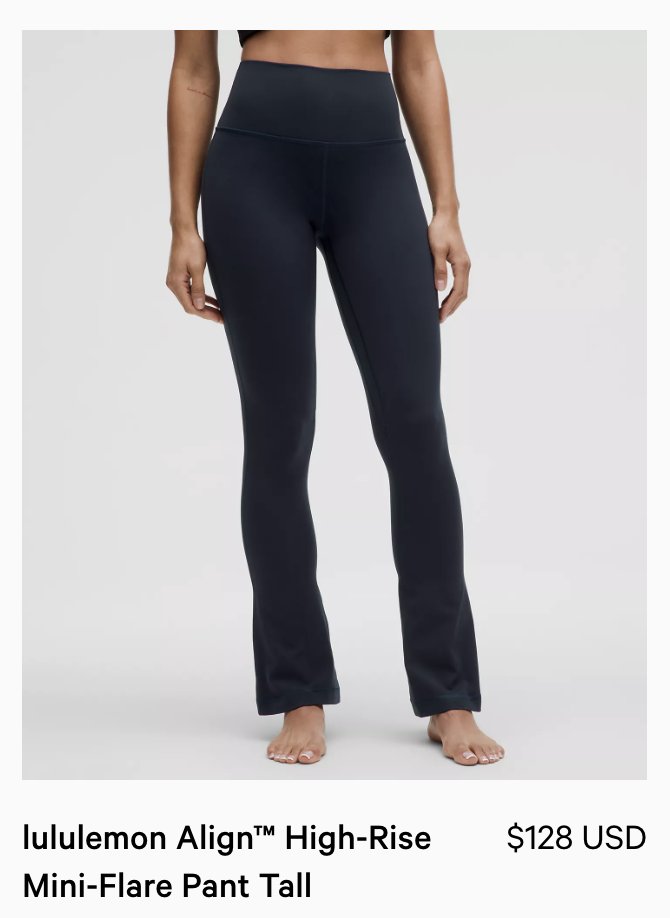
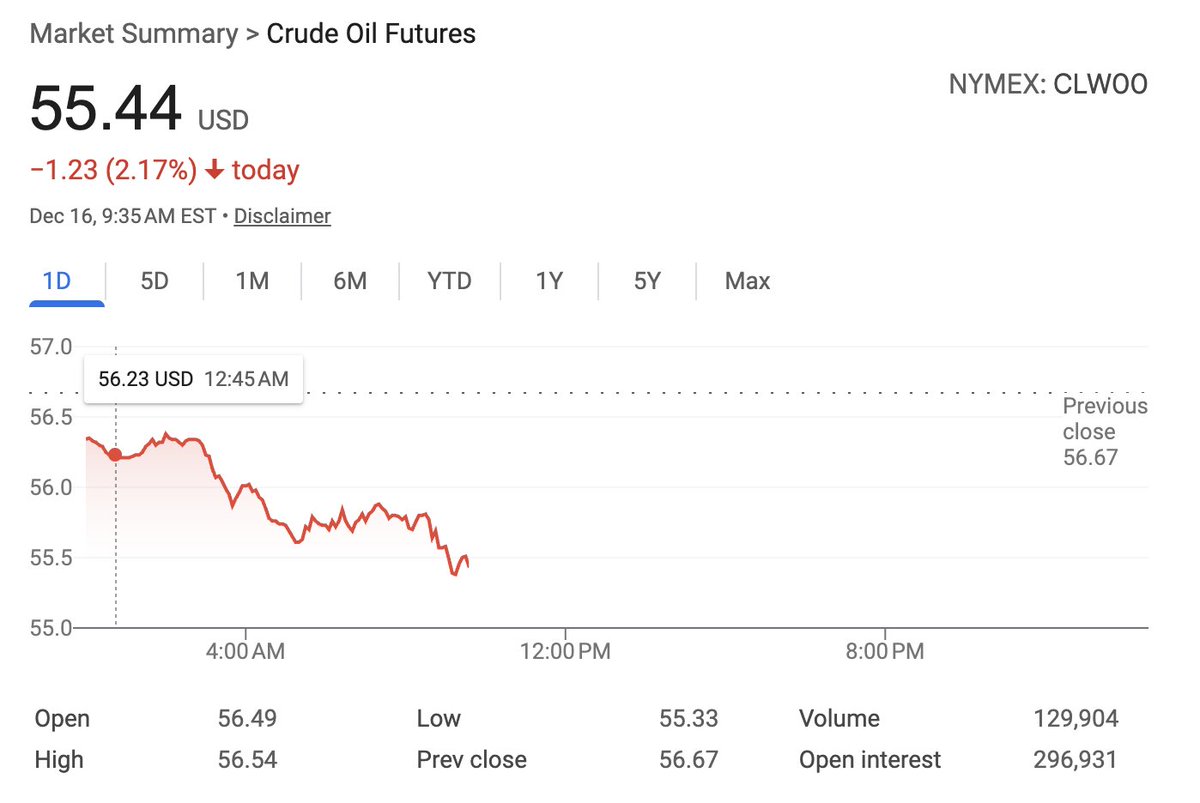
The Lululemon Leggings-to-Oil ratio just hit a new high.
You can now buy 2+ barrels of oil for every one pair of Lululemon high-rise leggings.
Tourlite Capital on FTAI Infrastructure $FIP US
Thesis: FTAI Infrastructure (FIP) is poised for significant growth, potentially exceeding $15 per share, driven by strategic acquisitions, anticipated EBITDA increases from its infrastructure assets, and upcoming catalysts, despite initial market concerns over leverage.
(From their Q3’25 letter — link in bio)
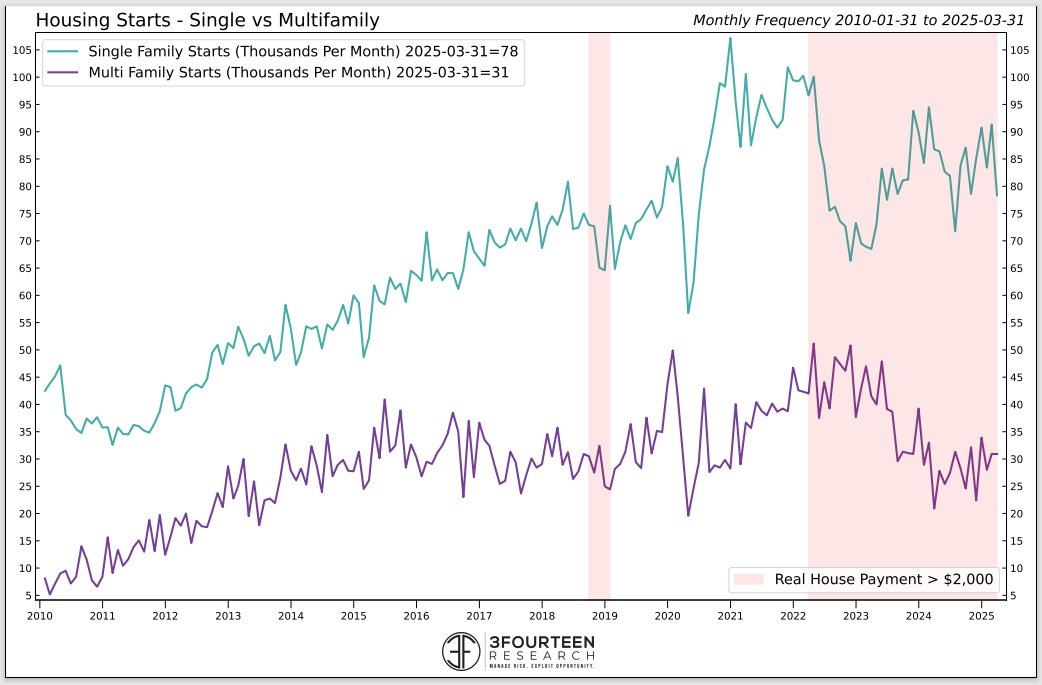
HOUSING
SF starts fell to 78k for March.
This is the second-lowest monthly print in almost 2 years.
This level of starts does not support the current construction labor force.
7% mortgage rates do not fit the housing market (i.e. restrictive).
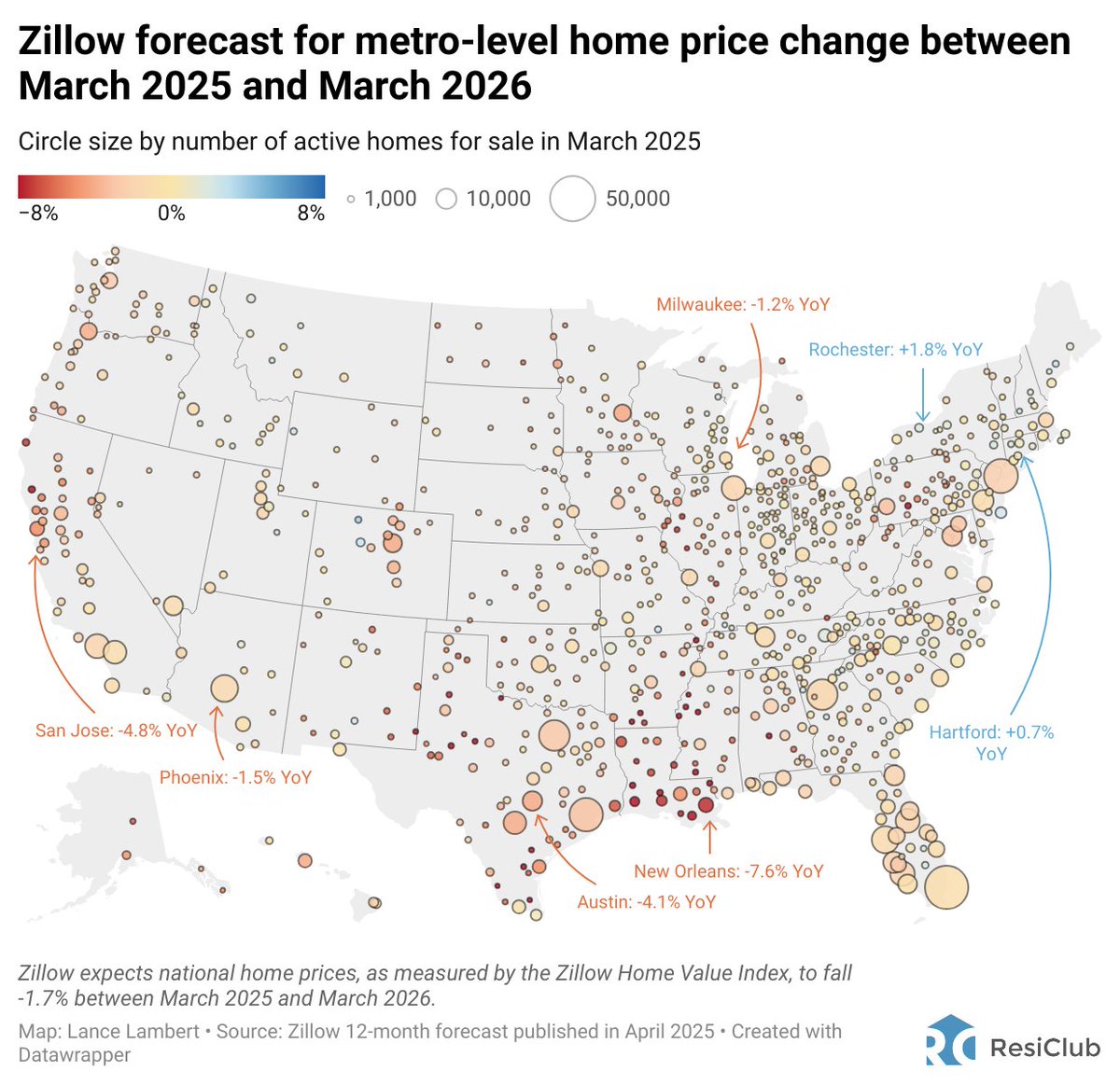
HELL JUST FROZE OVER: ZILLOW TURNS HOUSING BEAR
Zillow projects that U.S. home prices will fall -1.7% between March 2025 and March 2026.
Last month, Zillow economists still thought U.S. home prices would rise this year.
"Hidden" U.S. supply chain exposure to China is high, according to NBER.
"China’s role as the dominant foreign supplier of industrial inputs to US manufacturing sectors is clear. Looking at the simple average across the 17 sectors (rightmost column) shows a figure of 3.5% for China – close to three times larger than the average for the next closest supplier, Canada."
https://t.co/Nis1txn2Yr
This is one of the clearest signals yet that the Bank of Japan has lost control of the long end of the curve. Japan’s 30-year yield hitting 2.845% its highest since 2004 isn’t just a local event. This has global knock-on effects: Japan is the largest foreign holder of U.S. Treasuries and a key player in the global carry trade. Rising JGB yields force Japanese institutions to repatriate capital, unwind overseas positions, and pull back on USD asset exposure adding pressure to U.S. yields and FX volatility.
This spike also signals the end of the deflationary regime that underpinned global risk assets for decades. If Japan once the global anchor of low yields can’t suppress its bond market anymore, it opens the door to a global repricing of duration risk. This isn’t a blip. It’s a sovereign-level alarm bell.
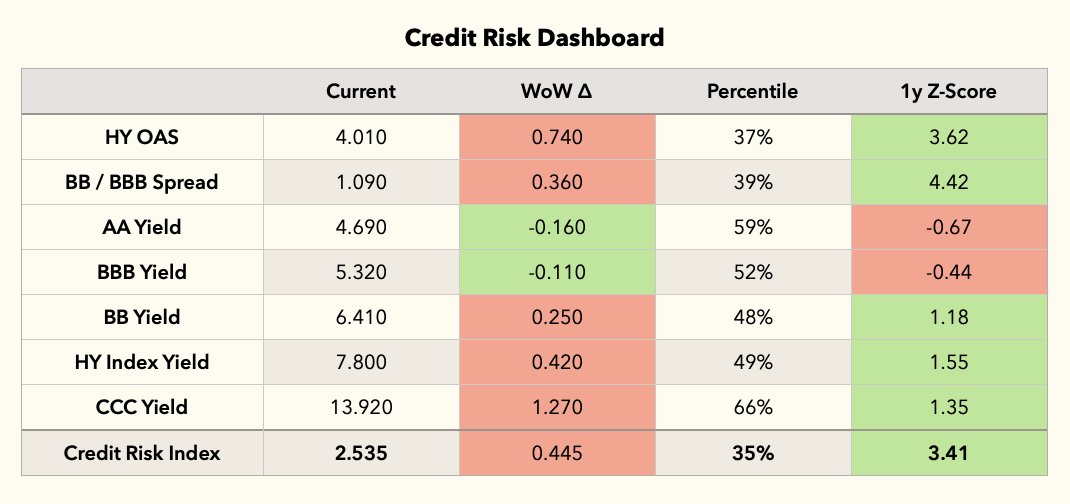
Credit Risk Dashboard Update
🔴 High Yield (HY) spreads are widening fast! HY OAS jumped +74 bps WoW heading into today, and the BB/BBB spread is up +36 bps.
Risk appetite is cooling as the Credit Risk Index surged to 2.535.
🟢 On the bright side, AA and BBB yields eased slightly, signaling some stability in higher-grade credit and a rush to safe haven credit risk.
🚨 CCC yields hit 13.92%, climbing +127 bps WoW.
@DOMOCAPITAL $QDT 50% max from France. Largest hardware/equipment (big ticket items) come from UK (much lower tariff).
Unsure of the validity on $PBI being as heavily as you indicate in U.S. manufacturing, can you confirm it's that high?
Both will be hit by tariffs on internal components.
BREAKING: Trump's Secretary of the US Treasury was just asked about the market sell off due to tariffs.
Bessent said: "The sell off is a Mag7 problem not a MAGA problem"
📉 SKEW ALERT! 🚨
The SKEW index has plummeted, while TailDex remains elevated. This divergence suggests rising fear of extreme downside risk despite overall market complacency.
Is a #BlackSwan event brewing? Keep watching #Volatility!
Liquidity Alert! 🚨 See how Fed & Fiscal policies danced from 2018-2024? The blue (Fed) peaked in early 2020, while red (Fiscal) surged later.
How do these shifts shape inflation and growth? How will they change under the current administration?
#FedPolicy#MarketTrends
From Torsten Slok, Apollo's Chief Economist:
•"[US] Consumer sentiment is declining rapidly both for households making more than $100,000 and less than $100,000 (see the first chart).
•Consumer worries about losing their jobs are at levels normally seen during recessions (see the second chart).
•A record-high share of consumers think business conditions are worsening (see the third chart).
•Households’ income expectations are declining (see the fourth chart).
•Inflation expectations are rising at an unprecedented speed (see the fifth chart).
The bottom line is that consumer sentiment is deteriorating at an alarming rate."
#economy #markets #growth #Inflation
NEGATIVE WEALTH SHOCK
B/c households are massively OW stocks, the current 10% market decline has created a wealth shock equivalent to 12% of GDP.
10% corrections are typical (53 since 1950).
But, wealth shocks are rare (13).
The economy is more vulnerable to a stock decline
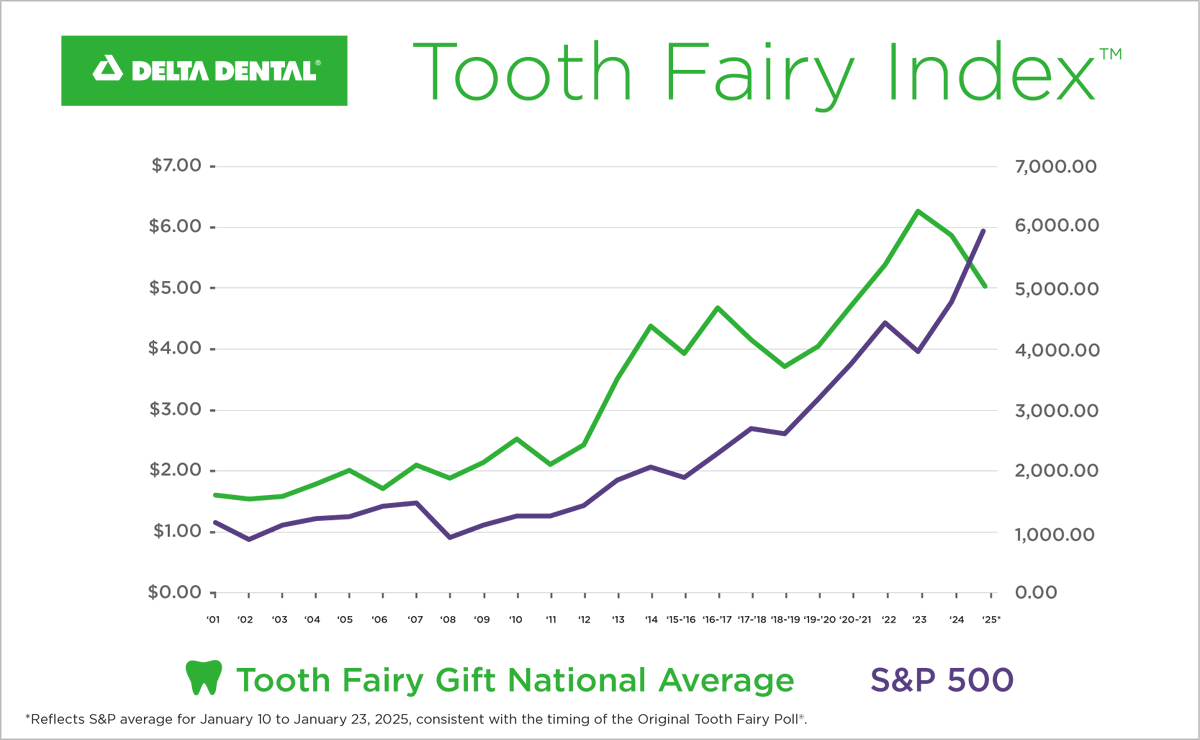
Delta Dental conducts a poll every year on the parental payout for lost teeth. It is down this year, which could spell problems for the stock market.
HISTORY OF THE POLL
Since 1998, Delta Dental has annually conducted the Original Tooth Fairy Poll® as a fun way to gauge how generous the tiny fairy had been in the previous year. The poll collects Tooth Fairy average giving and compares it to stock market activity to show how the value of a lost tooth relates to the U.S. economy (Tooth Fairy IndexTM)
Poll answers provide Delta Dental with valuable data that we in turn give to parents so they can discuss and promote good oral health care with their children. Talking about the Tooth Fairy’s giving habits makes for a fun and wonderful opportunity to help kids develop positive dental habits at an early age.
More than 1,000 parents of children ages 6-12 were surveyed using an email invitation and an online survey. The sample was designed to capture a broad spectrum of the U.S. population, not just those with dental insurance.
https://t.co/dzq4KGlBQh
Good morning, and God bless, #Team42!
Today’s Key Macro Question(s): How serious is @realDonaldTrump regarding #tariffs?
We may learn the answer this week. Until about a week ago, markets were assigning a low probability to the risk that @POTUS may be intentionally “kitchen sinking” the US economy and asset markets to create a low comparative base that flatters economic growth and market returns throughout the duration of his presidency.
Ronald Reagan did that while instituting a bevy of supply-side economics reforms that made him arguably the most popular Republican president of all-time. We’d be remiss to assume President Trump does not aspire to replace President Reagan in this regard.
This week is a big week for investors to gauge the risk of a “kitchen sinking” because Tuesday’s self-imposed deadline could mark a potential seismic shift in the US's relationships. Specifically, President Trump is planning to implement a 25% tariff on all imports from Mexico and Canada, with a reduced 10% tariff on Canadian energy. President Trump has also indicated he will double the 10% blanket tariff on Chinese imports to 20%. These measures would impact over $1.3tn in annual imports.
In addition to these tariffs, President Trump is planning reciprocal tariffs in response to findings from the joint global trade and currency policy review by the Departments of Commerce, Defense, State, and Treasury, and the US Trade Representative. Those reports are due on April 1.
President Trump has also announced tariffs on specific sectors, including 25% tariffs on steel and aluminum due to take effect on March 12. He also announced sectoral tariffs on autos, semiconductors, and pharmaceuticals due to take effect on or after April 2. In addition to that, President Trump has ordered two investigations that may lead to incremental tariffs on copper and lumber.
The tariffs on steel, aluminum, autos, and lumber will especially hit Mexican and Canadian exporters hard. President Trump may be targeting these countries to pressure them into reworking the USMCA to feature the same level of blanket tariffs on China across the three nations. This would prevent China from avoiding US tariffs by shipping products to Mexico and Canada intended for re-export to the US. @SecScottBessent lauded this idea, dubbing it “Fortress North America”.
China is considering retaliatory measures, including fresh trade barriers to US agricultural products. Canada is also considering retaliatory measures, including fresh export tariffs on Canadian energy to ensure US drivers “feel the pain” of Trump’s trade war, according to outgoing Prime Minister Justin Trudeau. Additionally, Canada is planning to immediately impose retaliatory tariffs on $21bn in US goods, with fresh tariffs on another $86bn in US goods to follow three weeks later.
All told, when we introduced our “Triple S’s” theme last fall, we did so with the view that the economic outcomes President Trump can control via executive order—i.e., trade and immigration—were skewed negative and likely to front-run the economic outcomes President Trump needs Congress to legislate (e.g., tax cuts). Given this precondition, it may be the case that President Trump is doing his best Ronald Reagan impersonation by “kitchen sinking” the economy and asset markets. Tariffs and restricting immigration are undeniably stagflationary.
As such, the onus shifts to the @federalreserve to use its policy tools to offset that and prevent a global debt refinancing air pocket. If the Fed does not act forcefully within this window of economic weakness to prevent a deepening US growth scare, a further unwinding of popular yen carry trades is likely to trigger the crash in risk assets our Positioning Model has been warning about for months. The global debt refinancing clock is ticking…
If you found this note helpful, please like and repost. Thank you!
Consistently making money and protecting gains in financial markets require a lot of time, expertise, and computational power. Investors partner with 42 Macro because we do the heavy lifting and answer the hard questions for them. See for yourself: https://t.co/LQvjX7i7qY.
Have a great day!
-Skipper




![elerianm's tweet photo. From Torsten Slok, Apollo's Chief Economist:
•"[US] Consumer sentiment is declining rapidly both for households making more than $100,000 and less than $100,000 (see the first chart).
•Consumer worries about losing their jobs are at levels normally seen during recessions (see the second chart).
•A record-high share of consumers think business conditions are worsening (see the third chart).
•Households’ income expectations are declining (see the fourth chart).
•Inflation expectations are rising at an unprecedented speed (see the fifth chart).
The bottom line is that consumer sentiment is deteriorating at an alarming rate."
#economy #markets #growth #Inflation](https://pbs.twimg.com/media/GmKf0hdXkAAuZy_.jpg)
![elerianm's tweet photo. From Torsten Slok, Apollo's Chief Economist:
•"[US] Consumer sentiment is declining rapidly both for households making more than $100,000 and less than $100,000 (see the first chart).
•Consumer worries about losing their jobs are at levels normally seen during recessions (see the second chart).
•A record-high share of consumers think business conditions are worsening (see the third chart).
•Households’ income expectations are declining (see the fourth chart).
•Inflation expectations are rising at an unprecedented speed (see the fifth chart).
The bottom line is that consumer sentiment is deteriorating at an alarming rate."
#economy #markets #growth #Inflation](https://pbs.twimg.com/media/GmKf0hVWwAAd3o-.jpg)
![elerianm's tweet photo. From Torsten Slok, Apollo's Chief Economist:
•"[US] Consumer sentiment is declining rapidly both for households making more than $100,000 and less than $100,000 (see the first chart).
•Consumer worries about losing their jobs are at levels normally seen during recessions (see the second chart).
•A record-high share of consumers think business conditions are worsening (see the third chart).
•Households’ income expectations are declining (see the fourth chart).
•Inflation expectations are rising at an unprecedented speed (see the fifth chart).
The bottom line is that consumer sentiment is deteriorating at an alarming rate."
#economy #markets #growth #Inflation](https://pbs.twimg.com/media/GmKf0gcWUAAumIO.jpg)








![elerianm's tweet photo. From Torsten Slok, Apollo's Chief Economist:
•"[US] Consumer sentiment is declining rapidly both for households making more than $100,000 and less than $100,000 (see the first chart).
•Consumer worries about losing their jobs are at levels normally seen during recessions (see the second chart).
•A record-high share of consumers think business conditions are worsening (see the third chart).
•Households’ income expectations are declining (see the fourth chart).
•Inflation expectations are rising at an unprecedented speed (see the fifth chart).
The bottom line is that consumer sentiment is deteriorating at an alarming rate."
#economy #markets #growth #Inflation](https://pbs.twimg.com/media/GmKf0h1bgAAbFiE.jpg)