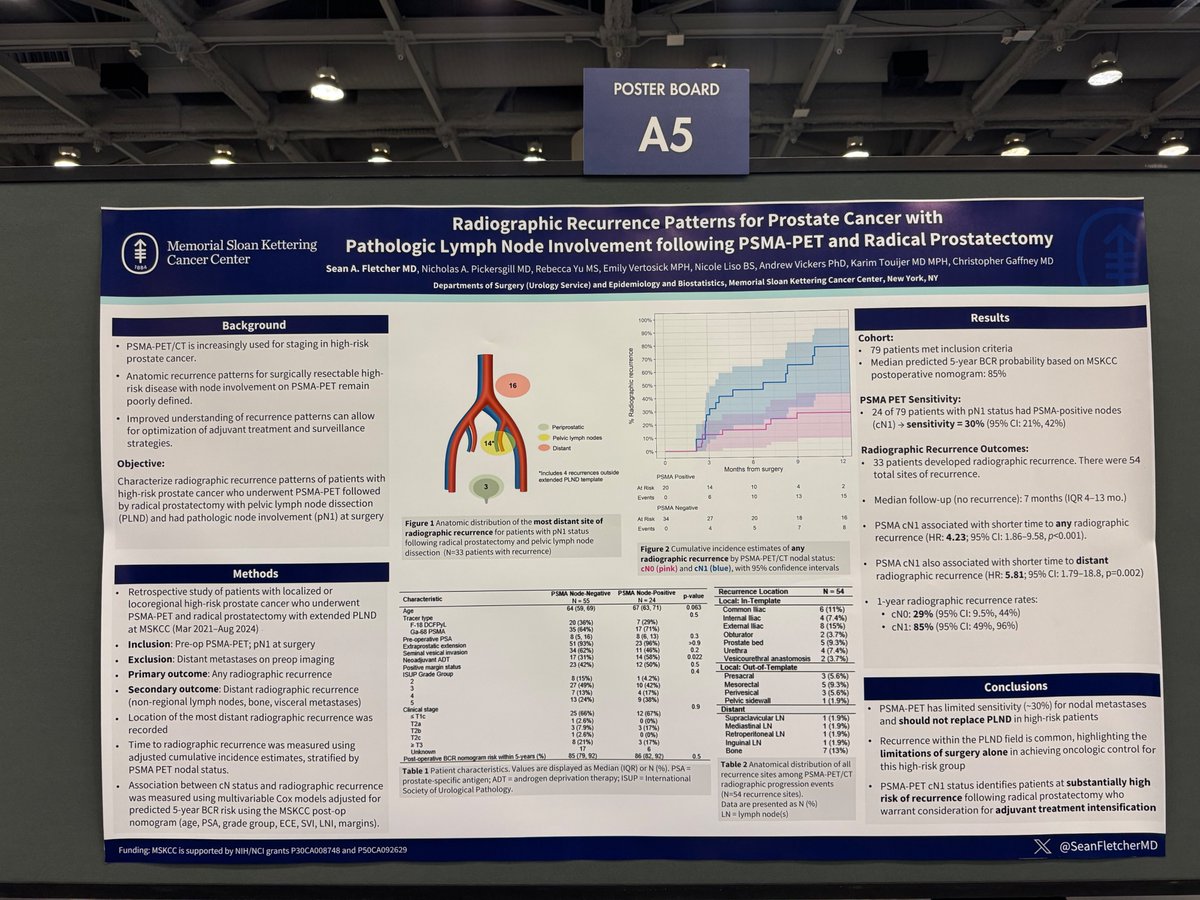
New in @BJUIjournal: PSMA-PET/CT in pN1 prostate cancer
• Poor sensitivity for LNI in high-risk pts; negative PSMA-PET does not justify omitting PLND
• PSMA+ nodal disease = nearly guaranteed BCR & radiographic progression (1-yr BCR ~84%)
• Do these patients need adjuvant treatment intensification? Prospective trials needed
@UrologyMSK@SeanFletcherMD@VickersBiostats
https://t.co/v6B7SfA3kN
"Due to low sensitivity, PSMA-PET/CT without evidence of nodal disease does not obviate the need for PLND" BUT "PSMA-avid nodal disease portends ... nearly inevitable ... recurrence and radiographic progression, supporting treatment intensification." https://t.co/0p3blERPj2
Interested in learning about the oldest and largest urologic oncology fellowship in the world? Join us in our virtual open house wed Nov 12th at 7 pm EST Hear from faculty and current fellows!!
https://t.co/pZDjdvWCEK
Sign up: https://t.co/ouDww8278U
New in @JAMAOnc: Our study of >11,000 PLCO participants shows that ~25% of elevated PSA values fall below threshold within a year, but persistent elevations rarely do (<10%), and should proceed directly to further eval.
@SigridCarlsson@MariaPereMD@UrologyMSK@VickersBiostats
Check out our Clinical Consultation Guide on Neoadjuvant Chemotherapy for Upper Tract Urothelial Cancer, published in @EurUrolFocus@nirmishsingla@JCensits
https://t.co/iJWH2qKQD4
Family History of Prostate, Breast, Ovarian, and/or Pancreatic Cancer and Associations with Grade Reclassification in a Large Prostate Cancer Active Surveillance Cohort
https://t.co/OwEyrkzOqL
In a prospective cohort of 1,421 prostate cancer patients on active surveillance, family history of #ProstateCancer (FH-Pr) was associated with a higher risk of grade reclassification, including progression to Gleason grade ≥3, whereas family history of breast, ovarian, or pancreatic cancer (FH-BOPa) was not. Among 349 patients who underwent radical prostatectomy, no family history was linked to adverse pathological features.
These findings suggest that patients with a FH of prostate cancer can remain on active surveillance but may benefit from closer monitoring.
@ClaireDlc@SeanFletcherMD@KatarzynaMacura@LotanLab
William B. Isaacs @brady_Urology
Christian P. Pavlovich
@OncoAlert 🚨
@Silke_Gillessen@AOmlin@nataliagandur@bavilima
Big Congratulations to @LoganGalanskyMD for matching @BostonChildrens Pediatric Urology Fellowship! A former AUA Holtgrewe Legislative Fellow, meticulous surgeon, and future leader. We are all so proud of Logan!!
Out in @BJUIjournal: Retro cohort study on detection of GG2+ PCa on systematic biopsy outside of MRI ROI (n=481 biopsies @brady_urology)
- 6.4% with GG2+ outside of ROI
- 1.5% with GG2+ contralateral to ROI
- No association w baseline factors (e.g. PSA-D)
https://t.co/7HLNxm86HF
Congratulations to Dr. Tony Su matching @theNCI for @UroOnc SUO fellowship! Joining former @brady_urology alumni @markballmd & Peter Pinto. Tony is an amazing surgeon-scientist and glad to have him "down the street!"
Excited to share our team’s work @brady_urology describing the evolution of AS for PCa in the modern era! Is Confirmatory Biopsy Still Necessary for Active... : Journal of Urology https://t.co/QiEIGKpTnz
Come on over to booth #361 to learn about our residency program, try out our VR surgery simulator, and meet with our team! @brady_urology@SLICE_JHU@aghazimd#AUA2025
Proud to share our latest DISSRM publication, which explores the relationship between tumor size and growth rates in small renal masses among patients undergoing active surveillance https://t.co/MCntUEALfI