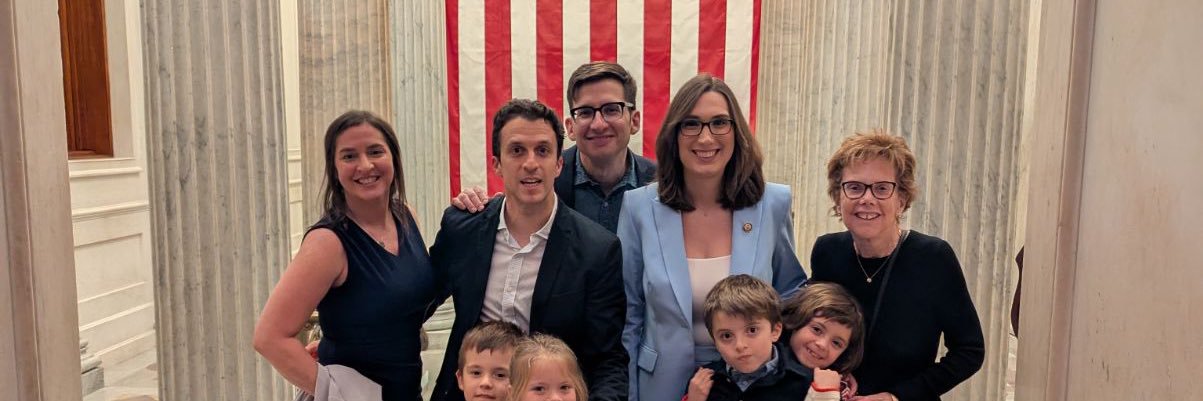
1/n Today we've started a legal campaign to break down state telehealth licensure restrictions. The fact that MD specialists, already licensed in their home state, must also obtain full licensure in every state where their potential patients reside violates the US Constitution🧵
Today, we've sued New Jersey's medical board on behalf of Massachusetts and Pennsylvania physician-specialists and their patients in New Jersey. Restricting access to specialty care benefits no one, is potentially deadly, and violates the Constitution. https://t.co/O9H25UcZg4
The FDA approved LuPSMA (Pluvicto) + androgen receptor pathway inhibitor therapy for metastatic androgen pathway modulation-naïve or -sensitive prostate cancer. Approval is based on the PSMAddition trial. Congrats to everyone whose hard work led to this new option for patients!👏
Congratulations to Dr. Janopaul-Naylor on receiving the Editors' Spotlight Award from @themednet! 🎉
This award recognizes his thoughtful, evidence-based contributions to the #RadOnc community and his commitment to advancing physician education and patient care.
Well deserved!
🚨 Open at @MSKCancerCenter & @NYProton
The Phase II BREATHE trial is evaluating BIO 300 to reduce radiation-induced lung injury during #SBRT for patients with early-stage #NSCLC and #ILD/#IPF.
Learn more or refer patients:
https://t.co/ltmRswhaGZ
#ClinicalTrials#RadOnc
Great read, Prof Squitieri! Brought up a couple questions for me:
1) What are we to make of the fact that when the Constitution countenances inter-branch cooperation, it makes the terms of such arrangements explicit? In other words, the process of lawmaking is clear (passage in both houses and then presentment). There is no discretion. If the expansive reading of the Excepting Clause is right, it would be the one case where the terms of inter-branch cooperation are ill-defined and more uncabined.
2) The examples given of inter-branch appointment (outside of the narrow US Attorney exception) seem to be to offices with more ministerial/minimal authorities. Might a doctrinal limit on inter-branch appointments parallel the arguments against significant inter-branch delegations (e.g. certain delegations of significant authority might approach per se prohibition)?
New in @JCO_ASCO: Results from the DART trial evaluating definitive RT plus immunotherapy for patients with unresectable stage III NSCLC ineligible for concurrent chemoradiation.
Congratulations to the multidisciplinary DART team at @MSKCancerCenter.
https://t.co/tOcHPTIgqs
@VickersBiostats Of course, some patients will regret regardless of how complete the explanation, but you certainly reduce the overall proportion experiencing regret by having a fulsome up-front conversation.
I think best way to mitigate "regret" is to provide for the patient up-front a very clear picture of the counter-factual. That's core to the consent discussion. So I would argue that, sure, regret has, as a necessary component, the "bad outcome", but that alone is not sufficient to trigger the psychological state. It's bad outcome coupled with insufficient initial explanation of the true alternatives to whatever treatment triggered the "bad outcome".
I'm taking a firm stand in refusing to spell out acronyms that 99.99% of intended readers of academic articles already know.
If the first time you’re encountering the acronym “HPV” is when you click on an article about the “Treatment of HPV Related Cancers”, chances are ya clicked on the wrong article.
In one fell swoop, that would eliminate 40% of queries on proofs. You're welcome :) #radonc #medtwitter
This is a great discussion. FWIW, I think your reading, Thomas, of the text is accurate: 1) the text of the clause clearly lays out as the default position that inferior officers require senate approval ("and all other Officers of the United States"). All other officers self-evidently includes all inferior officers. Then you have the "but" statement. For some tranche of inferior officers (which ones? the ones Congress "thinks proper"), appointment can be vested in the "President, the Courts of Law, and the Heads of Departments".
I think Dilan's reading of the plain text is accurate in relation to whether it permits Courts of Law to appoint obviously inferior, executive officers. But that would lead to somewhat absurd results (e.g Congress permitting a Circuit Court to appoint an Undersecretary of State). I think we typically use Court-developed doctrine to limit absurd results that constitutional text may superficially permit. Don't we do this with the 1st amendment (putting aside Justice Black's opinion)? If Congress was truly forbidden from making ANY law that abridged the freedom of speech, it would cripple agencies' ability to regulate (amongst other issues). We use doctrine (e.g. balancing tests that weigh the restriction on speech against the government's interests) to avoid that....
I also think it's unlikely that the Framers intended to permit Courts of Law to appoint inferior, executive officers. Presumably, they meant inferior, judicial officers (e.g. Magistrates, clerks, etc). But absent any historical sources that demonstrates that intention, all we're left with is the text....
K99/R00 funded by @theNCI at 1st %ile. Multimodal AI fusing tumor histopathology with genomics to guide cancer treatment selection. Launching my lab in '27.
Great piece @latimes. This is the very reason we've sued the Medical Board of California. These specific licensure restrictions are non-sensical and unconstitutional. They only harm residents of California. #medtwitter@PacificLegal@CatoInstitute@ShannonMacDonMD@nolatarian
https://t.co/isUqn7vaZS
https://t.co/sWsWr2zJX6
🚨 We're hiring!
We're seeking a board-eligible or board-certified radiation oncologist to join our team.
Learn more and apply: https://t.co/saIsqPSGVl
Please share this faculty opportunity with interested colleagues! #RadOnc