EU Companies need “legal certainty” to ensure consumer protection and fundamental rights, @SeanPerrymanVA said.
“[There] are three different laws that all touch on automated decision-making and AI … it’s like, which obligation do you want us to meet?”
#POLITICOAITech
When you’re putting two people together in the real world, responsible AI isn’t optional.
At #POLITICOAITech, @Uber's Sean Perryman breaks down how AI is already being used, from fraud detection to customer support, and why governance, transparency, and human oversight matter.
▶️ Watch the clip
#PartnerSpeaker
I’m reading Five Types of Wealth by @SahilBloom
His framework made me realize something about AI’s promise.
The technology genuinely could give us more time, deeper social connection, mental space than we’ve never had.
But that’s not what’s happening because our economy only knows one move: convert efficiency into output, and replace the people who are no longer needed to produce it.
AI isn’t failing to deliver wealth. We’re failing to build a society that could receive it.
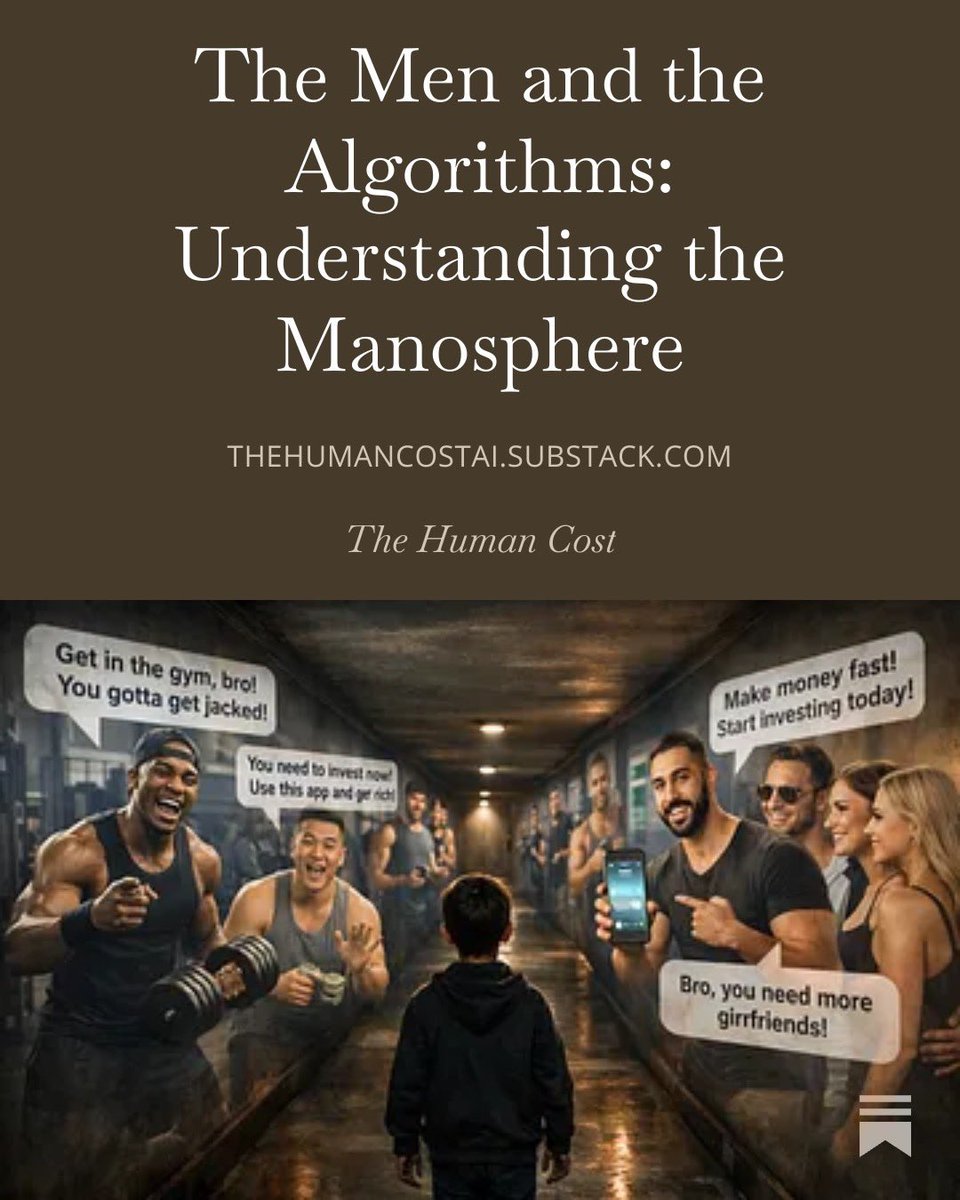
A 19-year-old searches YouTube for career advice.
One recommendation at a time, he ends up in the manosphere.
Nobody anticipated that outcome. Many people profit from it.
New piece ↓
https://t.co/7HNzgzNJO2
We talk about what AI is doing to jobs and economies.
We rarely talk about what it’s doing to us.
That’s what I built The Human Cost for — a Substack on AI’s impact on human relationships, grief, connection, and meaning.
A few things I’ve covered so far:
→ AI companion apps and adolescent attachment (scarier than social media)
→ Who actually pays when Block cuts thousands of jobs and calls it progress
→ What the Paramount-Skydance deal tells us about who controls our narratives
I’ve spent years in AI policy — House Oversight, Uber, Vanderbilt Law. The most consequential stuff rarely makes it into the regulatory frameworks.
So I’m writing about it: https://t.co/4cfqXHsX77
Our YouTube channel is the go-to destination for sharp analysis—all delivered with unfiltered honesty and unmatched clarity with the leading thinkers and policy-makers of our time.
Excited to continue great conversations with @GEBogden
https://t.co/BdPYdt0TuO
If you’re in tech, policy, or the creative space, now’s your moment to help set the guardrails for AI storytelling. The future is being written—literally—in one click.
AI tools that remove all friction from creation can also remove friction from harm. The answer? Build ethical standards into product design from day one. #ResponsibleAI
Innovation must come with accountability. If AI is the “new electricity,” then building its grid should be a shared responsibility, not a public subsidy.’’
Data centers power AI’s future—but they’re also driving electricity bills up for millions. We need policy that ensures the companies creating demand also carry the cost. https://t.co/D9b03B6urE
Policies must lead—not lag. The rise of AI in the workforce demands governance that protects workers, bridges skill divides, and prioritizes fairness in deployment.
The finance sector is on the frontlines—AI now handles up to 75% of analyst work in some firms. As automation deepens, human oversight, ethics, and client relations must remain central.
Entry‑level trajectories are shrinking, and as AI takes over lower‑rung roles, career paths are shifting. We must reclaim access and opportunity through targeted reskilling.
AI is disrupting workforce dynamics fast—white‑collar layoffs are accelerating as firms deploy AI to replace routine roles. This isn’t just tech—it’s a test of policy, equity, and resilience.
AI isn’t just changing how we think—it’s making us think less.
Recent studies from @Wharton and @MIT suggest large language models are eroding our cognitive edge. One experiment showed ChatGPT users had lower comprehension than those using Google. Another found that participants couldn’t recall content generated with AI, or even their own thoughts.
We’re outsourcing critical thinking to machines built for pattern prediction, not wisdom. This isn’t just a UX flaw, it’s a societal risk.
As AI leaders, we must design for augmentation, not dependence.
How do we build AI that sharpens, not softens, the human mind?
The smarter AI gets, the dumber we risk becoming. Let’s fix that.
EEG studies at MIT show a drop in brain activity when people use AI for writing and decision-making. One key finding? Heavy LLM users had the weakest memory retention and analytical focus.
We’re not just saving time, we’re surrendering thought.
It’s time to rethink what “smart AI” really means. Human judgment, creativity, and critical thinking must stay in the loop.
What principles should guide ethical, human-centric AI use?