🧵 Ever wonder how to not miss any big winning stocks in 2025? At @TraderTimes_en, we use a systematic screening process built on 8 core market scans. Each one uncovers unique opportunities. Let’s break them down 👇 #StocksToBuy
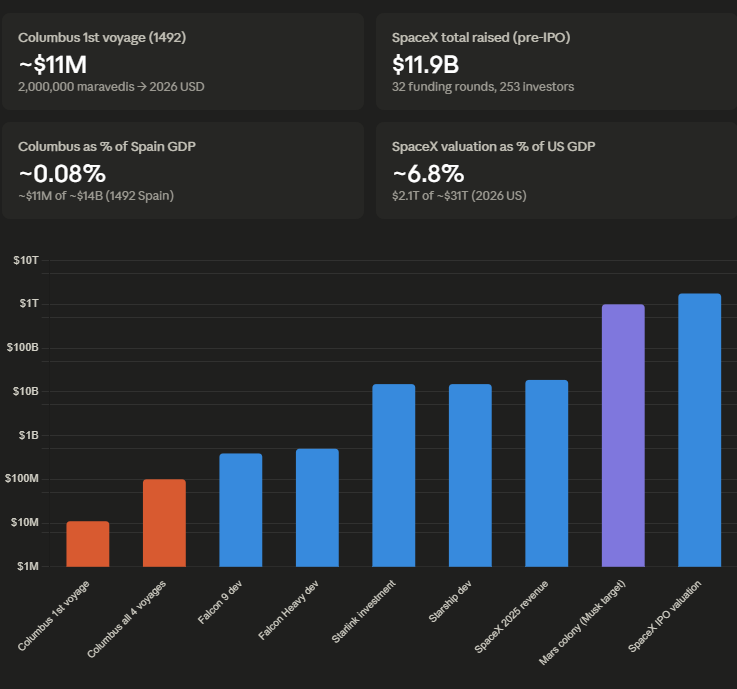
Most interesting: Columbus's entire 1492 expedition (~$11M in 2026 dollars) cost less than a single Falcon 9 launch ($67–74M). One rocket launch today costs 6–7× what it cost to discover the Americas. All four Columbus voyages combined (~$100M) wouldn't even cover a fifth of Falcon Heavy's development budget. $SPCX 2025 revenue alone ($18.7B) exceeds Spain's entire 1492 GDP (~$14B adjusted). A single company now out-earns the whole economy that funded the Age of Discovery.
IQE and Tower Semi signed a multi-year InP epiwafer supply deal for AI data center optical connectivity.
The deal supports $TSEM's silicon photonics platforms, including 200G/lane pluggable transceivers, 400G/lane modulator prototypes, and optical circuit switches.
Note: both companies settled their IP dispute, with Tower granting IQE a worldwide royalty-free license for the porous silicon patents involved.
CHINA ELIMINATES 12,000 ‘OBSOLETE’ UNIVERSITY DEGREES IN PUSH TO PREPARE FOR THE AI ERA
CHINESE UNIVERSITIES SCRAP 12,000 DEGREE PROGRAMS AS AI RESHAPES JOB MARKET DEMANDS
Netanyahu has decided to accept the Iranian deal. Security officials are despondent and see it as a disaster. Ynet brings some high level quotes from them:
1) A senior Israeli official said "Nobody is happy with this. We understand it is not good for us, and that it harms Israeli interests. What is troubling is that Israel cannot influence it. Its voice is not being heard."
2) The anger at Trump is palpable.: "Trump screwed us, we took the hit. We're no longer in the loop and can't really influence anything."
3) Israelis fear Iran will be economically revived: "They've blown money on the Iranians, who are getting everything they want. They'll build a missile corps, and we'll have to pour money into interceptors." Israel sees oil revenue flowing back into the exact capabilities the war was meant to degrade.
4) They don't believe a deal will adequately deal with the nuclear issue: "The real test of the deal is removing the uranium and destroying it. If that doesn't happen, the sense of a bad deal will turn into something more concrete."
5) They fear this will embolden Iran: "Iran has smelled that it can achieve things by force, and it will use that against its neighbors and against us."
6) The deepest worry is not military. It is perception. After months of direct fire, Iran is seen across the region as the side that took the pressure and did not fold: "the regional working assumption will be that it was signed under Iranian pressure and American capitulation, rather than the reverse."
Israel is concerned that Iran will be stronger, the US will be weaker and that the future for it will be bleak in the region. This war has been a disaster for Israel.
A member of Iran’s parliament presidium said any memorandum of understanding with the United States must be reviewed by parliament if it becomes an agreement, treaty or similar binding arrangement.
Alireza Salimi said no agreement should violate the Strategic Action Law to Lift Sanctions and Protect the Rights of the Iranian Nation, a law mandating the government to expand nuclear activities if US sanctions are not lifted.
Passed in 2020 after Tehran accused other parties to the 2015 nuclear deal of failing to meet their commitments, the law led Iran to step up uranium enrichment beyond the agreement’s limits and sharply restrict international inspections of its nuclear sites.
Its enrichment provisions were not merely a negotiating tactic. Iran began enriching uranium to 20% in early 2021, breaking the JCPOA limit of 3.65%, and later increased enrichment to 60% during talks with the West to revive the nuclear deal.
https://t.co/SFyFHupK9j
META IS AN ABSOLUTE MESS INSIDE RIGHT NOW
Wired just dropped an exclusive, and the details are wild.
This week someone interrupted a livestreamed Meta meeting, open to thousands of employees, with an expletive-filled rant about "being the company's bitch." They told the presenters to find a specific Meta AI executive and "tell him that he's a piece of shit."
A presenter covered their face with their hands. Employees in the chat called the start "spicy."
Here is what's behind it.
Meta's AI restructuring cut 8,000 jobs last month, 10% of the company. The same restructuring feeds a unit called Applied AI, where 6,500 engineers and product managers have been drafted in waves since April. There is no application process. You get selected, and your options are join or leave the company. Members call themselves "draftees."
The new job: writing puzzles and coding problems to train Meta's AI models, two tasks a week. People hired to build apps for billions of users now assemble training data for hundreds of AI scientists.
"It's literally the gulag," one employee told WIRED. "You have zero purpose in life all of a sudden, you barely interact with anyone, you just have these tasks every week."
Another: "Most people find the work soul-crushing."
At the same time, Meta started recording US employees' clicks and keystrokes to generate more AI training data. Over 1,600 employees signed a petition demanding it stop. The concession: employees can pause the tracking for up to 30 minutes.
Zuckerberg's response came in an internal memo Friday: "We've made mistakes and will almost certainly make more." He repeated his promise of no more mass layoffs this year. His fixes: limits on the manager ratios Meta had deliberately pushed to 50-to-1 on some teams, bigger budgets for team events, a hackathon next month, and assigned desks by the end of the year.
That same memo says Meta's north star is "to be the best place for the most talented people in the world to make an impact."
The most talented people in the world are writing puzzles for a model and asking permission to pause the keystroke logger.
META declined to comment.
The AI supremacy Wars begins.
Think a lot of the upstream supply chain bottlenecks caused by each Country export controlling each other (eg. $AXTI)
Should present some interesting opportunities in the near future.
That being said, Anthropic was getting distilled left and right in Singapore -> China and others.
Hot take, but steps like this do help preserve American dominance in AI, keeping the most advanced model at home.
I don’t think Superintelligence should be global access, since we’re starting to get into uncharted territories.
Tesla FSD (Supervised) has just officially been approved in Denmark!
This is the fourth European country to get FSD (Supervised) approved, and counting.
Elon Musk: In the beginning, we can launch chips that already exist. The current reference design is for NVIDIA chips - GB300 or Rubin - and we’ll also have reference designs for TPUs. Essentially, you can put existing chips into orbit
But the industry may only reach around 100 gigawatts per year of AI compute. That doesn’t answer how to get to a terawatt. For that, you need TerraFab
TerraFab is expected to be around 100 million square feet, about 10 times the size of Tesla Gigafactory Texas
Even without fundamental technology breakthroughs, scaling existing chipmaking to a terawatt of output per year would be equivalent to about 1 billion chips per year, each doing roughly 1 kilowatt, plus a huge amount of memory
Jane Street's invested in Situational Awareness, which has now seen AUM increase to over $20B. Leopold's investment in Anthropic also accounts for about 20% of their assets.
"Situational Awareness has gained about 270% after fees this year through May and is up more than 1,000% after fees since inception, one of the people said. One of the fund's most successful bets is a stake in Anthropic that today accounts for about one-fifth of its assets, the person said.
Its investors now include Jane Street, the savvy quant-trading firm that ranks among Wall Street's most profitable, some of the people said. Jane Street's investment in Situational Awareness is particularly notable because the firm rarely allocates capital to outside money managers."
⚡️ INTERESTING: 1X Technologies has begun mass production of its NEO humanoid robot in California, targeting 10,000 units annually and aiming to surpass 100,000 annually by 2027.