Personal views. former ECB | Swiss National Bank | ETH Zurich | Yale | Mannheim | ENS Paris. All opinions are my own. Retweets do not imply endorsement.
Why did asset prices soar after March 2020? 📈
Conventional answers from fundamental and behavioral asset pricing theories fall short.
In a new paper, “Asset pricing and the Covid-19 deposit glut: An application of Liquidity Preference Theory” D. Bezemer and I propose a 3rd way.
@ManuelSamuel@robin_j_brooks thanks Manuel. We also have the credibility and financial sanctions element, plus global liquidity effects, under which you can subsume the cash needed for higher oil prices, and combine this with a supply curve of gold mining
https://t.co/kGg6u47Bsq
New paper on financial sanctions, global imbalances and gold prices
With legendary Ulrich Bindseil and Svetla Daskalova
https://t.co/1f0LWGBIVO
Views are our own.
As described by Del Mar (1895, 326), the Mongol ruler of Persia was assassinated in 1294 apparently for having “criminally substituted paper for metallic money”, which might be one of the earliest known examples of a failure to introduce non-metallic fiat money. #Gold
commercial borrowers, as well as backed by the associated reputation of the bank. These banks operated��with credit money, where transfers occurred on the books of the bank. https://t.co/Xq2GMf5W4J
History provides only a few examples of central banks that came close to not promising convertibility. The Neapolitan public banks, including the Banco di Napoli and other Monte di Pietà-type institutions, did not initially offer convertibility into precious metals.
Instead, they operated primarily as giro banks—they provided deposit and transfer services (account-based payments) without issuing convertible notes. Their liabilities were not redeemable for coins or metals on demand but backed by loans, often to the government or
Our Financial Innovation Network (FIN) met in Frankfurt am Main this week, hosted by the European Central Bank @ecb. Among the topics discussed: #Crypto#AgenticAI#QuantumComputing and #Tokenisation
https://t.co/lyPNx59RTN
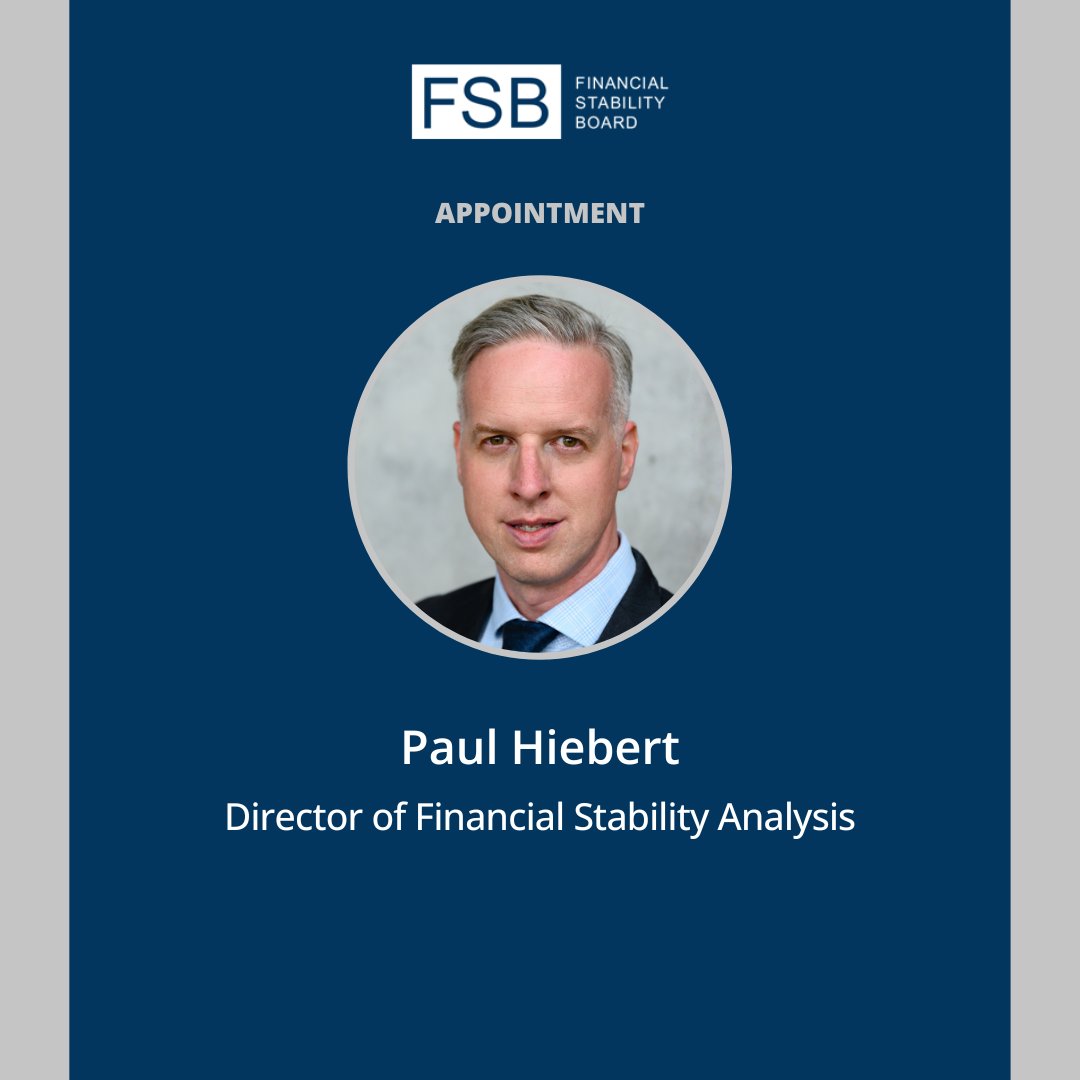
📢 We are pleased to announce the appointment of Paul Hiebert as Director of Financial Stability Analysis, effective 1 January 2026.
Learn more about the FSB’s work to assess risks and vulnerabilities in the global financial system: https://t.co/lyPNx59RTN
There is an interesting, slow-burning realisation, both economically and socially, that we are — as if — living with the after-effects of having lost a war without even realising we were in one.
With no bombs even dropped...
— Our industrial capacity has been eviscerated.
— Our autonomy has been compromised.
— We've lost our youth (not to battlefield deaths, but to low fertility).
— The population has post-traumatic shock in the form of a mental health crisis or an addiction crisis.
— Those working, work harder than ever before due to collapsing boundaries between work life and leisure.
— Cultural traditions and key institutions are being phased out.
— Privacy is being lost.
— Whether you tolerate the rich or not, their wealth is under attack too, but not necessarily for domestic redistribution.
— By many estimates, foreign investors now own more than 50% of the UK stock market, and roughly a quarter to a third of UK government debt, meaning an ever larger amount of our surplus or profit makes its way abroad, where it cannot be taxed.
To quote Kpop demon hunters,- the song we couldn't write, this is what it sounds like.
https://t.co/l9Ew9I8t4C
@wbmosler if returns are significantly driven by higher earnings, which they are, then these earnings are financed by others - government, foreigners, domestic households, other firms.
The classical gold standard was more of a pound sterling stabdard with gold features - but this is only visible once you look at the overall monetary system, from central banks to banks and non-bank financial institutions (NBFIs).
Read more here: https://t.co/Xq2GMf6tUh
Is Monetary Sovereignty an outdated concept? Ulrich Bindseil and I say no. We provide a modern definition and show its various dimensions, benefits and instruments. From money to payments, shadow banks and global monetary regimes. Intro paper in 1st comment