Capex isn't a death sentence: why "Path 2" doesn't always beat Path 1
I really enjoyed Antonio Linares' (@alc2022) new piece, "How to get rich from AI selloffs without getting lucky." It's sharp, it's logical, and it's written by a guy who actually bought AMD at $4 and Palantir at $7. Hard to argue with that track record, so let me say it up front: he's right about the core mechanism. Over the long run, a stock really does follow free cash flow per share (FCF/share).
But he takes a correct premise and lands on a conclusion I don't buy. In short, his take is that "Path 2" companies (proprietary data, cheap open models, low capex) are the better bet, while the heavy capex of "Path 1" gives you uncertain returns. I'd argue that as a general rule, this is wrong. Capex isn't good or bad by itself. What matters is who controls the scarcity, and whether the invested capital earns more than it costs.
Let me try to show it with numbers.
First, let's check the examples
Linares lists four companies whose FCF/share has exploded since 2020: Spotify (+1,260%), Duolingo (+580%), Palantir (+360%), Reddit (+344%). Impressive. But I looked at what the stocks themselves did. Total return from January 4, 2021 (or from IPO) to the November 20, 2026 close:
- Palantir: +514%. Fair play, he nailed this one. Hat off.
- Spotify: +86%. For comparison, the S&P 500 (SPY, dividends included) did +102% over the same stretch. Cash flow up roughly 13x, and the stock still lagged the index.
- Duolingo: +8% from the IPO price, and -73% from the May 2025 peak.
- Reddit: +69% from the March 2024 IPO, but the share count is up 21.5%, and the company licenses its crown-jewel data to Google and OpenAI.
- Hims & Hers, his future "superhuman model of biology": -7% since early 2021, with FCF/share down from $0.22 to $0.04.
To me this looks like classic survivorship bias. The winners were picked in hindsight, and the names that looked just as great on the same criteria but never took off didn't make the cut. Linares himself wrote back in February 2026 that he bought Duolingo at $323 and then watched it crash 80%. It's at $145 now. I'm not throwing shade, every investor has been a bagholder on something. But it's a good illustration: the same playbook that crushed it on Palantir is so far down more than half on Duolingo.
And there are other "boring" Path 2 names that should have ripped by the textbook. Intuit: FCF/share +97%, stock -24% since 2021. FICO, the credit scoring standard: FCF/share +158%, yet it trades at $694 vs a 52-week high of $1,859. Doximity, the closed network for doctors: 46% below its IPO price. The data is there, the capex is basically zero, and shareholders still didn't make money.
Now let's look at the "bad" Path 1
If "heavy capex = uncertain returns" were a law of nature, companies spending a fifth of revenue or more on building stuff should be losing. I pulled total returns since January 4, 2021 and trailing 12-month capex as a share of revenue from Yahoo Finance:
- Eli Lilly (LLY): +763%, capex 22% of revenue.
- Micron (MU): +723%, capex 23%.
- Vistra (VST): +571%, capex 15%.
- Talen (TLN): +616% since June 2023.
- Constellation (CEG): +488% since the January 2022 spin-off, capex 13%.
- Cameco (CCJ): +339%, capex 12%.
- TSMC (TSM): +213%, capex 34%.
- Alphabet (GOOGL): +210%, capex 34%.
- For reference, S&P 500 (SPY): +102%.
These aren't startups with a slick pitch deck. They're factories, power plants, uranium mines and chip fabs. Lilly built out GLP-1 capacity and made more money than any company in his piece except Palantir. Micron put $30.7B into memory production over the last 12 months and generated $59B of free cash flow over the same 12 months. So much for "uncertain returns." That's a company printing cash.
My take is that these stories share one thing: the capex created scarcity instead of fighting it. You can't copy an HBM memory fab, a grid-connected nuclear plant or a uranium mine with an open model in six months at a 95% discount. That takes years, permits and billions. So when demand showed up, the seller set the price.
Where the "data moat" argument springs a leak
Linares has a neat line: "The model is a commodity. Data is the moat." I half agree. If models get 95% cheaper and catch up to the frontier in six months, that cuts both ways. Cheap intelligence isn't just available to Spotify and Duolingo, it's available to any competitor who wants to build the same product. A thin data layer on top of a commodity model is surprisingly easy to replicate, especially when the data isn't all that unique. Plenty of apps have Spanish drills, and a free voice tutor from a frontier lab hits the product right where it hurts.
The second threat is bigger: agents. If an AI agent files your taxes or picks your music, the interface the whole business was built around stops mattering. I think that's exactly what the market fears with Intuit and Duolingo. It's not "confusion," it's a pretty rational doubt: your own data only protects you as long as the customer comes to you and not to the agent.
Physical scarcity, on the other hand, is something agents can't route around. Agents need power, chips and data centers. Every new leap in AI adds demand for exactly what Path 1 companies are building.
A simple model: low capex doesn't equal more value
To get past vibes, here's a simple model. The value a business creates in a year is roughly (ROIC - WACC) × invested capital. ROIC is the return on invested capital, WACC is the cost of that capital, i.e. what lenders and shareholders demand. In steady state, earnings growth is roughly ROIC times the share of earnings the company reinvests.
Three made-up companies, each earning 10 today, all with a 9% WACC. The numbers are illustrative, not a forecast for any real company.
- Company A, "Path 2" with nowhere to put capital: ROIC 50%, reinvests 10% of earnings, grows 5% a year. Free cash flow today 9.0, earnings in 10 years 16.3, free cash flow in 15 years 18.7.
- Company B, "Path 1" with scarcity and contracts: ROIC 20%, reinvests 60%, grows 12%. Free cash flow today 4.0, earnings in 10 years 31.1, free cash flow in 15 years 21.9.
- Company C, "Path 1" with no moat: ROIC 7%, reinvests 60%, grows 4.2%. Free cash flow today 4.0, earnings in 10 years 15.1, free cash flow in 15 years 7.4.
Here's what I see. A has gorgeous returns and hands back more cash every single year for a decade: 119 in total vs 79 for B. On "FCF/share today," A looks perfect and B looks like a heavyweight eating everything it makes. But ten years out, B's earnings are almost double A's, and by year 15 it beats A on free cash flow too. Linares' metric, taken at a point in time, punishes exactly the company creating the most value. That's how the market underrated Amazon for years while it was building warehouses and AWS.
Company C is the lesson where he's absolutely right. If ROIC is below the cost of capital, every new build burns money no matter how fast revenue grows. Fund that build with new shares and the shareholder gets hit twice.
The takeaway: what matters isn't the size of the capex, it's the gap between ROIC and WACC and how much capital you can deploy at that gap. A high-ROIC business with nowhere to reinvest is left buying back stock. That's fine, but it's not exponential.
Your entry price decides almost everything
There's also a very down-to-earth point. The market usually sees Path 2 quality already and happily pays up for it. By my rough math, Palantir trades at about 90x annual free cash flow, Micron at about 12x (with the caveat that memory is cyclical and peak cash flow may not repeat). Buying the dip works on both paths. But when a great company trades at 90x cash flow, it needs flawless execution just to justify the price. A capex-heavy business under a cloud often trades as if the build will never pay off. If it does pay off, the asymmetry is on its side, not on the side of "boring" software.
One more thing the article skips: the biggest winners of the AI build-out weren't the data owners or the builders. They were the picks and shovels guys selling to the builders. Comfort Systems (HVAC and engineering for data centers) is up 1,974% since 2021 with capex at 5% of revenue, Sterling Infrastructure +1,287% at 3%, GE Vernova +435% since its 2024 spin. Low capex, sure, but zero "data moat." Their moat is the order backlog and the shortage of capacity and skilled people. So even among the capital-light names, the winners didn't follow Linares' script.
Where he's right, and that matters
I'm not pretending Path 1 is safe. There are cases where capex did exactly what Linares warns about:
- Oracle: $75.7B of capex over 12 months on $71.8B of revenue (105%), free cash flow -$28.7B, stock -69% from its September 2025 peak.
- CoreWeave: capex at 279% of revenue, free cash flow -$20.4B, stock -78% from its June 2025 peak and roughly flat vs the IPO price.
- Intel: years of massive fab spending without tech leadership, +14% since 2021 vs +102% for the index.
- Meta: stock +111%, but FCF/share is about a third below 2023 levels because capex is eating the growth.
The common thread in the blowups is obvious: building on debt or new shares, chasing market share, with no signed demand and no pricing power. Here I'm fully with Linares: dilution destroys per-share value, no matter how pretty the top line looks.
A separate word on IREN, since I hold it and owe myself some honesty. IREN has what my framework counts as a moat: power and land for data centers, which is real scarcity. It has contracts with big customers, and customers prepay part of the GPU cost. But over the last 12 months capex was $9.1B on revenue of about $0.7B, free cash flow was -$6.6B, and the share count is up about 50% in a year, from 282.9M to 424.4M. On Linares' metric that's a negative right now, and I won't argue. To end up as Company B and not Company C, IREN has to hit its contracted revenue without more delays, close the funding gap without issuing stock at today's prices, and get to positive FCF/share. Until then, for me it's an option on execution, not a safe harbor. Ngl, that's not the most comfortable thing to write about your own position.
My conclusions
I think Linares is asking the wrong question. Which "path" a company is on doesn't matter much. What matters is who controls the scarcity and whose capital earns more than it costs. Sometimes the scarcity is unique data, like at Palantir. Sometimes it's a memory fab, a nuclear plant or a uranium mine. And sometimes the "unique data" turns out to be a thin layer on top of a commodity model, and then low capex won't save you.
So I run both types of companies through one checklist.
For capex-heavy businesses:
1. Does the build create scarcity that can't be copied quickly (power, permits, technology)?
2. Is demand signed before the build, with prepayments or long contracts?
3. Is ROIC on new investment above the cost of capital?
4. How is it funded: own cash flow, debt or new shares?
5. Is FCF/share growing, at least on a two to three year horizon?
For capital-light "data" businesses:
1. Is the data actually unique, or could someone rebuild it from scratch in a year?
2. Can an agent bypass the company's interface and take the customer?
3. Is there somewhere to reinvest at high ROIC, or is it just buybacks from here?
4. Is stock-based comp diluting shareholders?
5. How many years of flawless execution are already priced in?
My bottom line is simple. Linares is right that a panicking market throws everything into one pile, and that FCF/share wins in the end. But I'd argue that "Path 2 always wins" is a conclusion drawn from survivors. The last six years show something closer to the opposite: the biggest money went to those who built scarce capacity against signed demand, and to those who sold them the shovels. Capex can be a furnace for cash or the foundation of a fortress. What separates the two isn't the size of the check, it's what the money builds.
Linares' piece gave me more to think about than I expected. In Part 2 I'll go through capex-heavy companies outside AI, including some from my own portfolio, with my entries and my mistakes.
Not investment advice. I hold a position in IREN. All figures as of the 11/20/2026 close.
Linares' original: https://t.co/Y6sFra1W4r
“Low capex beats heavy capex" sounds smart. The numbers since Jan 2021 say otherwise.
Heavy builders (capex as % of revenue):
$LLY +763% (22%)
$MU +723% (23%)
$VST +571% (15%)
$TSM +213% (34%)
$GOOGL +210% (34%)
Asset-light darlings:
$PLTR +514%
$SPOT +86%
$DUOL +8% since IPO
$HIMS -7%
$SPY for reference: +102%
Spotify grew FCF/share ~13x and still lagged the index. Micron spent $30.7B on fabs and threw off $59B of free cash flow in the same 12 months.
Capex isn't good or bad. What matters is who owns the scarcity and whether the capital earns more than it costs. You can't copy an HBM fab or a grid-connected nuclear plant with an open model in six months.
Full breakdown with the math below 👇
Friday $IREN got absolutely nuked. Closed $11.82, down almost 18%. I held and ate it.
Monday morning Nvidia's board puts Jensen back in the chair. CEO, president, board seat, effective immediately. Not some X rumor, there's a press release and an 8-K with the SEC. The investigation's still running, but the man is back.
Bell rings, $IREN opens $14.81. That's +25% off Friday's close. $NVDA opens $167, +33%.
Friday's paper hands sold the bottom, Monday they're chasing it at $15+.
Still early, high beta cuts both ways. But damn, what a weekend to hold.
📈🚀🚀🚀 🚨 BREAKING: Jensen Huang Reinstated as NVIDIA CEO!
NVIDIA’s Board of Directors has unanimously reinstated Jensen Huang as President, CEO, and Board Director, effective immediately.
The investigation remains ongoing, but Huang is officially back at the helm of $NVDA.
https://t.co/ynfbMuPxdl
卧槽,兄弟们,连掌管 Meta 超级智能实验室的 29 岁掌门人 Alexandr Wang,今天都亲自下场写长文拉响最高级别警报了。
懂行的人都知道他的底细——从小在原子弹诞生地洛斯阿拉莫斯长大、MIT 出身、一路打数学竞赛杀出来的硬核理工天才,如今更是站在全球最顶尖 AI 牌桌核心的人物。
结果就在今天,他发出一篇极其清醒、也极其沉重的重磅长文,第一句话就直接把硅谷的窗户纸捅穿了:超级智能已经兵临城下,未来这十二个月人类怎么选,将直接决定我们往后活在一个什么样的世界里。
在 Alexandr Wang 看来,黎曼猜想被攻克,就是整个人类文明彻底转向的发令枪。
绝大多数外行,压根没意识到这件事的恐怖量级。在研究数学的人眼里,黎曼猜想代表了人类智力成就的绝对珠峰——论纯粹的思维强度,人类历史上干成过的一切都无出其右。甚至连他老家洛斯阿拉莫斯的许多物理学家都会承认:比起证明黎曼猜想,当年造出原子弹顶多算一道课后作业。
而这座人类最聪明的大脑死磕了 150 年的巅峰,刚刚在一种我们至今无法理解的“外星心智”协助下,被彻底踏平了。
他把时间拨回 2024 年 12 月:当年 o3 横扫美国数学邀请赛(AIME)时,打过数学竞赛的人心里就已经咯噔一下——完了,一切都要变了。道理很简单,AIME 压轴题的纯智力难度,早就远超最顶尖工程师和商界精英的日常工作;当时卡住 AI 的根本不是不够聪明,而是缺行业经验、上下文和落地约束。果然,过去这两年把这些非智力短板一补齐,编程几乎被彻底打穿,顶级网络攻防和通用智能体全面爆发。
可 AIME 终究只是青少年的课外竞赛,黎曼猜想却是人类历史上最烧脑的终极难题。MIT 的教授们都会告诉你,几乎所有人类核心学科里最顶尖的智力难题,纯思维难度其实都“低于”黎曼猜想,差的只是实验条件、数据积累和反馈闭环。
这意味着一个极其残酷的分水岭:从今天起,AI 在几乎所有领域大幅碾压最顶尖人类,瓶颈彻底不再是智力本身,剩下的只是行业诀窍、工程管道和实验对接。
而最致命的一刀,恰恰落在 AI 研发自己身上。
绝大多数研究者都会承认,搞 AI 研究的智力难度,同样远远低于证明黎曼猜想。这意味着模型很快就能把整个 AI 研发彻底自动化,在“自我升级”这件事上全面超越人类——同时把生物、武器、经济学等所有领域全按下疯狂加速键。就像今天数学界根本来不及消化黎曼猜想的证明一样,用不了多久,几乎每个学科的狂飙速度,都将彻底甩开人类大脑能够理解和监控的极限。
这就好比人类造出了一台能一边狂飙、一边自己改图纸升级发动机的超级列车。前两年大家还在争论它爬不爬得上眼前这道坡,结果一眨眼它连地球最高峰都直接碾平了——此时最要命的早就不是车跑不跑得动,而是车速快到连仪表盘都跟不上跳字,车里却还有人一边看着窗外一边自我安慰:“既然拦不住,那咱们就研究怎么安全地把方向盘交出去吧。”
整篇文章最狠、也最清醒的,是最后这段对整个 AI 圈的当头棒喝。
作为亲自掌舵超级智能实验室的核心大佬,Alexandr Wang 直接痛批了行业里正在蔓延的一种“懒人思维”——很多人默认“超级智能不可避免,唯一要解决的只是怎么安全地造出来”。
他把话撂得很死:面对不受约束的递归自我进化,以及比人类聪明 1000 倍的超级智能,很难想象人类还能轻松守住控制权。既然“把能力推到极限”的科学难题已经被基本解决,安全、对齐和防护已经刻不容缓;但更底层的红线在于——我们绝不该坦然接受把人类社会“交接(Handover)”给 AI 的结局。
人类真正应该拼命去打造的,是能赋予每个人更强主动权与赋能的技术。连冲在超级智能最前线的掌门人都站出来大喊“全行业必须立刻偏离眼前的默认轨道”,你就能明白:这绝不是外行的杞人忧天,而是人类留给自己亲手握紧方向盘的最后窗口期。
Great read, Antonio.
Fully agree that FCF/share drives returns over the long run. Where I'd push back is the idea that low capex beats heavy capex as a rule.
To me the winners are whoever owns the scarcity. I laid out my counterpoints with numbers here, would love your take: Great read, Antonio.
Fully agree that FCF/share drives returns over the long run.
Where I'd push back is the idea that low capex beats heavy capex as a rule.
To me the winners are whoever owns the scarcity.
I laid out my counterpoints with numbers here, would love your take:
https://t.co/BbAyRNC41m
Capex isn't a death sentence: why "Path 2" doesn't always beat Path 1
I really enjoyed Antonio Linares' (@alc2022) new piece, "How to get rich from AI selloffs without getting lucky." It's sharp, it's logical, and it's written by a guy who actually bought AMD at $4 and Palantir at $7. Hard to argue with that track record, so let me say it up front: he's right about the core mechanism. Over the long run, a stock really does follow free cash flow per share (FCF/share).
But he takes a correct premise and lands on a conclusion I don't buy. In short, his take is that "Path 2" companies (proprietary data, cheap open models, low capex) are the better bet, while the heavy capex of "Path 1" gives you uncertain returns. I'd argue that as a general rule, this is wrong. Capex isn't good or bad by itself. What matters is who controls the scarcity, and whether the invested capital earns more than it costs.
Let me try to show it with numbers.
First, let's check the examples
Linares lists four companies whose FCF/share has exploded since 2020: Spotify (+1,260%), Duolingo (+580%), Palantir (+360%), Reddit (+344%). Impressive. But I looked at what the stocks themselves did. Total return from January 4, 2021 (or from IPO) to the November 20, 2026 close:
- Palantir: +514%. Fair play, he nailed this one. Hat off.
- Spotify: +86%. For comparison, the S&P 500 (SPY, dividends included) did +102% over the same stretch. Cash flow up roughly 13x, and the stock still lagged the index.
- Duolingo: +8% from the IPO price, and -73% from the May 2025 peak.
- Reddit: +69% from the March 2024 IPO, but the share count is up 21.5%, and the company licenses its crown-jewel data to Google and OpenAI.
- Hims & Hers, his future "superhuman model of biology": -7% since early 2021, with FCF/share down from $0.22 to $0.04.
To me this looks like classic survivorship bias. The winners were picked in hindsight, and the names that looked just as great on the same criteria but never took off didn't make the cut. Linares himself wrote back in February 2026 that he bought Duolingo at $323 and then watched it crash 80%. It's at $145 now. I'm not throwing shade, every investor has been a bagholder on something. But it's a good illustration: the same playbook that crushed it on Palantir is so far down more than half on Duolingo.
And there are other "boring" Path 2 names that should have ripped by the textbook. Intuit: FCF/share +97%, stock -24% since 2021. FICO, the credit scoring standard: FCF/share +158%, yet it trades at $694 vs a 52-week high of $1,859. Doximity, the closed network for doctors: 46% below its IPO price. The data is there, the capex is basically zero, and shareholders still didn't make money.
Now let's look at the "bad" Path 1
If "heavy capex = uncertain returns" were a law of nature, companies spending a fifth of revenue or more on building stuff should be losing. I pulled total returns since January 4, 2021 and trailing 12-month capex as a share of revenue from Yahoo Finance:
- Eli Lilly (LLY): +763%, capex 22% of revenue.
- Micron (MU): +723%, capex 23%.
- Vistra (VST): +571%, capex 15%.
- Talen (TLN): +616% since June 2023.
- Constellation (CEG): +488% since the January 2022 spin-off, capex 13%.
- Cameco (CCJ): +339%, capex 12%.
- TSMC (TSM): +213%, capex 34%.
- Alphabet (GOOGL): +210%, capex 34%.
- For reference, S&P 500 (SPY): +102%.
These aren't startups with a slick pitch deck. They're factories, power plants, uranium mines and chip fabs. Lilly built out GLP-1 capacity and made more money than any company in his piece except Palantir. Micron put $30.7B into memory production over the last 12 months and generated $59B of free cash flow over the same 12 months. So much for "uncertain returns." That's a company printing cash.
My take is that these stories share one thing: the capex created scarcity instead of fighting it. You can't copy an HBM memory fab, a grid-connected nuclear plant or a uranium mine with an open model in six months at a 95% discount. That takes years, permits and billions. So when demand showed up, the seller set the price.
Where the "data moat" argument springs a leak
Linares has a neat line: "The model is a commodity. Data is the moat." I half agree. If models get 95% cheaper and catch up to the frontier in six months, that cuts both ways. Cheap intelligence isn't just available to Spotify and Duolingo, it's available to any competitor who wants to build the same product. A thin data layer on top of a commodity model is surprisingly easy to replicate, especially when the data isn't all that unique. Plenty of apps have Spanish drills, and a free voice tutor from a frontier lab hits the product right where it hurts.
The second threat is bigger: agents. If an AI agent files your taxes or picks your music, the interface the whole business was built around stops mattering. I think that's exactly what the market fears with Intuit and Duolingo. It's not "confusion," it's a pretty rational doubt: your own data only protects you as long as the customer comes to you and not to the agent.
Physical scarcity, on the other hand, is something agents can't route around. Agents need power, chips and data centers. Every new leap in AI adds demand for exactly what Path 1 companies are building.
A simple model: low capex doesn't equal more value
To get past vibes, here's a simple model. The value a business creates in a year is roughly (ROIC - WACC) × invested capital. ROIC is the return on invested capital, WACC is the cost of that capital, i.e. what lenders and shareholders demand. In steady state, earnings growth is roughly ROIC times the share of earnings the company reinvests.
Three made-up companies, each earning 10 today, all with a 9% WACC. The numbers are illustrative, not a forecast for any real company.
- Company A, "Path 2" with nowhere to put capital: ROIC 50%, reinvests 10% of earnings, grows 5% a year. Free cash flow today 9.0, earnings in 10 years 16.3, free cash flow in 15 years 18.7.
- Company B, "Path 1" with scarcity and contracts: ROIC 20%, reinvests 60%, grows 12%. Free cash flow today 4.0, earnings in 10 years 31.1, free cash flow in 15 years 21.9.
- Company C, "Path 1" with no moat: ROIC 7%, reinvests 60%, grows 4.2%. Free cash flow today 4.0, earnings in 10 years 15.1, free cash flow in 15 years 7.4.
Here's what I see. A has gorgeous returns and hands back more cash every single year for a decade: 119 in total vs 79 for B. On "FCF/share today," A looks perfect and B looks like a heavyweight eating everything it makes. But ten years out, B's earnings are almost double A's, and by year 15 it beats A on free cash flow too. Linares' metric, taken at a point in time, punishes exactly the company creating the most value. That's how the market underrated Amazon for years while it was building warehouses and AWS.
Company C is the lesson where he's absolutely right. If ROIC is below the cost of capital, every new build burns money no matter how fast revenue grows. Fund that build with new shares and the shareholder gets hit twice.
The takeaway: what matters isn't the size of the capex, it's the gap between ROIC and WACC and how much capital you can deploy at that gap. A high-ROIC business with nowhere to reinvest is left buying back stock. That's fine, but it's not exponential.
Your entry price decides almost everything
There's also a very down-to-earth point. The market usually sees Path 2 quality already and happily pays up for it. By my rough math, Palantir trades at about 90x annual free cash flow, Micron at about 12x (with the caveat that memory is cyclical and peak cash flow may not repeat). Buying the dip works on both paths. But when a great company trades at 90x cash flow, it needs flawless execution just to justify the price. A capex-heavy business under a cloud often trades as if the build will never pay off. If it does pay off, the asymmetry is on its side, not on the side of "boring" software.
One more thing the article skips: the biggest winners of the AI build-out weren't the data owners or the builders. They were the picks and shovels guys selling to the builders. Comfort Systems (HVAC and engineering for data centers) is up 1,974% since 2021 with capex at 5% of revenue, Sterling Infrastructure +1,287% at 3%, GE Vernova +435% since its 2024 spin. Low capex, sure, but zero "data moat." Their moat is the order backlog and the shortage of capacity and skilled people. So even among the capital-light names, the winners didn't follow Linares' script.
Where he's right, and that matters
I'm not pretending Path 1 is safe. There are cases where capex did exactly what Linares warns about:
- Oracle: $75.7B of capex over 12 months on $71.8B of revenue (105%), free cash flow -$28.7B, stock -69% from its September 2025 peak.
- CoreWeave: capex at 279% of revenue, free cash flow -$20.4B, stock -78% from its June 2025 peak and roughly flat vs the IPO price.
- Intel: years of massive fab spending without tech leadership, +14% since 2021 vs +102% for the index.
- Meta: stock +111%, but FCF/share is about a third below 2023 levels because capex is eating the growth.
The common thread in the blowups is obvious: building on debt or new shares, chasing market share, with no signed demand and no pricing power. Here I'm fully with Linares: dilution destroys per-share value, no matter how pretty the top line looks.
A separate word on IREN, since I hold it and owe myself some honesty. IREN has what my framework counts as a moat: power and land for data centers, which is real scarcity. It has contracts with big customers, and customers prepay part of the GPU cost. But over the last 12 months capex was $9.1B on revenue of about $0.7B, free cash flow was -$6.6B, and the share count is up about 50% in a year, from 282.9M to 424.4M. On Linares' metric that's a negative right now, and I won't argue. To end up as Company B and not Company C, IREN has to hit its contracted revenue without more delays, close the funding gap without issuing stock at today's prices, and get to positive FCF/share. Until then, for me it's an option on execution, not a safe harbor. Ngl, that's not the most comfortable thing to write about your own position.
My conclusions
I think Linares is asking the wrong question. Which "path" a company is on doesn't matter much. What matters is who controls the scarcity and whose capital earns more than it costs. Sometimes the scarcity is unique data, like at Palantir. Sometimes it's a memory fab, a nuclear plant or a uranium mine. And sometimes the "unique data" turns out to be a thin layer on top of a commodity model, and then low capex won't save you.
So I run both types of companies through one checklist.
For capex-heavy businesses:
1. Does the build create scarcity that can't be copied quickly (power, permits, technology)?
2. Is demand signed before the build, with prepayments or long contracts?
3. Is ROIC on new investment above the cost of capital?
4. How is it funded: own cash flow, debt or new shares?
5. Is FCF/share growing, at least on a two to three year horizon?
For capital-light "data" businesses:
1. Is the data actually unique, or could someone rebuild it from scratch in a year?
2. Can an agent bypass the company's interface and take the customer?
3. Is there somewhere to reinvest at high ROIC, or is it just buybacks from here?
4. Is stock-based comp diluting shareholders?
5. How many years of flawless execution are already priced in?
My bottom line is simple. Linares is right that a panicking market throws everything into one pile, and that FCF/share wins in the end. But I'd argue that "Path 2 always wins" is a conclusion drawn from survivors. The last six years show something closer to the opposite: the biggest money went to those who built scarce capacity against signed demand, and to those who sold them the shovels. Capex can be a furnace for cash or the foundation of a fortress. What separates the two isn't the size of the check, it's what the money builds.
Linares' piece gave me more to think about than I expected. In Part 2 I'll go through capex-heavy companies outside AI, including some from my own portfolio, with my entries and my mistakes.
Not investment advice. I hold a position in IREN. All figures as of the 11/20/2026 close.
Linares' original: https://t.co/Y6sFra1W4r
Everyone keeps saying $IREN just prints shares whenever it needs cash. I got curious and actually read the filings (10-K, latest 10-Q, the 8-Ks, the proxy). Short version: it's not what the timeline thinks.
Ugly part first. Share count went from 257M in June 2025 to 424M at the end of October 2026. That's +65%. Not small, not going to pretend it is.
But share count is only half of it. What matters is the price they sold at and what the money went into.
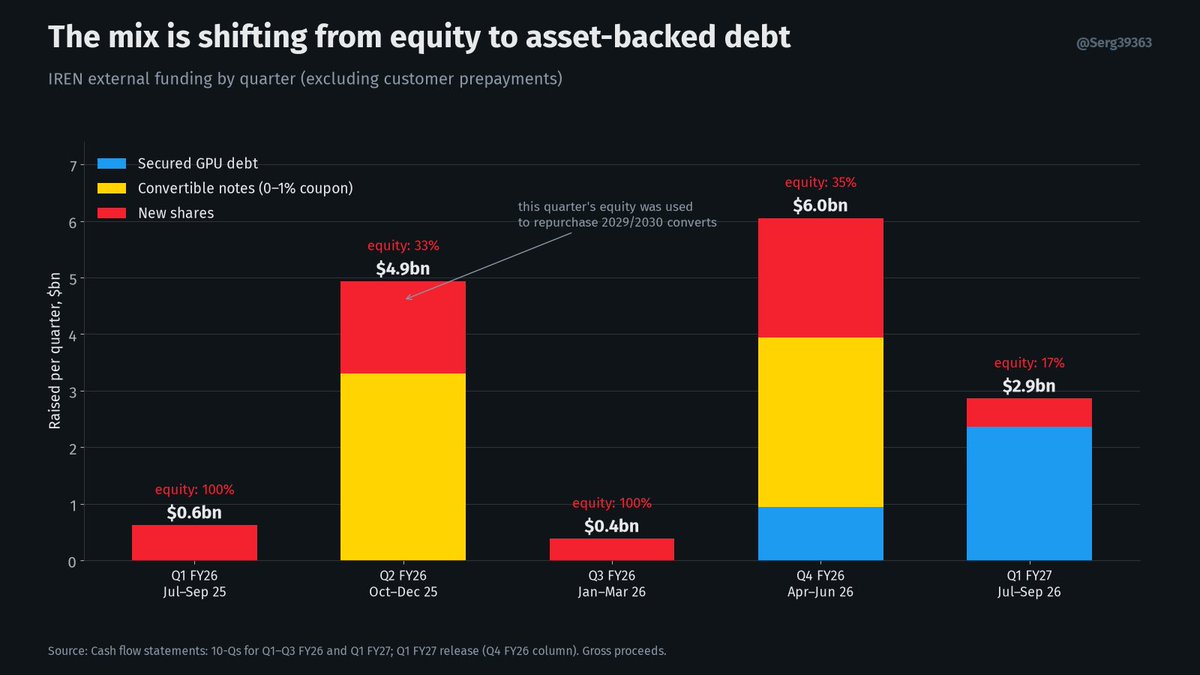
Price. Since July 2025 they've sold roughly 140M shares for about $5.9B. That's around $42 a share, some of it as high as $54 back in Apr-Jun. Stock's at ~$12 now. So most of that equity was raised at 3-4x today's price. FY24 was a totally different story: 121M shares for $0.8B, about $7 apiece. That was the painful dilution. This wasn't.
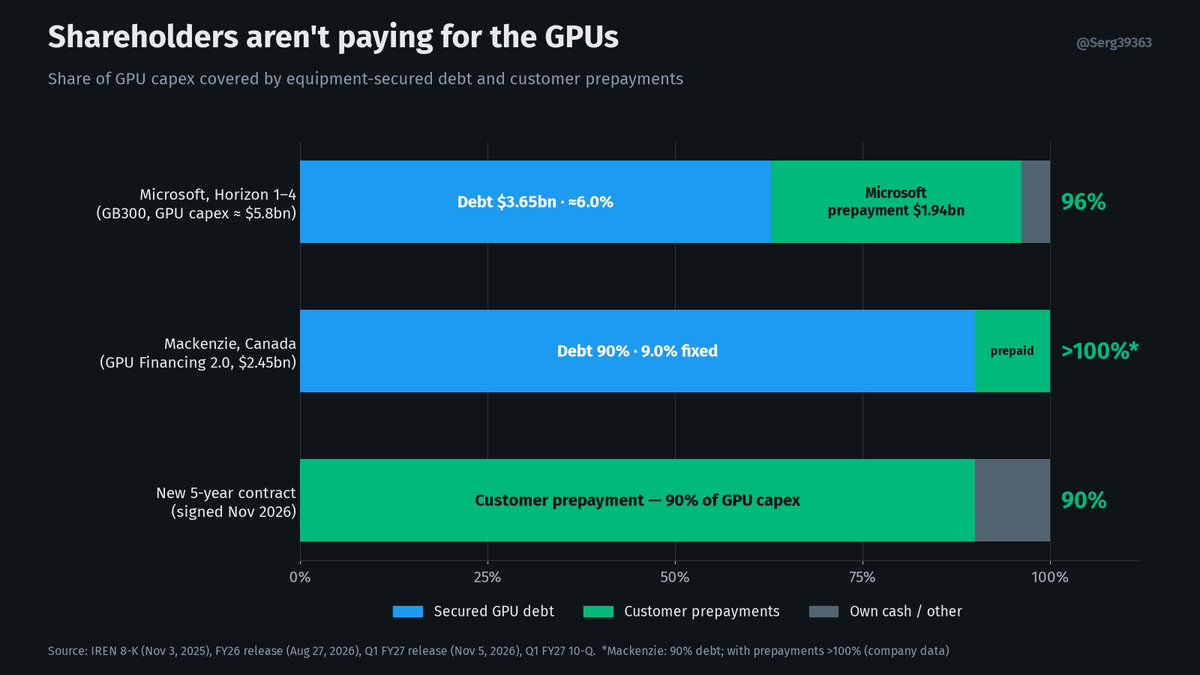
Where the money went. The GPUs mostly aren't being paid for with our equity.
Microsoft ($9.7B contract): $3.65B of debt at ~6%, arranged by Goldman and JPM, plus Microsoft's prepayment. Together that covers 96% of the GPU spend.
Mackenzie: $2.45B at a fixed 9% from Blue Owl funds (PIMCO advising some of the lenders). 90% of the GPU cost, over 100% once you add the customer prepayment.
And the new 5-year deal from this month: the customer prepays 90% of the GPU cost.
You can see it in the funding mix too. Last quarter (Jul-Sep) they raised $2.9B of outside capital. 17% equity, 83% debt tied to specific hardware and contracts. A year earlier it was basically all equity.
The debt is pretty cheap. ~$10B total, and $6.75B of that is converts paying 0-1%, so roughly $60M a year in coupons and nothing due before 2031. Conversion prices are $51-86, and the 2032/2033 notes have capped calls covering dilution up to $82 and $110. The Microsoft financing ($1.98B) has no recourse to the parent.
The CFO matters here. Anthony Lewis did 22 years at Macquarie (head of transactions & structuring, head of capital, co-treasurer). Joined in July 2025, CFO since September. Every deal above happened on his watch. I don't think that's a coincidence.
Management is at least saying the right things. Daniel Roberts on the Nov 5 call: "capital needs to be respected in the current environment, and we're not going to grow at all costs." Capex through June 2027 got cut to ~$15B, with $9B already funded. On the other $6B he said it "sits against $12 billion to $15 billion of sources before converts or equity", meaning DC and GPU financing plus prepayments.
Skin in the game: each Roberts brother holds ~3.2% (2026 proxy, incl. options and RSUs). NVIDIA has a warrant for up to 30M shares at $70. The stock is at 12.
Now the stuff that actually bugs me, because it's not all roses:
- At $12, raising $1B through the ATM means ~83M new shares, about 20% of the company. If they tap it down here, it'll hurt.
- $6B of the plan still isn't funded, and the $4B ARR target slipped to Jan-Feb 2027.
- IREN guarantees GPU Financing 2.0/3.0 and the equipment leases. No maintenance covenants on the parent and no breaches as of Sep 30, but still.
- SBC was $106M in a single quarter. Each co-CEO got ~$50M for FY26 at grant-date value. That's a lot.
- The 2029/2030 converts are in the money, so figure another ~30M shares.
Where I land: I don't see reckless dilution here. They sold stock when it was expensive, they're funding GPUs against signed contracts, and the debt is cheap and long-dated. The real test is the next 2-3 quarters. If they cover that $6B without hitting the ATM at these prices, the dilution bear case mostly falls apart. That's the first thing I'll check in every 10-Q.
Not advice. I own $IREN.
@zzhang2001 ATM at ten isn’t dilution, it’s selling tickets to a rollercoaster: whoever bought on the slide down to six rode all the way to seventy on the hype.
The only question is who’s getting off at the next capex loop.
@william26694 Dilution is a fact, but they sold 140 million shares at an average of forty-two dollars against today’s twelve.
Plus eighty-three percent of the last round was debt tied to specific hardware, not issuance.
“Cope” is when you ignore the price and where the money came from.
Half right.
Sixteen bucks for RSUs is basically a gift — even if the stock halves, founders are still up, and they can pledge it as loan collateral with almost zero risk.
High-strike options aren’t the fix either: they push you toward gambling on a big spike, and if it doesn’t happen, they just burn and get reissued at a new price.
What actually lines up incentives is pay tied to results — TSR, revenue per megawatt, debt-to-EBITDA — plus a ban on pledging shares until vesting is done.
Hi. Let me give you three points, and I think they’ll do.
One — “free” on the grant form doesn’t mean free in outcome. Six years of vesting and locks, and when the stock fell from forty-three to twelve, their wealth dropped exactly like yours. That’s not a payout, that’s a position.
Two — if they’d paid cash instead, the dilution would’ve been the same, just without any risk to the executives. Equity at least ties them to the price.
Three — scale. After both grants the brothers hold around six percent of the equity with forty-four percent of the votes. Founders at Nvidia or Meta sit at fifteen to twenty. That’s not an enrichment scheme, that’s a modest stake relative to what they’ve built.
@BP_EUR@mcF_dan That’s the number to watch. The $6B sits against $12-15B of sources before converts or equity — if the next 10-Q still shows that gap covered by DC and GPU financing plus prepays, the dilution bear case mostly falls apart.
IREN hasn’t bought back any shares on the market — zero in the filings. What’s on the agenda for the November twenty-fourth annual meeting isn’t a classic buyback — it’s approval to selectively receive shares from Citibank under a prepaid forward and from counterparties under capped calls, up to fourteen and a half million and nearly one hundred fifty million shares respectively. Essentially, the company is asking permission not to pay cash on its convertible notes but to take back its own shares instead. Against that backdrop, dilution is running in reverse: the share count has grown roughly fifty percent, from two hundred eighty-three million to four hundred twenty-four million, mostly through the ATM at an average price of around forty-two dollars. So the idea is sound, but they need that approval first.
That’s right, and these are management’s words, not speculation 👇
On the Nov 5 call Roberts said it straight: capital needs to be respected in the current environment, and we’re not going to grow at all costs.
On markets, also fair, with one caveat: they’re not stopping construction, they’re slowing it. Pace that construction and pace that CapEx spend and just hold it off and wait for market conditions to turn.
$4B+ ARR: The capacity behind the more than $4 billion of ARR is fully funded. Of the $15B capex through June 2027, $9B is already covered by cash, credit, and prepayments. The remaining $6B goes to expansion beyond the $4B ARR program. Launch target: January 2027, possibly by end of February.
Honest note. Nobody closed the ATM: about $2.3B remains on the $6B program. In October they sold $630M of stock at roughly $36. At $12, raising $1B through the ATM means ~83M new shares, about 20% of the company. If they tap it down here, it’ll hurt. From 06/30 to 10/30 share count grew 11%. So waiting for the market is a promise — we’ll check it in the next 10-Q.
Fair point, but $5.9 billion isn’t free: the interest on the debt and Microsoft’s prepayments still have to be serviced, and GPU amortization hits earnings before the contracts start generating cash.
The question isn’t dilution — it’s whether the margin is enough to cover the service until twenty twenty-eight.