The struggle of the Bengali nation - and of the people of all of Bangladesh that began in 1971 has not yet truly ended.
We achieved our map, our sovereign territory, but we have yet to secure full economic freedom. The journey toward that freedom was begun by Bangabandhu Sheikh Mujibur Rahman - who started building the nation after independence. Following his path, his daughter Sheikh Hasina led the country toward becoming a middle-income developing state.
But today Bangladesh faces a crisis marked by hunger and poverty. Freedom of expression is under strain, and political rights remain deeply contested.
On this historic and fiery day of 7 March Speech of Sheikh Mujibur Rahman, let us renew our pledge: to build Bangladesh, to free its people from hunger and poverty, and to restore the democratic rights of its citizens.
Joy Bangla.
Joy Bangabandhu.
১৯৭১ সালে বাঙালি জাতির তথা সমগ্র বাংলাদেশের মানুষের যে সংগ্রাম শুরু হয়েছিল তা এখনও শেষ হয়নি।
আমরা আমাদের মানচিত্র পেয়েছি, এখনও পায়নি অর্থনৈতিক মুক্তি। সেই মুক্তির পথে দেশ গঠন শুরু করেছিলেন বঙ্গবন্ধু, তার পথ অনুসরণ করেই দেশকে মধ্যম আয়ের উন্নয়নশীল রাষ্ট্রে পরি���ত করেছিলেন তারই কন্যা।
কিন্তু আজ বাংলাদেশে ক্ষুধা আর দারিদ্র্যের মহামারি, নেই কোন বাকস্বাধীনতা, নেই রাজনৈতিক অধিকার।
আসুন ৭ই মার্চের সেই অগ্নিঝরা দিনের শপথ নেই, বাংলাদেশ গড়ার। বাংলাদেশের মানুষকে ক্ষুধা, দারিদ্র্য থেকে মুক্ত করার, বাংলাদেশের মানুষের গণতান্ত্রিক অধিকার ফিরিয়ে আনার।
জয় বাংলা,
জয় বঙ্গবন্ধু।
#Banabandhu #7March #March1971 #Bangladesh #JoyBangla
The Speech That Awakened a Nation
March 7 is more than a date in history. It is the moment a nation found its voice.
On this day in 1971, Bangabandhu Sheikh Mujibur Rahman stood before millions at the Racecourse Ground in Dhaka and delivered a speech that changed the course of history. In just 18 minutes, he united a people who had endured decades of political exclusion, economic exploitation, and cultural repression.
With remarkable courage and strategic wisdom, Bangabandhu inspired a nation to prepare for its struggle for freedom while avoiding immediate repression from the regime. His words mobilized millions and laid the foundation for Bangladesh’s Liberation War.
In 2017, the historic speech was recognized by UNESCO and added to the Memory of the World Register.
March 7 was not just a speech. It was the awakening of a nation.
Joy Bangla. 🇧🇩
#Bangladesh #7March #March1971 #Bangabandhu
Regressive Views on #Women, An Alleged “Hack,” and #Jamaat
A post was recently published from the official, verified X (formerly Twitter) account of #JamaatEIslami#Bangladesh Ameer Shafiqur Rahman (@Drsr_Official) that ignited widespread controversy. In the post, he stated, among other things, that:
“when women are pushed out of the home in the name of modernity, they are exposed to exploitation, moral decay, and insecurity. It’s nothing but another form of prostitution. Social media vulgarity, workplace harassment, and commodification of women are not signs of progress—they are symptoms of moral collapse.”
Within minutes, the post was taken down, though not before screenshots spread rapidly across multiple social media platforms, triggering intense public backlash. Shortly thereafter, another post appeared from Shafiqur Rahman’s account claiming that the account had been “hacked.”
However, no evidence was provided to substantiate this claim. Nor was any explanation offered as to how the account was recovered within minutes, when such recoveries typically take hours, if not longer. The absence of transparency surrounding the alleged hack has raised serious doubts about the credibility of this explanation.
There are, in fact, stronger reasons to believe that the post was made deliberately and reflected the Jamaat Ameer’s genuine views. The so-called “hacked” post began with a clear ideological statement:
“On the question of women, Jamaat’s position is neither confused nor apologetic—it is principled. We do not think women should come into leadership. In Jamaat, it is impossible. Allah did not permit this.”
The language is deliberate, structured, and closely aligned with the party’s long-articulated positions. These statements closely mirror Shafiqur’s recent interview with @AJEnglish, where he openly reiterated the same views regarding women and leadership, often using nearly identical language.
In that interview, he asserted that it is “impossible” for women to lead any organisation, arguing that a woman’s primary responsibility is motherhood and childrearing. He further stated that Allah created men and women “differently” and that these differences are immutable.
As for the controversial equation of women’s participation in public life with “prostitution,” while the phrasing in the X post may have been more explicit, the underlying sentiment is consistent with Jamaat’s long-standing rhetoric. In the same AJ interview, Shafiqur defended his party’s stated position on reducing women’s working hours from eight to five, citing their supposed domestic and maternal obligations, implicitly reinforcing the idea that women’s presence in the public sphere is undesirable and morally suspect.
Further undermining the hacking claim was the response from within Jamaat itself. Shortly after the original post appeared, Shafiqul Islam Masud, a member of Jamaat’s central working committee and secretary of the party’s Dhaka South unit, publicly endorsed the statement on his verified Facebook account. In a post that has since been deleted, Masud wrote:
“I support this statement of Jamaat Ameer 100%. Do not destroy faith by bringing equality everywhere. Women’s leadership is not Jamaat’s priority—this is clear. This is not possible. Allah too would be displeased with it.”
Taken together, the consistency of language, the alignment with previous public statements, and the immediate internal support from senior party figures strongly suggest that the controversial post was not the result of a hack, but rather an unguarded expression of Jamaat’s entrenched and deeply regressive views on women.
The subsequent retraction and hacking claim appear less like a clarification and more like an attempt at damage control in the face of overwhelming public criticism.
…..
#BangladeshCrisis #GenderEquality
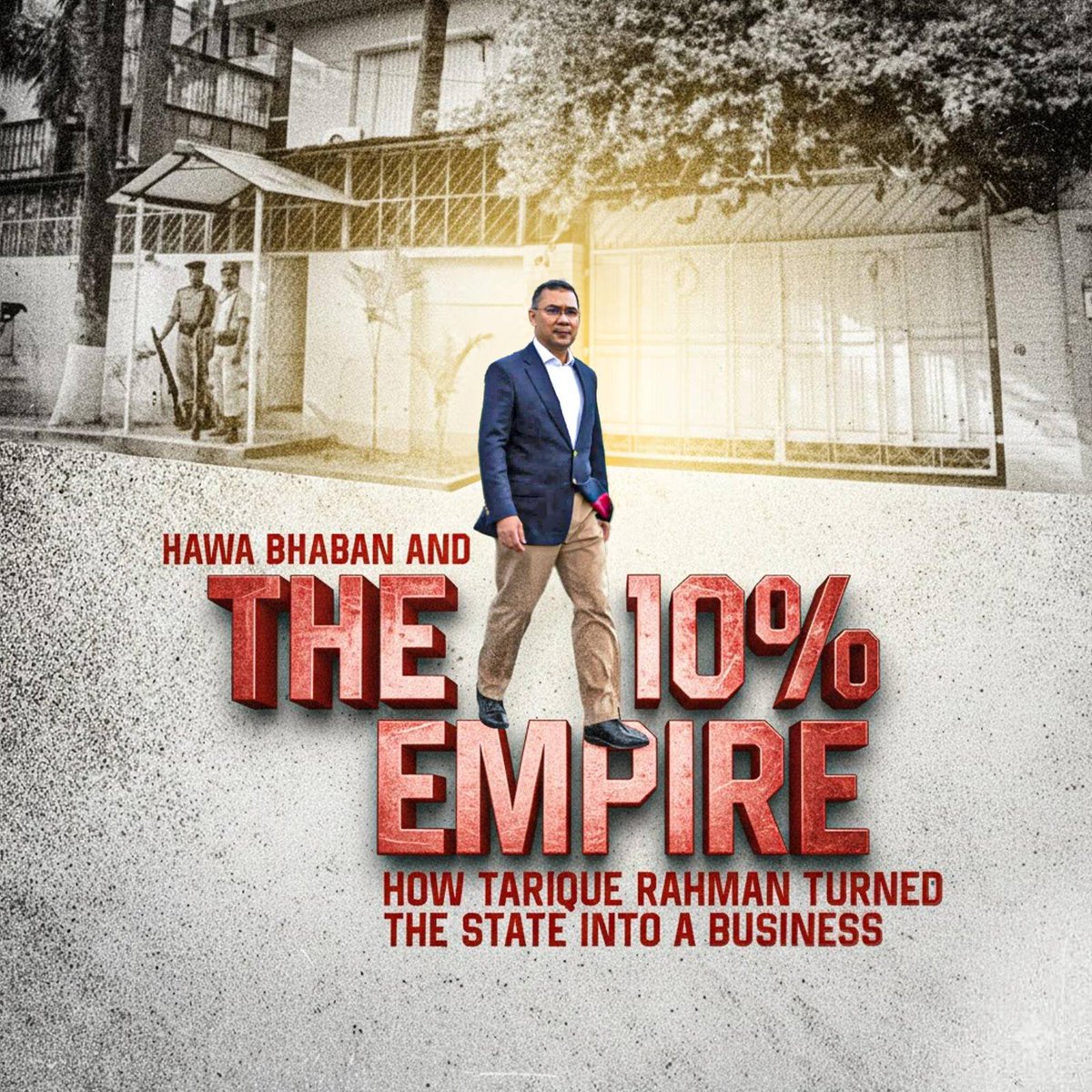
.@trahmanbnp’s legacy is tied to Hawa Bhaban—a parallel power centre that monetised the state, imposed a 10% commission on every project. Before repackaging him as a leader, history must not be forgotten.
👉 https://t.co/rsWnvFej6i
#BangladeshCrisis#BNPCorruption#SaveBangladesh
“If my mother had been willing to kill protesters, she would still be in power.”
– Sheikh Hasina’s son, Sajeed Wazed Joy, on her government’s defenestration from Bangladeshi politics
Watch the full interview with @SreenivasanJain ➡️ https://t.co/bRjLe8wLlE
This is not a vote, it’s a trap - to save Bangladesh, Bangladesh will not take part in this rigged election
The upcoming election in Bangladesh is not a transparent democratic process. It is a staged drama orchestrated by the illegal Jamaat-backed Yunus government. Another performance is underway to legitimize a rigged election. Just as extremist fundamentalist forces seized power in July–August by using ordinary students as a front, the same strategy is being applied again.
This government does not want to turn the election into a celebration of democracy. It wants to use the election as a tool to establish fundamentalism. Here, it is not the ballot box but a prewritten script that matters. Not the people’s opinion, but Yunus’s predetermined plan is the final word.
Today, the people of Bangladesh face a difficult but clear choice. Will they participate in this staged election and legitimize fundamentalism, or will they stay away from this farce and protect their future? The answer to this question lies not only at the polling station, but within one’s conscience.
An election from which the Bangladesh Awami League - the party that led the struggle for independence is deliberately excluded can never belong to the people. It is merely a tactic to seize power, a conspiracy to capture the state. Since coming to power, the illegal Jamaat-backed Yunus has pushed a once-organized country toward destruction. The economy, security, and social harmony are all under threat. Creating space for fundamentalism and militancy has become their core objective.
It is the responsibility of every parent in this country to ensure a safe and progressive Bangladesh for their children. To fulfill that responsibility, one must say no to fundamentalism, no to militancy, and no to this rigged election.
This is not a call for a vote boycott; it is a call to save the state. This is not about the interest of any party; it is about the future of Bangladesh.
Boycott this illegal, rigged election.
NO BOAT, NO VOTE
#Bangladesh #Elections #NoBoatNoVote
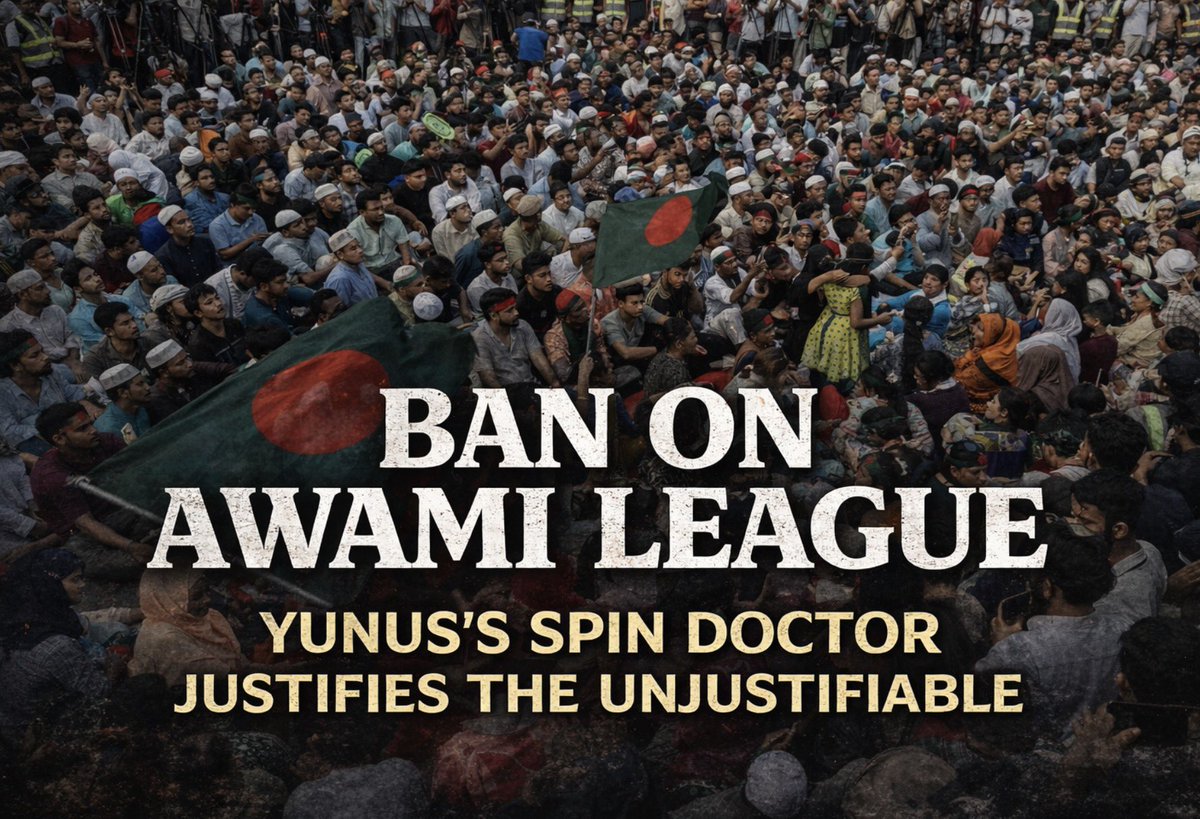
Despite the spin from #Yunus’s Press Secretary, the ban on #Awami League is clearly undemocratic and constitutes collective punishment.
In an interview with @AJEnglish, Shafiqul Alam defended the ban by citing the party’s “lack of remorse” and even dismissed its supporters as a “bunch of thugs.” The interviewer correctly pushed back, noting that banning an entire party is inherently undemocratic, that punishing hundreds of thousands for the alleged crimes of a few amounts to collective punishment, and that “remorse” is not a legal standard.
These justifications betray a troubling disregard for rule of law principles.
Faulty Legal Basis
The ban rests on a deeply problematic amendment to the Anti-Terrorism Act. The state now has the power to “temporarily suspend” organisations, without any defined time limits, creating a loophole for indefinite, arbitrary bans. This allows the government to effectively paralyse political parties without due process. Worse, the amendment criminalises almost all forms of expression or association linked to a suspended orgs, including social media activity. Journalists, academics, and citizens have already been arrested under this provision, chilling free speech and civic space.
Collective Punishment and Flawed Logic
Banning the AL because some leaders allegedly committed crimes violates the foundational principle of individual criminal responsibility under int’l #humanrights and criminal law. Historically, collective sanctions entrench revenge politics rather than deliver accountability. The argument that political exclusion must precede legal accountability is also misguided. Global experience shows such bans deepen grievances, delegitimise transitions, and often fuel further instability.
Manufactured Public Pressure
The ban followed roughly 48 hours of what appeared to be state-facilitated protests led by the National Citizen Party (#NCP) and its #Islamist allies, the #JamaatEIslami and #HefazatEIslam. Govt agencies were seen providing water and even cooling mist to protesters. This stands in stark contrast to the brutal crackdown on teachers protesting at the same location weeks earlier. Notably, the protest sites had officially been declared off-limits, rules enforced on everyone except these groups. This was not the government yielding to public pressure; it was the government manufacturing it.
Threat to Democratic Transition
Following the ban, the Election Commission cancelled AL’s registration, barring it from contesting the upcoming national election. Excluding a major political party from such a pivotal election jeopardises Bangladesh’s return to democratic governance. Around 30% of the electorate, long-time AL voters, now face effective disenfranchisement. Voting is meaningless when genuine choice is removed. An election without broad participation cannot reflect the true will of the people and risks entrenching an exclusionary political order.
…
#BangladeshCrisis #Democracy #Election2026 #Bangladesh
Asked about the uprising in Bangladesh that ousted his mother, Sajeed Wazeb, the son of Sheikh Hasina, says the Awami League 'mishandled the protests'.
I ask: is mishandled too mild a term to describe hundreds of protestors killed on his mother's instructions?
Full interview coming up on @AJEnglish. #BangladeshElections
Bangladesh’s February 2026 Election: Democracy Denied, Extremism Empowered
Bangladesh’s February 2026 election is being sold as a return to democracy.
In reality, it is an engineered exercise in exclusion.
By banning the Awami League — the party backed by nearly 60% of voters — the Yunus government has locked the majority of citizens out of the democratic process. An election that excludes the majority is not democracy. It is control.
No credible democracy bans its largest political party and still claims legitimacy. Democracies compete. Authoritarian systems eliminate rivals.
The excuse of “past election failures” does not hold. Under Sheikh Hasina, no registered party was banned. Participation gaps came from boycotts, not state-imposed bans. Choosing not to run is not the same as being prohibited from running — and that distinction is being deliberately erased.
The consequences are dangerous.
Removing the strongest secular force clears the field for extremist politics. Groups rejected repeatedly by voters are now normalized by default. This is not reform — it is radical political engineering.
At the same time, discredited figures once rejected by the public are being rehabilitated. Corruption, arms trafficking, and money laundering are being laundered into “leadership” by removing real electoral choice.
History is clear:
Elections without choice do not bring stability. Exclusion breeds radicalization.
The international community must not legitimize this process. Observation without inclusion is endorsement.
An election without the Awami League is not democracy. It is democratic suicide. And the consequences will not stay within Bangladesh’s borders.
#Bangladesh #BangladeshCrisis
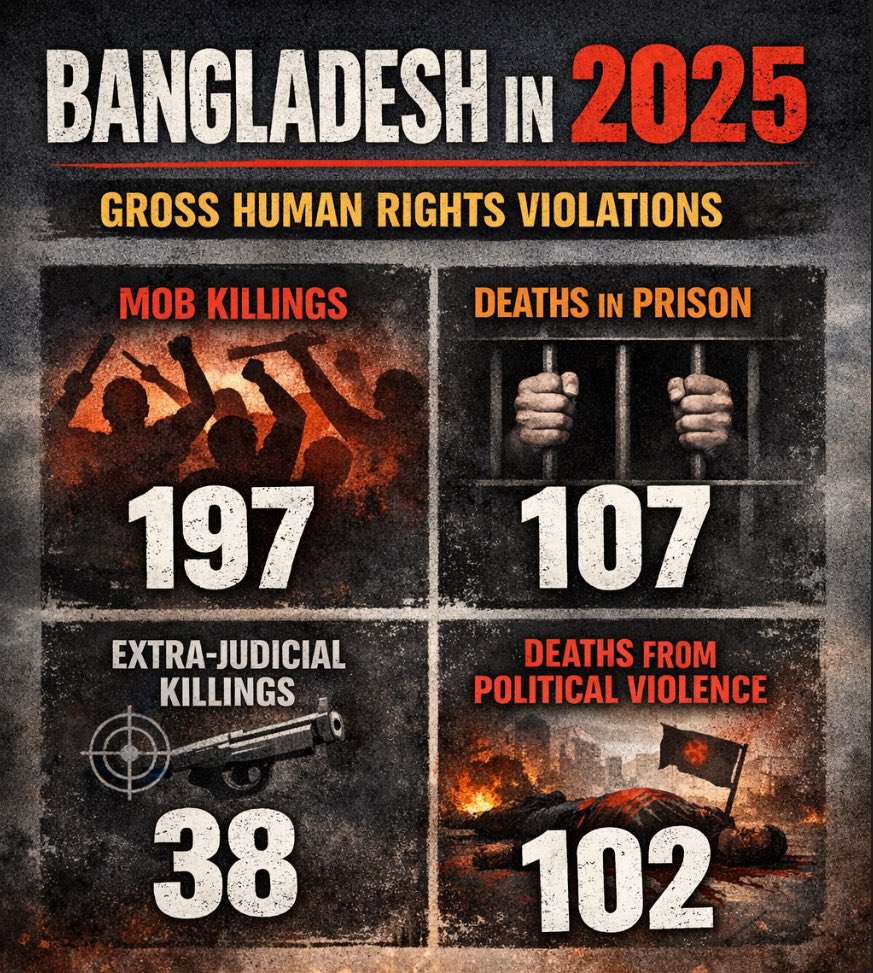
2025 marked an alarming deterioration of the human rights situation in #Bangladesh, with a sharp rise in deaths resulting from mob violence, political clashes, custodial abuse, negligence, and extra-judicial killings.
According to the 2025 Human Rights Report by Ain O Salish Kendra (AsK), deaths by mob beatings rose dramatically to 197 in 2025, representing an almost 54% increase from the 128 recorded deaths in 2024. Notably, the majority of the mob killings of 2024 occurred after August, highlighting a pattern of lawlessness and vigilantism since the #Yunus-led Interim Govt took over.
Deaths in prison also surged at an alarming rate. Between January and December 2025, 107 prisoners died in custody, marking an almost 65% year-on-year increase from the 65 custodial deaths reported in 2024.
What makes these deaths particularly disturbing is the high number of political detainees among the victims. At least 24 leaders and activists of the #AwamiLeague died in prison during 2025. Families of the deceased have alleged torture in custody, deliberate denial of medical treatment, and gross negligence by prison authorities, raising serious concerns about systemic abuse and impunity within custodial institutions.
Extra-judicial killings continued unabated throughout the year, often under the guise of so-called “crossfires”. AsK recorded at least 38 such killings in 2025. Of these, 26 victims died as a result of torture during alleged shootouts or while in the custody of joint security forces, while 12 others were killed while under the direct custody of law enforcement agencies at various police stations. These incidents underscore the persistent use of lethal force by security and law enforcement personnel outside the bounds of due process.
Political violence remained widespread and deadly. In at least 401 reported incidents of such violence in 2025, 102 people were killed and more than 4,000 injured. The majority of these incidents stemmed from intra-party conflicts within the #BNP, while others involved violent clashes between BNP and other political groups, including the #JamaatEIslami.
Taken together, these figures point to a deepening human rights crisis in Bangladesh, characterised by erosion of the rule of law and growing impunity for violence. The data from 2025 reflects not isolated incidents, but systemic failures that demand urgent accountability, independent investigations, and meaningful reforms to protect people’s lives and rights.
Report: https://t.co/n8XtO3Zxrn
….
#BangladeshCrisis #BDin2025 @amnestysasia@StateDRL@ESandersFCDO@PearsonElaine@meeganguly@HRF@hrw@IBAHRI@EURightsAgency@BonaveroIHR@paulocasaca1
#Bangladesh in 2025 was an exceptionally dangerous year for #journalists, underscoring a rapidly deteriorating environment for press freedom under the #Yunus-led Interim Govt.
According to the 2025 Human Rights Report by Ain O Salish Kendra (AsK), at least 381 incidents of harassment and/or persecution of journalists and #media workers were documented between January and December 2025. These figures speak volumes about the systematic pressure faced by the media and the shrinking space for independent journalism in the country.
Among these, 23 cases involved torture, harassment, or direct threats by law enforcement agencies, highlighting the role of state actors in undermining press freedom. At least 20 journalists received explicit death threats, while 123 journalists are currently facing criminal cases filed in apparent retaliation for their reporting.
Physical violence against journalists remained widespread: at least 118 media workers were assaulted or physically attacked while carrying out their professional duties.
Report: https://t.co/n8XtO3Zxrn
The use of anti-terrorism laws to arrest and detain journalists emerged as a disturbing new “feature” of media repression in 2025. Prominent among these cases were the arrests of journalists Monjurul Alam Panna and Anis Alamgir, the latter of whom remains behind bars, raising serious concerns about arbitrary detention and abuse of counterterrorism legislation to silence critical voices.
Another alarming development was the targeted attack on media institutions themselves. The offices of leading national dailies @ProthomAlo and @dailystarnews were vandalised, looted, and set on fire by politically empowered mobs.
Beyond the physical destruction, these mobs sought to dictate editorial decisions, effectively attempting to control how stories and political developments were reported.
Pressure on broadcast media intensified as well.
Following threats by a group calling itself the “July Revolutionary Alliance” to besiege the offices of three television stations, at least three broadcast journalists lost their jobs, simply for asking difficult and legitimate questions to Cultural Affairs Adviser Mostofa Sarwar Farooki.
These incidents reflect a climate where intimidation and mob pressure increasingly dictate journalistic boundaries.
The patterns observed in 2025 cannot be viewed in isolation. They build upon a wave of high-profile targeting of journalists that began immediately after the fall of the previous govt. Journalists detained in the latter half of 2024 in connection with questionable Jul–Aug 2024 violence cases, including Farzana Rupa, Shakil Ahmed, Mozammel Babu, and Shyamal Dutta, remained incarcerated throughout 2025.
In addition, hundreds of journalists continue to be implicated in what rights groups describe as false or politically motivated cases, severely impacting their freedom, livelihoods, and ability to work.
Taken together, these developments reveal a deepening crisis for press freedom in Bangladesh. The continued harassment, criminalisation, and intimidation of journalists in 2025 point to an environment where independent reporting is increasingly treated as a threat rather than a democratic necessity.
….
#BangladeshCrisis #PressFreedom #MediaFreedom @pressfreedom@CPJAsia@RSF_inter@MediaFreedomC@Irenekhan@volker_turk@UNHumanRights@ifjasiapacific@StateDRL@ESandersFCDO@hrw@amnestysasia@HRF@IBAHRI@EURightsAgency@UN_Spokesperson
A resurgence among Islamist groups is raising concerns in Bangladesh as the interim government struggles to manage a deteriorating law-and-order situation with murder, rape and other crimes on the rise. https://t.co/q33wB0SWQJ
The latest spell of attack to demolish Dhanmondi 32 residence and bringing of crane is an affront to national identity and a bid to erase collective history centering the liberation war that saw Pakistan forces and their local collaborators Jamaat e Islami defeated despite committing crimes against humanity resulting in birth of Bangladesh.
The repeated attack is the direct outcome of a notorious indemnity provided by Yunus regime to those involved in violence and killing till August 10 against dissenters of the regime. This series of attacks on the residence is a step towards reinforcing the Pakistan’s narrative on liberation war and brings echoes of rise of pro war criminal backed forces in power as the residence was targeted whenever Jamaat backed forces ruled the country.
Moreover, brazen efforts by the top Kings party leaders to project the historic structure as center of fascism marks patronization of war criminal backed narrative. On the other hand, this barbaric attack also coincides with meticulously designed plot that saw over 600 monuments and structures symoblising the heroic struggle of war heroes against Pakistan dismantled in the aftermath of August 5.
Moreover, police with their presence on spot and allowing continuation of carnage for several hours with army turning a blind eye exhibited the total politicization of the law enforcement and this violent act received direct endorsement from Yunus part of his reset scheme.
#Bangladesh #BangladeshCrisis #MobViolence #SaveBangladesh #AwamiLeague #AwamiLeagueNews