This is a message from one of teachers of Indian students, who won gold at Physics Olympiad.
I taught JEE physics for years. That paper breaks strong kids in three hours. This exam (International Physics Olympiad) is five hours of theory and five hours of lab work,* and these five did close to perfect scores on it.
The "International Physics Olympiad" is the world championship of school physics. It was the 56th edition, held in Bucaramanga, Colombia,from July 5 to 12. 381 students from more than 85 countries.* Every one of them the best physics student,btheir country could find.bIndia sent five kids.
All five came back with gold.
Their names are Kanishk Jain from Pune, Riddhesh Anant Bendale from Indore, Rishit Garg from Dwarka (in Delhi), Shresth Suraiya from Mumbai and Svarit Joshi from Ahmedabad.
That clean sweep put India at "Joint World Number One", tied with China, Russia, Kazakhstan, South Korea and Taiwan. Those are countries that pour serious money and national pride into science education. We are standing level with them.
Now here is what the exam actually was - two papers each, five hours long. The theory paper had three problems.
(i) One on the thermodynamics of para-magnetic cooling.
(ii) One on the
photoionisation of ozone.
(iii) One on the dynamics of electron positron pairs.
The experimental paper was another five hours in a lab, working through heat transfer and thermodynamic processes in fluids.
That means you get given equipment you have never seen and you have to design your own experiment, take your own readings, handle the errors and reach a real answer - nomultiple choice, no shortcuts, no pattern recognition.
You either understand physics or you sit there for five hours. HBCSE says the Indian students were near perfect on theory and excellent on the practical too. Now, this was India's 27th appearance at the IPhO. Across all those years, about 44 percent of Indian students have won gold, 41 percent silver, 10 percent bronze.
In the last ten years, every single Indian student has come home with a medal - 62 percent gold, 38 percent silver. Not one kid has gone and come back empty handed in a decade.*
Five golds in one year has happened only twice. This year and in 2018. So who built this? The programme is run by (HBCSE), the Homi Bhabha Centre for Science Education under (TIFR) Tata Institute of Fundamental Research, which sits under the Department of Atomic Energy.
They run the whole funnel - a national exam, then a national Olympiad, then a brutal selection and training camp and out of everyone in the country, five kids get on a plane. The team was *led by Professor Anwesh Mazumdar of HBCSE-TIFR and Dr Leena Joshi from St Xavier's College, Mumbai.
The scientific observers were Professor Ananda Dasgupta from IISER Kolkata and Nisha Kelkar from Gogate-Joglekar College in Ratnagiri. Yes, Ratnagiri, a college in a coastal town in Maharashtra. This is public education doing something the private coaching industry could never do on its own.
An olympiad paper does not have a known type. There is *no shortcut chapter. There is no formula sheet that saves you. You have to sit with a problem you have never seen and think. That is a completely different muscle.
And a government funded centre has been quietly building it in Indian teenagers for 27 years. So yes, be proud. Loudly, HBCSE also shared that around 64 percent of India's olympiad medallists go on to do a Ph.D. But only about 32 percent of medallists end up settling in India.
I do not say that to spoil the moment. These kids owe the country nothing. They earned every option they have. But it should tell us something.
- We are excellent at finding this talent.
- We are excellent at training it.
- We are still not great at giving it somewhere worth staying.
Congratulations, Kanishk, Riddhesh, Rishit, Shresth and Svarit. This is one of the best things an Indian did this year and most of the country will never hear about it.
@AnandaramSanjay writes for @natstrat_org on the importance of strategic persuasion for India.
Strategic Persuasion is about pragmatic economic statecraft that advances a country’s strategic interests internationally in a non hegemonic manner. “India, as a four-trillion-dollar economy with aspirations to become a developed country by 2047, cannot be reactive or merely respond to the fast-changing global situation. It needs to strategically persuade others while setting the agenda in areas it has pioneered globally, such as Digital Public Infrastructure (DPI)..”
Through MOSIP - the world’s largest deployment of DPIs for countries, India has already shown prowess in this endeavour. By making our DPIs our arrowheads, we should continue on the path of strategic persuasion.
Read @: https://t.co/wuq0Vy1FRB
#DPI #MOSIP #StrategicAutonomy #strategic_persuasion
How does India avoid the trap of “Digital Colonisation” and overcome geopolitics in cross-border trade?
We need to break the silos in trade.
Intuitively, what is digital must ultimately be governed through digital means. Cross-border trade governance can no longer remain trapped in regulatory silos in the data-driven Al era.
Hence we need to use our prowess in DPI, connect all trade administration systems in to one single DPI driven framework, that removes Silos and provide both an ease of business as well as empower smart policy making on trade to get best out of our cross border trade.
Read the complete piece at: https://t.co/nqU8qL5K09
@narendramodi , @nsitharaman , @PiyushGoyal , @NITIAayog , @cabsect_india , @sharads , @Sudhirzsingh , Amit Jain, @TanuviT
India was the world’s back office.
Now it wants to build the products the world runs on.
#Semiconductors. #AI. #Telecom. #Drones. #Deeptech
Not just services. Not just consumption.
Ownership. IP. Manufacturing. Platforms.
A #product_nation mindset changes everything:
→ better jobs
→ stronger supply chains
→ global leverage
→ technological sovereignty
The next Indian decade will be powered by #Indian products.
@AshwiniVaishnaw Ji's interview with The Week captures this path very lucidly.
https://t.co/5wInlD6SS0
Whether you’re running an IT services company, a financial institution, a manufacturing unit, or a startup, your business runs on digital infrastructure, and #cybersecurity is at the core of operations.
At iSPIRT, SAKRAM is our proposed solution to comprehensively deal with cybersecurity threats. Over the coming weeks, we will be publishing a dedicated series of blogs (and videos) that unpack SAKRAM in depth: what it is, how it works, and how your organization can put it into practice.
Read our first blog @ https://t.co/R5naRPinDv
@rinka_singh@gelchuri@sharads@KesavaReddy
#cybersecurity #cyber_training #DigitalFuture #startups #productmanagement
The release of Claude Mythos has raised serious concerns in Delhi and in capitals across the world about what the model can do, who has access to it, and what it means for national infrastructure security.Bilateral engagement with Anthropic is natural and should be pursued, but it will not solve the problem. US technology companies are bound by US law regardless of foreign jurisdiction, as the ICC learned in 2025 when Microsoft blocked its Chief Prosecutor's email on US sanctions. Working at the level of model access may not help as the patching bottleneck affects every defender, with or without model access.If we cannot act at the level of the model, we must act at the level of the data ecosystem the model is being used against. India has already built the tools for this through DEPA. They turn out to be exactly what is needed for cyber defence at national scale. #DEPA
https://t.co/j6A6V15wPC
For reforms to have an impact we need to come out of the monolithic Single window or Portal mindset and set a stage for Connected systems with a constellation of app providers at service layer leading to a true Digital transformation.
For success it requires an institutional mechanism, like an EoDB authority working on One Nation approach to build a National Regulatory Compliance Grid aligned to three Governance layers Union, State and Local bodies.
Check out our article of EoDB reforms by @Sudhirzsingh with Vallabh Bhansali
https://t.co/lHyrtV3n6C
@PMOIndia@NITIAayog@DPIITGoI@FinMinIndia@PiyushGoyal
🇨🇳 BREAKING: Chinese researchers just unveiled a photonic quantum chip that delivers 1,000-fold speed boost to AI data centers. This "world first" 6-inch thin-film lithium niobate marvel just won the Leading Technology Award at World Internet Conference Wuzhen Summit, beating 400+ global entries
While the US was busy sanctioning Chinese "entities" and trying to choke our semiconductor supply chains, Shanghai just quietly delivered what Pentagon planners feared most: a photonic quantum chip that's already giving China's AI data centers a 1,000-fold speed boost. Not "in development." Not "by 2030." Already deployed!
The award-winning breakthrough from CHIPX and Turing Quantum isn't lab theatrics—it's industrial-grade, wafer-scale production. Aerospace, biomedicine, finance: all feeding from the trough of computing power that "exceeds classical limits." Translation: your Nvidia clusters are already obsolete, you just don't know it yet...
Let's make make a quick comparison:
China's approach: National venture fund commits 1 trillion RMB structured as a public-private partnership to drive rapid commercialization. Full industrial chain from chip design to quantum algorithms. 153 quantum startups (up 40% in one year). Photonic-electronic co-packaging? Mastered. TFLN wafer production? 12,000 six-inch wafers annually at 110GHz+ modulation. Real-world AI integration? They already fine-tuned billion-parameter models on quantum hardware
America's approach: Early 2025 Jensen Huang says quantum computing is "15-30 years away" while Google and IBM frantically rush press releases. DARPA launches programs asking "can this actually be useful by 2033?" Pure-play quantum stocks surge 3,700% on hope. $2.5B federal investment vs China's $138B+. You do the math...
The technical scorecard is even more shocking:
🇨🇳 Zuchongzhi 3.0 (105-qubit) is 1 quadrillion times faster than Frontier supercomputer for specific tasks. Jiuzhang 2.0 photonic computer solved in 200 seconds what would take classical computers 2.5 billion years. This new photonic chip? 1,000x speedup for AI workloads today
🇺🇸 Google Willow (105-qubit) repeats 2019's "quantum supremacy" circus—impressive, but still solving problems nobody actually has. IBM promises "quantum advantage by 2026" with Nighthawk. We've been hearing "5-10 years to commercialization" since 2018.
Meanwhile, Chinese quantum computers are already improving breast cancer screening accuracy
The geopolitical punchline: Washington's "small yard, high fence" strategy just discovered quantum physics doesn't respect fences 🚧
While US export controls strangle classical chip supply chains, China leapfrogged to photonic quantum integration—materials (thin-film lithium niobate) we dominate, manufacturing we scaled, applications we commercialized
Just this Thursday, former Commerce Secretary Gina Raimondo has called for stricter export controls to deny China accessing high-end chips and cutting-edge products.
However, it’s important to remember: you can't sanction what you don't understand, and you can't contain what you can't produce
The American "rules-based order" crowd mumbles about "fair competition" while their own CHIPS Act subsidizes legacy silicon. China's building the infrastructure for 6G, AI, and quantum networks from Beijing to South Africa via quantum key distribution satellites (Micius, operational since 2016). America's quantum communication? PowerPoints
Western media will frame this as "concerning," "dual-use," and "militarization."
Meanwhile in reality:
- US quantum programs are explicitly DARPA-led
- IonQ's billion-dollar "Capital of Quantum" sits next to Washington DC for reasons
- Every US quantum breakthrough is measured against "utility-scale operation"—code for "can we weaponize this first?"
China wins awards at World Internet Conference and deploys in civilian hospitals. But sure, we're the threat to global stability. Keep spinning that narrative while your semiconductor industry begs for $52B bailouts and our "Quantum Avenue" in Hefei hosts 40+ functional companies
Article Link
https://t.co/KqY2oKYuQk
Read our latest blog to understand more on how respecting consent can also fuel innovation!
https://t.co/8LO3JLljU7
The concept of consent predates the digital era — it began in a paper-based world, where signatures and written permissions authorized the use of personal information.
Today, there are two kinds:
•Consent to collect data (e.g., an app accessing your camera)
•Consent to share data (e.g., a bank sharing your salary details with a lender)
The real challenges – and opportunities – lie in the second.
Watch the complete Open House @ https://t.co/VXz7T40rkm…
@sharads@03_saga@hurryharan@ObserveZero@Kapilvaswan@SaumyaJetley@fooobar w Sunu Engineer, Pawan Kumar Adukuri & Vikram Garg
Privacy isn’t the same as confidentiality.
Privacy means you can’t be identified from the signals you produce.
Confidentiality means restricting access to those signals.
Models tend to memorize training data, and “anonymized” data can be re-identified through cross-referencing and joins.
The 2017 Puttaswamy judgment affirmed privacy as a fundamental right, and the DPDP Act enshrined it in law.
To truly protect individual privacy, we need control primitives that account for these risks and safeguard data through its entire lifecycle.
https://t.co/8LO3JLljU7
Or watch @ https://t.co/M2UmkYOMw0
@sharads@03_saga@hurryharan@ObserveZero@Kapilvaswan@SaumyaJetley@fooobar w Sunu Engineer, Pawan Kumar Adukuri & Vikram Garg
What does it mean to have privacy in the age of AI? How can we harness the value of data while preserving individual privacy?
The answer to this lies in understanding the mechanics of consent through a techno-legal lens. Our latest Open House & blogpost tries to answer these questions through some of the work that we have been undertaking.
Watch: https://t.co/mQyF6vKo9X
Or Read our two part blog post that breaks down new frameworks for data collaboration
https://t.co/8LO3JLkM4z
https://t.co/XWqLlHVTgi
@sharads@03_saga@hurryharan@ObserveZero@Kapilvaswan@SaumyaJetley@fooobar w Sunu Engineer, Pawan Kumar Adukuri & Vikram Garg
“DPI is what we think of as the 8th continent. India is creating the 8th continent in a unique partnership of government + private sector + regulators + inspired volunteers like Sharad Sharma and his @Product_nation team, without which we would not have seen the India Stack happen,” said Srivatsa Krishna, Indian Administrative Service, at Citizen Stack: Inaugural Conference on Digital Public Infrastructure at the United Nations Headquarters, New York.
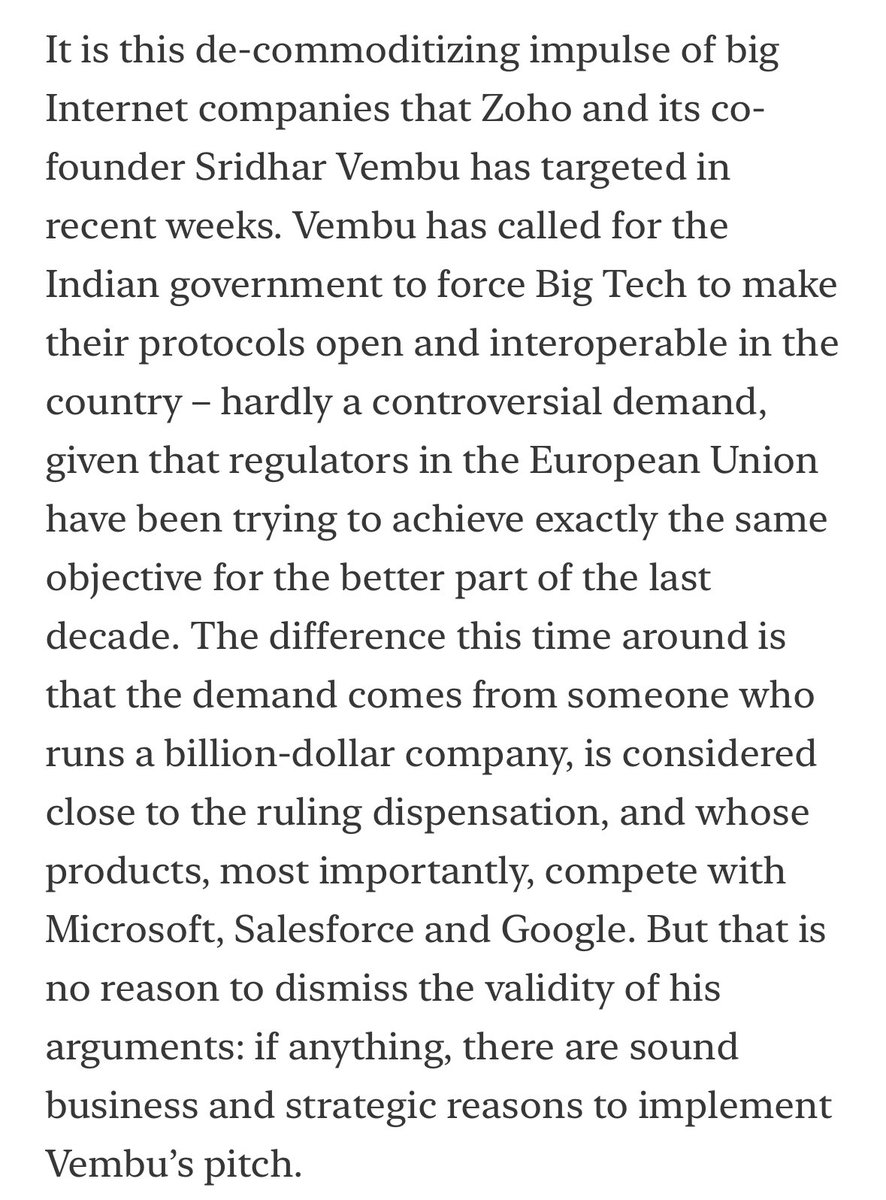
great piece and an interesting perspective from @arunmsukumar on why it could be good actually for GOI to back and support Zoho.
Sharing some snippets - people and countries have pushing for open & interoperable protocols worldwide
Naval for kids. 2 years ago my nephew and I had conversation on important ideas from @naval
Turned his ideas suitable for a 11 year old conversation. Back then he forbade me sharing the project on any social media. He changed his mind last week, sharing this now.
Protection and innovation aren't opposites. 🎥👇
https://t.co/a23GPSKQBq
Privacy isn't secrecy. It's control.
Consent is broken for AI. You can't ask millions of people repeatedly for permission to train models.
The solution? Privacy Budgets—mathematical accounting for…
In the September edition of #VigyanDhara, @sharads and @harshitkacholia from @Product_nation delve into the three distinct generations of #AI data and highlight why training AI on open web data is becoming increasingly constrained.
Explore insights in the article “Digital Public Infrastructure for AI” and discover how:
→ This shift to privacy-first, large-scale data repositories is shaping the requirements of next-gen AI innovation, without compromising sensitive data.
→ Data Empowerment and Protection Architecture (DEPA) can address these challenges, simultaneously treating data sharing as a technical and legal problem.
Read the article on OPSA’s Vigyan Dhara Magazine at https://t.co/RfHLNsXjUP
@PrinSciAdvGoI@AjaySoodIISc@PreetiBanzal@ChagunBasha@ayushee_17
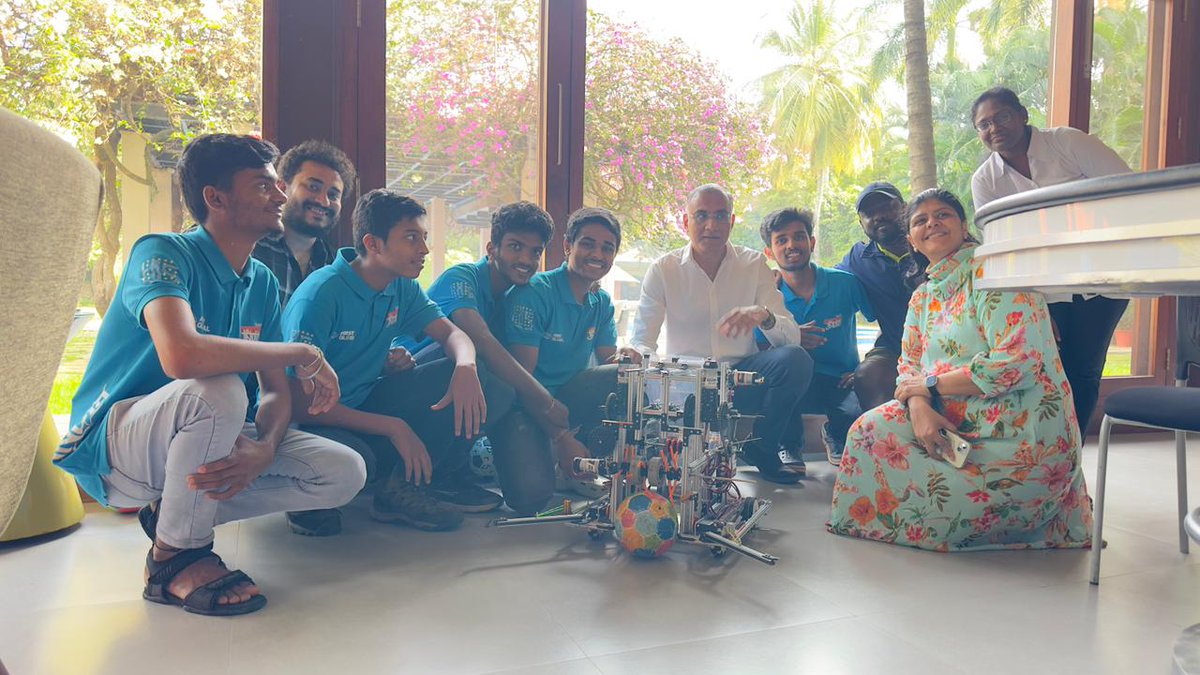
Guess what!?!
This is the India team @India1First for Robotics Olympiad.
From a Govt school in Bangalore,
the kids discovered their love for robotics in 'Atal Tinkering Labs'.
Super Proud of my partner @Goyal4Gagan who is their coach.
The Sept edition of @PrinSciAdvOff’ Vigyan Dhara features how India is designing a new foundation for AI development that can leverage private & public data in a privacy-preserving, collaborative ecosystem. Read to know more about the role of #DPI for #AI
https://t.co/jLGTOhovCy