Today in @Nature, we report MouseMapper: foundation-model AI to map disease perturbations across the entire mouse body cell-by-cell.
In obesity, it revealed body-wide inflammation & unexpected facial nerve damage. 🧵👇🔉
https://t.co/BERf5GQ10Z led by @Dorie00 & @yingchen733
The US National Institutes of Health (NIH) has one of the few labs in the world which can study Ebola virus.
In March 2025 RFK Jr had it shut down.
We now have a huge Ebola outbreak on our hands.
What a foolish move
Microtubules were discovered and named by looking at plants through an electron microscope. The pair behind it: Myron Ledbetter, a plant biologist, and Keith Porter, co-founder of cellular biology. 🌱 🔬
Porter was the giant. Harvard PhD 1938. From 1939 at the Rockefeller Institute, he and Albert Claude invented biological electron microscopy — first EM image of an intact cell in 1944, named the endoplasmic reticulum, co-invented the Porter-Blum ultramicrotome that made the whole field possible, co-founded the American Society for Cell Biology and the Journal of Cell Biology.
Ledbetter was the plant person — Berkeley Master’s, Columbia PhD in botany, then came to Rockefeller to learn EM under Porter and followed him to Harvard.
Their motivation was a long-standing botanical question. Plant cells lay down cellulose in highly patterned arrangements — circumferential, helical, and random — and these patterns determine cell shape. What in the cytoplasm tells the cellulose where to go?
Porter argued in the 1950s the endoplasmic reticulum was the patterning agent, but too floppy and sparse for the job. Something else was orienting it — a structural element no one had yet resolved.
The opportunity came from chemistry. In 1962, David Sabatini at Yale introduced glutaraldehyde as an EM fixative. Porter heard about it immediately and pushed Ledbetter to try it on plants.
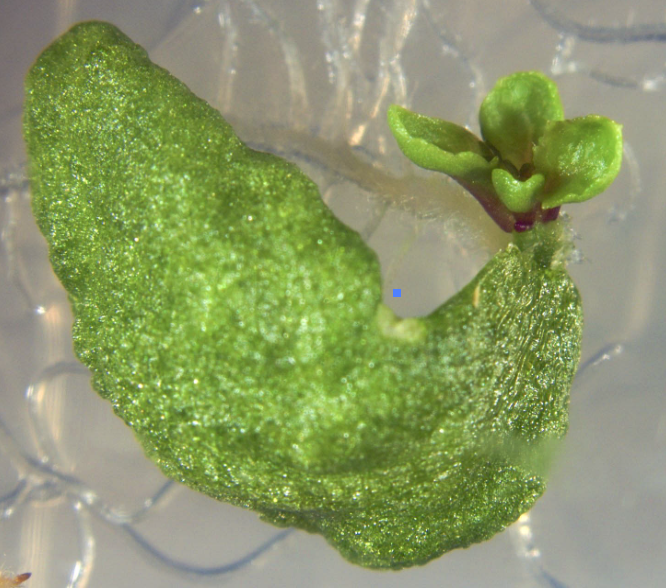
The plants… Three species, all with root tips full of wall-building cells. Phleum pratense (timothy grass) does most of the work and supplies every cortex image. Spirodela oligorrhiza (duckweed) catches a cell mid-division and gives them the spindle. Juniperus chinensis (Chinese juniper) provides the clinching image — tubes running parallel to cellulose fibers across the membrane, as if guiding their deposition. Two flowering plants and one conifer — enough phylogenetic spread to claim universality.
The instrument… A standard 100 kV transmission electron microscope — fires electrons through tissue and builds an image from how they scatter off heavy-metal-stained structures. Far better resolution than light microscopy, but the sample is killed, dehydrated, embedded in plastic, and sliced thinner than a light wavelength. Whether your prep preserved anything real is the whole game. Osmium tetroxide alone shredded the delicate plant cortex. Glutaraldehyde locks proteins in place in seconds. They ran it on root tips, looked at the cortex, and the tubes were just there, waiting.
What they saw… Hollow cylinders, ~250 Å across, with a clear central lumen and a wall suggesting smaller subunits packed side by side. Lengths indeterminate — traceable for several microns without finding an end. Each tube sat in a clear “halo” excluding ribosomes and everything else. In the cortex they ran parallel to the surface, wrapped like hoops on a barrel, up to three layers deep. In dividing cells, 500+ packed the mitotic spindle, oriented along its long axis, converging on the chromosomes.
Before this paper, the cytoplasm was a messy soup with organelles floating around. A few people had glimpsed tubular profiles in odd places — Roth / Daniels in an amoeba a year earlier, Slautterback in Hydra in the JCB issue just prior. But Slautterback called them phospholipid membranes for ion transport… Wrong!
Ledbetter and Porter predicted one kind of protein tube, of repeating subunits, present everywhere — plants and animals, cortices and spindles, cilia and flagella — doing the cell’s structural work.
What’s amazing is how much they got right from so little! The subunit composition was correct — tubulin wouldn’t be isolated until 1968. The identity with cilia and flagella was also correct. The claim about spindle birefringence was correct. Plant cells forming spindles without centrioles anticipated decades of work on acentrosomal nucleation. And the alignment hypothesis, born from the juniper image, drove cell biology for the next fifty years.
https://t.co/awhawqF4wD
We have been cooking up this story for a while and we are excited to finally be able to share!
Read on if you're interested in whole plant regeneration WITHOUT the application of hormones!
In back-to-back papers, our lab and the Casal lab tackle the question: How does temperature reshape auxin-driven growth?
Together, we reveal that temperature directly rewires ARF behavior.
https://t.co/WfqsQPihF6
With missiles raining down across the country and a powerful war raging across the Middle East, life at Tel Aviv University continues in spite of it all.
Our students keep learning. Our researchers keep asking hard questions. Our labs, classrooms, and libraries remain places of curiosity, determination, and hope.
Because even in difficult times, the pursuit of knowledge doesn’t stop. It moves forward — for Israel, and for the future of humanity.
#resilience #amisraelchai #IranWar #campuslife #Israel #EpicFury
Amazing letter by @Cornell President rejecting the resolution. Should be read by all:
Dear Zora,
Thank you for conveying SA Resolution 61: Calling for the Termination of Cornell University’s Partnership with the Technion – Israel Institute of Technology While Preserving Cornell Tech. I reject this resolution, which fundamentally conflicts with Cornell’s principles of academic collaboration and our core commitment to academic freedom.
Cornell Tech is not a political entity. It is an academic partnership, created through shared investment by Cornell University, the Technion, and the City of New York for the benefit of the city and the state, according to a negotiated set of conditions that govern its development and the terms of its 99-year ground lease on Roosevelt Island. As one of Cornell University’s many international partnerships and collaborations, Cornell Tech deepens, enriches, and strengthens the ability of our students, faculty, and staff to pursue knowledge and advance the university’s academic mission. The Joan and Irwin Jacobs Technion-Cornell Institute, the core international partnership upon which Cornell Tech is based, is an extraordinarily valuable collaboration focusing on education and research in health tech, media tech, and urban tech, and supporting the development of new startup companies.
Severing our relationship with the Technion—or with any entity affiliated with governments, institutions, or enterprises with which some of our community members disagree—as a statement of political protest, would not only hinder our research, teaching, and public engagement; it would imperil our academic principles.
Our university, like all of our peer institutions, regularly faces pressure—from across the political spectrum, from within and beyond our own community—to make academic decisions according to political priorities. The phenomenon is not a new one: universities have grappled with such pressures from governments and societies for as long as the institution of the university has existed. When we yield to these pressures and proscribe specific collaborations or collaborators on grounds other than merit, we compromise our principles of academic freedom, undermine our own institutional excellence, and damage public trust in our work.
Moreover, this resolution inaccurately asserts that “the continued operation of Cornell Tech as a Cornell University campus does not require an ongoing partnership with the Technion-Israel Institute of Technology.” Cornell Tech, while part of Cornell, is a joint effort of the university, the Technion, and the City of New York. It is no more possible for Cornell to unilaterally terminate that effort and claim full control of the campus than it would be for the Technion or the City of New York to do the same.
Finally, I am deeply troubled by the selective manner in which this resolution singles out the Technion, alone of Cornell’s many international partners, for censure. Cornell currently maintains 159 active agreements with institutions in 59 nations and regions; all of these institutions have some government affiliation, and many conduct research with military and security applications. Cornell itself has military research contracts, conducts research with potential military applications, and has relationships with companies whose products are used in military contexts. Cornell also has relationships with institutions in countries whose governments have been accused of human rights violations—as our own has been.
None of these publicly available facts are mentioned in the resolution; only our partnership with an Israeli institution is targeted for erasure. The political bias evident in this selective approach is deeply disturbing, and the resolution is incompatible with both the Student Assembly’s purpose and Cornell University’s core values. I reject it fully and forcefully.
Sincerely,
Michael Kotlikoff
President and Professor of Molecular Physiology
Cornell University
I am a Democrat. I served in the Clinton administration. I did not vote for Donald Trump and am highly unlikely to support him or his acolytes in the future. I also have serious disagreements with many of the Trump administration’s domestic and foreign policies.
But it is profoundly disturbing that a growing segment of the far left appears to be almost rooting for Hamas, Hezbollah, the Iranian regime, and other forces fundamentally opposed to the United States and our allies. This seems to reflects a corrosive strain of anti-Americanism, dressed up in postcolonial theory, that risks blinding us to the moral realities of our world and the nature of our adversaries.
Rama Duwaji, the wife of NY Mayor Mamdani, liked posts praising the Oct. 7 massacre in Israel.
Yet the (embarrassing) New York Times headline describes it as “Support for the Palestinian cause.”
In an attempt to downplay the story, the NYT is implying that the “Palestinian Cause” means slaughtering 1,200 Israeli men, women, babies and the elderly, raping men and women, and kidnapping 251 people - including children, babies and grandparents over 80.
A molecular 'gatekeeper' in plants opens the door for beneficial microbes
Congratulations, Thomas Ott on a great paper in Science.
https://t.co/6CQ15FjFqz
In the spring of 1980, Farrokhroo Parsa — Iran’s Minister of Education before the Islamic Revolution — was executed. She had devoted her life to fighting for women’s rights and did not betray her principles even after the victory of the Islamic Revolution. In the verdict issued by the new authorities, she was found guilty of “spreading corruption on earth and denying Allah.”
“I would rather face death with open arms than live in disgrace, forcibly covered with a veil. I will not kneel before those who expect me to repent for half a century of my struggle for equality between men and women. I am not prepared to wear the chador and take a step backward in history,” Parsa wrote in her farewell letter to her children.
30,000 hours of footage, equivalent to 3 years and 7 months, were filmed to capture the blooming of 77 types of flowers, and the result is spectacular.
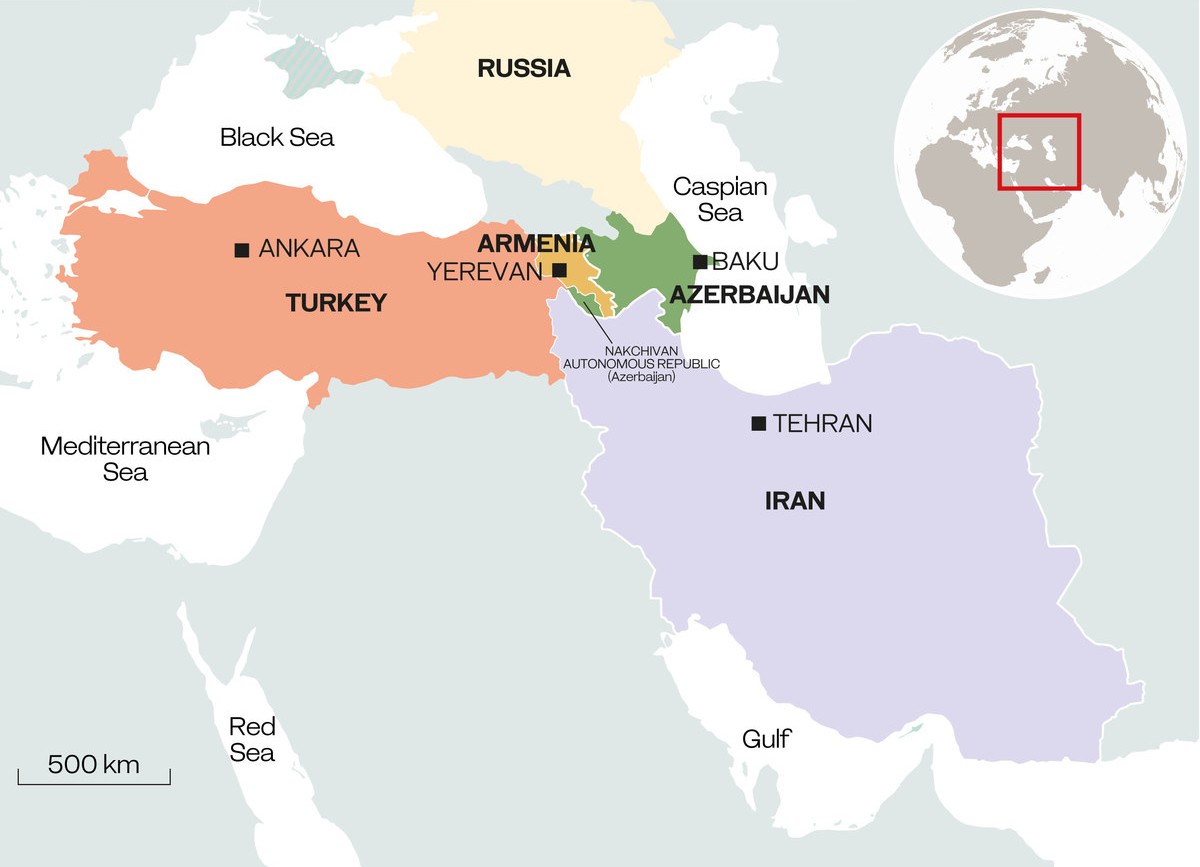
It is quite revealing that the Islamic Republic of Iran has not attacked Turkey with missiles or drones, where the huge Incirlik Air Base that hosts major US Air Force assets is based, nor did it strike Azerbaijan, which has close military ties with Israel and has a massive amount of Israeli intelligence stations and agents based there. Perhaps Tehran is worried about Turkey being part of NATO and the risk of triggering Article 5, which necessitates collective defense, in addition to Turkey’s powerful military that could carry out aerial and land attacks against Iranian territory.
Some have speculated that the Iranian regime’s targeting of Gulf nations is partially nationalistic and ideological in nature, viewing Arabs as inferior politically and militarily, while Turkey is in a league of its own, and Azerbaijan is a majority Shia-Muslim country. Regardless, it appears that even amidst its most serious existential crisis, the Iranian regime understands the risks of hitting countries that are backed by effective and reputable defense pacts and blocs, highlighting just how much the Islamic Republic only fears and respects force and power, not appeasement and acquiescence.
One of the hardest realizations for me after Oct. 7, as an Israeli feminist, was the sense of betrayal by many Western women’s organizations. 1/6>>
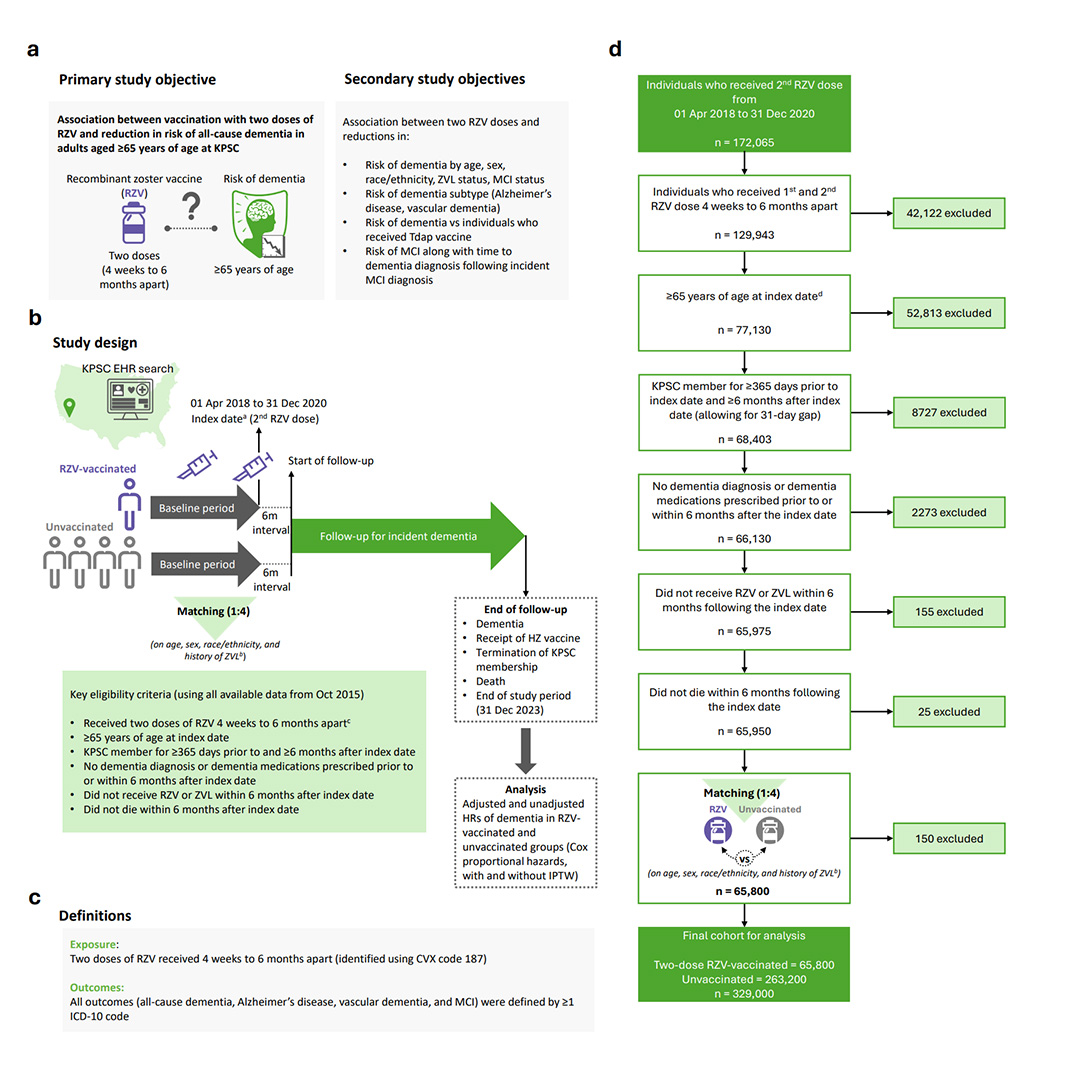
Vaccination with two doses of recombinant zoster vaccine is associated with a 51% lower risk of dementia in adults over 65 years, reports a study published in @NatureComms. https://t.co/IRniv23CO5
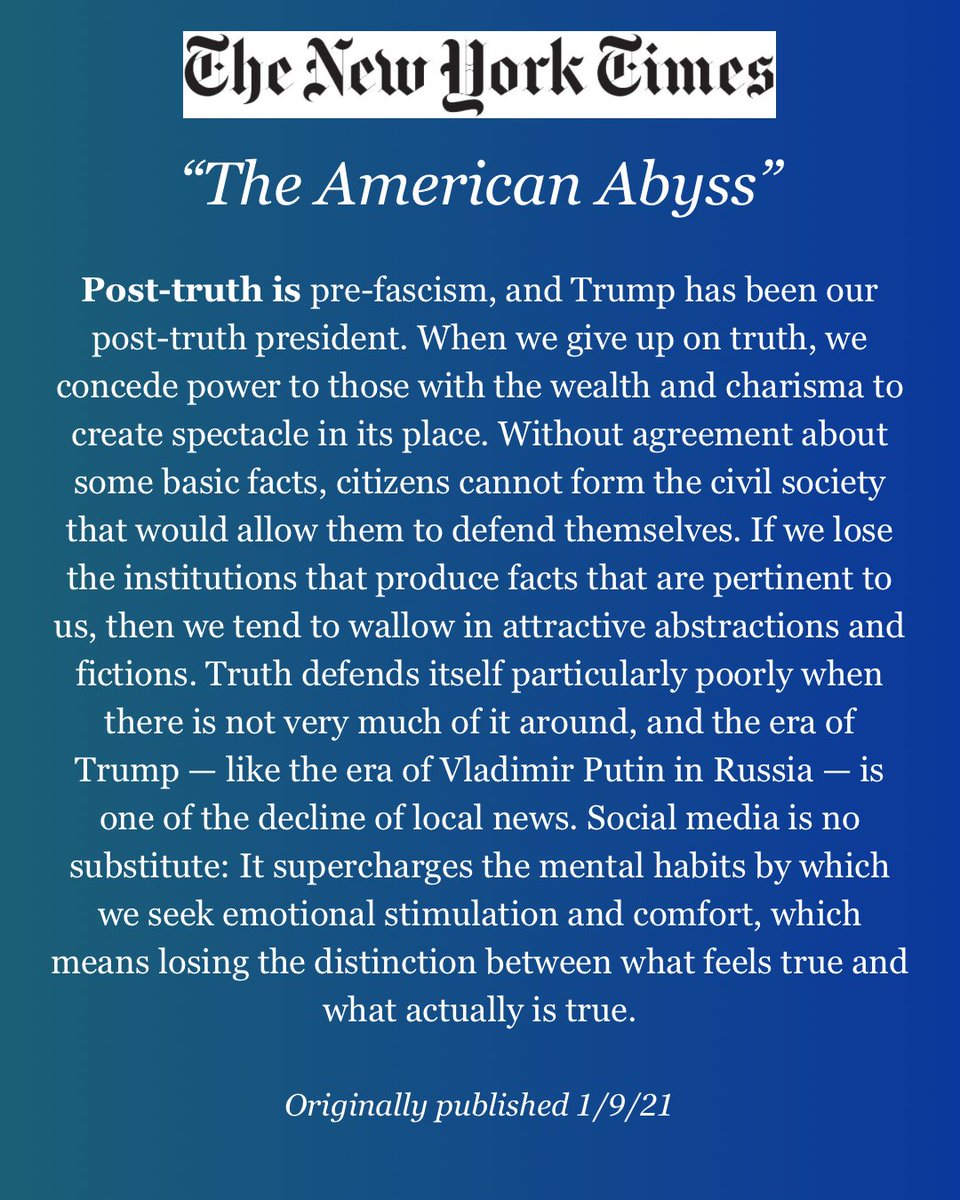
"Post-truth is pre-fascism, and Trump has been our post-truth president... Post-truth wears away the rule of law and invites a regime of myth."
I published this piece on January 9th, 2021. Unfortunately, it remains all too relevant.