16-years-old kid created Starlink prototype and made $300,000
It capture the signal from satellite, and works anywhere
SpaceX tried to shut him down, but the kid was already covered.
Here's how he made it using nothing except Claude:
He's not stealing internet from Starlink.
He's using the radio beacons SpaceX broadcasts as a free positioning system that works when GPS doesn't.
Every Starlink satellite emits a constant beacon.
With a small dish and a $35 radio, you can pick them up and triangulate your location anywhere on Earth, even where GPS is jammed or blocked.
The US Army is testing the same concept.
The kid built a portable version and sold it to hikers, sailors, and emergency crews.
Step 1.
Order the hardware.
RTL-SDR Blog v4 USB receiver ($35)
Small Ku-band parabolic dish (~$50)
Ku-band LNB downconverter ($20)
Raspberry Pi 5 (8GB)
Bias-tee adapter
5000 mAh USB battery
Total around $180.
Step 2.
Flash Raspberry Pi OS Lite to the SD card and boot the Pi.
Step 3.
Install the SDR tools in Terminal:
sudo apt update
sudo apt install rtl-sdr gnuradio python3-numpy
Step 4.
Mount the LNB at the dish focal point.
Connect LNB to bias-tee, bias-tee to SDR, SDR to Pi via USB.
Step 5.
Open Claude Code and paste this prompt:
Write me a Python program that captures Starlink satellite beacons through an RTL-SDR and uses them for positioning.
Hardware: RTL-SDR Blog v4 + Ku-band LNB + parabolic dish.
Requirements:
Scan Ku-band downlink frequencies for Starlink beacons.
Identify each satellite using public TLE data from https://t.co/eZL1xnRATd.
Use Doppler shift from at least 3 satellites to compute position.
Output latitude, longitude, and accuracy to a small OLED screen.
Use pyrtlsdr, skyfield, numpy.
Add comments so I can tune the math.
Step 6.
Run the program.
The Pi locks onto satellites overhead and shows your coordinates with around 10-30 meter accuracy.
No GPS, no cell signal, no internet needed.
The kid 3D-printed a case, branded it as "GPS backup for hikers and sailors," and sold 350 units at $899 each.
Cost per unit: $180.
Profit per unit: $719.
His customers are wildfire crews, bush pilots, backcountry skiers, and yacht owners.
SpaceX has no legal issue with passive reception of public beacons.
The kid's lawyer confirmed it in advance.
In 1873, a painfully shy Yale professor published a series of dense, mathematical papers that practically no one in America could understand.
He was so obscure that his university didn't even bother to pay him a salary for the first nine years of his career.
Yet Albert Einstein later called him "the greatest mind in American history."
His name was J. Willard Gibbs.
He didn't invent a new machine or discover a new particle. Instead, he did something far more profound: he took the invisible, chaotic chaos of chemical reactions and turned it into a breathtaking geometric map.
In doing so, he quietly laid the foundation for modern chemistry, metallurgy, and the materials that built the 20th century.
In the late 19th century, chemistry was a mess of trial and error. Scientists knew that if you mixed certain elements together under heat and pressure, things happened. Sometimes they exploded. Sometimes they froze. Sometimes they morphed into entirely new substances.
But no one knew why. There was no universal formula to predict if a chemical reaction would happen spontaneously or require external energy.
The scientific establishment was trying to solve this by treating chemistry like a giant cookbook, memorizing thousands of individual recipes.
Gibbs looked at this chaotic kitchen and realized they were missing the underlying architecture.
He introduced a radical new concept that we now call Gibbs Free Energy. He proved that every chemical system has a hidden, mathematical bank account of energy available to do work.
But his true genius wasn't just the math; it was how he visualized it.
Gibbs realized that you could map a substance’s temperature, pressure, and energy onto a three-dimensional geometric surface.
Suddenly, the messy, unpredictable behavior of matter became a landscape.
A chemical reaction wasn’t a mysterious magical event anymore. It was just a ball rolling down a hill. If the geometric slope leaned downward, the reaction would happen naturally (spontaneous). If the slope went upward, the reaction was impossible without forcing it. Water turning to ice, iron turning to rust, coal turning to diamond, all of it was just matter navigating the hidden topography of Gibbs' geometry.
When Gibbs sent his work to Europe, the legendary physicist James Clerk Maxwell was so struck by its genius that he literally sculpted a 3D plaster model of Gibbs’ thermodynamic surface with his own hands and mailed it to Gibbs' house in Connecticut.
The philosophical blueprint Gibbs left behind is a game-changer for navigating complex decisions:
You cannot master a chaotic system by memorizing every possible outcome. You master it by mapping the terrain.
Most people approach their life decisions, their careers, investments, or habits like 19th-century chemists. They treat every new situation as an isolated recipe. They ask, "If I mix X and Y today, will it explode?" They look for specific formulas for specific moments.
But life, like chemistry, is governed by an underlying energetic terrain.
If you stop looking at individual events and start looking at the energetic slope of your choices, everything changes. Some habits have a downward geometric slope, they require almost zero effort to maintain once they start rolling, naturally producing massive results. Other goals have an impossible upward slope because you are fighting the natural friction of your environment.
Success isn't about forcing an explosion through sheer willpower. It’s about altering the geometry of your environment so that the outcomes you want become the path of least resistance.
What is a goal in your life right now that feels like an impossible, exhausting uphill battle? Stop trying to force the mixture to react. How can you change the pressure, the environment, or the underlying structure of your day so that success becomes a ball rolling down a hill?
My pessimistic take on the increasingly popular assumption that Putin's regime is on the verge of defeat—or collapse—in @ObserverUK.
https://t.co/wv4qFB17Yn
A British psychologist spent her PhD years proving that something as stupidly simple as chewing gum can change how the human brain stores information, and the reason it works is stranger than it sounds.
Her name is Lucy Wilkinson.
She was a PhD student at Northumbria University in Newcastle when she designed the experiment that would put chewing gum into the cognitive science literature for the first time in any serious way.
The paper was published in 2002 in the journal Appetite, and it was one of those rare studies that sounded like a joke when you read the abstract and turned out to hold up the moment you read the data.
The experiment was deceptively simple.
Wilkinson and her supervisors recruited 75 healthy young adults, and divided them into three groups to take a 20-minute battery of memory and attention tests.
The first group was chewing gum the whole session.
The second group moved their jaws as if they were chewing but had no gum in their mouth at all.
The third group sat still, and did nothing with their jaws.
Then everyone took the same tests, which included immediate word recall, delayed word recall, working memory for numbers and spatial memory tasks.
The part nobody had expected were the results.
Gum chewers were significantly better than the no-gum control group on both immediate and delayed word recall. Same words, same test, same brain on the other side of the desk, and the group with a piece of gum in their mouth just remembered more of them.
The weirdest part of the finding was what happened to the second group, the one that was mimicking the chewing motion without any gum in their mouths. They did not gain the same benefit. Just moving the jaw was not enough. But it was something about actually chewing a piece of gum that was causing the effect.
That detail was what made the paper interesting rather than dismissible, because it meant the explanation couldn’t just be that jaw movement keeps people alert. Something deeper was afoot that the field would spend the next 20 years trying to untangle.
The follow-up experiment that explained the most likely mechanism was done by John Aggleton’s team from Cardiff University two years later. One set of participants was asked to chew gum while learning a list of words and then chew gum later on 24 hours later while trying to remember the same words. A second group was asked to chew gum only during learning.
A third group chewed gum just during recall. A fourth group did not eat any.
The group that chewed gum at learning and recall did the best by a wide margin. Those who chewed at only one or the other stage did about as well as the no-gum group.
What the result showed was that chewing gum wasn’t just improving memory in some general way. It was behaving as what psychologists refer to as a context cue.
Your brain does not store memories as isolated bits of facts floating in a void. It saves them with the full context around it . The room you were in , the sounds around you , the mood you were in , even the physical state of your body when you encoded them . When you try to remember something later, your brain goes to those context cues to find the file.
If the context at recall is the same as the context at learning, the memory will come back faster and cleaner. If the context is different the file is more difficult to reach.
One small but reliable physical state that the brain was using as one of those context tags turned out to be chewing gum. The regular motion of the jaws, the flavour of the tongue, the steady low level of mouth activity were being filed away with the words being learned. The brain was quicker at pulling up the file when it was in the same physical state at recall.
And there was a second mechanism built into that. Other studies have looked at blood flow to the brain while chewing and found it to increase about 25 percent. One such study was done in 2001 by Sasaki in Japan.
Other investigators have reported faster times on cognitive processing and improvement on sustained attention tasks while chewing gum. Chewing appears to push the brain into a somewhat more aroused state, making it better able to hold onto information over a task that takes minutes rather than seconds.
The next part is the real part of the story.
Wilkinson’s finding of an improvement in immediate recall was not reproduced in two independent efforts to replicate this in 2004 and 2005. Other studies replicated the context-dependent effect, but claimed that the simple alertness boost was only real under certain conditions, such as when the task was long and demanding, rather than short and easy.
The best evidence from two decades of research is that chewing gum has a measurable effect on cognition, but the effect is conditional and is most reliably observed in tasks requiring sustained attention, working memory under load, and recall benefitting from matching the encoding state to the retrieval state.
What all the critics agree on is the deeper finding under the original headline. Your brain is not a neat filing cabinet, where information is stored separate from the body that took it in. Your physical state at the time you learn is part of the memory itself, so anything you can recreate at the time of recall can give you a small edge in getting the file back.
That is why students who study in the same room that they will take the exam in, often do better. That is why you remember your dreams better if you wake up in the same position you fell asleep in. Which is why a smell can pluck a memory out of decades-old storage faster than any conscious effort can. The index contains the body.
Chewing gum is just the cheapest, weirdest, most available form of that mechanism ever tested by anyone.
Next time you have something difficult to remember, try the experiment yourself. Chew a particular flavour of gum as you study. Before you sit down to review what you learned, have another chew of the same flavour. The gum is not doing the job. The gum is acting as a thread for your brain to follow back to where the information was stored.
The most powerful memory tool you own is not your willpower or your intelligence.
It is the physical state of your body the moment you decide to pay attention.
The genius of Father Ted wasn’t that it told people what to think.
It simply exposed the ridiculousness of human nature and let the audience work it out for themselves. 😂🤣🤭
Anthropic engineer:
"You're not supposed to prompt Claude. You're supposed to build a system that prompts itself."
this is one of the best workflows I've seen in a long time
in this video he breaks down exactly how most people are using Claude:
- the 14% you lose to CLAUDE.md before typing a word
- the plugins that 95% of users have never installed
- the caching setup that keeps it at 95% hit rate and almost free
- why starting every chat from zero is the slowest way to use Claude
if you've been using Claude for more than a month and never left the chat window, you've been using one project when you could be running a team of them
instead of another show tonight, watch this
make sure to bookmark it before it gets lost in your feed
full guide in the article below
Two math olympiad champions wrote a training manual in 1993 on two old Macintosh computers, and every American kid who has won a major math competition in the last decade learned to think from it.
Their names are Sandor Lehoczky and Richard Rusczyk. The book is called The Art of Problem Solving. Most people in math know it as AoPS.
Since 2015, every single member of the US International Math Olympiad team has been an AoPS student. Not most of them. Every one.
That statistic sounds impossible until you understand what the book actually does.
Lehoczky and Rusczyk were not professors. They were competitors. Lehoczky earned the sole perfect AIME score in 1990 and led the national first place team. Rusczyk was a USA Mathematical Olympiad winner and a perfect AIME scorer in 1989. They had both survived the same brutal selection process the book was designed to train students for.
And the first thing they decided was that almost every existing math textbook was teaching the wrong thing.
School math gives you formulas. You memorize them. You apply them. You pass the test. Then you sit down in front of a real competition problem and the formula does not apply, and you have nothing underneath it.
That is the gap. The gap is not knowledge. It is thinking.
The entire premise of AoPS is that problem-solving is a transferable skill, not a bag of memorized tricks. A student who genuinely understands why a technique works can adapt it, combine it with something else, and deploy it in a context they have never seen before. A student who only memorized the technique freezes the moment the problem looks different.
The book teaches the difference between a formula and a method.
A formula tells you what to compute. A method tells you how to see. The students who win olympiads are not the ones who know more formulas. They are the ones who have trained themselves to look at an unfamiliar problem and recognize its structure. To see that this problem is secretly asking the same question as a problem they solved three weeks ago, just dressed differently.
Rusczyk calls this "learning to read the problem." Not reading the words. Reading what the problem is actually asking underneath the words.
The second thing they built into the book is tolerance for being stuck.
Most students treat confusion as a signal to stop. The book treats confusion as the starting point. Every chapter pushes students past the point where the obvious approach runs out. That moment of running out is not failure. That is where the actual thinking begins.
Lehoczky once described it this way. If you can solve a problem quickly, you are not learning. You are performing. Learning only happens when you are past the edge of what you already know.
The book was written on old Macintosh computers in 1993. Rusczyk launched the AoPS website in 2003. Today the community has over one million users. Thousands of students enroll in AoPS online courses every year. Most winners of every major American math competition are AoPS alumni.
A platform built by two kids who were good at math competitions has become the infrastructure that produces the next generation of mathematicians, engineers, and scientists who are good at thinking.
The formulas you memorized in school will eventually be obsolete.
The thinking you trained will not.
What is one problem in your life right now that you have been avoiding because you do not yet know the right formula to solve it?
Cardiology calls statins miracle drugs. Social media calls them poison.
Both sides cite published scientific papers. How can they be looking at the same evidence and reaching opposite conclusions?
As a cardiologist, I think both sides are are on to something. Let me explain. 🧵
An engineering professor who failed math her entire childhood spent years figuring out exactly what had been sabotaging her, and the answer was not low intelligence. It was a hidden mode her brain kept switching into that nobody had ever told her existed.
Her name is Barbara Oakley. The book is called A Mind for Numbers.
She failed math and science from grade school to the end of high school. Numbers felt like a language everyone else had been taught in secret.
So she ran toward the thing she was good at. She enlisted in the Army right after graduation, and the Army paid her to learn Russian at the Defense Language Institute in Monterey.
She got very good at Russian. Good enough to earn a degree in Slavic Languages, serve four years in Germany as a Signal Officer, and rise to Captain.
Then the wall appeared.
She watched her career options shrink because she could not handle the technical side of her own job. The people with math moved up and moved out. The people without it stayed stuck. So at 26 she did something that sounds insane. She left the Army and enrolled in engineering, starting from remedial math, sitting in classrooms with teenagers.
In between, she worked as a Russian translator on Soviet trawlers in the Bering Sea and as a radio operator in Antarctica. Today she is a professor of engineering at Oakland University with a doctorate in systems engineering.
The question that drove her for years was simple. What changed? She was the same brain that failed algebra. Why did it suddenly start working?
The clue was hiding in the one subject she had mastered. She noticed she had never learned Russian by staring at it. She practiced a little every day, walked away, came back, and the language quietly assembled itself between sessions. Math she had attacked the opposite way. Lock eyes with the problem. Push harder. Refuse to look away until it cracks.
It never cracked. And neuroscience explains why.
Your brain has two modes. The focused mode is the one you know. Tight attention, prefrontal cortex engaged, grinding through familiar steps. The diffuse mode is the one nobody teaches you. It runs in the background when you relax. It is loose, wide, and wired for connecting ideas that sit far apart from each other.
Oakley uses a pinball machine to explain the difference. In focused mode, the bumpers are packed tight. Your thought bounces in the same small circle, over the same ground, again and again. In diffuse mode, the bumpers spread out. The thought travels. It reaches parts of the brain the tight loop could never touch.
The trap has a name. The Einstellung effect. The first approach that comes to mind blocks every better approach behind it. The harder you focus, the tighter the loop, the more locked in you become. The grinding feels virtuous. It is actually the cage.
And every time her mind wandered off a math problem as a kid, she dragged it back, believing the wandering was laziness. The wandering was her brain trying to switch into the mode that solves things. She spent ten years fighting the half of her brain that wanted to help her.
You cannot run both modes at once. The diffuse mode only takes over when you genuinely let go. Which is why answers ambush you in the shower, on a walk, at the edge of sleep. Salvador Dali knew this. He napped in a chair holding a key over a plate, and the instant he drifted off, the key dropped, woke him, and he carried the half-formed ideas straight back into focused work. Edison did the same trick with ball bearings. Two of the most inventive minds in history were deliberately farming the mode the rest of us treat as slacking off.
The practical version fits in two sentences. Focus hard on the problem until you stall. Then stop completely, and let the other mode take the shift.
The break is not a reward for the work. The break is the work. It is also why cramming fails and procrastination is fatal. Diffuse mode needs hours and nights between focused sessions to build anything, and procrastination burns that time before the first session even starts.
Oakley failed math for ten years using one mode at full strength.
She became an engineering professor the day she started using both.
A Google engineer named Lee Boonstra wrote down everything she knew about prompting in one 68-page document, and Google gave it away for free instead of selling it.
Link is in the comments. Download it
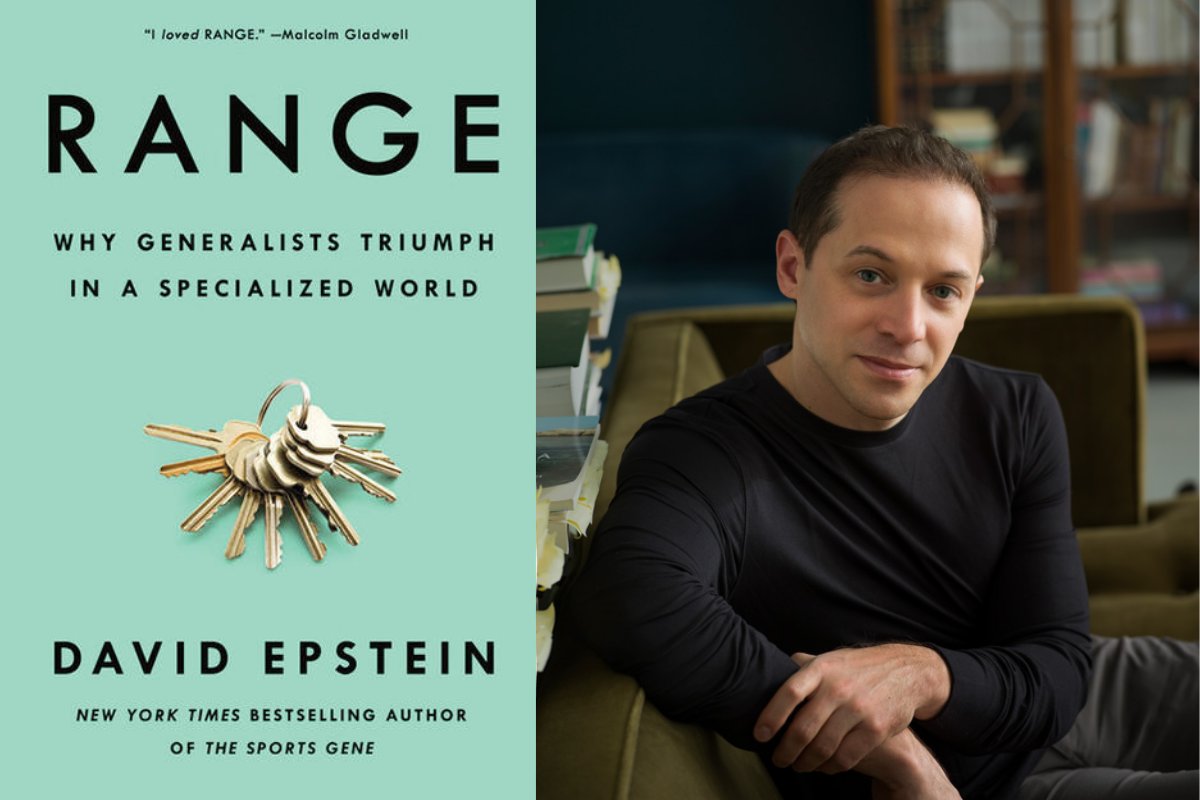
David Epstein studied the world's best athletes, scientists, and inventors, and found they all broke the same rule.
Here are 10 reasons from "Range" why generalists beat specialists in everything that matters.
1) Specializing late is an advantage, not a delay
The unfolding history of artificial intelligence has now arrived at what may be its most dangerous moment. There are two barely controlled AI races, one between around five American companies—@Anthropic, @GoogleDeepMind, @Meta, @OpenAI, and @xai lead the field—and the other between the two geopolitical superpowers: the United States and China, with its own competing companies. The leadership of the competitors in this race is, to say the least, of mixed quality. 1/10
@stevenstrogatz I did not read it yet (will do later) though it seems to me similar to the Secretary Problem which its solution is 1/e. Must be there something different there.
https://t.co/2Z3gSgDHhM
A beautiful example of an "optimal stopping problem" – Feynman's restaurant problem – with a great backstory behind it. This is a fun, well written article, and a fun math problem too.
https://t.co/0Nng9KLDHa