Two metal plates can pull each other together even in a vacuum, with no electric charge attracting them.
In 1948, Dutch physicist Hendrik Casimir predicted this effect. Quantum fields fluctuate even in empty space, and the plates change which fluctuations can exist between them, producing a tiny attractive force.
The surprising part is how quickly it grows as the gap shrinks. For ideal plates, the force per unit area scales as 1/d⁴. Halve the gap, and the pressure becomes 16 times stronger.
Even empty space has physical consequences.
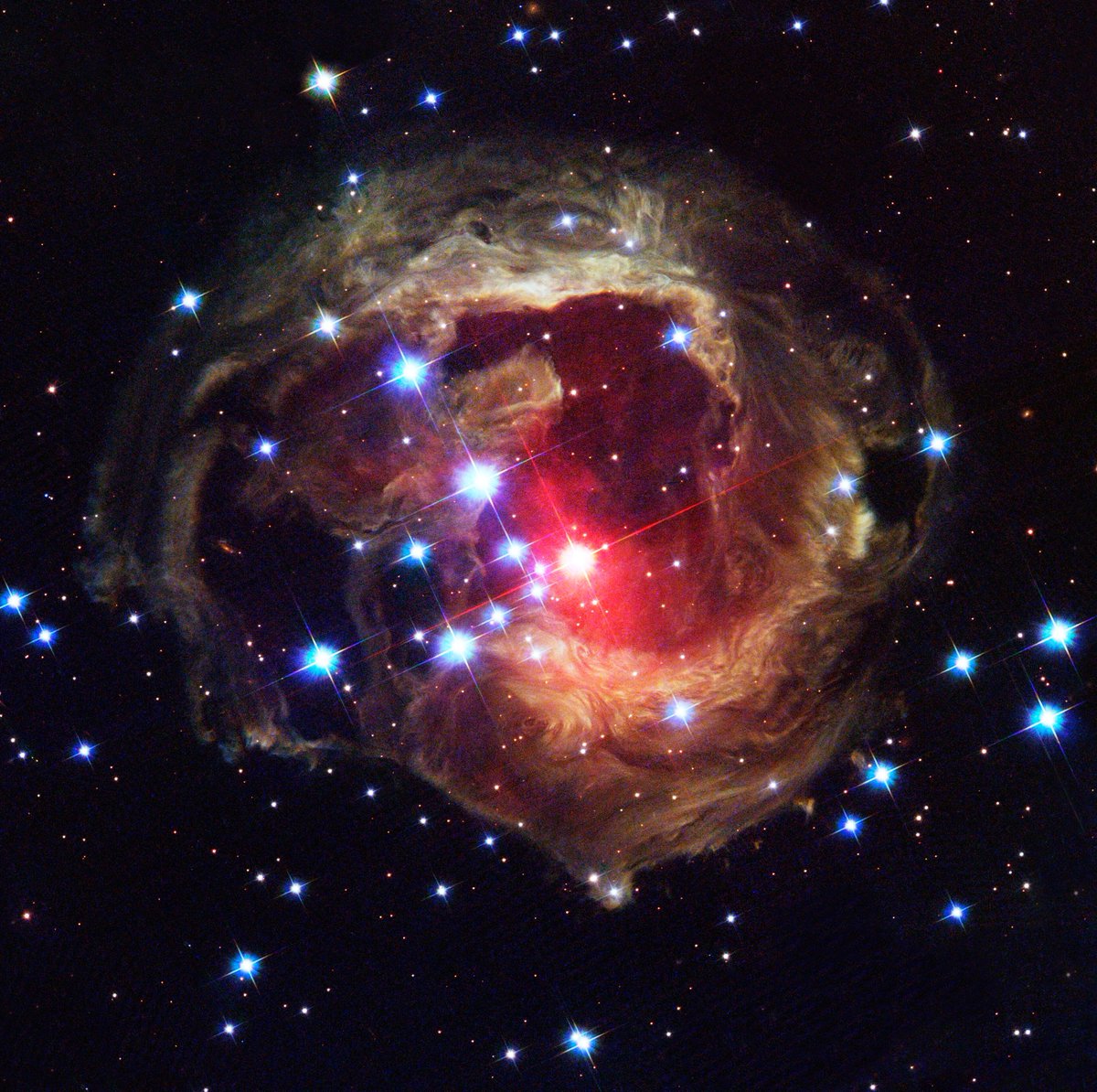
✨ A star’s light revealing the hidden beauty of space!
This stunning Hubble image of V838 Monocerotis shows a phenomenon known as a light echo. After the star suddenly brightened in early 2002, its light illuminated surrounding clouds of dust, revealing intricate structures that had never been seen before. 🌌
It’s a beautiful reminder that even a star’s past outburst can reveal new wonders across the universe.
📸 Credit: NASA, ESA, and The Hubble Heritage Team (AURA/STScI)
#Hubble #NASA #Astronomy #Space #Universe
An object in orbit is constantly falling toward Earth, but moving sideways fast enough to keep missing it. To escape Earth's gravity completely, it needs about 41% more speed.
In low Earth orbit, that means going from 7.9 km/s to 11.2 km/s. The relationship is simple: escape velocity equals √2 times orbital velocity.
Reaching space is one thing. Having enough energy to leave Earth behind is another.
Planetary Rotation & Axial Tilt 🪐
See how the planets and dwarf planets spin compared with one another and how dramatically their axes can tilt.
Jupiter and Saturn are the fastest rotators, completing a day in roughly 10 hours. Earth takes about 24 hours, while Venus rotates exceptionally slowly and in the opposite direction.
Uranus is the real outlier, with an axial tilt of about 98°, essentially rotating on its side as it travels around the Sun.
These differences in rotation and tilt are more than just fascinating they offer clues about how each world formed, evolved, and experienced massive collisions in the early Solar System 🌌